


Landing in Delhi for the first time can be disorienting, especially when you step out of Indira Gandhi International Airport and face a wall of drivers calling "Taxi? Taxi?" The city now has app cabs, metro and buses, but for many visitors, the most straightforward option after a long flight is still the official prepaid taxi. This guide explains exactly how those Delhi Traffic Police and airport prepaid counters work in 2026, what you should pay to reach different areas, how to handle luggage and late-night arrivals, and how to avoid the informal drivers and small scams that can turn a simple ride into an expensive headache.
Get the latest updates straight to your inbox!
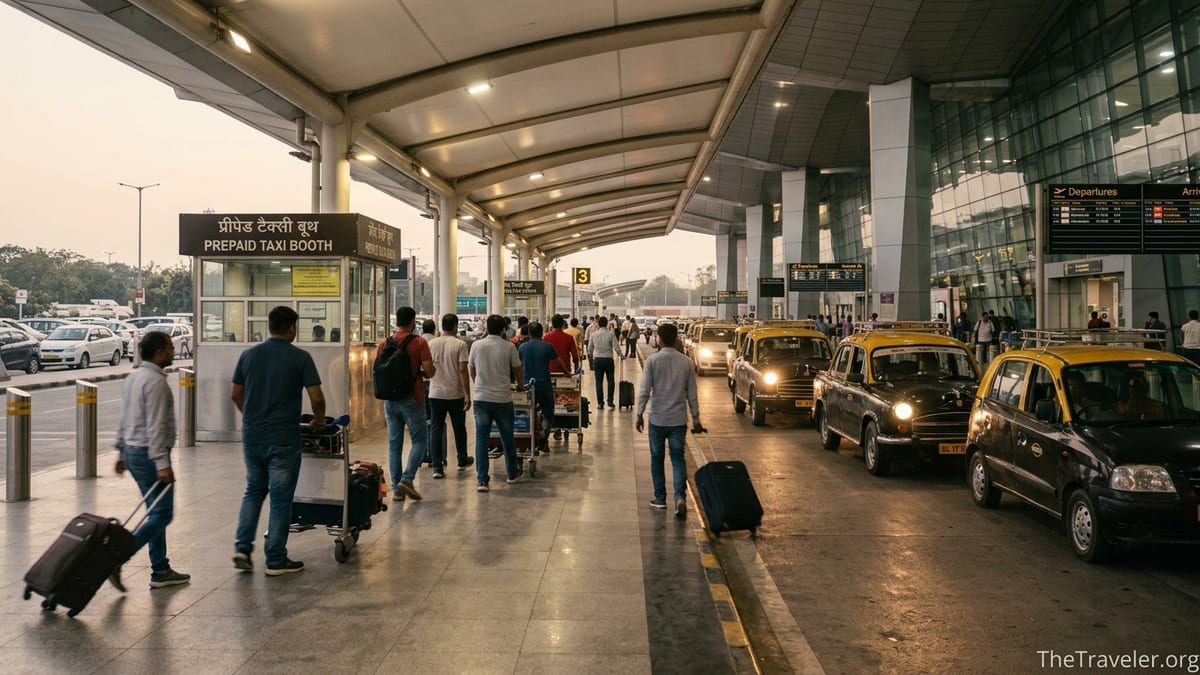
How Delhi Airport’s Prepaid Taxi System Works in 2026
Delhi’s prepaid taxi system is one of the city’s longest-running attempts to give arriving travelers a fixed-fare, police-monitored option from the airport. The booths are operated under the supervision of Delhi Traffic Police at all three terminals of Indira Gandhi International Airport, and in 2026 they are in the middle of a digital upgrade. A recent agreement between Delhi Traffic Police and a cooperative operator aims to modernise 34 prepaid booths across the city, including those at the airport, with better record-keeping and tracking of rides. In parallel, Delhi Police has announced digitised booths at IGI with terminals linked directly to police systems to improve oversight.
For travelers, the core idea is simple. Instead of negotiating a fare at the kerbside, you go to an official counter inside or just outside the terminal, tell the clerk your destination, pay a fixed amount displayed on a board or screen, and receive a printed or digital receipt. The dispatcher matches you with a licensed taxi in the official queue, records the vehicle number against your receipt, and the driver is paid by the booth operator later. In theory, that means no haggling, no surprise detours and no extra passengers along the way.
Prepaid taxis are especially useful if your phone data is not yet working, if ride-hailing apps like Uber or Ola are surging to very high prices, or if you are arriving late at night when metro and many buses are not running. Even seasoned Delhi residents sometimes choose the prepaid counter when app pickup zones are gridlocked or when they want a simple, cash-based transaction without sharing card details.
Finding the Official Prepaid Taxi Counters at Each Terminal
At Delhi Airport, the official prepaid taxi booths are available day and night at Terminal 1, Terminal 2 and Terminal 3. They are typically branded as Delhi Traffic Police or as an official airport taxi counter, and may simply be marked “Prepaid Taxi” in English and Hindi. Staff usually sit behind a glass window with a computer, and you will see laminated or digital fare charts behind them listing neighborhoods like Connaught Place, Karol Bagh, Greater Kailash, Saket, Noida or Gurgaon.
At Terminal 3, which handles most international flights and a large share of domestic traffic, you will first pass through customs and baggage reclaim before emerging into the arrivals hall. The main prepaid taxi counters are on the arrivals level near the exit doors, alongside bank ATMs and currency exchange booths. There is usually a booth inside the terminal just before the final sliding doors to the pick-up ramp, and another just outside on the raised arrivals roadway where taxis and private cars line up. If in doubt, follow overhead signs for “Taxi” rather than listening to individuals approaching you.
Terminal 2, adjacent to Terminal 3 and connected by a short walk or shuttle, also has prepaid taxi counters in its arrivals area, operating on a similar pattern. At Terminal 1, which serves many low-cost domestic carriers, the prepaid booth is usually just after you exit baggage claim, near the exit to the forecourt. Staff at all terminals are used to international visitors; if you simply say the name of your hotel, they will generally know which zone or sector to use for calculating the fare.
Ignore anyone who says, “Prepaid counter finished” or “Official counter closed, come with me instead.” Official booths operate 24 hours, although late at night they may have only one window open and a short queue. If you arrive during a very busy period, such as winter evenings or major festivals, you may see a line of 10 to 20 people waiting; this can still be faster and less stressful than hunting for your app cab in a crowded parking area.
Typical Fares and What You Should Expect to Pay
Exact fares change periodically, and they depend on distance, traffic surcharges and the type of vehicle, but the prepaid counters use a standardised tariff card. For a rough idea, in 2026 a small non-air-conditioned taxi from Terminal 3 to central Delhi areas such as Connaught Place, Karol Bagh or Paharganj typically costs somewhere in the range of 500 to 900 rupees, depending on time of day, tolls and whether you choose an air-conditioned or larger vehicle. To popular South Delhi neighborhoods like Green Park, Hauz Khas or Greater Kailash, expect a similar or slightly higher range. Journeys that cross into satellite cities like Noida in Uttar Pradesh or Gurgaon in Haryana are usually more, reflecting state border taxes.
For example, many travelers report paying in the mid-hundreds of rupees for a prepaid taxi from Terminal 3 to hotels around Connaught Place or Khan Market. A run to the budget hotel cluster in Mahipalpur, only a few kilometres from the terminals, can be under 400 rupees, although some visitors have complained of counters trying to charge a higher fixed rate than the distance would suggest. To corporate hubs like Cyber City in Gurgaon or Sector 29, prepaid fares often land in the broad 800 to 1,200 rupee band, again depending on exactly which sector and whether airport toll fees are included.
Short rides, such as from Terminal 3 to a nearby airport hotel in Aerocity, sometimes feel disproportionately expensive compared with an app cab, because the prepaid tariff has a minimum slab that covers the airport access and base distance. If you are going only one or two metro stops away, consider the Airport Express metro to Aerocity and then taking an app cab; but if you have heavy luggage or are arriving in the early hours, the simplicity of a prepaid taxi can still justify the cost.
Always check what is included in the fare shown at the counter. Many counters include standard tolls and airport access fees in the prepaid amount, which means you should not be paying anything more to the driver at the end of the journey. If the clerk mentions “tolls extra” or “parking extra,” ask what that means in rupees; if you are quoted a total that seems significantly higher than the broad ranges above for common destinations, it is reasonable to ask to see the printed tariff card.
Late-Night Arrivals, Luggage and Choosing the Right Ride
Late-night arrivals are where the prepaid taxi system comes into its own. After around 11.30 pm, the Airport Express metro closes for the night, and while app cabs do operate 24 hours, they can be patchy in the early morning, especially if there is rain, fog or a big event in the city. Travelers landing between midnight and 5 am often find that the official prepaid counter is the most reliable fallback, even if it costs a little more than an off-peak Uber or Ola during the day.
If you are arriving alone with one suitcase and a backpack, a standard small sedan is usually sufficient. Families or groups with large suitcases, ski or camera equipment, or multiple backpacks may need to request a larger vehicle at the counter. The booths generally categorise vehicles into “small car,” “big car” and sometimes premium or SUV options. For example, a family of four with three large checked bags heading from Terminal 3 to a hotel in Greater Kailash might reasonably ask for a larger car category, paying a higher tariff but avoiding a cramped ride where luggage blocks the rear window.
When traveling with bulky luggage, ask the clerk to write the vehicle category clearly on the receipt, and before you get into the taxi, check that the car matches what you paid for. Most official prepaid taxis at Delhi Airport are basic sedans or hatchbacks; roof racks exist but are less common than in some other Indian cities. If your luggage obviously will not fit, politely refuse and ask the dispatcher to assign another car. It is better to lose two minutes at the curb than to drive half the way into town with a half-closed trunk and the risk of bags falling out.
Women traveling alone late at night often prefer prepaid taxis over informal offers partly because every ride is logged with the booth, vehicle number and driver. You can add an extra layer of protection by sending a photo of the taxi and your receipt to a friend or family member, or by sharing your live location over a messaging app once your mobile data is working. If you feel uncomfortable at any point, ask the driver to stop in a well-lit, busy area, such as a petrol station or police post, and consider calling the Delhi Traffic Police helpline from your phone.
Staying Safe: Avoiding Touts and Common Airport Taxi Scams
Delhi Airport is safer and more regulated than it was a decade ago, but touts still operate around the arrivals area and pick-up ramps. The most common pattern is a man in plain clothes approaching you as you exit customs, saying “Taxi sir? Prepaid taxi, government taxi.” Some will claim the official counter is closed, that there is a huge queue, or that they can give you a “fixed price” that is cheaper than the booth. The basic rule is simple: if someone approaches you unsolicited, do not follow them. Instead, walk to the signed official counters or to the clearly marked app pickup zones.
A second pattern is subtle overcharging at or around legitimate-looking booths. Some travelers have reported paying with a large note at a counter and being told they handed over a smaller one, or having an amount rounded up substantially beyond what the printed tariff lists. To reduce the risk, keep smaller denomination notes handy, count your money aloud as you hand it over, and ask for a proper printed receipt that includes the fare, your destination and the vehicle number. If the clerk refuses to issue a receipt or writes the details by hand on a blank slip without a stamp or logo, that is a red flag.
Another frequent complaint involves drivers trying to add extra charges mid-journey: for example, claiming there is a new toll, insisting on a night surcharge that was supposedly excluded, or offering to take you on a “city tour” via a travel agency or handicraft shop. In a true prepaid taxi, your fare is paid in full at the booth. You do not need to give extra money for tolls or parking unless this was specifically explained to you at the counter and matches what is printed on your receipt. If a driver insists, calmly remind them that the fare has already been settled with the booth and that you will call the police helpline if there is a problem.
A small minority of drivers may try to invent a story that your hotel is closed, unsafe or fully booked, and then suggest a different, often more expensive property where they receive commission. This type of scam is not unique to Delhi, but it still occurs occasionally in the budget areas around Paharganj and Karol Bagh. Always call your hotel on the number in your booking to verify; do not accept a driver’s claim without checking. If you genuinely need to change accommodation, ask to be dropped at a neutral, busy landmark such as Connaught Place and search for alternatives yourself rather than following a driver’s suggestion.
Prepaid Taxi vs App Cabs and Metro: When Prepaid Is the Safer Bet
Delhi now has several practical ways to leave the airport. The Airport Express metro runs from the IGI Airport station near Terminals 2 and 3 into New Delhi Railway Station in about 20 minutes, and connects to the wider metro network. At times when it is running, it is usually the fastest way to reach central Delhi if you have light luggage and are comfortable with a short walk and a possible interchange. App-based cabs like Uber and Ola operate from designated pickup zones at each terminal, and in off-peak hours can be cheaper than a prepaid taxi, especially for short trips.
However, prepaid taxis still have a clear role. They are often the safer and more predictable choice in several scenarios. First, if you arrive after the metro has closed or before it opens, you may find long waits or poor availability on apps, especially in bad weather or during winter fog. Second, if you do not yet have a local SIM card or your roaming data is unreliable, navigating to the correct app pickup zone and coordinating with a driver can be stressful. The prepaid counter, by contrast, is a physical, staffed point of contact inside the terminal.
Prepaid taxis also avoid some of the parking and FASTag time-limit issues that app drivers complain about at the airport. Many app-based rides now pass their parking or access charges on to passengers informally, asking for extra cash over the app fare. With prepaid, any airport access fee should be baked into the fixed tariff you pay at the counter, which means fewer surprises at the end. For women traveling alone at night, older travelers, or those visiting Delhi for the first time, the psychological comfort of a police-supervised booth and a paper receipt can outweigh the few hundred rupees they might save with an app cab in ideal conditions.
That said, during the daytime, especially between roughly 8 am and 8 pm, a combination of metro and app cab can make sense. For example, you could take the Airport Express to New Delhi station and then a short app cab ride to a hotel in Civil Lines or South Delhi, often saving money compared with a single prepaid taxi from the airport. The trick is to decide what you value more at the time you land: absolute simplicity and oversight, in which case prepaid wins, or maximum savings and flexibility, in which case apps and metro may be better.
Step-by-Step: Using the Prepaid Taxi Counter Without Stress
Once you know what to expect, using the prepaid taxi booth is straightforward. After collecting your bags and exiting customs, ignore anyone approaching you directly about taxis and walk to the clearly signed “Prepaid Taxi” or “Taxi” desk. Join the queue and, when it is your turn, tell the clerk the exact name and area of your hotel or destination. If you have the address written down, slide it under the glass; staff see hundreds of destinations every day and will usually recognise common hotel clusters such as Aerocity, Connaught Place, Paharganj, Karol Bagh, Defence Colony, Saket, Noida Sector 18 or Gurgaon Cyber City.
The clerk will check the zone on the system, quote you a price, and often point to a printed tariff sheet or digital display. Confirm whether the fare includes tolls, airport access and night surcharge. Pay in cash or, at many counters, by card; some of the new digitalised booths also support QR-code based UPI payments that locals prefer. You will be given a receipt with your destination, fare and sometimes a booth stamp. Keep this with you until the end of the journey and do not hand it to the driver until you have reached your destination.
After paying, you will be directed to a specific taxi stand outside. At busy times, a dispatcher in a reflective jacket or uniform will stand at the queue, collecting receipts and matching passengers to vehicles. Check that the number on your receipt matches the plate of the car you are about to enter, or at least that the dispatcher marks the vehicle number on your slip. Before the car moves, quickly note the plate number on your phone or take a photo of the back of the car. Once you arrive, hand the receipt to the driver only after you and your luggage are safely out and you have confirmed you are at the correct address.
If something feels wrong at any stage, you have options. If the counter clerk seems to inflate the fare well beyond typical amounts, you can politely step out of the queue and either check another official booth or compare with an app cab quote on your phone. If a driver behaves aggressively about extra money, tell them that you will speak to Delhi Traffic Police; many prepaid booths display helpline numbers, and officers patrol the airport approach roads. Calm, firm insistence that you know the system usually defuses attempts to overcharge.
The Takeaway
For all its crowding and occasional frustrations, Delhi’s prepaid taxi system at Indira Gandhi International Airport remains one of the most straightforward ways to get from the terminal to your hotel, especially if you are landing late, carrying heavy bags or visiting the city for the first time. The combination of fixed fares, police oversight and a physical, staffed counter makes it easier to say no to touts, avoid on-the-spot haggling and focus on reaching your destination safely.
Think of prepaid taxis as one tool in your arrival toolkit, alongside the Airport Express metro and app-based cabs. When the metro is running, traffic is light and your phone is fully connected, you may find that an app ride or metro-plus-cab combination saves money and time. On the other hand, if your flight lands at 2 am in winter fog, the reassuringly simple routine of walking to a brightly lit prepaid counter, paying once and stepping into a logged, licensed taxi can be worth every rupee.
As Delhi continues to upgrade its prepaid booths with digital systems and closer police integration, travelers can expect the system to become more transparent over time. Until then, remembering a few key principles will serve you well: always use the official counters, keep your receipt, refuse unsolicited offers, and trust your instincts. With that, your first journey from Delhi Airport into the capital should be uneventful, leaving you free to focus on the city’s food, history and energy rather than its traffic.
FAQ
Q1. Where exactly is the prepaid taxi counter at Delhi Airport Terminal 3?
The main prepaid taxi counters at Terminal 3 are in the arrivals hall near the exit doors and just outside on the arrivals roadway. Follow the official “Taxi” signs after customs and baggage claim and look for glass-fronted booths marked “Prepaid Taxi” or “Delhi Traffic Police.” Ignore individuals who try to divert you elsewhere.
Q2. How much does a prepaid taxi from Delhi Airport to Connaught Place usually cost?
Fares change over time, but as a broad guide many travelers in 2026 pay in the mid-hundreds of rupees from Terminal 3 to central Delhi areas like Connaught Place. The exact amount depends on the official tariff, time of day, vehicle type and whether tolls and airport access fees are included in the prepaid amount.
Q3. Are prepaid taxis at Delhi Airport safe for solo female travelers at night?
Prepaid taxis are generally considered one of the safer options because rides are registered at a police-supervised booth with vehicle details recorded. Many women traveling alone at night choose prepaid taxis over informal offers or unauthorised cabs. It is still sensible to share your taxi and receipt details with someone you trust and to sit in the back seat.
Q4. Can I pay for a prepaid taxi by card or do I need cash?
Many Delhi Airport prepaid booths now accept card payments and, at some counters, local QR-based payments. However, systems can occasionally be offline, so carrying some cash in rupees is wise. If you plan to use your card, confirm at the counter before queuing and always keep the payment receipt with your taxi coupon.
Q5. Do I need to tip the prepaid taxi driver?
Tipping is not compulsory and the fare you pay at the booth covers the entire journey. If the driver is helpful with luggage and drives safely, it is common but not obligatory to round up by a small amount, usually no more than a few tens of rupees. There is no expectation of a large percentage tip as in some other countries.
Q6. What should I do if the taxi driver asks for extra money during the trip?
In a true prepaid taxi, your fare is settled at the booth and you should not need to pay extra for tolls or parking unless this was clearly explained when you bought the coupon. If a driver insists on more money, calmly remind them that you have already paid at the prepaid counter and that any disagreement can be taken up with the booth or Delhi Traffic Police. Do not be intimidated into paying large unplanned extras.
Q7. How do prepaid taxis compare with Uber or Ola from Delhi Airport?
Uber and Ola can be cheaper at off-peak times, especially for short rides, and they allow you to track the route in the app. However, they depend on mobile data and can involve confusion at the pickup zones or added parking charges. Prepaid taxis are often more straightforward after long flights, during late-night arrivals or when your phone is not working, because you pay a fixed fare at a staffed counter and receive a paper receipt.
Q8. Is it normal for touts to approach me for taxis inside the terminal?
Yes, it is common for unofficial drivers or touts to approach arriving passengers with offers of “cheap” or “government” taxis. You should decline these offers and walk directly to the official prepaid counter or to the signed app pickup area. Using only official channels greatly reduces the risk of overcharging, detours or unsafe vehicles.
Q9. What if my hotel is very close to the airport, like in Aerocity or Mahipalpur?
For nearby areas such as Aerocity or Mahipalpur, prepaid taxis sometimes feel relatively expensive because a minimum tariff applies. You can still use the prepaid counter for convenience, especially late at night or with heavy bags. If you arrive during the day and feel comfortable, you might compare the prepaid quote with Uber or Ola, which can be cheaper over very short distances.
Q10. What details should I note from my prepaid taxi receipt?
Before leaving the booth, check that your receipt clearly shows the fare, your destination and the taxi or booking number. When you reach the car, verify or write down the vehicle’s number plate and consider photographing the back of the taxi and the receipt. Keeping these details until your journey is over helps in case of forgotten items, disputes or if you need to contact Delhi Traffic Police later.