


Indira Gandhi International Airport in Delhi is one of India’s busiest hubs, and ordering an Uber here is not as simple as walking out of the terminal and hopping into the first car you see. Dedicated app-based cab zones, multi-level parking garages, airport access fees and occasional driver refusals can all catch first-time visitors off guard. This guide walks you through exactly how Uber pickups work at Terminals 1, 2 and 3, how to find the T3 parking pickup area, what to expect with luggage and surge pricing, and when it might make sense to switch to a taxi or metro instead.
Get the latest updates straight to your inbox!
How Uber Works at Delhi Airport Today
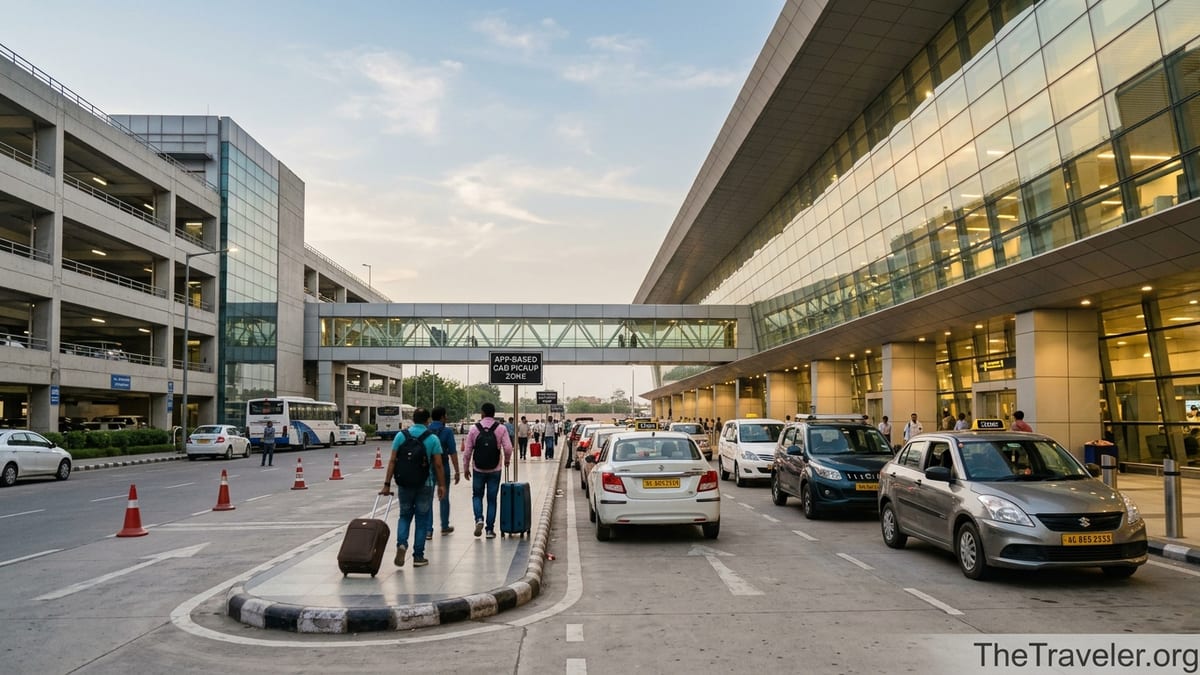
Uber operates across all three passenger terminals at Delhi’s Indira Gandhi International Airport: Terminal 1 and Terminal 2 for domestic flights, and Terminal 3 for both international and key domestic services. Unlike some airports where rideshare cars pull up directly outside arrivals, IGI generally funnels app-based cabs such as Uber and Ola into designated pickup zones, many of them inside or next to multi-level car parks. That means you usually need to walk a short distance from the terminal exit before meeting your driver.
On the Uber app, Delhi Airport appears as “Indira Gandhi International Airport (DEL)” with separate labeled pickup points for each terminal. When you request a ride, the app will normally auto-detect your terminal based on your GPS, but it is wise to confirm by checking your boarding pass or baggage tag. For instance, IndiGo and SpiceJet use all three terminals for different flights, so a passenger landing on an IndiGo domestic route could arrive into T1, T2 or T3 depending on the flight number and time of day.
Uber’s airport fares from IGI usually include an airport access or parking component built into the quoted price. For a typical mid-range Uber Premier or Uber Go from Terminal 3 to central Connaught Place in off-peak hours, travelers report paying in the region of ₹450 to ₹700, depending on traffic and surge. For longer trips, such as to Gurgaon’s Cyber City or Noida’s Sector 62, it is common to see totals between roughly ₹700 and ₹1,400, again fluctuating with demand and time of day.
Shared options such as Uber Go Share or other carpool-style products have been gradually reintroduced on key city routes from Terminal 3 after earlier suspensions, which can reduce the fare significantly when available. However, they are more sensitive to demand and may not appear in the app late at night or during irregular hours. Solo travelers with only a backpack often find these shared rides a cost-effective way to leave the airport, while families with multiple suitcases generally prefer regular Uber Go, Premier or XL categories.
Terminal 3: Finding the Multi-Level Parking Pickup Zone
Terminal 3 is where most international passengers arrive, and it also handles major domestic traffic for airlines like Air India and select IndiGo and SpiceJet flights. The default Uber pickup point for T3 is not directly outside the arrivals doors. Instead, the app typically directs you to the parking structure opposite arrivals, often described as the Multi-Level Car Park or MLCP. Uber and Ola share space here in a dedicated rideshare zone on the lower levels of the building.
After collecting your baggage and clearing customs, you exit Terminal 3 arrivals onto the forecourt. Rather than waiting at the first lane where private cars and hotel shuttles pull in, you walk across to the large multi-level parking building visible directly in front of the terminal. Signage for “Car Park” is posted along the walkway, and in many cases you will pass under a covered pedestrian path. Inside the parking structure, look out for markings or small signboards indicating “App-based cabs,” “Uber/Ola” or numbered pickup bays where drivers stop briefly.
When the Uber app shows “T3 Parking – Uber Pickup” or a similar label, it is referring to this area. A common real-world pattern is that your driver will wait at a designated bay and call or send a message asking for your exact staircase or pillar number. It is worth noting down the nearest pillar code or lane sign, such as “P2, lane B,” as you enter the zone. This helps the driver find you faster and reduces the risk of a cancellation fee if they cannot spot you within the standard waiting period.
During busy evening banks, especially when multiple wide-body international flights land between 9 p.m. and 1 a.m., this T3 parking pickup zone can feel crowded and noisy. Travelers with heavy luggage should factor in a five to ten-minute walk from the arrivals hall to the car. If you are traveling with elderly relatives or very young children, consider using a luggage trolley all the way to the car park entrance, and allow extra time in case the elevator or escalator area is congested.
Terminal 1: Domestic Arrivals, Short Walks and Pain Points
Terminal 1 primarily serves domestic low-cost carriers and is located on the opposite side of the airfield from T3. Here, app-based cabs usually pick up from a designated area just across the main pickup road outside arrivals, rather than deep inside a multi-level car park. For many travelers, T1 is actually the easiest terminal from which to find an Uber because the walking distance from the exit to the rideshare bay is relatively short and clearly visible once you are outside.
Upon exiting T1 arrivals, you typically cross the pickup lanes using marked pedestrian crossings and follow signs or staff directions toward “App-based cabs” or “Uber/Ola.” The Uber app may show a label such as “Terminal 1 App Cabs” or “T1 Pickup Zone.” Travelers arriving during mid-morning or mid-afternoon lulls often report finding a car within a few minutes, with wait times under ten minutes in reasonable traffic. Light travelers carrying only a cabin bag can usually walk this distance comfortably, even in Delhi’s heat, in two to four minutes.
However, some passengers arriving late at night or at peak domestic banks have described more challenging experiences. Reports mention cases where drivers are reluctant to enter the closest pickup bay or ask riders to walk farther toward the main road to avoid parking or access fees. A traveler arriving at T1 with a single duffel bag, for example, might be repeatedly asked by drivers over the phone to walk out of the official zone toward the highway slip road, particularly if surge or airport access charges are in effect. When this happens, you need to balance convenience, safety and cost. If you are alone at odd hours or carrying heavy bags, it is usually wiser to insist on pickup inside the official zone or switch to an airport taxi immediately outside the terminal.
Uber categories available at T1 are broadly similar to T3, with Uber Go being the most common and Uber XL or higher-end cars appearing less frequently in the app, especially off-peak. For a typical ride from Terminal 1 to south Delhi neighborhoods like Hauz Khas or Greater Kailash, travelers often see fares in the range of ₹350 to ₹650, while rides to Gurgaon or Noida may push toward ₹800 or more in heavier traffic. Always remember that these are app-quoted prices that can rise quickly if demand spikes after a bank of arrivals.
Terminal 2: Older Domestic Terminal With Mixed Experiences
Terminal 2 is an older domestic terminal that has been used by several airlines at different periods to balance capacity across IGI. From a passenger perspective, Uber pickups at T2 follow a similar concept to T1: you exit the arrivals hall, move across the pickup lanes, then follow signage or security staff directions toward the area where app-based cabs wait. However, because T2 facilities and traffic patterns have been through multiple changes, on-the-ground experiences can vary more than at T1 or T3.
Travelers using T2 often report a modest walk from the exit to the point where app cabs can stop without blocking through-traffic. The Uber app will typically offer a “Terminal 2 Pickup” option, but drivers may still call to clarify your exact location, asking whether you are closer to a particular gate number, signboard or lamp post. It can be helpful to step slightly to the side of the main crowd flow and identify a landmark such as a kiosk, pillar or specific gate and then describe this clearly to the driver over the phone.
From T2, fares to central Delhi, Gurgaon or Noida are broadly comparable to those from T1, since these terminals are relatively close to each other on the domestic side of the airport complex. As an example, a mid-morning ride to Connaught Place might display a fare similar to T1, perhaps around ₹450 to ₹700 under normal conditions. At night or during weather disruptions, surge pricing can push these numbers much higher, sometimes doubling typical off-peak levels. If that happens and you are not in a hurry, it can be worth waiting ten to fifteen minutes to see if demand cools and the surge multiplier comes down.
Because Terminal 2 is often used to handle overflow or specific route groups, some domestic travelers with tight connections between T1 and T2 may consider using Uber for an inter-terminal transfer. In practice, the airport operates a shuttle service between domestic terminals, and cabs can get caught in congestion or face entry queues. If you are connecting between T1 and T2 with less than two hours of buffer, the airport shuttle or dedicated inter-terminal arrangements offered by your airline may be more predictable than hailing Uber for such a short hop.
Booking in the App: Step-by-Step and Luggage Considerations
The most reliable strategy at Delhi Airport is to book your Uber only after you have collected your luggage and are ready to walk to the pickup point. If you request too early, while still waiting for bags or finishing immigration, the driver may arrive, wait briefly, then cancel or call asking where you are. This is particularly common at Terminal 3, where it can easily take ten to twenty minutes from clearing customs to reaching the multi-level parking pickup zone.
Once you are landside and know which terminal exit you will use, open the Uber app and set your pickup location to the appropriate airport pickup label, such as “Delhi Airport T3 Parking Uber Pickup” or “Terminal 1 App-based Cabs.” Avoid dropping the pin randomly in the middle of the terminal building, because that can confuse both the routing system and the driver. If the app shows multiple pickup points for the same terminal, choose the one that aligns with signage outside, even if it appears a few hundred meters away from your current indoor GPS reading.
For luggage-heavy groups, choosing the right car category is as important as selecting the correct pickup zone. A family of four with two large suitcases and two cabin bags arriving into T3 might be tempted to save money by choosing Uber Go, but in practice a small hatchback may struggle to fit all bags safely in the trunk. In such scenarios, upgrading to Uber XL or a similar multi-row vehicle often proves more comfortable and only marginally more expensive when the cost is split among several passengers. Solo travelers with a backpack or small roller suitcase, on the other hand, will generally find Uber Go sufficient from any terminal.
When traveling with bulky or fragile items, such as musical instruments or sports equipment, it is courteous to send a brief text via the app to the driver as soon as the ride is confirmed, explaining what you are carrying. For example: “We have two large suitcases and a guitar case, can your car fit this?” If the driver replies that it will be difficult, you can cancel promptly and reorder a larger category rather than discovering at the pickup zone that the boot cannot close. This simple step can save time and reduce the chance of last-minute disagreements at the curb.
Understanding Airport Fees, Surge Pricing and Driver Behavior
Uber fares from Delhi Airport typically include an airport fee component, sometimes described as an access charge or parking fee. This is added on top of the base distance and time charges and is visible in the upfront price shown before you confirm the ride. In practice, you may notice that two rides of similar distance, one starting at the airport and another starting from an inner-city neighborhood, show different per-kilometer economics because of this fixed airport element.
Surge pricing is another major factor shaping the real cost of Uber at IGI. When many passengers request rides at once, such as immediately after a cluster of late-night international arrivals at T3 or during a domestic holiday rush at T1, the app can apply higher multipliers to entice more drivers into the area. A ride that usually costs around ₹500 could climb to ₹900 or more at peak load, especially in poor weather or during major city events. Some travelers monitor the fare for five to ten minutes before committing, noticing that the price often dips slightly once the highest wave of demand passes.
Airport-related parking and access rules can also influence how drivers behave. On some occasions, passengers report that drivers accept a trip but hesitate to enter official pickup bays, instead phoning riders and asking them to walk to nearby roads or metro stations where entry fees are lower or non-existent. While this can sometimes reduce your fare slightly, it may expose you to unnecessary walking in dark or congested areas, particularly if you are alone or carrying valuables. From a safety standpoint, it is generally advisable to insist that the driver collect you from the designated airport pickup zone if that is what the app indicates.
If a driver repeatedly asks you to move outside the airport perimeter, or threatens to cancel unless you comply, you can calmly decline, end the trip from your side and request another car. In more persistent cases, it is possible to contact Uber’s in-app support and briefly describe the incident. Keeping communication within the app rather than on personal calls, and using built-in safety tools like trip sharing and audio recording where available, adds a layer of accountability for both parties and aligns with best practices for using rideshare services in large cities.
Taxi, Metro and Other Alternatives if Uber Is Not Ideal
While Uber is convenient for many travelers, it is not always the best option at Delhi Airport, especially during extreme surge periods or late-night driver shortages. Each terminal at IGI has conventional taxi options immediately outside arrivals, including government-approved prepaid booths and private fleets such as Meru or Mega Cabs when in operation. At Terminal 3, for instance, a prepaid taxi counter in the arrivals hall or just beyond the exit allows you to pay a fixed fare for a metered or slab-based ride, which can be reassuring if you are arriving very late and do not want to rely on an app connection.
Typical prepaid taxi fares from T3 to central Delhi locations can be similar to or slightly higher than off-peak Uber prices, but they have the advantage of being fixed upfront and not subject to real-time surge. Some visitors arriving with limited mobile data or without an Indian SIM choose this option for their first night, then switch to Uber and other app-based services later in their stay once they are fully connected. For very short trips, such as from T3 to nearby Aerocity hotels, a prepaid taxi can sometimes feel expensive compared to the distance covered, but it offers door-to-door simplicity if you are tired after a long flight.
The Delhi Metro’s Airport Express line is another strong alternative, especially for passengers landing at T3 who are headed toward New Delhi Railway Station or central business districts. The airport station is linked to T3 via a walkway and brings you into town in around twenty minutes under normal conditions, often for far less than a cab. From there, you can either transfer to another metro line or take a shorter Uber ride within the city, reducing overall cost and exposure to surge pricing around the airport perimeter.
Auto-rickshaws and bike-taxi services such as Rapido or motorbike variants of app cabs may be visible around the broader airport area, but their direct access to terminal forecourts can be more tightly controlled by security and current regulations. Travelers carrying only a small backpack and comfortable with two-wheeler travel sometimes use a bike taxi to reach a nearby metro station during rush hour, then transfer to rail for the main leg of their journey. However, for most visitors with luggage, particularly after long-haul flights, four-wheeled options like Uber, Ola, traditional taxis or hotel cars remain the more practical choice.
Real-World Scenarios: What Most Travelers Actually Do
Patterns observed over the past few travel seasons suggest that many frequent visitors to Delhi develop a simple decision tree around IGI. If they arrive at Terminal 3 during daylight or early evening and see normal Uber prices, they follow the app to the MLCP pickup zone, choose Uber Go or Premier depending on luggage, and are on their way within twenty to thirty minutes of clearing customs. If the app shows extreme surge or very long estimated wait times, they pivot to a prepaid taxi or the Airport Express line instead.
Domestic passengers landing at Terminal 1 with only hand luggage often favor Uber or other app cabs because of the short walk to the pickup area and the availability of budget categories. A business traveler arriving from Mumbai at T1 around 10 a.m., for example, might step out of arrivals, request an Uber Go to Gurgaon Cyber Hub for around ₹500 to ₹700 in moderate traffic, and reach their office in under an hour. By contrast, the same journey starting at 9 p.m. on a Friday after a bank of flights could cost significantly more if surge is active, prompting some passengers to share a prepaid taxi or wait for the peak to ease.
For families and groups landing late at night, a common strategy is to compare the price of an Uber XL or equivalent large cab against that of a hotel-arranged pickup. Some Delhi hotels quote all-inclusive airport transfers from T3 in the range of ₹1,200 to ₹2,000 depending on distance and vehicle size, which can be competitive with a surging app fare for a large car. In addition, hotel drivers are usually waiting with a placard just outside arrivals, eliminating the need to navigate parking structures or crowded pickup lanes after midnight.
Inter-terminal transfers are another context where Uber is sometimes considered but not always optimal. A traveler with three hours between an international arrival at T3 and a domestic departure from T1 might assume that a cab will be fastest, only to encounter airport traffic and security bottlenecks. In practice, many connecting passengers rely on the dedicated shuttle systems and airline-supported transfers between terminals, using Uber or taxis only if they have a long layover and wish to leave the airport complex entirely between flights.
FAQ
Q1. Where exactly is the Uber pickup point at Delhi Airport Terminal 3?
At Terminal 3, Uber pickups usually happen inside or at the ground levels of the multi-level car parking building opposite the arrivals hall. After exiting with your luggage, follow signs to “Car Park” and then look for the app-based cab or Uber/Ola zone inside the structure, rather than waiting on the main arrivals curb.
Q2. How far do I have to walk to reach the Uber pickup at T3, and is it safe at night?
The walk from T3 arrivals to the parking pickup zone typically takes five to ten minutes, using a well-lit pedestrian path. The area is monitored and busy with other travelers, but as in any large city airport you should keep an eye on your belongings, avoid isolated corners of the car park and use the app’s safety features such as trip sharing when traveling late at night.
Q3. Is Uber available at Delhi Airport Terminal 1 and Terminal 2, or only at T3?
Uber operates across all three terminals. At Terminal 1 and Terminal 2, the pickup areas are usually just across the main pickup road outside arrivals in the zones set aside for app-based cabs, rather than deep inside a multi-level car park as at T3. The Uber app will show labeled pickup points for T1 and T2 when you request a ride.
Q4. When should I request my Uber after landing at Delhi Airport?
It is best to request your Uber only after you have collected your bags and are ready to walk toward the pickup zone. At T3 in particular, clearing immigration, customs and baggage claim can take time, and ordering too early may lead to drivers arriving, waiting briefly and then canceling because you are not yet outside.
Q5. How much does an Uber from Delhi Airport to central Delhi usually cost?
Prices vary with time of day and surge, but many travelers see Uber Go or Premier fares from the airport to central areas like Connaught Place in the approximate range of ₹450 to ₹700 in normal conditions. During heavy demand or late-night peaks, the same ride can cost more if surge pricing is active.
Q6. What if my Uber driver at the airport asks me to walk outside the official pickup zone?
If a driver calls and insists that you leave the designated airport pickup area to meet them on a main road or at a metro station, you can choose to decline for safety and convenience reasons. You are within your rights to cancel and request another car or switch to an official airport taxi if you do not feel comfortable walking further, especially at night or with heavy luggage.
Q7. Which Uber category should I choose if I have a lot of luggage?
If you are traveling alone or as a couple with one large suitcase and a cabin bag each, Uber Go is often adequate. For families or groups with multiple large suitcases, strollers or bulky sports equipment, a larger category such as Uber XL or an equivalent multi-row vehicle is more practical from any terminal, even if it costs a little more.
Q8. Are prepaid taxis at Delhi Airport cheaper or more expensive than Uber?
Prepaid taxis from the airport are not always cheaper, but they offer fixed pricing that does not surge with demand. In off-peak hours, Uber can be less expensive for many routes. During peak arrival banks or extreme surge, prepaid taxis may end up being comparable in price, with the added reassurance that the fare is agreed before you leave the terminal.
Q9. Can I use the Delhi Metro instead of Uber from the airport?
Yes. From Terminal 3, the Airport Express metro line connects the airport station with key city points such as New Delhi, where you can transfer to other metro lines or take a shorter Uber ride. This option is often faster and cheaper than a car during rush hour, though it is less convenient if you have very heavy luggage or are arriving in the middle of the night.
Q10. What is the best option if I arrive very late at night and my phone data is not working?
If you land at T1, T2 or T3 very late and cannot use the Uber app reliably, heading straight to the official airport taxi or prepaid counter just outside arrivals is usually the most straightforward choice. You can pay in cash or card, receive a printed receipt with your destination, and avoid the uncertainty of waiting for an app-based cab when connectivity is poor.