


More news on this day
Passengers traveling from Detroit to Escanaba on a Delta Connection service operated by SkyWest experienced an unexpected diversion to Green Bay, Wisconsin, after their Mitsubishi CRJ-701ER regional jet altered course en route to Michigan’s Upper Peninsula.
Get the latest news straight to your inbox!
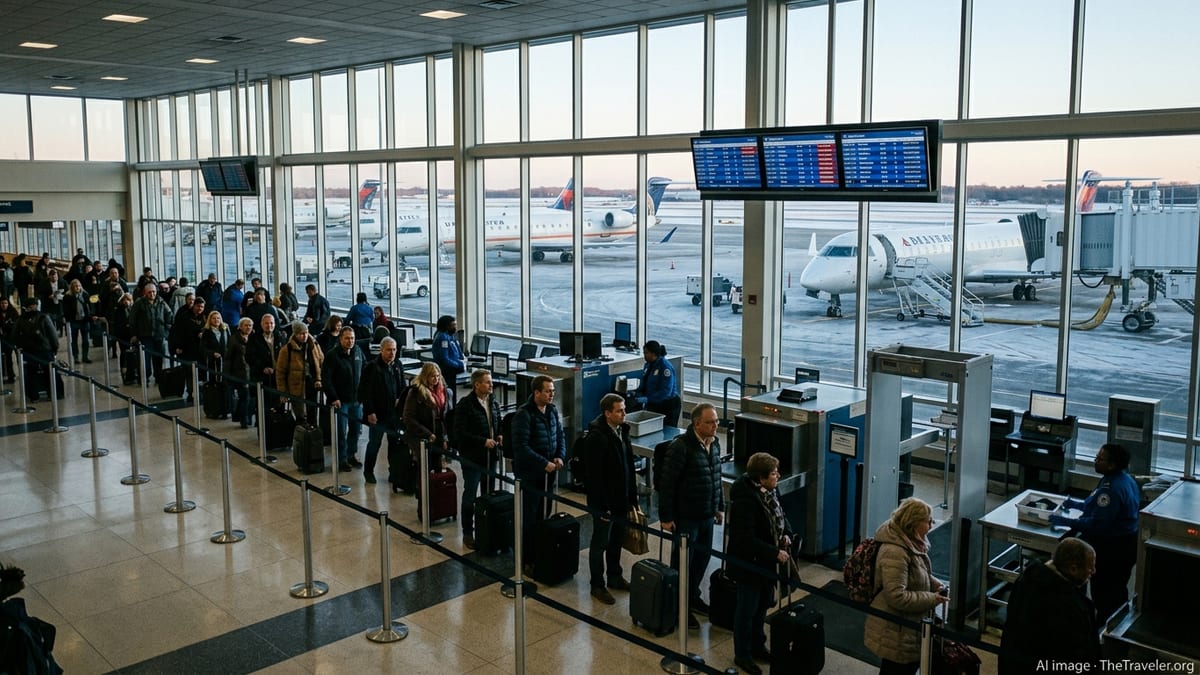
Delta Connection Service Diverts En Route to Escanaba
Publicly available flight tracking data shows that SkyWest flight SKW4243, operating as a Delta Connection service between Detroit Metropolitan Wayne County Airport and Delta County Airport in Escanaba, departed southeast Michigan as scheduled before turning west and ultimately diverting to Green Bay. The flight was operated by a Mitsubishi CRJ-701ER, a 70-seat regional jet commonly used on shorter Midwest routes.
The service, which links Detroit with Michigan’s south-central Upper Peninsula, typically follows a relatively short route across Lake Michigan to Escanaba. On this occasion, however, tracking information indicates that the crew discontinued the approach toward Escanaba and proceeded instead to Green Bay Austin Straubel International Airport, where the aircraft landed safely.
Reports indicate that the diversion occurred partway through the final segment of the flight, with the aircraft descending toward Escanaba before rerouting to northeastern Wisconsin. The change resulted in an unscheduled stop for passengers expecting to arrive directly into Delta County Airport.
Operational Factors Likely Behind Reroute
While no single official cause has been specified in publicly accessible reports, diversions on this route are frequently associated with a combination of weather, runway conditions, and operational limitations at smaller regional airports such as Escanaba. Delta County Airport has a relatively short runway and more limited ground infrastructure compared with larger regional hubs, which can lead to tighter performance margins for regional jets.
In winter and shoulder seasons, Upper Peninsula airports often see diversions or delays when visibility drops, crosswinds strengthen, or runway braking action is reduced. Even outside of peak winter, low clouds, fog, or changing wind patterns off Lake Michigan can quickly alter approach conditions for arriving traffic. When operating within conservative safety margins, flight crews may choose or be instructed to divert to an alternate field with more favorable conditions.
Green Bay Austin Straubel International Airport, by contrast, offers longer runways, more extensive instrument approach options, and broader ground support, making it a common alternate for flights serving smaller Upper Peninsula communities. The decision to reroute SKW4243 to Green Bay is consistent with standard regional airline practice in the area when conditions in Escanaba are not ideal.
Impact on Passengers and Regional Connectivity
The diversion meant that travelers bound for Escanaba arrived in a different state, adding time and complexity to their journeys. After diversions of this type, passengers are typically re-accommodated on later flights, bus transfers, or other ground transportation arranged from the diversion airport, depending on schedules, crew duty limits, and aircraft availability.
For Upper Peninsula residents and visitors, the Detroit to Escanaba route serves as a key link to Delta’s national and international network. Disruptions on this corridor can ripple through travel plans that include tight connections, especially for those starting or ending trips in smaller communities with limited daily frequencies.
Travel industry observers note that diversions such as that involving SKW4243 highlight the delicate balance between maintaining reliable air links to smaller markets and managing the operational realities of flying into airports with more challenging weather and infrastructure profiles. While these reroutes can be disruptive, they remain a standard part of regional airline operations designed to prioritize safety and operational control.
Profile of the Mitsubishi CRJ-701ER on Midwest Routes
The aircraft involved, a Mitsubishi CRJ-701ER, is part of the CRJ700 family widely used by regional operators in North America. Configured for around 65 to 70 passengers depending on the airline, the type is optimized for short to medium-haul flights like the Detroit to Escanaba run, offering a balance between capacity and performance suitable for smaller markets.
Regional jets in this class are capable of operating from shorter runways than larger mainline aircraft, but they still face stricter performance considerations when conditions deteriorate. Factors such as runway length, surface condition, temperature, and aircraft weight all feed into dispatch and in-flight decisions regarding whether to land as planned or divert to an alternate field.
Aviation analysts point out that route planners often pair aircraft like the CRJ-701ER with communities across the Great Lakes region precisely because of their versatility. However, flights into airports on or near the lakeshores must also contend with rapidly changing microclimates, which can prompt last-minute adjustments, including diversions similar to that experienced by flight SKW4243.
Regional Air Service Challenges in the Upper Peninsula
The diversion of SKW4243 underscores broader challenges facing commercial air service to smaller cities across the Upper Midwest. Many communities in Michigan’s Upper Peninsula rely on a limited number of daily flights, often tied to a single major hub such as Detroit or Minneapolis, to connect residents and businesses with the rest of the country.
Industry reports highlight that airlines serving these regions must navigate thin margins, fluctuating demand, and crew and aircraft constraints alongside weather-related disruptions. When a single flight diverts or cancels, options for same-day rebooking can be sparse, particularly on routes operated by regional partners with smaller fleets.
At the same time, travelers increasingly depend on these links for access to health care, education, and tourism. Episodes like the diversion to Green Bay reinforce how critical resilience and contingency planning are for maintaining confidence in regional air service, even when operational decisions require rerouting flights for safety and performance reasons.