


More news on this day
Air travelers across Europe faced another day of disruption as more than 118 flights were cancelled and about 2,478 services delayed, with Vienna among the key hubs affected and knock-on impacts reported on routes across the continent.
Get the latest news straight to your inbox!
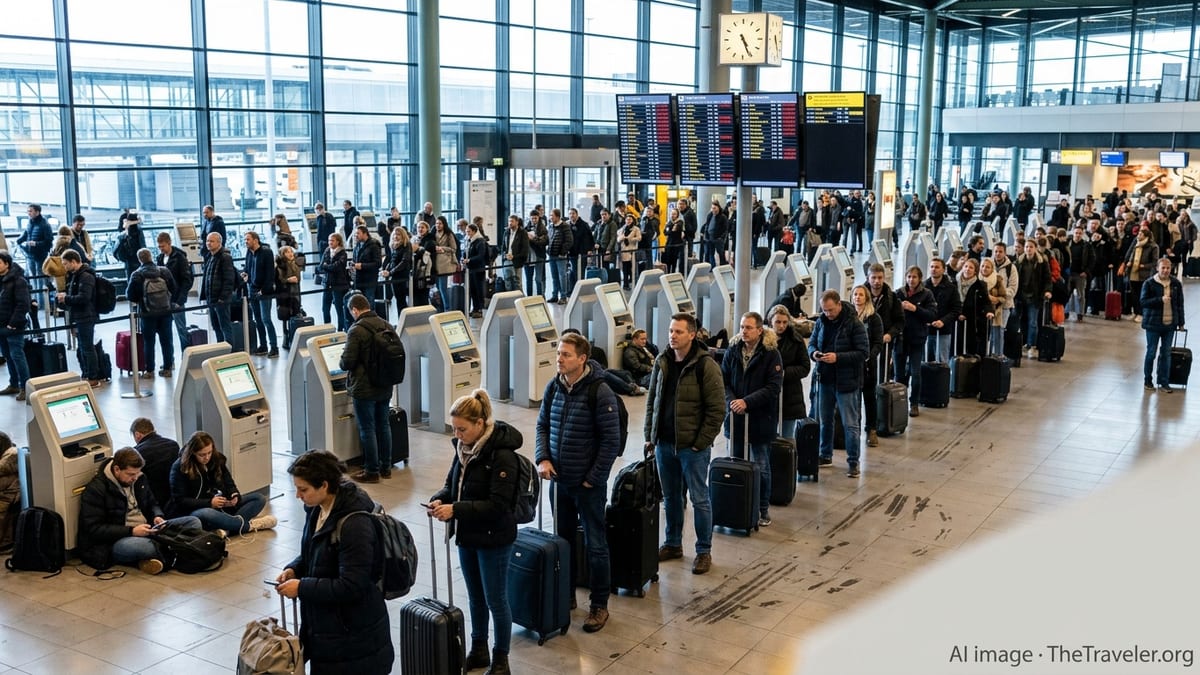
Vienna Emerges As A Major Bottleneck
Publicly available flight-tracking data for central Europe shows Vienna International Airport experiencing one of the highest concentrations of disrupted movements in the region, with dozens of cancellations and several hundred delayed departures and arrivals compressed into a single operational day. The figures underline how quickly Europe’s tightly timed hub networks can become strained when capacity or weather issues converge.
The disruption in Vienna has had a cascading effect on connections to Western and Southern Europe, particularly on routes to Germany, Italy and Spain that rely on tight transfer windows. Travelers reported missed onward flights and extended layovers after short delays on inbound services turned into missed slots for departures during peak traffic waves.
Operational statistics for recent months already pointed to a fragile balance between traffic growth and punctuality at major European hubs, and Vienna’s latest disruption highlights the limited margin for recovery when several delay drivers combine at once. Even relatively small timetable changes have translated into wider schedule dislocation across multiple carriers using the airport as a transfer node.
For passengers, the practical impact has been visible in growing queues at rebooking counters, longer waits for baggage and an uptick in overnight stays around the airport as evening cancellations left travelers unable to reach their final destinations on the same day.
Knock-On Effects Across Key European Routes
The wave of cancellations and delays has not been confined to Austria. Data aggregating arrivals and departures across major European hubs indicates that traffic through cities such as Frankfurt, Munich, Zurich and Milan has also been affected, with schedule reliability reduced on short and medium haul services that interlink these airports with Vienna.
Because many intra-European itineraries involve at least one connection, a cancellation at a single hub often forces an entire chain of rebookings and reroutings. A delayed departure from Vienna bound for Frankfurt, for example, can jeopardize onward flights to long-haul destinations in North America or Asia, turning a one-hour delay into missed connections further along the journey.
Summer travel patterns have amplified the effect. Strong demand on leisure routes has left fewer empty seats for disrupted passengers to be re-accommodated, particularly on departures to Mediterranean destinations. When flights are already operating close to capacity, airlines have less flexibility to absorb travelers from cancelled services onto later departures the same day.
Reports from several European airports show that some travelers have opted to switch to rail on shorter cross-border sectors, especially between Austria and neighboring countries with extensive rail links. However, for longer journeys and for trips involving islands or remote regions, flying remains the only realistic option, leaving travelers dependent on how quickly airlines can rebuild their schedules.
What Is Driving The Latest Wave Of Disruptions
The precise mix of causes behind any given day of European disruption can be complex, but recent patterns point to a combination of weather, air traffic management constraints and resource pressures on the ground. Eurocontrol analyses of previous months have highlighted how convective weather cells and thunderstorms over central Europe can force reroutings and slot restrictions, quickly creating a backlog of arrivals and departures.
When storms or strong winds trigger flow restrictions, airports and air traffic control units respond by limiting the number of aircraft that can land or take off each hour. This protects safety and runway operations but often results in a queue of flights waiting for new departure times, which can cascade into missed connections and ultimately cancellations as aircraft and crews run out of legal operating hours.
At the same time, the wider European network continues to operate close to its practical capacity during busy travel weeks. Even small disruptions in one sector can generate reactionary delays elsewhere, particularly on routes with high aircraft utilization where there is limited slack to absorb unexpected ground time. Vienna’s recent difficulties fit into this broader pattern, where a combination of local and regional factors translate into continent-wide schedule challenges.
Ground handling capacity, staffing patterns and aircraft rotations all play a role. When a single inbound aircraft arrives significantly late, it often cannot complete its planned sequence of flights, creating a chain of subsequent delays or cancellations that reach far beyond the initial problem.
Impact On Travelers And Compensation Options
For passengers caught up in the disruptions, the most immediate challenge has been uncertainty around revised departure times and rebooking options. Crowded terminals and stretched customer service teams mean some travelers have turned to airline apps and digital platforms as the primary channel for rebooking, seat selection and overnight arrangements.
Publicly available guidance on European flight rights indicates that, depending on the cause of the disruption, many passengers departing from or arriving in the European Union may be entitled to care provisions such as meals, refreshments and hotel accommodation, as well as potential financial compensation for long delays or cancellations that are within an airline’s control. Weather-related restrictions and certain air traffic control decisions are treated differently under these rules, which can limit eligibility for direct payouts while still obliging carriers to provide assistance.
Consumer organizations around Europe regularly advise travelers to retain boarding passes, booking confirmations and any written notifications of delays or cancellations, as these documents can be required when submitting claims. In complex cases involving multiple carriers or code-share flights, passengers are often directed to file claims with the operating carrier responsible for the disrupted leg.
With the latest wave of cancellations and delays affecting itineraries at short notice, many travelers have also faced additional out-of-pocket costs for missed hotel nights or rearranged ground transport at their final destination. In these situations, travel insurance policies and credit card coverage may offer a secondary avenue for reimbursement, though coverage terms can vary significantly between providers.
Preparing For Continued Volatility In Summer Schedules
Given the continued concentration of traffic during peak holiday weeks, analysts expect further periods of strain across the European network, particularly on days when adverse weather overlaps with high demand. Vienna’s recent experience, with more than a hundred cancellations and thousands of delayed services across Europe in a short period, is seen as indicative of the tight operating conditions faced by many hubs.
Travel industry observers suggest that passengers build additional buffer time into itineraries, especially when connecting between different airlines or booking separate tickets. Opting for longer connection windows, early-day departures and, where possible, nonstop routes can help reduce exposure to cascading disruptions when schedules come under pressure.
For airports and airlines, improving resilience remains a central focus. Investments in better weather forecasting tools, more flexible crew and aircraft planning and enhanced coordination between airports and air navigation service providers are all being discussed in industry forums as ways to limit the scale of future disruption. However, most experts acknowledge that during peak periods some degree of volatility is likely to persist, particularly in a summer defined by strong demand and limited spare capacity.
As Europe moves through the remainder of the busy travel season, the events around Vienna serve as a reminder that even a relatively modest number of cancellations, when combined with thousands of delays, can reverberate widely across the continent’s highly interconnected air transport network.