


More news on this day
Deutsche Bahn is stepping up enforcement of face covering rules on its long-distance services, with publicly available information indicating that the operator is doubling mask checks as part of a broader effort to strengthen health safeguards on rail travel across Germany.
Get the latest news straight to your inbox!
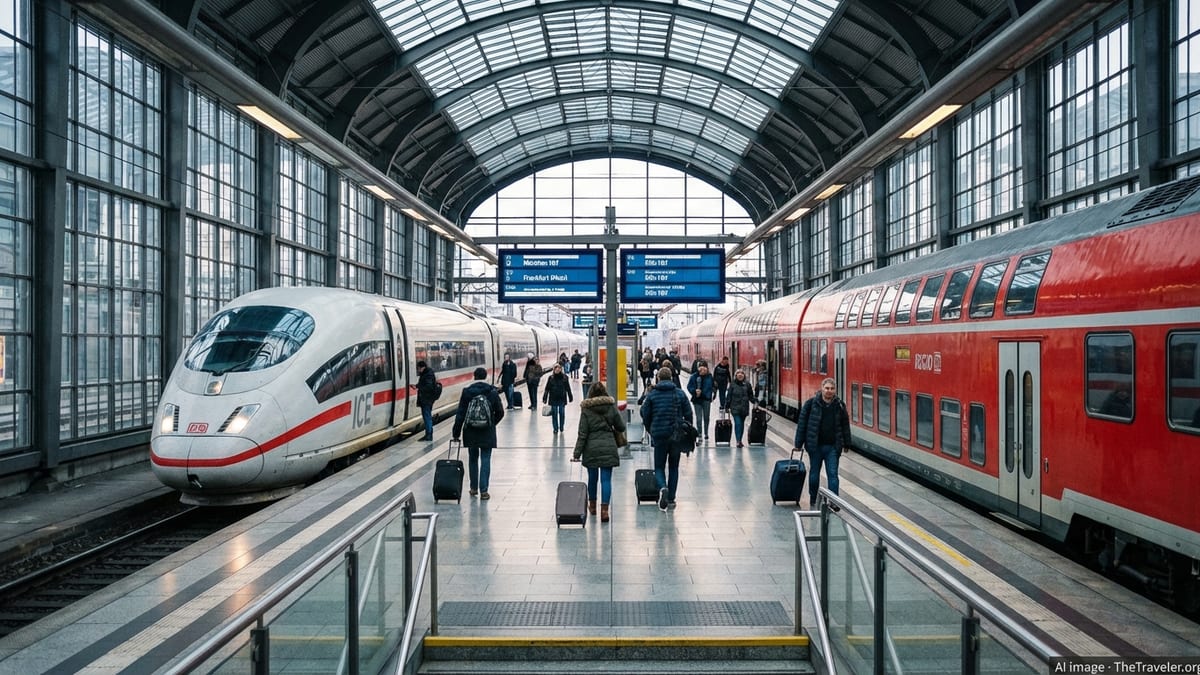
Stricter enforcement on ICE and Intercity routes
Reports from government decision papers and German media coverage indicate that the move is focused on Deutsche Bahn’s long-distance network, particularly high-speed ICE and Intercity services that connect major cities and carry large volumes of passengers. These trains have been a central pillar of domestic and cross-border mobility, and health protection measures on board are viewed as a key component of wider national efforts to contain infection risks in public transport.
Face coverings on long-distance trains have been a legal requirement under German pandemic rules, with train staff already tasked with reminding passengers of the obligation and, where necessary, asking non-compliant travelers to leave the service at the next suitable station. Doubling mask checks signals a shift toward more systematic monitoring, with inspections expected to become more frequent and more visible in carriages along busy routes.
Publicly available policy documents from the federal government reference intensified mask controls on long-distance trains as one of several measures aimed at reinforcing adherence to hygiene and distancing rules. Deutsche Bahn’s own communications on safety and cleanliness in long-distance transport have highlighted the need for passengers to wear masks correctly throughout their journey, complementing other measures such as enhanced cleaning and improved air circulation on board.
Industry observers note that the decision to scale up checks reflects ongoing concern that compliance can fluctuate, especially on longer journeys where passengers may be tempted to remove masks for extended periods outside of meal or drink breaks. Doubling the number of checks is designed to create a consistent expectation of enforcement across the network.
How the expanded mask checks are expected to work
While detailed operational plans have not been outlined in full, the doubling of checks is expected to involve both regular train crews and additional staff assigned specifically to monitor compliance with mask rules. On long-distance services, ticket inspections already take place at various points during a journey, and mask inspections are likely to be carried out in parallel, with staff moving systematically through the carriages.
Public information on Deutsche Bahn’s onboard procedures indicates that inspection teams typically work their way through long-distance trains several times between major stops. The new approach is expected to increase the frequency of these passes, shortening the intervals between checks so that each coach is monitored more often. This could be particularly noticeable on heavily frequented routes such as those linking Berlin, Hamburg, Munich, Frankfurt and Cologne.
Rail passengers may also see a closer coordination between mask checks and other forms of control, such as passport inspections on international services or random ticket validations that already occur despite digital self check-in options. Observers suggest that combining these activities can reduce disruption while still strengthening compliance, allowing checks to take place while trains are moving and minimizing additional delays at stations.
According to published coverage of federal-level decisions, there has also been discussion of involving federal police more closely in enforcement on certain long-distance routes. In practice, this would likely mean that mask checks carried out by railway personnel could be supported by law enforcement where necessary, especially in cases of repeated refusal to comply.
Part of a wider package of rail hygiene and safety measures
The intensification of mask checks is one element in a broader package of health and safety actions that Deutsche Bahn has introduced on its long-distance services since the start of the pandemic. Company fact sheets and quality reports describe an expanded cleaning regime, including more frequent disinfection of high-contact surfaces such as door handles, tables and restrooms, as well as increased staffing for cleaning teams both at terminal stations and on trains during their journeys.
Other measures include the promotion of contactless ticketing via the company’s mobile app, which allows passengers to purchase and validate tickets digitally. This reduces the need for paper ticket handling and shortens direct contact between passengers and staff. Information from the operator’s digital services pages shows that long-distance trains have increasingly been integrated into self check-in systems that enable travelers to confirm their presence in a specific seat without a traditional ticket inspection at their place.
In addition, ventilation and air filtration systems on long-distance rolling stock have been highlighted in public communications as a key part of the health strategy. Modern ICE trains are equipped with powerful air conditioning systems designed to refresh cabin air frequently, and Deutsche Bahn has emphasized in its materials that these systems play an important role in mitigating airborne transmission risks when combined with mask wearing.
Officials and analysts cited in German media have framed the combined effect of masks, enhanced cleaning, digital ticketing and ventilation as a layered protection model. Doubling mask checks is presented within this context as reinforcing the layer most reliant on individual passenger behavior: the consistent, correct use of face coverings.
Impact on passengers and travel experience
For travelers, the immediate impact of doubled mask checks is likely to be a more visible presence of staff in the aisles and an increased likelihood of being reminded to adjust or put on a mask during the journey. Passenger advocacy groups quoted in local coverage have generally welcomed clearer enforcement of existing rules, arguing that it can reduce tensions between travelers by shifting responsibility for interventions from individual passengers to trained staff.
However, the policy may also heighten scrutiny on routes where compliance has been uneven, leading to more frequent interactions between staff and passengers who are reluctant to follow the rules. Rail commentators note that the success of the measure will depend on clear communication before and during journeys, including signage at stations, announcements on board and up-to-date information in booking channels in multiple languages.
From a practical standpoint, passengers planning long-distance trips are advised by travel information services to factor in mask requirements when preparing for their journeys, ensuring they carry an adequate number of compliant face coverings for the duration of the trip. Given that some services can last several hours, especially on cross-border routes, having spare masks available is considered important should one become damp or damaged.
Travel planners also note that the intensified checks could indirectly influence seat selection behavior, with some passengers choosing quieter coaches where they feel more comfortable wearing masks for extended periods. Nonetheless, German transport analysts point out that long-distance trains remain a central component of environmentally friendly travel, and strengthened health safeguards are intended to sustain confidence in rail as a safe alternative to private car or air travel.
Ongoing monitoring and potential future adjustments
Policy documents and media reports suggest that the decision to double mask checks will be monitored over time, with authorities and the rail operator assessing both compliance levels and any operational side effects. Metrics such as the number of reported incidents related to mask refusal, passenger satisfaction scores and punctuality statistics on long-distance routes are expected to inform future adjustments.
If the intensified checks are shown to significantly improve adherence without causing notable disruption, similar approaches could be maintained or adapted for future public health needs, even as specific pandemic rules evolve. Observers also highlight the possibility that lessons learned from long-distance services could be transferred to regional or local transport where appropriate, though implementation would depend on different legal frameworks and operating conditions.
At the same time, analysts caution that public acceptance of stricter enforcement measures can shift over time, particularly as infection rates and official guidance change. For this reason, clear and transparent communication about the rationale for doubled checks, their temporary or permanent nature, and the criteria for scaling measures up or down will be crucial.
For now, the move underlines the central role of long-distance rail in Germany’s mobility system and signals that health protection on board remains a priority. As travel demand continues to fluctuate in response to broader conditions, the balance between passenger comfort, safety and operational reliability will remain at the heart of decisions shaping the country’s intercity rail network.