


More news on this day
A sharp spike in delays and cancellations at Dallas Fort Worth International Airport in early June 2026 is sending fresh shockwaves through already fragile global airline schedules, snarling connections across North America, Europe and parts of Asia at the outset of the busy summer travel season.
Get the latest news straight to your inbox!
Hundreds Disrupted at American’s Largest Hub
Operational data and industry monitoring for the first week of June indicate that Dallas Fort Worth, one of the world’s busiest hubs and the primary base for American Airlines, has endured a sustained period of disruption. A cluster of severe thunderstorms, repeated ground stops and equipment and crew imbalances combined to produce hundreds of late departures and missed connections. One snapshot of activity showed roughly 288 delayed departures and arrivals across American, Delta, United and a handful of international carriers at DFW over a single operating window, alongside several dozen outright cancellations.
Publicly available reports focused on American Airlines, which dominates traffic at the airport. One recent analysis of a similar disruption period at DFW logged more than 30 cancellations and well over 300 delayed American flights in a day, with the carrier’s overall delay rate at its hub running close to one in three services. Comparable patterns are appearing again in June 2026 as tightly scheduled aircraft and crews struggle to recover once storms or temporary ground stops interrupt normal operations.
Delta Air Lines and United Airlines, both relative minnows at DFW compared with American, have also seen their smaller schedules hit by knock-on delays. Tracking data suggests that while the absolute number of affected flights for these carriers is lower, passengers connecting from or to DFW on multi‑segment itineraries are still encountering missed onward flights and extended rebooking holds.
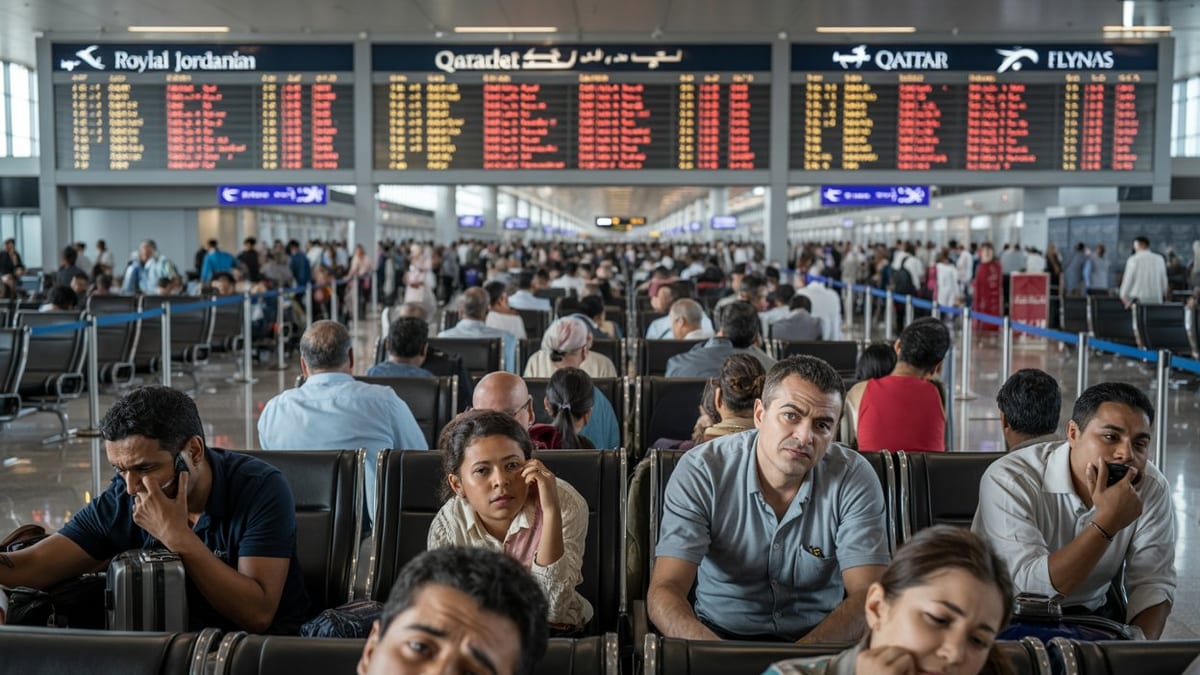
Travelers have been reporting lengthy overnight waits as rolling departure estimates slip by 30 minutes at a time before turning into cancellations. Social media posts and forum discussions highlight cases of passengers remaining in the terminal for 10 to 12 hours while attempts are made to source flight crews or aircraft. Others describe diversions to nearby airports when storms build over north Texas, adding further strain to an already stretched regional network.
Storms, Crew Shortages and Tightly Packed Schedules
DFW’s location in north Texas makes it particularly vulnerable to severe thunderstorms during late spring and early summer. Aviation analysts note that when convection builds over the Metroplex, air traffic control may slow or pause arrivals, sprinting to clear queued traffic once cells move through. That creates a surge‑and‑stall pattern that can rapidly fill aircraft parking stands, delay pushbacks and force aircraft to sit on the ground waiting for a departure slot.
Weather alone, however, does not fully explain the scope of disruption. Reports from recent days describe flights initially coded as weather‑related delays later running into crew duty‑time limits, aircraft swaps or maintenance inspections, prolonging disruption long after storms have cleared the area. With summer schedules built around high aircraft utilization and tight turnarounds, even modest operational issues at a hub can ripple through the system for many hours.
Industry data from the past year shows that U.S. carriers, including American, Delta and United, have been operating near pre‑pandemic capacity, with many routes at or above 2019 frequency levels. Schedules at large connecting hubs like DFW are particularly dense, as airlines seek to maximize banked connection waves feeding transcontinental and long‑haul services. That density leaves limited slack to absorb unexpected holds, diversions or aircraft taken out of rotation.
As a result, a late‑evening storm line or brief ground stop can strand aircraft and crews out of position for the next morning’s departure banks. The early June pattern at DFW reflects this dynamic: once the first wave of delays took hold, subsequent days saw repeated downstream issues as aircraft started the day late, leading to further missed connections and rebookings.
Knock-On Effects Into Europe and Asia
The turbulence at DFW is not occurring in isolation. Operational snapshots from early June show that Europe’s aviation network remains under significant strain, with recent monitoring capturing dozens of cancellations and several hundred delays in a single morning across hubs such as Amsterdam, Paris, London and Vienna. Earlier in the month, another review logged more than 2,000 delays and over 50 cancellations across European airspace in one day, affecting carriers including Ryanair, Lufthansa, KLM and Air France.
Connections between North America and Europe magnify those stresses. Long‑haul departures from Dallas Fort Worth to key European gateways often feed into onward flights across the continent and onward to the Middle East, Africa and Asia. When DFW suffers large‑scale delays, widebody departures can miss their scheduled slots into congested European hubs. That in turn forces rescheduling and missed connections for passengers heading to secondary cities or transferring onward to Asia via major European hubs.
Similar pressure points are emerging in Asia‑bound traffic. Monitoring from previous disruption events this season shows that weather at DFW has diverted transpacific flights to alternate U.S. gateways, complicating crew scheduling and aircraft rotations. When such diversions line up with staffing shortages or airspace constraints at intermediate hubs, delays can cascade along routes serving Japan, Korea and Southeast Asia.
This interplay means a passenger beginning a journey in a mid‑sized U.S. city may feel the impact of a storm over Dallas or a staffing issue at a European control center many hours later and thousands of miles away. The early June disruptions at DFW are therefore contributing to a broader lattice of summer travel issues rather than existing as a contained, local event.
Passengers Face Missed Connections and Limited Options
For travelers, the immediate consequence of DFW’s latest disruption cycle is uncertainty. Reports from airport terminals describe long rebooking lines and stretched call centers as customers attempt to salvage itineraries. With summer load factors typically high, same‑day alternative flights can be difficult to secure, particularly for families or larger groups wanting to travel together.
Passengers connecting through DFW from smaller U.S. markets appear to be especially exposed. When late‑night departures from Dallas are delayed into the early hours or cancelled outright, travelers may find that the next available flight to their destination is not until late the following day. In some cases, those onward services are already heavily booked by other disrupted passengers, creating multi‑day delays.
Accommodation and meal arrangements add further complexity. Accounts from recent days reference situations in which hotel vouchers issued during mass disruptions did not correspond to actual room availability, leaving passengers to search for last‑minute lodging on their own. Others describe choosing to remain in the airport overnight to avoid high last‑minute hotel prices, sleeping in gate areas while awaiting early‑morning departures.
Consumer advocates observing the latest disruption cycle are reiterating the importance for passengers to familiarize themselves with carrier contracts of carriage and, for international segments touching Europe, with compensation frameworks that may apply to long delays and cancellations. With little indication that weather patterns or structural capacity constraints will ease in the short term, travelers using DFW as a connecting point may need to plan for added buffer time, especially when connecting to long‑haul services bound for Europe or Asia.
What the Turmoil Signals for Peak Summer 2026
The DFW disruptions arrive just as analysts are forecasting another strong summer for global travel, with demand in many regions matching or exceeding 2023 and 2024. Research from financial and tourism industry groups points to resilient consumer appetite for international trips, including to Europe and major World Cup host cities in North America over the next two years. Yet the same reports caution that structural bottlenecks in air traffic control, staffing and airport infrastructure could make service reliability uneven.
Dallas Fort Worth plays an outsize role in that outlook. As American’s primary hub and a key node for Delta, United and several foreign carriers, DFW functions as a gateway not only to domestic U.S. destinations, but also to Europe, Latin America and Asia. When its operation falters, the effects radiate widely through global networks, as this latest wave of delays and cancellations demonstrates.
Infrastructure investments at DFW, including newly opened gates and terminal refurbishments in recent months, are intended to improve the passenger experience and add capacity. However, physical expansion may not be enough to offset volatile summer weather patterns and industry‑wide staffing and airspace constraints. Experts tracking operational performance suggest that network resilience will depend on a combination of more conservative scheduling, enhanced crew planning and closer coordination between airports and airlines when severe weather is forecast.
For now, travelers connecting through DFW face a peak season shaped by both strong demand and heightened risk of disruption. As the early June meltdown reverberates across itineraries touching Europe and Asia, the episode is emerging as a key stress test for how well U.S. hubs and global carriers can manage the complex web of connections that underpin modern air travel in 2026.