


My first glimpse of Cannes looked exactly as I expected. The Croisette shimmered with palm trees and polished sports cars, luxury boutiques glowed behind spotless glass and the famous red carpet staircase sat waiting for its next festival crowd. What I did not expect was how quickly that cinematic facade would fall away once I wandered a few streets back. My biggest surprise in Cannes was not the glamour I came for, but how much more the city offered beyond it: neighborhood markets where stallholders greet regulars by name, forested hills where you can hear cicadas instead of traffic, and quiet coves where a beach day costs little more than the ferry ticket to get there.
Get the latest updates straight to your inbox!
From Red Carpet Fantasy to Everyday City
Like many first-time visitors, I arrived in Cannes with movie scenes in my head. The name is so closely tied to its film festival that it is easy to imagine the entire city as one long stretch of velvet rope. And yes, for a few blocks along the Boulevard de la Croisette, life really does look like a perfume commercial: historic grand hotels such as the Carlton and the Martinez, private beaches with neatly aligned loungers and superyachts moored just beyond the sand.
The surprise begins as soon as you turn inland. Within five minutes of leaving the Croisette, the mood changes from polished to practical. On Rue Hoche, students linger over coffees at sidewalk tables that cost only a couple of euros, and shopkeepers roll up metal shutters on bakeries, greengrocers and hardware stores serving people who actually live here year-round. The terrace prices drop, the dress code relaxes and the conversation switches from English and Italian back to French.
Walk ten minutes more and you reach streets where nobody seems impressed by the idea of a film festival. Around Boulevard Carnot and in the residential quarters north of the railway line, you pass neighborhood playgrounds, small supermarkets and office buildings. It feels like a medium-sized provincial town that just happens to front one of the most famous bays in the world. For a visitor, that shift is liberating. You are no longer just a spectator of glamour but a guest in a functioning city.
This everyday Cannes is also where prices soften. While a cocktail on the Croisette can easily run to 18 or 20 euros, a glass of house wine in a side-street bar might be 5 or 6, and a simple plat du jour at a local brasserie often comes in around 15 to 18 euros. The contrast can be stark, but it also means you can experience the Riviera without a movie-star budget if you are willing to step a few streets off the sand.
Le Suquet: A Hilltop Village Above the Bay
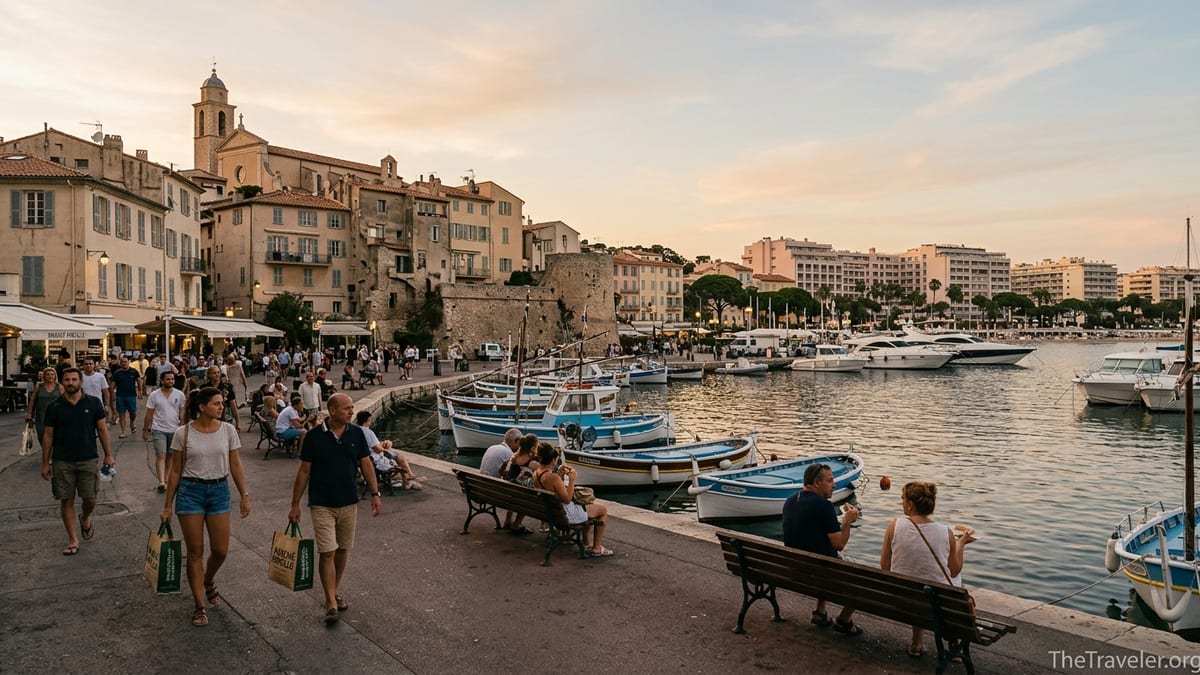
The strongest argument that Cannes is more than its waterfront sits on the hill above the old port. Le Suquet, the city’s medieval quarter, predates the festival by centuries and still feels like a self-contained Provençal village. Climbing the cobbled Rue Saint-Antoine from the harbor, you swap polished marble for worn stone, and the soundtrack shifts from car engines to cutlery, as diners talk over plates of grilled fish at tightly packed bistro tables.
Le Suquet is where I first understood how small Cannes really is. In less than fifteen minutes, you can walk from the Croisette to the top of the hill by the Church of Notre-Dame d’Espérance, yet the atmosphere at the summit is completely different. From the square beside the church and the Musée des Explorations du Monde, panoramic views stretch over the port, the curve of La Croisette and the distant Lérins Islands. On a clear afternoon you can trace the coastline all the way toward Antibes. Families sit on the stone walls sharing takeaway pizza, and local teenagers balance on the steps with scooters and backpacks, pointedly ignoring the view they grew up with.
After dark, Le Suquet changes again. While the Croisette pulls in gala dinners and black-tie parties during festival season, the restaurants along Rue Saint-Antoine and Rue du Suquet fill with a mix of locals and visitors looking for something less formal. Menus lean into Provençal favorites: grilled sea bream with olive oil and lemon, vegetable tian layered with tomatoes and zucchini, and desserts built around figs, honey and almonds. Prices here are not cheap, but dinner for two with wine is more likely to land around 80 to 100 euros than the several hundred you might pay at a palace hotel on the waterfront.
What struck me most was how unselfconscious it felt. In a city known for paparazzi, I saw more dogs than cameras on the hill. Residents hauled shopping bags up the steps, waiters joked with regulars and the crowds were busy enjoying their evening rather than documenting it. If your image of Cannes is all tuxedos and lenses, the casual warmth of Le Suquet comes as a welcome shock.
Marché Forville: Where Cannes Shops Like a Local
If Le Suquet is the historic heart of Cannes, Marché Forville is its kitchen. Tucked at the foot of the old town, this covered market has long been the place where residents come for seasonal produce, fish and flowers. On busy mornings the hall fills with the smell of ripe melons, basil and cured olives, while stallholders call out prices for crates of tomatoes and baskets of strawberries. It is one of the fastest ways to glimpse the city beyond hotel lobbies and conference badges.
Arriving just after opening, I watched chefs from neighborhood restaurants buying whole sea bass and red mullet from fishmongers, their orders packed in ice and loaded into vans. Locals queued at stalls selling socca, the chickpea pancake typical of this stretch of the Riviera, tearing off pieces to eat still hot from the wood-fired oven. Others lined up for pan bagnat, the Niçoise-style tuna sandwich that has become a staple on Cannes beaches, stuffed with tomato, olives and anchovies.
For visitors, the market is surprisingly affordable. With around 10 to 15 euros you can assemble an abundant picnic: a wedge of local goat cheese, a bag of olives, a still-warm baguette, a punnet of apricots and perhaps some tapenade. Coffee at one of the café terraces on the market’s edge is usually only slightly more expensive than inland French towns, and the reward is a front-row seat to the choreography of daily life: stallholders chatting between sales, neighbors comparing recipes, grandparents buying single peaches for grandchildren.
Even as the city renovates parts of Marché Forville and its surroundings, the spirit remains firmly local. Some days, particularly early in the week, you will see more Cannes residents than tourists. By late morning, when many of the fresh-produce stalls start to wind down, antique dealers and bric-a-brac sellers sometimes move in, adding another layer to the experience. That constant evolution is part of what makes the market feel lived-in rather than curated.
Sea, Sand and the Shock of Affordable Beaches
Cannes’ manicured private beaches are famous, but they are not the only way to put your feet in the Mediterranean. Public stretches of sand line much of the bay, especially west of the old port along Plage du Midi and east toward Pointe Croisette. Here, entry is free, and your main expense is whatever you choose to buy from the nearest boulangerie on your way down.
On the Croisette itself, private beach clubs rent loungers with waiter service, changing cabins and often elaborate lunch menus. Prices vary widely, but in high summer a front-row sunbed can reach into three figures for the day, especially at the most sought-after clubs. For many visitors that is part of the Cannes dream. Others, like me, are surprised to discover that the same sea and sky are available without the price tag just a short walk away.
Plage du Midi, stretching west toward the La Bocca district, is where I found my favorite version of Cannes beach life. The sand is more relaxed, with families spreading their own towels, groups of friends sharing supermarket picnics and older residents swimming slow laps parallel to the shoreline. Simple beach restaurants behind the sand sell menus of grilled sardines, salads and pasta dishes, often at prices closer to 15 or 20 euros than the 30-plus you might pay on the Croisette. Sunbed rentals here, where they exist, tend to be noticeably cheaper as well.
Then there are the Lérins Islands, a pair of low, pine-covered islands just offshore. A short ferry ride from the old port carries you to Sainte-Marguerite or Saint-Honorat, where the beaches are smaller and often pebbly, but the water is remarkably clear. The cost of the round-trip boat ticket is usually in the range of a modest restaurant meal, yet it buys you a full day in a setting that feels much farther removed from the city than the 15 minutes it takes to cross the bay.
Green Hills, Quiet Streets and the Outdoor Side of Cannes
Another surprise in Cannes waits above the built-up coastline. The hill of La Croix des Gardes rises behind the city, covered in forest and threaded with walking paths. Locals describe it as the green lung of Cannes, and once you set foot under the umbrella pines and eucalyptus trees, the description feels accurate. Birdsong replaces traffic noise, and through gaps in the foliage you glimpse blue sea and the tiled roofs of the city below.
There is no entry fee to this natural park, and the only equipment you need is a pair of comfortable shoes and some water. Joggers share the paths with dog walkers and families pushing strollers. Some routes climb gently to viewpoints marked by a large cross, offering wide-angle views of the bay and the Lérins Islands. In late afternoon, when the light softens and shadows lengthen across the paths, it is easy to forget that the Croisette is only a short bus ride away.
Cannes also hides smaller pockets of green closer to the sea. Along the western end of the Croisette near the Port Canto and the Roseraie gardens, locals take evening strolls with ice creams, stopping to watch children cycle along the promenade. Benches face the water, and the atmosphere feels more like a neighborhood park than a luxury resort. In high season you may still share the path with festival guests and business travelers, but the rhythm here is gentler.
For anyone who associates Cannes purely with indoor events and red carpets, this outdoor side of the city is an eye-opener. Renting a public bike to follow the shoreline, hiking above the bay at sunrise or simply sitting on a public bench with a takeaway coffee proves that some of Cannes’ best experiences are free or close to it. The Riviera climate does the rest, with mild winters and long, warm evenings that invite you outside most of the year.
Eating Well Without Emptying Your Wallet
Food is often where visitors feel the disconnect between Cannes’ glamorous reputation and their own budget. It is possible, of course, to spend lavishly: tasting menus at renowned hotel restaurants, multi-course seafood feasts on private beaches and late-night champagne in clubs where entry alone can be significant. But it is equally possible to eat well on moderate means, especially once you learn where locals go.
A typical strategy is to make lunch your main restaurant meal of the day. Many bistros away from the Croisette offer fixed-price lunch menus that include a starter and main course for less than a single main dish would cost in the evening. In the streets around Marché Forville and Rue Meynadier, you find small places serving plates of socca, salads, bowls of moules-frites and glasses of house rosé at prices that feel reasonable for a city on the Côte d’Azur.
Self-catering is another way to experience Cannes like a resident. Apartment rentals are plentiful, and with a kitchen at your disposal, a visit to Marché Forville becomes more than a sightseeing stop. For roughly the cost of a single entrée in a waterfront restaurant, you can put together a dinner of grilled seasonal vegetables, charcuterie, cheese and local wine to share on a balcony while the city lights reflect off the bay.
Even in more touristed areas, small adjustments help. Choosing a café one street behind the Croisette instead of on the seafront can shave several euros off the price of a drink. Ordering the day’s special rather than a steak or lobster dish keeps the bill in check while often delivering better flavor, since those dishes reflect what looked good at the market that morning. The surprise is not only that Cannes allows for budget-conscious choices, but that some of its most satisfying meals happen in those unassuming settings.
Using Cannes as a Base for the Riviera
Another side of Cannes that often catches visitors off guard is how effectively it works as a base for exploring the wider Côte d’Azur. The city’s train station sits just a few minutes’ walk from the Croisette and most central hotels, and frequent regional trains link Cannes to nearby destinations such as Antibes, Nice and Menton. Tickets to towns along the coast are usually priced in the range of a casual lunch, making day trips an attainable part of a longer stay.
Head west and within a short ride you can be in Antibes, with its fortified old town and Picasso connections, or farther along toward Saint-Raphaël and the red rocks of the Esterel. Travel east and you reach Nice with its museums and markets, then onward to Monaco if you want to contrast Cannes’ brand of glamour with another. All of this is accessible without hiring a car, a welcome relief for those daunted by the idea of parking along the Riviera.
Even on the water, Cannes serves as a gateway. Regular boat services leave the old port for the Lérins Islands, where you can visit the fortress prison linked to the legend of the Man in the Iron Mask on Sainte-Marguerite or the centuries-old monastery and vineyards on Saint-Honorat. Schedules and prices vary by season, but for many visitors the cost compares favorably with a single afternoon’s sunbed rental on a private beach, yet delivers an entirely different experience of the bay.
Using Cannes as a hub in this way changes your relationship with the city. Instead of treating it as a destination to “do” in a day, you settle into its rhythms: morning coffee at the same bar, a few hours on the beach or hill, perhaps a train ride to another town, then dinner back in familiar streets. The festival posters and luxury storefronts remain, but they become part of a broader backdrop to a more varied Riviera stay.
The Takeaway
By the time I left Cannes, the polished image that had first drawn me there felt strangely incomplete. The red carpets and luxury hotels are real enough, and worth seeing once for their cultural weight. But the memories that stayed with me came from elsewhere: the fishmonger at Marché Forville slipping an extra handful of shrimp into a local customer’s bag, the view from the top of Le Suquet as church bells marked the hour, the hush of the pine forest on La Croix des Gardes and the laughter of families picnicking on Plage du Midi at sunset.
The biggest surprise was not that Cannes offered more than glamour, but that this other side was so easy to access. It required no special connections, no VIP invitations and no five-figure budget. A willingness to walk a little beyond the Croisette, to climb a hill or catch a local ferry, was enough. In doing so, I discovered a city where festival glitz coexists with genuine community, where the Riviera’s natural beauty is still freely shared and where everyday life unfolds in the shadow of the spotlight.
If you arrive in Cannes expecting a glossy postcard, you will certainly find it. Look a little closer, and you may find something better: a coastal town that lives a rich, ordinary life behind its extraordinary reputation.
FAQ
Q1. Is Cannes worth visiting if I am not interested in the film festival?
Cannes is absolutely worth visiting even outside festival season. Historic neighborhoods like Le Suquet, local markets such as Marché Forville, public beaches and nearby islands offer plenty to enjoy without any connection to cinema.
Q2. Can you experience Cannes on a moderate budget?
Yes. By favoring public beaches, eating at neighborhood bistros or cooking with ingredients from local markets and choosing accommodation a few streets back from the Croisette, you can keep costs manageable while still enjoying the city.
Q3. Where can I find authentic local food in Cannes?
Areas around Marché Forville and the streets of Le Suquet are good starting points. Look for places serving socca, pan bagnat, grilled local fish and seasonal vegetables rather than only international staples.
Q4. Are there free or cheap things to do in Cannes?
Many of Cannes’ best experiences are low-cost or free, including walking up to Le Suquet for the view, hiking in La Croix des Gardes, strolling along the seafront promenades and swimming at the public sections of the beach.
Q5. How busy is Cannes outside the festival period?
Outside major events, Cannes feels more like a relaxed Mediterranean town. Summer is still lively, but spring and autumn often bring pleasant weather with fewer crowds and a more local rhythm.
Q6. Is it easy to get from Cannes to other Riviera towns?
Yes. The central train station offers frequent services to Nice, Antibes and other coastal towns, and regional buses and boats connect Cannes with nearby destinations, making day trips straightforward.
Q7. What is the best area to stay in for a first visit?
Staying near the old port, between the Croisette and Le Suquet, gives easy access to both the waterfront and the historic quarter. It is a convenient base for walking almost everywhere in central Cannes.
Q8. Do I need a car in Cannes?
You can comfortably explore Cannes itself on foot and by public transport. Trains and boats cover many nearby attractions, so a car is optional rather than essential unless you plan extensive inland travel.
Q9. Are the beaches in Cannes all private?
No. While parts of the shoreline in front of major hotels are managed as private beach clubs, substantial stretches, especially around Plage du Midi and near the ends of the Croisette, remain public and free to access.
Q10. How many days should I spend in Cannes?
A stay of two to three days allows time for the old town, markets, beaches and at least one boat trip to the Lérins Islands. With four or five days, you can add relaxed day trips to nearby Riviera towns.