


The United States is less a single destination and more a continent-sized menu of travel experiences. In one trip, visitors can ride a subway to a Broadway show, wake up to elk bugling outside a cabin, sip wine in a small-town tasting room, and finish the week surfing Pacific waves. This breadth is what keeps the U.S. near the top of global tourism wish lists: it has the scale to offer something for every type of traveler, and the infrastructure to make those experiences surprisingly accessible.
Get the latest updates straight to your inbox!
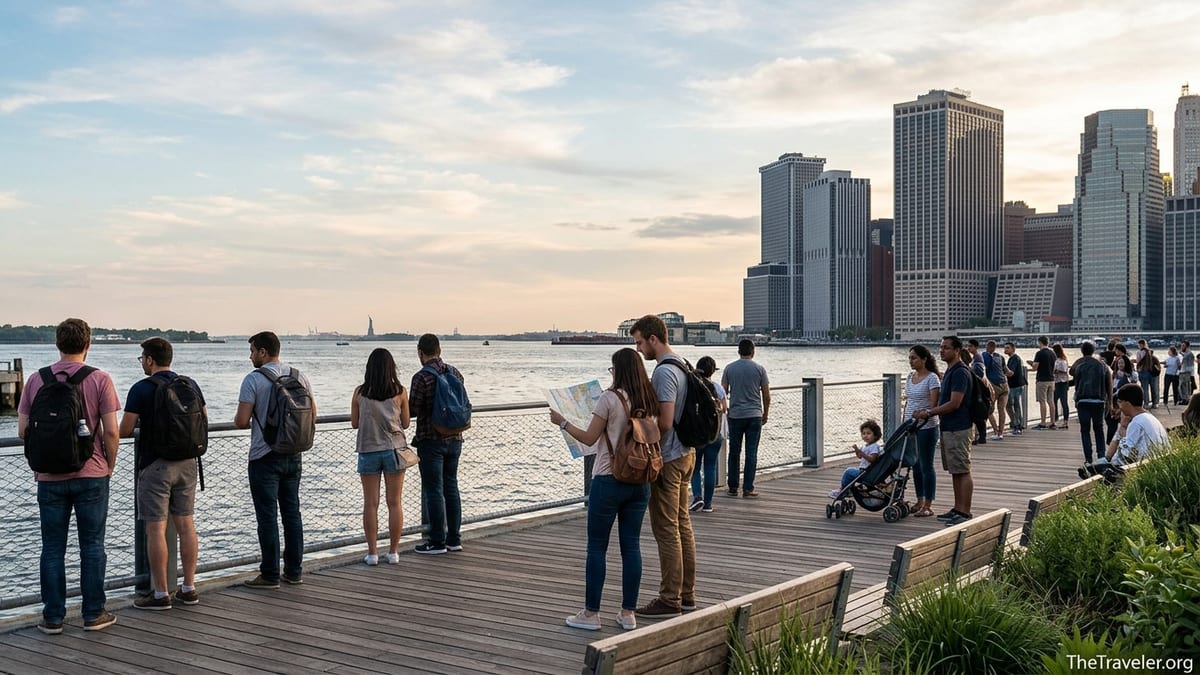
From Skyline Icons to Neighborhood Streets
For city-focused travelers, a first trip to the United States often starts with New York City. The city remains the country’s top urban magnet for overseas visitors, drawing well over 9 million international arrivals a year to its wider metro area according to recent federal tourism monitors. Walk a single north–south stretch of Manhattan and you pass glass office towers at Hudson Yards, 19th-century brownstones in Chelsea, street food stands in Midtown, and the neon spectacle of Times Square. A standard single subway ride costs just a few dollars, with weekly fare caps that make unlimited tap-and-go city travel manageable for visitors on a budget, so you can crisscross boroughs in a day without thinking too hard about ticketing.
Other U.S. cities deliver their own distinct flavors. Chicago’s skyline wraps around Lake Michigan, and it is possible to spend a day entirely on foot: start with a morning river architecture cruise, walk the lakefront trail to public beaches, then duck into the Art Institute to see Grant Wood’s "American Gothic." In San Francisco, the appeal is more intimate: pastel Victorian houses in the Mission, fog rolling through the Golden Gate, and cable cars still clanging up steep streets. Even smaller cities have become destinations in their own right. Austin draws music fans with nightly live performances on Red River Street, while Portland, Oregon, has turned coffee roasteries and food truck pods into a lifestyle.
What sets U.S. cities apart for many travelers is not only the vertical drama of their skylines but the diversity inside them. In Queens, often called the most ethnically diverse urban county in the country, you can eat Peruvian roast chicken for lunch, Tibetan momos for an afternoon snack, and Filipino halo-halo for dessert, all within a few subway stops. In Los Angeles, a short rideshare trip can take you from Korean barbecue in Koreatown to Oaxacan moles in Boyle Heights. These everyday experiences ground the big-ticket icons in real neighborhoods and help city lovers feel less like spectators and more like temporary residents.
Nature on a Continental Scale
The U.S. national park system is a major draw for nature seekers. In 2023, parks managed by the National Park Service recorded roughly 325 million recreation visits, with more than 4.5 million of those at Yellowstone alone. That scale of visitation hints at how central outdoor experiences have become to both domestic and international travelers. Parks range from drive-up viewpoints at the Grand Canyon to remote tundra in Alaska’s Gates of the Arctic, meaning travelers can calibrate their adventure to comfort levels, fitness, and time.
For many first-time visitors, the classic nature itinerary includes a loop through Utah and Arizona. In Zion National Park, a free shuttle bus carries hikers into a sandstone canyon where easy riverside strolls run alongside famous routes like Angel’s Landing. Nearby Bryce Canyon’s amphitheaters of orange hoodoos look especially otherworldly at sunrise, when the temperature can be close to freezing even in shoulder seasons. Further east, Mesa Verde in Colorado lets travelers climb ladders into ancient cliff dwellings built by Ancestral Pueblo people, combining hiking with tangible history.
Even travelers based in big cities can reach wild landscapes in a matter of hours. From Seattle, a summer weekend can include kayaking on Puget Sound one morning and hiking among wildflowers on Mount Rainier in the afternoon. From Miami, airboat tours skim across the Everglades, where visitors often spot alligators and roseate spoonbills within minutes of leaving the dock. In Alaska, small-group boat tours out of Seward take travelers into Kenai Fjords National Park to watch tidewater glaciers calve into the sea while puffins and orcas share the same icy waters.
Crucially for international visitors, a wide range of guided options make these landscapes accessible without specialized skills. Outfitters in Moab, Utah, offer half-day rafting trips on the Colorado River that are suitable for families, including all safety gear and transport, for prices that are comparable to a big-city theater ticket. In Yosemite Valley, free ranger-led walks interpret everything from geology to Miwok cultural history, while well-marked day hikes like the Mist Trail let reasonably fit travelers stand beside thundering waterfalls without needing ropes or technical equipment.
Road Trips, Rail Journeys, and Scenic Byways
Much of the romance of traveling in the United States lies between the destinations. Iconic road trip routes like Route 66 and California’s Highway 1 have entered global pop culture precisely because they turn the journey itself into the main attraction. On a typical two-week drive between Chicago and Los Angeles along the old Route 66 corridor, travelers might eat at neon-signed diners in Oklahoma, sleep in a vintage motor court in New Mexico, and detour to see the Grand Canyon before rolling into the Los Angeles metro area. Along the Pacific, Highway 1 winds between San Francisco and Los Angeles with pullouts overlooking sea cliffs where elephant seals haul out on the beach.
Driving is not the only way to see the country. Long-distance rail travel has seen fresh interest from both U.S. residents and overseas visitors looking for lower-stress, lower-emission options. Amtrak’s USA Rail Pass, for instance, allows travelers to book multiple segments over a 30-day period, turning routes like the California Zephyr or the Empire Builder into moving observation decks. On the Zephyr, an economy coach ticket gives access to a glass-domed lounge car where passengers watch the Rockies and Sierra Nevada roll by, chatting with seatmates over coffee. Many travelers pair overnight train segments with city stays, using stations in Denver, Chicago, or San Francisco as natural breakpoints.
Beyond famous routes, almost every state maintains designated scenic byways that reward slower exploration. In New England, autumn visitors time trips along Vermont’s back roads for peak foliage, staying in small inns and farm stays where breakfast might feature maple syrup made on-site. In the Deep South, the Natchez Trace Parkway links Tennessee, Alabama, and Mississippi along a gently curving road with a strict speed limit and no billboards, ideal for cycling tours and relaxed drives. The sheer mileage of paved secondary roads, combined with widespread car rental options, gives independent travelers the flexibility to improvise, detour, and linger where a sunset or a roadside farm stand catches their eye.
However, the scale of distances does require realistic planning. A first-time visitor who hopes to drive from New York to Miami and then across to Las Vegas in a ten-day trip will likely underestimate just how much time is lost to transit. Many repeat visitors learn to focus each trip on one region: perhaps New England and eastern Canada one year, then the Southwest deserts the next. This regional approach allows deeper experiences, whether that means spending three days exploring Navajo-led tours in Monument Valley or devoting a full week to tasting rooms and cycling trails in Oregon’s Willamette Valley.
Cultural Immersion: Music, Food, and Everyday Life
Another reason the United States appeals to such a broad range of travelers is the sheer variety of cultural experiences packed into its cities and small towns. Music fans can trace entire genres along specific routes: jazz in New Orleans’ clubs along Frenchmen Street, country at honky-tonks in Nashville, blues in Chicago’s South Side bars, and indie rock in Brooklyn venues. Festivals help travelers experience these scenes in concentrated form, from summer jazz gatherings in Newport, Rhode Island, to multi-stage events such as Austin City Limits in Texas.
Food culture has become a major motivator in its own right. In Houston, it is possible to start the day with Vietnamese bánh mì, move on to West African jollof rice for lunch, and finish with Texas brisket for dinner, all at locally run spots that rarely appear in guidebooks. On the West Coast, travelers might spend a day in Sonoma or the Willamette Valley visiting two or three wineries by appointment, pausing at food carts or roadside farm stands for seasonal produce. Urban food halls, from Seattle’s Pike Place Market to newer developments in Detroit and Atlanta, let travelers sample regional specialties like clam chowder, gumbo, or peach cobbler without committing to a formal sit-down meal.
Cultural institutions provide another layer of immersion. Many of the country’s most-visited museums are in Washington, D.C., and New York, including the Smithsonian complex and the American Museum of Natural History, which each attract several million visitors a year. Yet some of the most memorable stops are smaller, more focused spaces: the National Civil Rights Museum in Memphis, built around the former Lorraine Motel; the Museum of the American Revolution in Philadelphia; or regional art museums in places like Crystal Bridges in Arkansas. Combined with walking tours that explore historic districts or immigrant neighborhoods, these visits help travelers contextualize the monuments and city skylines they see outside.
For long-stay or slow travelers, everyday routines can be just as enriching as headline experiences. Renting a short-term apartment in a residential neighborhood opens the door to weekly farmers markets, local gyms or yoga studios, and neighborhood parks where pick-up basketball games or outdoor movie nights are open to anyone who shows up. Many visitors find that these small moments, like chatting with a barista about the best nearby taco truck or watching a high school baseball game under the lights, offer an intimacy that balances the scale of the country.
Accessibility, Infrastructure, and Practical Comforts
The United States’ extensive infrastructure helps it accommodate everyone from budget-conscious backpackers to luxury-focused travelers. Major gateway airports like New York’s JFK, Los Angeles International, Atlanta, and Chicago O’Hare offer direct flights from dozens of countries, often with multiple airlines competing on the same routes. Once on the ground, most large cities have a mix of public transit, rideshares, and taxis, with app-based navigation and payment systems that reduce the language barrier for visitors who are more comfortable with smartphones than with asking directions.
Accommodation choices run the full spectrum. Companies from global hotel brands to locally run motels operate in nearly every mid-size town, while vacation rentals in residential neighborhoods let families or groups cook their own meals and spread out. Around national parks, private campgrounds supplement government-run sites that often fill quickly in summer, giving road trippers extra flexibility. Many travelers mix styles: perhaps two nights in a chain hotel near a conference center, three nights in a mountain cabin outside Denver, and a final splurge night in a historic hotel in downtown Santa Fe.
For travelers with specific needs, accessibility has steadily improved. Many national parks now highlight paved, wheelchair-friendly trails and provide detailed information on grade and surface conditions. In cities, low-floor buses, audio announcements on subway systems, and an increasing number of step-free station entrances make it easier for people with mobility or visual impairments to get around independently. Families with young children benefit from public playgrounds, stroller-friendly museums, and widely available baby-changing facilities in larger airports and shopping centers.
Costs can vary widely, but there are predictable ways to manage budgets. City passes in places like New York, Chicago, and San Diego bundle popular attractions at a discount, particularly for visitors planning to see multiple museums or theme parks. In many destinations, free experiences offset pricier ones: walking the National Mall in Washington, D.C., where major Smithsonian museums do not charge admission; joining a volunteer-led hike in a state park; or attending free summer concerts in public squares. Combined with the ability to self-cater meals and travel in shoulder seasons, these options make a cross-country trip more feasible for a broader swath of travelers.
Adventure, Wellness, and Niche Interests
Beyond headline cities and national parks, the United States excels at serving niche travel interests. Adventure travelers head to places like Moab for mountain biking on slickrock trails, or to Colorado’s San Juan Mountains for hut-to-hut ski tours. In Hawaii, surf schools on Oahu’s Waikiki Beach and Maui’s Lahaina area offer beginner lessons that include gear and instruction, letting first-timers stand up on a board in a protected cove. Farther afield in Alaska, multi-day kayaking trips through fjords or guided backpacking in Denali National Park attract those looking for extended immersion in remote wilderness.
Wellness and recharge-focused trips have grown just as quickly. Desert retreats near Sedona combine guided hikes among red rock formations with meditation sessions and spa treatments. In California’s Big Sur, clifftop lodges and retreat centers host yoga weekends where sunrise classes overlook the Pacific, followed by afternoons in natural hot springs. In the Southeast, historic spa towns like Hot Springs, Arkansas, pair restored bathhouses with modern wellness offerings, creating unusual combinations of 19th-century architecture and contemporary self-care.
Special interest travelers find deep communities built around everything from bird-watching to space exploration. Along the Gulf Coast and Atlantic seaboard, birders converge during spring and fall migrations to spot warblers and raptors at wildlife refuges. Out West, dark-sky parks in Utah, Nevada, and Arizona draw amateur astronomers who set up telescopes in designated viewing areas for meteor showers or planetary alignments. In Florida, visitor complexes at space launch sites let travelers watch rocket launches from designated viewing zones, turning highly technical events into shared public spectacles.
What ties these varied experiences together is the way they can be layered. A traveler attending a technology conference in San Francisco might tack on a weekend of coastal hiking and wine tasting in nearby counties. Someone flying to New York for a Broadway premiere could add a two-day side trip to the Hudson Valley for farm stays and river kayaking. The country’s internal flight network and expanding intercity rail system make these combinations increasingly practical within a single vacation window.
The Takeaway
The United States attracts every type of traveler because it operates on multiple scales at once. At the macro level, it offers continent-spanning contrasts: skyscraper districts and empty deserts, glacier-carved peaks and subtropical wetlands, jazz bars and desert silence. At the micro level, it meets visitors where they are, whether that means an evening neighborhood food tour, a ranger talk beside a geyser, or a quiet morning in a small-town coffee shop.
Crucially, the country’s transportation links, accommodation range, and abundance of guided experiences let first-time visitors access these contrasts without needing to be expert hikers, seasoned drivers, or fluent English speakers. Repeat travelers often find that they can design completely different trips focused on new regions or themes, from civil rights history in the South to Indigenous cultures in the Southwest or coastal ecosystems in New England.
For city lovers, the draw might start with a skyline or a museum collection. For nature seekers, it might be the promise of standing at the edge of a canyon or beneath a redwood tree older than many countries. For others, it is the stories embedded in music halls, diners, and small-town main streets. Taken together, these experiences explain why the United States remains one of the world’s most compelling travel canvases, inviting visitors to sketch their own journeys across its vast and varied landscape.
FAQ
Q1. When is the best time of year to visit the United States?
The best time depends on where you are going and what you want to do. Spring and fall generally offer milder weather and fewer crowds in many regions, while summer is ideal for higher-elevation national parks and beach destinations. Winter is popular for ski trips in the Rockies and cultural city breaks when airfares can be more competitive.
Q2. How long should a first-time visitor plan for a trip to the U.S.?
Many first-time visitors find that 10 to 14 days allows them to explore one or two regions without feeling rushed. Trying to cross the entire country in a single short trip often leads to long travel days and less time actually experiencing destinations, so focusing on a manageable area usually results in a better experience.
Q3. Is it necessary to rent a car to travel around the United States?
In major cities like New York, Chicago, Boston, and San Francisco, you can rely on public transit, walking, and rideshares without renting a car. However, for rural areas, many national parks, and smaller towns, a rental car provides far more flexibility and is often the most practical option, especially if you are traveling with family or friends.
Q4. Are U.S. national parks suitable for beginners or families with children?
Yes. Many national parks offer paved viewpoints, short interpretive trails, and ranger-led activities designed for all ages and ability levels. Families can choose easy walks and scenic drives while more experienced hikers tackle longer routes from the same base, making the parks adaptable to mixed experience levels within one group.
Q5. How expensive is travel in the United States compared with Europe or Asia?
Costs vary significantly by region and travel style. Major coastal cities and some resort areas can feel as expensive as northern Europe, especially for central hotels and restaurant dining. However, mid-sized cities, rural areas, and self-catering options can bring daily budgets down, and free attractions such as public museums, national monuments, and outdoor spaces help offset higher costs in some categories.
Q6. What is the safest way to handle payments and tipping while traveling in the U.S.?
Most travelers rely on credit or debit cards, which are widely accepted and often compatible with contactless payment systems. It is common to tip service staff such as restaurant servers, bartenders, and rideshare drivers, typically with a percentage added to the bill or through an app. Keeping a small amount of cash on hand for smaller gratuities, such as hotel housekeeping or local guides, is also useful.
Q7. Can I see both cities and national parks in a single U.S. trip?
Absolutely. Many itineraries pair a gateway city with nearby natural attractions, such as combining San Francisco with Yosemite, Denver with Rocky Mountain National Park, or Las Vegas with Zion and the Grand Canyon. Planning around these hubs allows you to enjoy urban culture at the start or end of your trip while still spending several days immersed in nature.
Q8. Do I need special permits or reservations for popular U.S. attractions?
Some high-demand sites now require advance reservations or timed-entry permits, especially during peak season. Examples include certain trails in national parks, well-known viewpoint areas, and popular museums or observation decks in big cities. Checking official park or attraction websites a few months before travel and booking key experiences early helps avoid disappointment.
Q9. How can vegetarian or vegan travelers manage food in the United States?
Most larger cities and many smaller towns offer vegetarian and vegan options, often clearly marked on menus. Supermarkets stock plant-based staples and ready-made meals, and many fast-casual chains highlight meat-free choices. In rural areas, options can be more limited, so having snacks or simple self-catering supplies can make travel days smoother.
Q10. Is it realistic to travel around the United States by train or bus instead of flying?
It is possible, especially along major corridors such as the Northeast between Boston and Washington or the West Coast between Seattle, Portland, and California cities. Long-distance trains and intercity buses connect many regions, but journeys can be slower than flights, and schedules may be less frequent. Many travelers combine one or two strategic flights with regional rail or bus segments to balance time, cost, and scenery.