


Few moments are more stressful for travelers than watching a flight status flip from "on time" to "delayed" or "canceled." In that instant, questions pile up: Will you make your connection? Who pays for the hotel if you are stuck overnight? Can travel insurance actually reimburse you, or are you on your own? The answer is that many travel insurance policies do offer benefits for flight delays and cancellations, but the coverage is tightly defined and full of exclusions, documentation requirements and dollar limits. Understanding those details before you buy can make the difference between a smooth reimbursement and a denied claim.
Get the latest updates straight to your inbox!
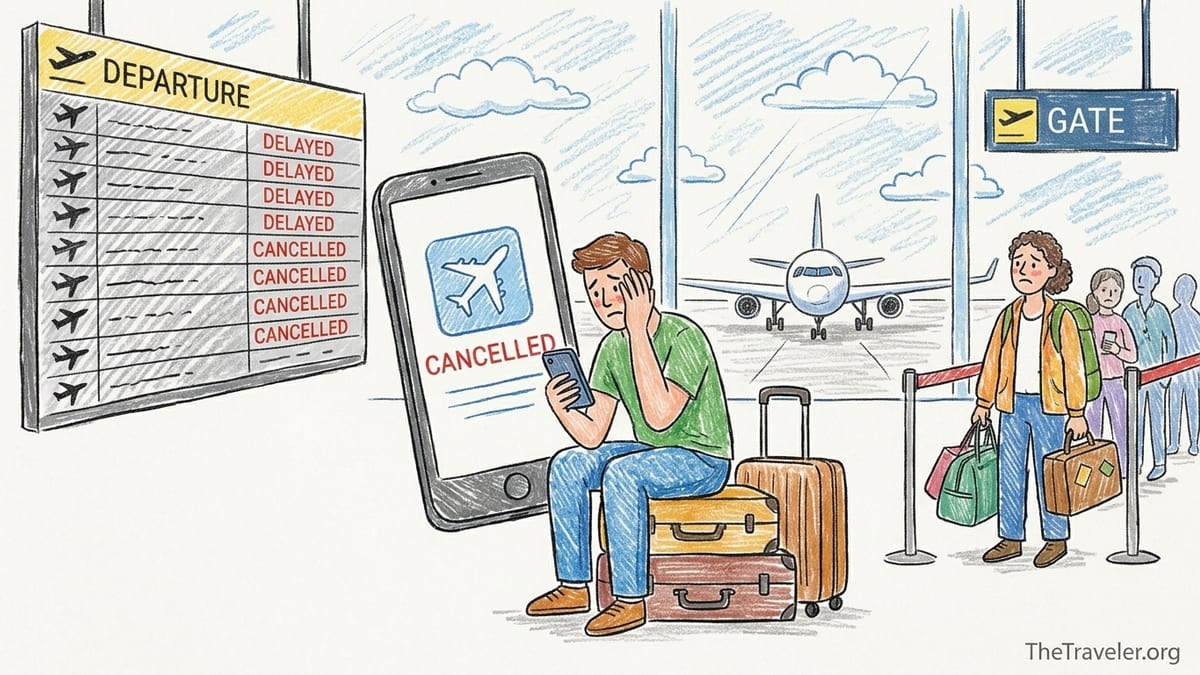
How Travel Insurance Looks at Flight Delays and Cancellations
Travel insurance regulators and major insurers generally break protections into several buckets: trip cancellation, trip interruption, travel delay and missed connection. Trip cancellation and interruption apply when your entire trip is called off or cut short for a covered reason, such as a serious illness, injury or a major storm that makes your destination uninhabitable. Travel delay and missed connection benefits are what usually come into play when you are caught in long airport delays or when a canceled flight forces an unplanned overnight stay.
The National Association of Insurance Commissioners describes travel delay coverage as reimbursement of costs incurred because travel did not occur at the time expected. That can include hotel nights, meals and local transportation during a delay, provided the delay is long enough and caused by a covered event. Trip cancellation coverage, by contrast, usually reimburses nonrefundable, prepaid trip costs if you must cancel before departure for a reason listed in the policy, which can include an airline completely canceling flights due to severe weather or a strike.
Real policies illustrate the differences. A major insurer like Chubb, for example, describes travel delay benefits that reimburse reasonable additional expenses once your trip is delayed at least a set number of consecutive hours by a covered unforeseen event, while separate missed connection benefits can help pay for extra transportation to catch up to a cruise or tour you have missed. Another widely sold plan through online comparison platforms may state that trip cancellation covers prepaid nonrefundable tickets when an airline ceases service due to bad weather, but that mere schedule changes or minor delays do not qualify.
It is crucial to remember that travel insurance does not replace airline obligations or government passenger rights rules. In the United States, there is no federal requirement for cash compensation when flights are delayed or canceled, though many airlines will provide meal vouchers or hotel rooms as a courtesy in some situations. In Europe, strong consumer regulations can require airlines to compensate passengers directly for certain long delays or cancellations. Travel insurance sits on top of those rights; the insurer will often require you to seek help from the airline first and will only reimburse expenses that are not already provided or refunded by the carrier.
What Typically Is Covered When Flights Go Wrong
Most comprehensive travel insurance policies sold to U.S. residents include some level of coverage for flight delays and cancellations, but the coverage only applies when specific triggers are met. A common pattern for travel delay benefits is that the delay must last at least three to twelve consecutive hours, depending on the plan, and it must be caused by a listed reason such as severe weather, a mechanical breakdown, air traffic control delays, a strike or a documented security incident at the airport.
For example, Allianz Global Assistance describes its travel delay benefit as applying when your trip is delayed at least three consecutive hours for a covered reason. In a scenario Allianz uses, a traveler’s flight home is canceled due to a winter storm, forcing an extra night in a hotel. Because the delay is long enough and weather is a covered cause, the policy can reimburse eligible expenses like the hotel bill, dinner and even a modest breakfast. A different insurer selling through a comparison site highlights that travel delay might cover extra meals and local transport up to a daily and total maximum if a storm forces an overnight stay away from home.
Missed connection benefits are another key piece for travelers relying on tight itineraries. AXA’s missed connection language notes that, depending on the plan, coverage may reimburse additional transportation needed to reach your destination if you miss a flight, cruise departure or guided tour because your inbound common carrier was delayed by a covered reason. Travelex Insurance gives a concrete example in its own marketing: an entry-level plan may offer up to around 150 dollars in missed connection coverage, while a premium tier might provide up to about 750 dollars per person to cover extra flights, transfers or unused nonrefundable portions of a cruise.
Trip cancellation and interruption can also help when flights are outright canceled. A Canadian Automobile Association regional insurer, for instance, explains that if your policy includes trip cancellation and interruption and your flight is canceled in a way that significantly impacts your trip, the coverage may reimburse nonrefundable costs and additional transportation if you cannot find a reasonable alternative. In practice, this might apply when a transatlantic flight from Toronto to London is canceled due to a strike, the airline offers a voucher instead of a refund, and you must buy a last-minute replacement ticket to make a prepaid small-group tour departure in the United Kingdom.
Major Policy Exclusions You Need to Watch For
If there is a single reason so many travel insurance claims for delays and cancellations are denied, it is policy exclusions. State consumer guides, such as a travel insurance FAQ from Hawaii regulators, stress that policies generally do not cover cancellations or delays caused by your own change of mind, preexisting medical conditions unless specifically covered, or known events that were public knowledge when you bought the policy. They also typically exclude losses that were within your control, like failing to arrive at the airport on time.
Many policies carve out tight or risky itineraries from coverage. A detailed plan document from Travel Guard, sold through some U.S. airlines, includes a missed connection benefit but notes that it does not apply if your original domestic itinerary allowed less than one hour between connections, or less than two hours for international connections. Similar language appears in sample contracts from international medical and travel insurers that require a minimum connection buffer before they will reimburse missed connection expenses. This means if you intentionally booked a 35 minute layover to save money, your insurance may refuse to pay for a hotel and rebooking costs if the inbound flight arrives late.
Another frequent exclusion involves weather and air traffic disruptions that were reasonably foreseeable. Some policies state that if a storm had already been named, or an airline schedule change was announced before you purchased coverage, you cannot claim benefits related to that event. Others exclude strikes that were announced before you bought the policy. Insurers and comparison sites alike emphasize that you must buy coverage before problems are on the horizon. Buying a policy the day after a major airline publishes a schedule reduction due to staffing shortages may not protect you from the fallout of that specific disruption.
Finally, many plans exclude compensation when alternative arrangements are available but refused. For instance, a policy sold through a comparison marketplace may say that missed connection coverage will not be provided if you could have met your scheduled connection but chose to cancel your trip after a carrier announced potential bad weather. Some trip delay provisions also do not apply if you voluntarily accept an airline’s rebooking that gets you to your destination on the same calendar day, even if it is hours later than originally planned. Understanding these carve outs prevents expensive surprises when delays cascade.
Coverage Limits: Per Day and Per Trip Realities
Even when a delay or cancellation is clearly covered, benefits are capped. Policies set maximum dollar amounts per person, per day and per trip for travel delay and missed connection claims, and those caps vary significantly between entry-level and premium products. Travelers who expect luxury hotel stays and gourmet meals during disruptions often discover too late that their reimbursement limit barely covers a budget motel and simple food.
Allianz’s travel delay descriptions show typical structures: a benefit that might reimburse up to a certain amount per day, such as around 200 dollars, subject to an overall maximum for the trip, for example 600 dollars per person. A comparison site that analyzes travel delay benefits recently calculated that the average comprehensive policy with travel delay coverage costs around 31 dollars per day of trip length and often includes a per-day delay reimbursement cap in the low hundreds of dollars. That means a four-day delay on a standard plan might be capped at under 1,000 dollars total even if your out-of-pocket costs are higher.
Missed connection and trip interruption limits also matter in real life. Travelex’s missed connection benefit tiers, where an essential plan provides up to roughly 150 dollars and an upgraded plan around 750 dollars, show how entry-level coverage might only pay for a modest change fee or a low-cost carrier ticket, while a higher tier could help fund a last-minute one-way flight of several hundred dollars. A separate sample from an online aggregator illustrates a missed connection limit of 750 dollars per person, with language clarifying that it will not pay if you cancel by choice rather than actually missing the connection due to a delay.
Trip cancellation limits are usually tied to your insured trip cost, often capped at a figure such as 10,000 to 100,000 dollars per person depending on the plan. However, benefits for additional expenses after a cancellation, like extra hotel nights or new flights, may have smaller sublimits buried in the policy schedule. A policy document from a large underwriter notes that while cancellation benefits can reimburse up to the full insured trip cost, trip delay may only reimburse additional transportation up to the lesser of an economy-class ticket or a fixed dollar amount shown in the schedule. Travelers booking business-class replacement flights during disruptions may find that their claim is only reimbursed at economy fare levels.
Documentation: What Insurers Expect You to Provide
When it comes to claims for flight delays and cancellations, travel insurers rely heavily on documentation from airlines and service providers. A major auto and home insurer that sells travel coverage through a partner explains in its guidance on delayed and canceled flight claims that you will typically need to submit the original itinerary, proof of payment, documentation of the delay or cancellation from the airline, receipts for any additional expenses, and confirmation of any refunds or vouchers the airline issued.
Airlines themselves acknowledge the role of this paperwork. Southwest Airlines, for example, maintains a page where customers who bought third-party travel insurance can request verification letters confirming delays or cancellations. The airline notes that it is not responsible for the outcome of any insurance claim, but it does provide documentation on request. Other carriers have similar processes, often providing a standardized letter showing the flight number, scheduled and actual times, the cause of the disruption and whether any compensation or hotel vouchers were given.
Real-world experiences shared by travelers underscore how precise documentation can matter. In one case discussed by a traveler who relied on credit card trip delay insurance, the insurer denied a claim because the traveler had been proactively rebooked before actually missing a connection; the insurer interpreted the policy language strictly and said the missed connection benefit did not apply. In other examples involving standalone policies, insurers approved claims after customers submitted boarding passes, receipts, photos of departure boards showing cancellations, and written confirmation from an airline that no hotel vouchers were issued.
The key takeaway is that you should keep every piece of paper or digital record connected to a disruption. Save boarding passes, airline notifications, hotel folios, meal receipts, ride-hailing invoices and credit card statements. If an airline kiosk agent confirms that they cannot offer a hotel, go to a customer service desk and politely ask for written confirmation of the delay and its cause. When you eventually file an online claim, clear and organized uploads can shorten review time and reduce the risk of a denial based on missing proof.
How Claims Play Out in Practice
Understanding how claims unfold in real life can help set expectations. Consider a traveler flying from Chicago to Rome with a connection in New York on a single ticket, who purchased a comprehensive travel insurance plan with trip delay and missed connection benefits. If severe thunderstorms in Chicago delay the first leg by five hours, causing a missed international connection and an overnight stay in New York, the traveler would typically first work with the airline to be rebooked on the next available flight. The airline might rebook them free of charge but decline to provide a hotel. In that case, the traveler could pay out of pocket for a midrange airport hotel, meals and taxis, keep all receipts and then file a travel delay or missed connection claim for reimbursement up to the policy limits.
Another example involves independent or self-connected itineraries. Suppose a traveler from Denver books a low-cost carrier from Denver to London and a separate budget airline from London to Athens, with a five-hour gap between flights, then buys a travel policy that explicitly covers missed connections due to airline delays provided at least three hours were scheduled between flights. If the Denver to London flight is delayed by six hours due to a mechanical issue, causing the traveler to miss the London to Athens flight, the London-Athens airline may treat the ticket as forfeited. With proper documentation of the delay, the traveler could claim the cost of a new London-Athens ticket and potentially a hotel night from their missed connection benefit, subject to the per-person limit stated, such as 750 dollars.
There are also many situations where claims are denied, often for reasons hidden in fine print. A common frustration appears in traveler reports when they discover that a credit card’s trip delay coverage kicks in only if the delay is at least six or twelve hours, not merely a missed connection. For instance, a cardholder rebooked onto a next-day flight after a three-hour delay that caused a missed last connection of the night might find that the credit card insurer refuses reimbursement for a hotel because the total delay at the departure airport was under the required threshold. Standalone policies can have similar time-based triggers you must meet before any benefits are payable.
Processing time is another practical issue. Many insurers explain that claims are typically reviewed within a few weeks once all documents are received, but complex cases involving multiple airlines, partial refunds or overlapping benefits can take longer. Some travelers report having claims for a few hundred dollars approved within days when paperwork was straightforward, while others with multi-thousand-dollar disruption claims have waited months as insurers requested additional documentation. If your delay-related costs are significant, it is worth filing promptly, responding quickly to any information requests and keeping realistic expectations about how long reimbursement might take.
Practical Strategies to Maximize Coverage and Minimize Risk
Because coverage for delays and cancellations is limited and conditional, smart planning can reduce both risk and the chance of denied claims. State insurance departments and consumer advocates consistently urge travelers to read policy summaries and, if possible, the full certificate before purchase. Focus on sections labeled trip cancellation, travel delay, missed connection and exclusions. Note the minimum delay length, covered reasons, dollar limits and any requirements for connection times. If you are booking a complex itinerary with separately ticketed legs or a cruise departure, consider a plan that explicitly includes missed connection benefits rather than relying solely on basic trip cancellation.
Choosing the right product tier also matters. If your trip involves expensive last-minute flights, such as business travel to Asia or a luxury cruise departure from a remote port, an entry-level policy with a 150 dollar missed connection limit and 500 dollars total travel delay coverage is unlikely to make you whole. In that case, paying more for a premium plan with higher per-day and per-trip caps can be sensible. A comparison site’s indication that comprehensive policies with robust travel delay coverage average about 31 dollars per trip day can serve as a rough reference point; travelers with cheaper or short-haul trips may comfortably choose lower limits, while those on long and costly itineraries may justify a higher premium.
Complementary protections are also worth considering. Many premium travel credit cards marketed by major banks include trip delay or cancellation benefits when you pay for your trip with the card. Guides from financial publishers highlight examples where an American Express or Chase card provides up to several hundred dollars per trip for delays beyond six or twelve hours, covering hotels and meals. Pairing such a card with a standalone travel policy can produce overlapping coverage, but keep in mind that you cannot be reimbursed twice for the same expense. Insurers may coordinate benefits, and you will be expected to disclose any assistance already provided by an airline or another insurer.
Finally, your own itinerary choices remain one of the strongest tools for avoiding painful disruptions. Building generous connection times, especially when passing through busy hubs like New York, London or Frankfurt, can keep you safely within both airline and insurance tolerance. Avoid planning critical events, such as a destination wedding or expedition cruise embarkation, on the same day you arrive. If a major storm, strike or operation meltdown appears likely days before departure, contact your airline and insurer early to ask what options are available and what documentation would be required should your trip be affected.
Conclusion: Know Your Policy Before You Need It
Travel insurance can absolutely help cushion the financial blow of flight delays and cancellations, but only when your situation fits the policy’s rules. Coverage is usually limited to delays of a certain length caused by specific events, with strict exclusions for tight connections, foreseeable disruptions and voluntary changes of plan. Benefits themselves are capped per day and per trip, which means they are designed to soften the impact of reasonable hotels and meals, not to underwrite luxury detours.
The travelers who fare best in disruption season are those who buy coverage before trouble is on the horizon, choose policies whose limits match the scale of their trip and keep meticulous documentation when things go wrong. By carefully reading policy sections on trip cancellation, interruption, delay and missed connections, asking questions before purchase and making conservative choices about flight connections, you can set yourself up so that when that dreaded "canceled" notice appears, at least the financial side of the ordeal is manageable.