


Driving to Hamad International Airport in Doha is often the most convenient way to start or end a trip, especially if you are traveling with family or carrying extra luggage. Yet many travelers reach the terminal without a clear plan for where to leave the car, what it will cost, or how long the walk will take. This guide brings together the latest publicly available information and on-the-ground experience to help you choose the right parking option at Doha’s main airport, avoid surprise fees, and arrive at check in calm and on time.
Get the latest updates straight to your inbox!
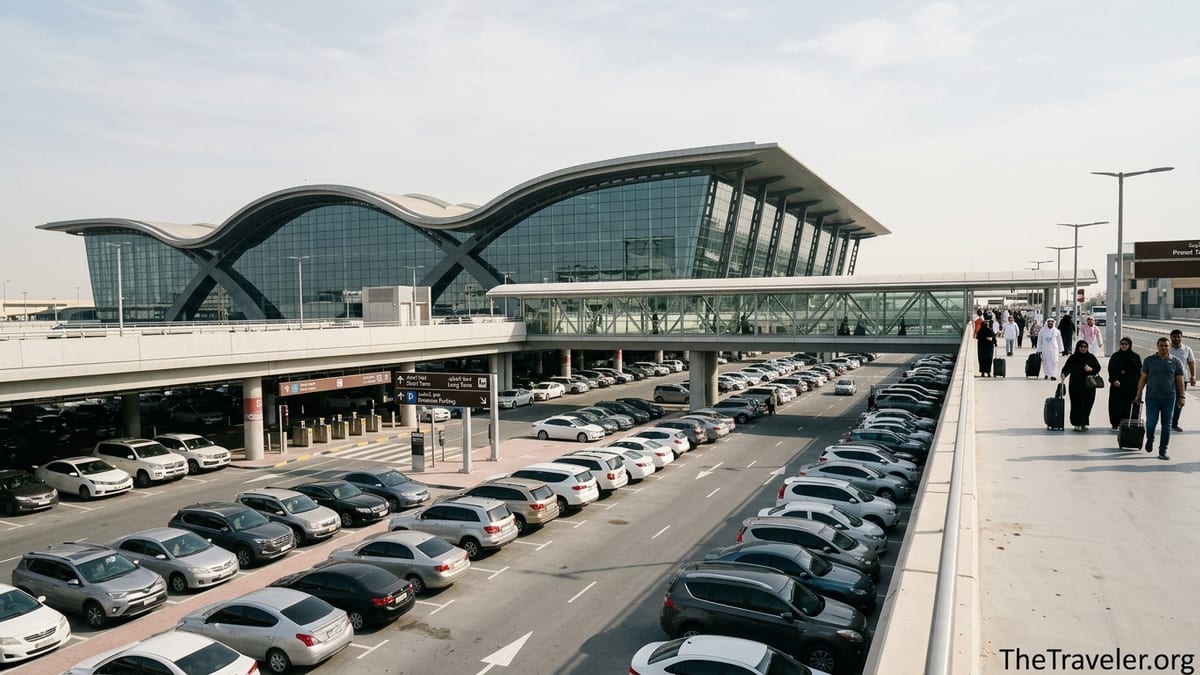
How Airport Parking Works at Hamad International
Hamad International Airport (DOH) is served by a cluster of multi story car parks and surface lots arranged around Terminal 1. For most travelers, the choice comes down to four core options: short term parking close to the terminal, long term parking connected by shuttle, premium parking in the closest zones to Departures, and paid valet service for true drop and go convenience. There are also private monthly and air conditioned arrangements marketed to residents, but these are less common for short trips and holidays.
Signage as you approach the airport clearly separates the main options. Short term and premium parking are signposted directly from the access roads leading to Departures and Arrivals, while long term parking is reached via a spur road that leads to a larger surface area with shuttle stops. Drivers who are unfamiliar with the airport often follow the signs to “Short Term” by default, only to discover later that they have chosen the most expensive solution for a week long trip, so it pays to know your plan in advance.
Importantly, Hamad International is not designed around vast distant economy lots like many large US airports. Even long term parking is relatively close by regional standards, helped by frequent shuttle buses and well organized drop off points. For a Qatari resident leaving a car for ten days, the long term lot is almost always better value, while someone circling the terminal to pick up visiting friends at midnight will find short term or premium parking more practical.
Prices and details can change, particularly around major events or peak holiday seasons, so treat the figures in this guide as indicative and always cross check at the entrance barrier or machine before you confirm your ticket.
Short Term Parking: Best for Pickups and Same Day Trips
Short term parking at Hamad International is located in multi level structures close to the terminal, typically signed as East and West car parks. These decks are designed for fast turnover, with drivers usually staying from 30 minutes to a few hours. The walk from the car to the terminal is through covered walkways and is manageable even with luggage or small children, which makes short term particularly attractive for quick pickups and drop offs when you still want to meet someone inside the terminal.
Recent publicly available guidance suggests that the short term tariff now starts with a free or very low cost grace period for the first half hour, followed by charges that rise in 30 minute blocks and then a higher daily cap once you cross the 24 hour mark. Reports in local media and consumer blogs mention figures around QAR 15 per hour after the initial period, with a full 24 hours costing well into triple digits in Qatari riyals. These examples are intended to illustrate scale rather than exact current pricing, but they show how quickly costs can climb if you leave a car for more than a day.
For a concrete scenario, imagine you are collecting family arriving from London with a scheduled landing at 18:00. If you enter short term parking at 17:30 and leave by 19:30, you are likely to pay only two or three hourly blocks, which is acceptable for the convenience of walking directly into Arrivals. If, however, you park at 10:00 for a 16:00 departure and then your flight is delayed overnight, leaving the car in short term for more than 24 hours could end up costing as much as or more than a budget airline ticket within the region.
The rule of thumb: use short term parking if you are confident you will be back within a few hours, or at most for a same day out and back business trip. For any itinerary that spans a full day or more, check whether long term parking will be significantly cheaper, even when you factor in the shuttle time.
Long Term Parking: Better Value for Multi Day Stays
Long term parking at Hamad International is aimed at travelers who plan to be away for several days or weeks. Instead of charging purely by the hour, long term tariffs are generally structured as bundled blocks that cover several days at a discounted total. Figures shared by insurance and travel providers in late 2025 and 2026 point to packages such as a flat rate for days one to three, a slightly higher flat rate for days four to seven, and then a modest incremental increase for stays of up to two weeks.
To understand how this plays out, consider a Qatari resident driving to the airport for a ten day holiday to Istanbul. Instead of risking short term charges that could accumulate well beyond QAR 100 per day, the driver can leave the car in the long term area on a package rate that may work out closer to QAR 30 to QAR 40 per day on average over the entire period. In practical terms, the difference can easily cover a nice dinner for two in Doha on the way home.
Access to the long term lot is usually by shuttle bus, operating 24 hours and circulating between key stops in the parking area and the main terminal. Travelers describe the ride as taking roughly ten to fifteen minutes, similar to the economy shuttles at many major international airports. Buses are equipped with luggage racks and are used heavily by expatriate families headed on annual leave, who value the predictable total price more than the few extra minutes of transit time.
One common mistake is underestimating how long a trip will actually last. For example, a traveler might plan for a four day business conference but extend their stay to six or seven days once meetings are confirmed. In such cases, leaving the car in long term parking still makes sense, but the total bill on exit will reflect the longer bundled period. When you insert or tap your ticket at the payment machine, you will see the calculated amount before you commit, so take a moment to confirm it matches your expectations.
Premium and Valet Parking: Paying for Maximum Convenience
For passengers who prioritize proximity over price, Hamad International offers premium parking zones. These spaces are located closest to the terminal doors, typically aligned with Qatar Airways check in areas and the main Departures hall. Publicly shared examples suggest that premium pricing starts with a higher first hour charge, followed by slightly lower hourly blocks and then a steep daily cap. The structure is designed to keep turnover high while still allowing travelers to leave a car all day if they are willing to pay for it.
Premium parking is especially attractive for travelers with mobility challenges, parents managing several young children, or business travelers arriving just before boarding when every minute matters. It is not unusual for frequent flyers who value their time to choose premium parking for a one day return trip to the Gulf region, reasoning that the higher fee is justified by the time saved and the shorter walk in Doha’s heat.
Valet service takes convenience one step further. At Hamad International, valet pickup points are typically located at the Departures curb near the main entrance, with staff who will take your keys, issue a ticket, and park the vehicle in a secured area. On your return, you call or confirm your arrival time and the car is brought back to the same curbside location. Examples shared by local users indicate that valet tariffs often include a premium for the first couple of hours and then specialized bundles such as a 24 hour rate or a fixed weekend price, with extras like exterior car washing commonly included.
For instance, a Doha resident heading away on a two day business trip might choose valet for the convenience of driving right up to the terminal, paying a weekend bundle that could be in the mid hundreds of Qatari riyals. Someone dropping off elderly parents for a late night long haul flight may decide that paying for a couple of hours of valet service is worth the smoother experience of handling luggage directly at the terminal doors, especially in high summer temperatures.
Payment, Booking and Practical Logistics
Payment for parking at Hamad International is typically handled by automated machines positioned near pedestrian exits from the car parks and in key areas of the terminal. Drivers take a ticket at the barrier when entering, then insert the ticket at a kiosk before returning to their car. The machine calculates the fee according to the time spent and accepts major payment cards and local digital options. Once paid, the ticket is validated and used to open the exit barrier. Some travelers report that paying at the barrier with a card is also available in certain lanes, but using the machines inside is generally more predictable, especially at peak times.
Pre booking is becoming more common, particularly for long term stays and premium zones. By reserving a space online ahead of time, you may gain access to promotional pricing or bundled discounts that reduce the total cost by a meaningful percentage. For example, travelers leaving for two weeks in Europe have reported offers that effectively knock a day or two off the bill compared with paying drive up rates. Pre booking also helps during busy periods such as Eid holidays or major sporting events, when demand for airport parking in Doha spikes.
When planning, allow extra time for both payment and transfers. If you are using long term parking, add at least 30 minutes to your usual airport arrival buffer to account for parking, waiting for the shuttle, and walking from the drop off point to check in. If you are using short term or premium parking, build in ten to fifteen minutes to find a space, park, and walk through the covered bridges to the terminal. Early morning departures and late night arrivals can be particularly busy in Doha, so err on the side of caution rather than cutting it fine.
Finally, check the conditions printed on your ticket or the signage at the car park entrance. These often cover details such as maximum stay, liability for loss or damage, and whether vehicles can be left for extended periods without prior notice. If you anticipate leaving your car for several weeks or using a high value vehicle, consider taking photos of the car’s condition and mileage before handing it to valet staff or leaving it in any parking structure.
Alternatives to Driving: When Parking Is Not the Best Choice
Although this guide focuses on parking, it is worth considering whether you need to bring a car to Hamad International at all. Doha’s taxi and ride hailing options are extensive, with metered cabs and app based services connecting most neighborhoods to the airport in 20 to 40 minutes depending on traffic. For a solo traveler on a short trip, the combined cost of round trip rides may be similar to or even less than leaving a car in short term parking for several days.
The Doha Metro Red Line includes a dedicated Hamad International Airport station beneath Terminal 1, offering a budget friendly and predictable alternative to driving. Residents living near metro stations often take the train directly to the airport, especially during busy holiday periods when road traffic can be heavy. Using the metro eliminates parking costs entirely and reduces the risk of delays caused by congestion near the terminal access roads.
There are also park and ride style solutions, where travelers use commercial car parks or hotel parking in the city and continue by taxi or metro. For example, an expatriate family living in Al Wakrah might park at a residential building or paid covered garage near a Red Line station, then ride the metro to the airport with their luggage. This approach trades parking fees near the terminal for lower cost city parking, though it introduces more steps and is better suited to confident travelers without mobility restrictions.
Ultimately, the decision to park at Hamad International should weigh convenience, cost, and the nature of your trip. A business traveler returning the same day might value the certainty and comfort of premium parking, while a family on a three week summer holiday could save a meaningful amount by using long term parking, taxis or the metro instead.
Real World Scenarios: Choosing the Right Option
To see how these choices work in practice, consider a few typical itineraries. A resident of The Pearl driving a mid sized SUV to the airport for a weekend in Muscat may leave on Thursday afternoon and return Saturday night. For this two night window, long term parking will almost always cost less than leaving the car in short term, but the difference may only amount to a couple of hundred riyals. If the traveler values a short walk in the heat more than the savings, premium parking could still be a rational choice.
Now imagine an extended family trip for ten days to Southeast Asia. Two adults, three children and multiple suitcases pile into a large family car, departing from a villa in Al Rayyan. In this case, long term parking is the clear winner among on airport options. The shuttle handles the luggage, and the bundled rate avoids eye watering charges on return. Alternatively, if one adult is not flying and is willing to drive back home after drop off, the family could use the free or low cost grace period at the curb or short term parking, unload at Departures, and then send the driver home with the car, eliminating airport parking costs altogether.
A third scenario involves a solo traveler on a tight business schedule. She has a 07:30 flight to Kuwait and will return to Doha the same evening around 19:00. With a laptop bag and no checked luggage, she decides to park in the premium zone closest to the Qatar Airways business class check in. The higher hourly cap is acceptable compared with the value of her time and the early hour, and she is back in her car about twelve hours later without ever waiting for a shuttle bus or walking through multiple levels of parking in the heat.
Finally, consider a long summer absence. A Doha based teacher is leaving for a month long break in Europe. In this case, on airport long term parking may still be more expensive than alternatives such as leaving the car with family, renting a covered space in the city, or using taxis and the metro for airport transfers. Here, the driver might compare the approximate total cost of 30 days of long term parking with the combined cost of four taxi rides plus daily residential parking, then choose whichever aligns best with their budget and risk tolerance.
The Takeaway
Parking at Hamad International Airport is straightforward once you understand the basic structure. Short term parking in the multi story decks is ideal for quick pickups, drop offs and same day trips, but costs escalate quickly beyond a few hours. Long term parking, often reached by shuttle, offers better value for multi day and multi week stays, with bundled rates that smooth out the daily cost. Premium zones and valet service trade higher fees for maximum convenience and minimal walking.
Before you set off for the airport, decide how long your car will stay, how much you are prepared to spend, and how much effort you are willing to invest in transfers. Check the signage at the entrance, keep an eye on your parking ticket, and allow enough time for payment and walking or shuttling to the terminal. By thinking through these details in advance, you can avoid last minute stress at the barriers and start your journey from Doha on a calmer, more predictable note.
FAQ
Q1. Where is the best place to park at Hamad International Airport for a short pickup?
The short term multi story car parks near the terminal are usually best for brief pickups. You park, walk through the covered bridges into Arrivals, meet your passenger, pay at the machine and exit. If you are only stopping for a few minutes and your passenger is ready at the curb, you may also be able to use the arrivals curbside area within the posted time limits.
Q2. How early should I arrive if I plan to use long term parking at Doha airport?
Allow at least 30 extra minutes beyond your normal check in time. You need time to find a space, wait for the shuttle, ride to the terminal and walk to the check in area. During busy travel periods such as Eid holidays or major events, giving yourself 45 extra minutes is more comfortable.
Q3. Is there covered parking at Hamad International Airport?
Yes, the short term and premium car parks are in multi level structures that provide shade and protection from direct sun. Some long term options may be open air surface lots. If covered parking is important to you, follow signs specifically indicating multi story or shaded parking and confirm at entry.
Q4. Can I pre book parking at Hamad International Airport?
Pre booking is increasingly available, particularly for long term and premium zones, and can sometimes offer discounted bundled rates. You typically provide your travel dates and vehicle details in advance and receive a booking reference. On arrival, you follow the instructions on your confirmation to enter the correct car park and link your stay to the reservation.
Q5. Is valet parking at Doha airport worth the extra cost?
Valet parking can be worth it if you value maximum convenience, especially in hot weather or when traveling with elderly relatives or young children. You drive directly to the designated curb, hand over your keys and luggage, and walk straight into the terminal. The cost is higher than self parking, so it makes most sense for short, intense trips or for travelers who prioritize comfort over savings.
Q6. What happens if my return flight is delayed and I overstay my planned parking time?
If you stay longer than expected, the final fee is calculated based on the total time between entry and exit, following the published tariff. For bundled long term packages, the system usually moves you into the next price bracket once you exceed a threshold, such as moving from a one to three day band into a four to seven day band. You will see the total on the payment machine before you confirm payment.
Q7. Are there any completely free parking options at Hamad International Airport?
Free options are very limited and usually tied to very short grace periods at the curbside or in certain parking areas, designed for quick drop offs or pickups. These time limits are strictly enforced, and overstaying can lead to normal parking fees or penalties. For any stay beyond a brief stop, you should plan on using paid parking, public transport, or taxis.
Q8. Is it safe to leave my car in Doha airport parking for several weeks?
Airport parking areas are generally monitored and designed for short and medium term stays, but leaving a vehicle for several weeks is always a personal decision. Many residents do leave their cars in long term parking for extended holidays. If you do so, remove valuables from sight, lock the vehicle, take note of its location and condition, and keep your parking ticket or reservation details secure.
Q9. Can I park overnight at the airport if I am just meeting someone on an early morning flight?
Overnight parking is allowed in both short term and long term areas subject to the standard tariffs. If you are arriving at night and leaving in the morning, compare the likely cost of short term versus long term based on the number of hours involved. For stays approaching or exceeding 24 hours, long term is usually more economical.
Q10. What is the cheapest way to reach Hamad International Airport if I do not want to pay for parking?
The cheapest options are usually the Doha Metro Red Line to the airport station or shared transport such as buses where available. Taxis and ride hailing services cost more than public transport but remove the need to park and can still be cheaper than several days of airport parking. For many solo travelers or couples on shorter trips, combining metro or taxi with no parking at all is the most economical solution.