


More news on this day
The U.S. Department of Transportation has clarified that airlines are not considered at fault for delays or cancellations that occur after a passenger dies on board, placing such disruptions in the same category as uncontrollable events like severe weather and some air traffic control issues.
Get the latest news straight to your inbox!
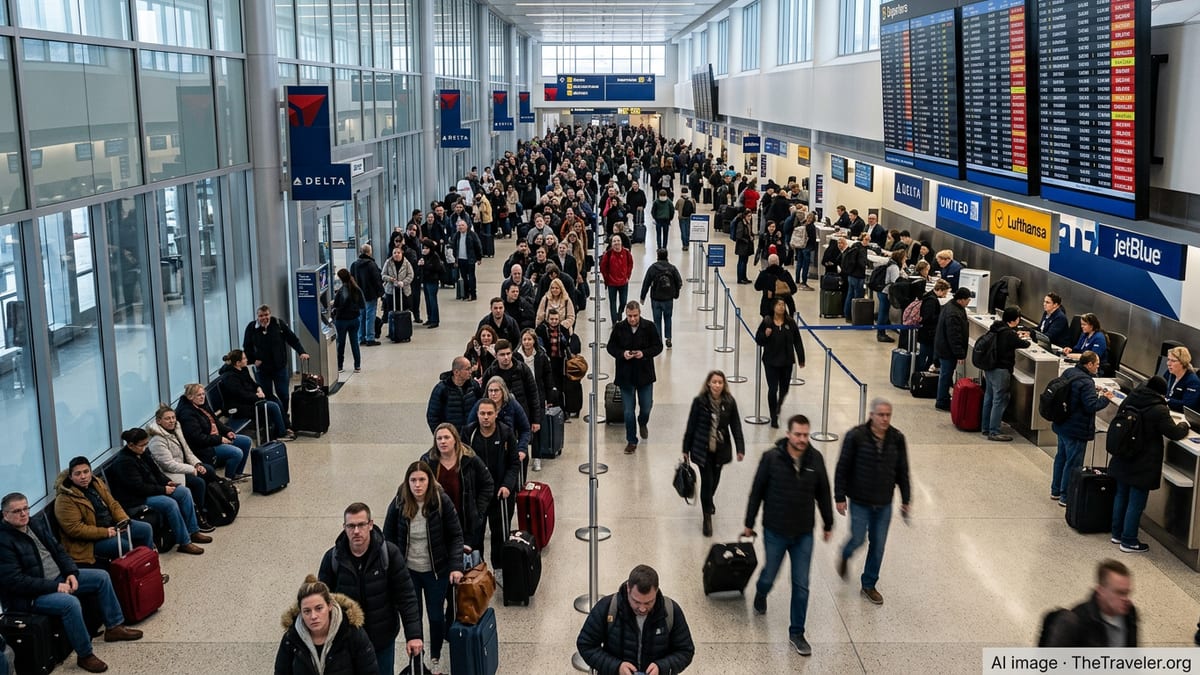
Clarification Targets Confusion Over Post-Incident Delays
The clarification appears in a recent update to the Department’s rules on how carriers must report the causes of delays and cancellations. The rule implements Section 511(b) of the FAA Reauthorization Act of 2024, which directs regulators to refine delay categories and specify events that must be excluded from the “Air Carrier” responsibility code used for federal statistics and public dashboards.
Under the revised framework, certain rare but serious disruptions are explicitly carved out from airline-responsible categories. Publicly available rule text and summaries indicate that events such as in-flight passenger deaths, serious medical emergencies and security actions fall into an “outside carrier control” bucket that is tracked but not treated as an airline-caused delay.
The move responds to ongoing public and political scrutiny of flight disruption data. Earlier federal efforts focused on making it easier for travelers to secure refunds when flights are canceled or significantly changed. The newer clarification focuses more narrowly on how extreme, unpredictable events are coded in government statistics, which in turn inform consumer-facing tools such as delay dashboards.
Passenger advocates have pushed for clear distinctions between carrier-caused disruptions and those rooted in factors outside an airline’s control. The Department’s interpretation attempts to draw that line without expanding airline responsibility to include situations that regulators view as tragic but fundamentally unforeseeable.
How the Change Fits Into DOT’s Broader Passenger Rights Push
The clarification comes alongside a wider expansion of passenger protections in recent years. In April 2024, the Department finalized a major rule on “Refunds and Other Consumer Protections,” establishing nationwide standards for when refunds are owed after cancellations or significant schedule changes. According to federal summaries, the rule requires prompt, automatic cash refunds when a carrier cancels or significantly changes a flight and a traveler chooses not to continue their trip.
That rule, reinforced by follow-on action under the 2024 FAA Act, also codified the definition of a “significantly changed or delayed flight” for domestic and international itineraries. It obliges airlines to return baggage fees if checked bags are significantly delayed and to refund paid ancillary fees when services such as seat selection or onboard Wi-Fi are not provided.
Separately, a final rule on delay and cancellation cause reporting revises how airlines classify disruptions for federal data. Published material shows that ten specific types of events, now including post-incident delays after a passenger death, must be excluded from the main “Air Carrier” code. The goal is to prevent statistics from suggesting a carrier failed to manage its operation in situations where safety or emergency response measures made delay unavoidable.
This combination of rules has created a more detailed map of when airlines must issue refunds or travel credits, and when even serious delays are recorded as beyond the carrier’s control. The new guidance on in-flight deaths is one of the more sensitive edge cases in that framework.
What It Means for Travelers Facing Extreme Disruptions
For passengers, the practical impact centers on expectations around compensation versus refunds. Under existing rules, when a flight is canceled or significantly changed for any reason and a traveler declines the alternative transportation offered, the airline must provide a refund of the unused portion of the ticket. That applies whether the trigger is a mechanical issue, staffing shortage or an emergency such as an onboard medical crisis.
However, the newer clarification indicates that when a flight is delayed due to the handling of a passenger death or similarly grave incident, the disruption is not classified as airline-caused for purposes of data reporting or potential compensation programs tied to “controllable” delays. In other words, travelers may still be entitled to a refund if they choose not to travel after a major schedule change, but they should not expect additional standardized compensation based solely on the fact that the delay followed an onboard fatality.
Consumer-facing tools promoted by the Department, such as flightrights.gov and carrier customer service plans, generally emphasize benefits like hotel rooms, meal vouchers and rebooking when the disruption is within the airline’s control. The new interpretation helps delineate which scenarios fall inside those commitments. In-flight deaths and similar emergencies, while deeply disruptive, are now more clearly placed in a category where humanitarian response and safety take precedence over any expectation of carrier fault.
Travelers confronted with such situations may still seek accommodations directly from airlines, which can choose to provide assistance on a goodwill basis beyond what regulations require. The federal clarification does not prevent carriers from offering more generous treatment; it instead frames what they are obligated to do when reporting causes of delay and honoring legally mandated refunds.
Airlines’ Reporting Obligations and Accountability Metrics
The Department’s updated delay-coding rule is also intended to improve the accuracy of federal performance metrics. Published explanations of the rule highlight concerns that lumping all serious disruptions into an “Air Carrier” category can blur the distinction between operational mismanagement and safety-driven decisions.
By excluding ten specified events, including those tied to passenger deaths and certain security or public health interventions, regulators aim to generate cleaner data on where airlines have direct control. That data is used in consumer information tools and in oversight reports that compare carriers’ records on controllable delays, cancellations and missed connections.
At the same time, other regulatory actions keep pressure on airlines in areas where they do have meaningful control. Recent federal fact sheets emphasize that, after a multi-year push, all major U.S. airlines now guarantee free rebooking and meals, and most guarantee hotel accommodations when a delay or cancellation is caused by an issue within the airline’s control. Those commitments are separate from, but informed by, the way disruptions are categorized in government data.
The clarification around onboard deaths therefore operates as a technical adjustment within a larger accountability framework. It narrows the set of events counted against an airline while leaving intact the strengthened refund rights and disclosure obligations that apply whenever operations fall short for reasons a carrier can reasonably manage.
Why the Distinction Matters for Future Policy Debates
Analysts of aviation policy note that the handling of rare but emotionally charged events, such as passenger deaths in flight, often shapes public perceptions of airline responsibility. Without a clear regulatory line, travelers may assume that any severe disruption should prompt automatic compensation, while airlines and regulators focus on whether an event was avoidable or managed consistent with safety protocols.
By codifying that post-incident delays after a passenger death do not count as airline-caused, the Department has signaled that future policy debates over compensation are likely to concentrate on more routine operational failures. Ongoing rulemaking efforts continue to explore whether carriers should be required to provide standardized payments or services for controllable delays, but those discussions now rest on a more precise definition of what “controllable” means.
For travelers, the message is that stronger refund protections and clearer fee disclosures are now in place, yet they do not extend into every extreme circumstance. Understanding where the line is drawn can help set realistic expectations when disruptions occur, especially in situations where crew and airport staff are responding to a medical emergency or fatality rather than a maintenance or scheduling lapse.
As new customer-service rules take effect and reporting categories evolve, consumer groups and airlines are expected to monitor how often these exceptional codes are used. The treatment of in-flight deaths in delay statistics represents one of several nuanced decisions that will shape how airline reliability is measured and presented to the traveling public.