


More news on this day
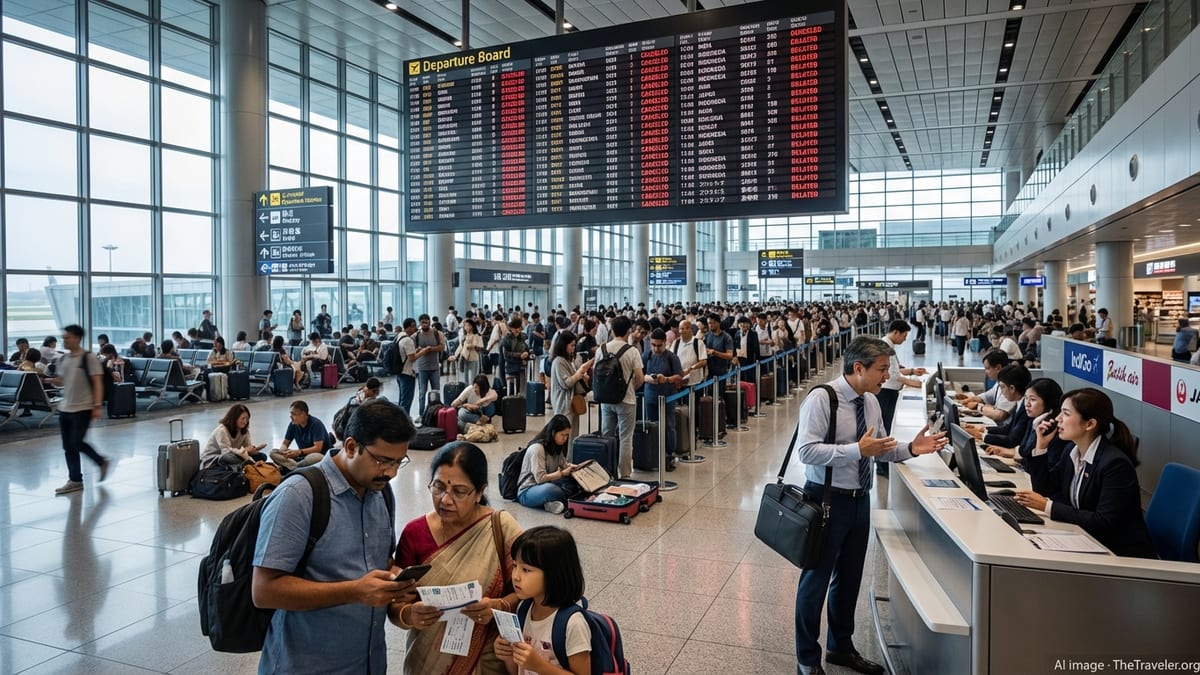
Air travel across Asia is facing another bout of disruption as fresh aviation data points to 106 flight cancellations and at least 1,578 delays in a single operational window across 22 major airports, with Singapore Changi and Delhi’s Indira Gandhi International among the hardest hit hubs.
Get the latest news straight to your inbox!
Fresh Numbers Underscore Scale of Disruption
Aggregated statistics drawn from flight tracking dashboards and industry monitoring sites for 11 and 12 September 2026 indicate that the latest wave of disruption has concentrated on a core group of 22 Asian airports. Within that group, publicly available records show a combined tally of 106 cancellations and 1,578 delayed departures and arrivals, underscoring how quickly operational pressure can build during peak travel periods.
These figures fit into a broader pattern of strain across the region. Recent coverage compiling FlightAware and similar data reported 4,804 delays and 206 cancellations across major Asian hubs over the same two day window, placing Asia at the center of worldwide schedule volatility. According to published coverage, disruption indices at several airports moved into ranges typically associated with sustained, moderate operational problems rather than isolated weather events.
While the headline numbers remain below the worst days seen earlier in the month, when more than 2,900 delays and nearly 600 cancellations were logged in association with volcanic ash episodes, the concentration of issues at key connecting hubs this week is having an outsized impact on passengers with multi‑segment itineraries.
Singapore and Delhi Emerge as Key Pressure Points
Within the current disruption snapshot, Singapore Changi and Delhi’s Indira Gandhi International Airport stand out as significant contributors to the region’s delay totals. Travel‑industry reporting based on real‑time telemetry has repeatedly highlighted Delhi as one of Asia’s most delay‑prone hubs in recent weeks, with earlier datasets showing it recording the single highest volume of delayed flights in the region on certain days.
Singapore has generally retained a reputation for resilience, with Cirium’s July 2026 on‑time performance report placing Singapore Airlines at the top of Southeast Asia’s punctuality rankings. Even so, the latest data suggests that Changi is not immune to broader network stresses, with a rising number of delayed departures as aircraft and crews arrive late from other congested airports or rerouted flight paths.
According to published disruption profiles, the two hubs have been sharing many of the same risk factors: convective storms, knock‑on effects from airspace restrictions further west, and a tight operating schedule that leaves little slack when one bank of flights falls behind. As a result, delays in Delhi can quickly propagate onto Singapore‑bound rotations, and vice versa, magnifying the impact for travelers transiting between South and Southeast Asia or continuing onward to Europe and Australia.
Volcanic Ash, Weather and Airspace Constraints Still Ripple Through Schedules
The latest figures arrive only days after a significant bout of disruption linked to volcanic activity in Indonesia. National and regional outlets reported that ash from Mount Anak Krakatau led to extensive ground restrictions, with Indonesia’s main gateway at Soekarno‑Hatta temporarily closed and hundreds of flights delayed or canceled. Air navigation notices extended those limitations into the night on 8 September, as operators assessed ash movement and aircraft safety.
Parallel tallies compiled by travel‑focused sites indicated that more than 2,900 delays and over 580 cancellations were recorded across Asia on 7 and 8 September, with many of the worst‑affected airports located in Indonesia, Japan and India. Tokyo Haneda, for example, was cited in one recent analysis as the single most delayed airport in a large tracking dataset, while Indian and Chinese hubs also reported dense backlogs of late departures.
Although Indonesia’s airports have since reopened and the immediate ash hazard has diminished, the resulting aircraft mis‑positioning, crew duty‑time limitations and rolling maintenance adjustments continue to influence operations this week. Industry commentary suggests that these earlier disruptions have left some carriers with limited flexibility, so even relatively modest bouts of weather or congestion can now trigger wider waves of delays across the regional network.
Network Knock‑On Effects Extend Beyond Immediately Affected Airports
Analysts who track operational performance note that Asia’s current challenges are not confined to airports directly hit by adverse weather or local closures. The Traveler’s own previous review of disruption days this month found that problems in one sub‑region often cascaded into others, as late‑running aircraft arrived into already congested hubs such as New Delhi, Jakarta, Shanghai and key Japanese gateways.
Earlier compiled statistics covering late August and early September showed that, on some days, nearly 4,000 flights were either delayed or canceled across a set of 39 Asian airports in a single 24‑hour period. Those reports emphasized that capacity growth at some hubs has outpaced expansions in runways, taxiways, stands and air traffic control staffing, creating conditions in which a single severe weather episode or short‑notice airspace restriction can tip airports into sustained delay territory.
Against that backdrop, the latest 106 cancellations and 1,578 delays across 22 airports can be seen as part of an extended sequence rather than a one‑off event. Publicly available aviation outlooks for 2026 have also drawn attention to the effects of airspace closures linked to geopolitical tensions further west, which have forced some long‑haul flights between Europe and Asia to take longer, more circuitous routes, utilizing additional fuel and narrowing turnaround windows at Asian destinations.
What Travelers Can Expect in the Coming Days
With the disruption data pointing to elevated delay levels rather than a brief, isolated spike, travelers with itineraries through Singapore, Delhi or other Asian hubs over the next several days are likely to encounter continued schedule volatility. Monitoring tools and industry commentary suggest that airlines are attempting to stabilize operations through selective cancellations, minor retiming of flights and the use of larger aircraft on high‑demand routes where possible.
Travel‑advice sections in recent disruption coverage consistently encourage passengers to check flight status repeatedly in the 24 hours before departure, enable notifications within airline mobile applications, and allow extra time for connections at known congestion points. Even when a specific flight is not listed among the 106 cancellations or the more than 1,500 delays identified in the latest dataset, late‑running inbound aircraft and crew rotations can still alter departure and arrival times at short notice.
For now, aviation data from the first half of September suggests that Asia remains one of the most disruption‑prone regions globally, even as carriers work to restore reliability. The combination of lingering operational hangovers from volcanic ash, seasonal storms, structural capacity constraints and rerouted long‑haul traffic continues to challenge both airlines and airports, leaving passengers to navigate a travel environment where flexibility has become almost as important as a confirmed ticket.
NomadLawyer: Asia Flight Disruptions, 4,804 Delays and 206 Cancellations
NomadLawyer: 2,927 Delays and 584 Cancellations Across Asia
ANTARA News: Mount Anak Krakatau Ash Disrupts Indonesian Flights