


More news on this day
Uzbekistan has launched the first block freight train from China to Iran in transit through its territory, a milestone that positions the country at the heart of a new Eurasian rail corridor and signals far-reaching implications for trade, logistics, and future travel across Central Asia and the Middle East.
Get the latest news straight to your inbox!
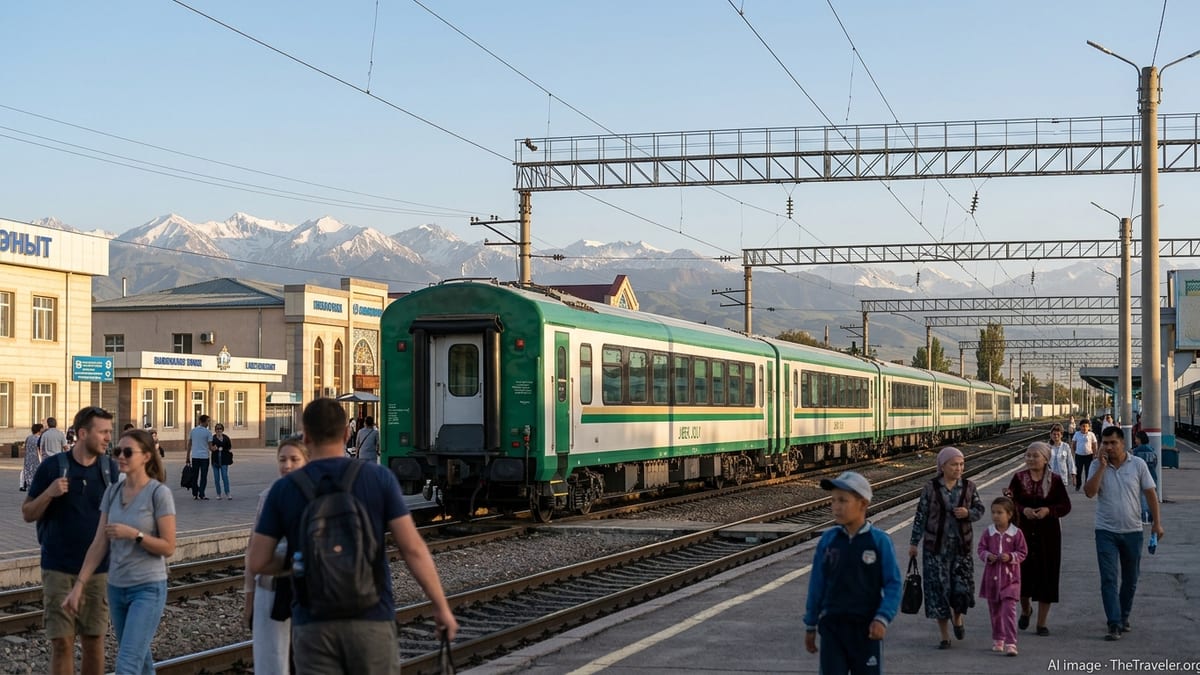
First China–Iran Block Train Rolls Through Uzbekistan
According to recent coverage from regional news agencies, rail operator UzTemirYulKonteyner has dispatched the first dedicated block train carrying freight from China to Iran via Uzbekistan. The inaugural service is described as part of the China–Central Asia–Iran transport corridor, using existing rail links to move containers across Central Asia and into the Iranian network.
Reports indicate that the train’s route connects inland hubs in China with Central Asian railheads before crossing Uzbek territory and continuing southward toward Iran. While detailed schedules and intermediate stops have not been fully published, publicly available information describes the service as a block train, meaning the entire consist moves from origin to destination as a single unit without being split or re-marshaled en route.
Regional logistics sources frame this movement as a proof-of-concept that demonstrates operational readiness along the corridor. It follows earlier China–Iran rail connections that primarily used northern routes through Kazakhstan and Turkmenistan, as well as multimodal services via Iranian ports on the Persian Gulf. The new train through Uzbekistan is being highlighted as a direct test of an emerging, more central land bridge between East Asia and Iran.
Trade observers note that the launch comes at a time of heightened interest in diversifying Asia–Europe and Asia–Middle East freight routes, particularly overland options that offer an alternative to maritime passages and corridors affected by geopolitical disruptions. The Uzbek transit variant adds another pathway to an increasingly dense map of rail and multimodal services crisscrossing Eurasia.
Uzbekistan’s Ambition to Become a Central Eurasian Hub
Publicly available government and rail-sector documents show that Uzbekistan has been steadily positioning itself as a pivotal transit state between China, the Caucasus, the Middle East, and Europe. The country already sits on key segments of the Eurasian Land Bridge and is connected by rail to Kazakhstan, Turkmenistan, Tajikistan, and Kyrgyzstan, as well as to Iran via Turkmen territory.
In recent years, Uzbek rail operators have supported container flows linking Chinese ports such as Xiamen with inland terminals near Tashkent, using a mix of sea legs to Iran’s Bandar Abbas and overland sections onward into Central Asia. Reports from 2023 describe containerized household appliances traveling from China to Iran by sea, then entering Uzbekistan as rail cargo via Turkmenistan. The new block train transiting Uzbek territory toward Iran builds on that experience while shifting greater attention to a through land route.
Policy speeches and strategy documents released in 2024 emphasize that Tashkent sees transit diversification as essential for economic growth. By capturing more east–west and north–south cargo, Uzbekistan aims to generate new revenue from rail tariffs, logistics services, and industrial zones clustered around key junctions. The rollout of a China–Iran block train via Uzbek territory aligns with these ambitions, reinforcing narratives of the country as a connector between major markets.
Analysts point out that Uzbekistan’s transit role is not limited to east–west trade. The country also connects routes that extend toward the Persian Gulf and the Black Sea via Turkmenistan and the South Caucasus, making it a natural node where shippers can shift between corridors heading to Europe, the Middle East, and South Asia.
Linking to the Future China–Kyrgyzstan–Uzbekistan Railway
The launch of the China–Iran block train coincides with accelerated planning for the China–Kyrgyzstan–Uzbekistan (CKU) railway, a long-discussed project that received renewed political backing in 2024. According to official summaries of the trilateral agreement and subsequent statements from participating governments, CKU is intended to run from Kashgar in China’s Xinjiang region through Kyrgyz territory to Uzbekistan’s Andijan, where it will connect with the existing Uzbek network.
Published feasibility studies and regional infrastructure reports describe CKU as a relatively short but strategically important link, estimated at just over 300 kilometers in its cross-border segment. Once complete, the line is expected to trim several days off freight journeys between China and markets in the Middle East and Europe by creating a more direct route that bypasses longer detours through northern Central Asia.
Current services between China and Uzbekistan often rely on a combination of rail and road legs across Kyrgyzstan or alternative routings through Kazakhstan. The new China–Iran block train transiting Uzbekistan demonstrates that substantial China-linked cargo volumes can already be consolidated on Uzbek rails even before CKU opens. When the dedicated CKU line comes online, it is expected to feed more predictable, higher-capacity flows into corridors from Uzbekistan toward Iran, Turkey, the South Caucasus, and Europe.
Regional transport analyses from international organizations underline that CKU is designed to complement, rather than replace, existing corridors such as the routes through Kazakhstan and Turkmenistan. The emergence of a China–Iran train via Uzbekistan therefore fits into a broader pattern in which multiple overland lines operate in parallel, creating redundancy and giving shippers more route choice.
Travel, Tourism, and the Long-Term Outlook for Passengers
While the newly launched China–Iran service through Uzbekistan is a freight-only block train, its operation has significance for future passenger travel. Historically, cargo corridors across Eurasia have often preceded the development of international passenger trains, and travel industry analysts are already watching Central Asia’s rail build-out for signs of a longer-term shift toward overland tourism.
Uzbekistan itself has positioned tourism as a priority sector, promoting its Silk Road cities such as Samarkand, Bukhara, and Khiva. Stronger freight connectivity with China and Iran may indirectly support travel by prompting upgrades to rail infrastructure, signaling systems, and border facilities that can later accommodate passenger services. In other parts of Eurasia, investments driven by freight have eventually enabled new night trains, regional cross-border services, and charter specials targeting tourists.
For now, most China–Iran rail connections remain focused on containerized and bulk goods, with limited or no regular passenger offerings on the full through route. Overland travelers typically stitch together segments using domestic trains and buses, or book air links between major cities. However, as Central Asian states pursue high-profile projects like CKU and upgrade their existing mainlines, the idea of rail-based backpacking or organized tours across the heart of Eurasia may become more realistic in the coming decade.
Travel planners observing the region suggest that growing frequency and reliability of freight trains often act as early indicators of corridors that could support scheduled passenger services later on. The fact that Uzbekistan is now hosting a dedicated China–Iran block train is therefore more than a logistics milestone; it is a signal that the physical backbone for future trans-Eurasian rail journeys is gradually taking shape.
A New Piece in Eurasia’s Shifting Transport Map
The inauguration of the China–Iran block train through Uzbekistan adds another layer to an already complex Eurasian transport map. Since the mid-2010s, a series of new rail and multimodal links have emerged, connecting China with Iran via Kazakhstan and Turkmenistan, as well as testing land-sea combinations that use the Caspian Sea and ports such as Bandar Abbas and Aktau.
Infrastructure reviews from organizations focusing on Asia and Europe describe these developments as part of a wider effort to strengthen the “Eurasian Land Bridge,” a collection of corridors that channel cargo between East Asia, the Middle East, and Europe. In this context, Uzbekistan’s corridor with Iran is seen as one of several south-of-Russia options that offer shippers alternatives when northern routes face congestion or geopolitical constraints.
For Iran, additional rail access points through Central Asia complement existing lines that connect to Turkmenistan, Turkey, and the Caucasus. For China, the gradual thickening of rail links to Iran aligns with efforts associated with the Belt and Road Initiative to create multiple overland pathways toward energy suppliers and consumer markets west of its borders.
Observers note that continued success of the new block train service will depend on pricing, reliability, and coordination among rail operators across several countries. However, its early operation already illustrates how a landlocked state like Uzbekistan can leverage geography and infrastructure investment to become a key junction in the evolving web of Eurasian trade and, potentially, future long-distance rail travel.
Interfax: First block train launches from China to Iran in transit through Uzbekistan
Wuxi Government: China–Kyrgyzstan–Uzbekistan freight and future rail plans
President of Uzbekistan: Address on China–Kyrgyzstan–Uzbekistan railway agreement
Eurasian Development Bank: Infrastructure trends and CKU corridor analysis