


More news on this day
Violent Typhoon Champi is churning across the Philippine Sea toward Japan’s southwestern islands, prompting updated advisories and raising urgent questions for Canadian travellers with plans in the region.
Get the latest news straight to your inbox!
Where Typhoon Champi Is Tracking Now
Recent tracking data shows Typhoon Champi, designated Typhoon 30 by the Japan Meteorological Agency (JMA), over the Philippine Sea with maximum sustained winds above 200 kilometres per hour and a central pressure near 900 hectopascals. Forecast discussions describe it as a large and violent system, with a broad wind field extending well beyond the eye and capable of producing destructive gusts and intense rainfall.
Specialist weather services that synthesize JMA forecasts indicate that Champi is moving west-northwest toward waters east of Taiwan and the Sakishima and Miyako islands in Japan’s far southwest. Projections for the coming days suggest it will remain a powerful typhoon through at least October 22, with gradual weakening expected only as it begins to curve northeast toward the open waters south of Kyushu and the rest of Japan.
Event-response analysis used by the insurance and risk sector currently anticipates that Champi may approach Taiwan late this week before turning toward southern Japan, weakening to a severe tropical storm or transitioning to an extratropical low as it nears Kyushu and possibly South Korea early next week. These outlooks are inherently uncertain several days out, but they underline that conditions in the Ryukyu Islands, including Okinawa Prefecture, are expected to deteriorate first and most severely.
While mainland hubs such as Tokyo and Osaka are not in the direct path at this stage, past storms have shown that even a glancing blow or offshore track can bring disruptive winds, heavy rain and localized flooding over a wide area. Travellers connecting through Japan or flying onward to other parts of Asia should plan for knock-on effects even if their final destination is outside the core impact zone.
Government of Canada Advisory and What It Means
The Government of Canada updated its travel advice for Japan on October 20, 2026, maintaining the overall recommendation to exercise normal security precautions but adding a regional warning related specifically to Typhoon Champi. The advisory now urges travellers to avoid non-essential travel to the Ryukyu Islands, including Okinawa Prefecture, because of the storm’s projected impacts.
That regional advisory reflects concerns about powerful winds, storm surge, intense rainfall and possible infrastructure damage in island communities where evacuation options can be limited once conditions deteriorate. For Canadian travellers, “avoid non-essential travel” signals that tourism, discretionary business trips and other optional journeys to the affected islands should be postponed until Champi has passed and local services have safely resumed.
Outside the Ryukyu chain, Canadian officials continue to classify most of Japan as a destination where routine caution is appropriate, while noting that natural disasters such as typhoons can cause sudden disruptions. Travellers are encouraged to monitor the Japan page on the Government of Canada’s travel site, review the dedicated guidance on severe storms abroad and check for any further regional updates as Champi’s track evolves.
Canadians already in Japan who are registered with the Registration of Canadians Abroad service can use it to receive direct updates. Those who are not registered can still consult Canadian government travel pages and local Japanese information sources to understand any new restrictions, evacuation notices or transport suspensions that may arise if the forecast changes.
Flight, Rail and Ferry Disruptions Around Champi
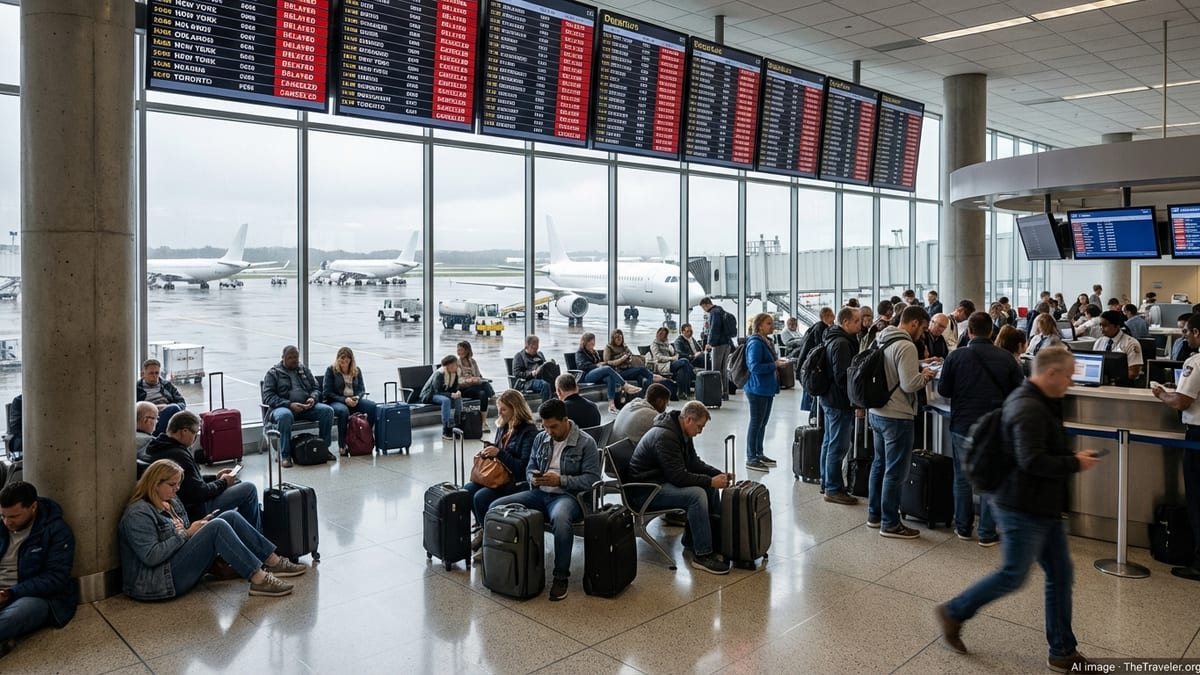
Typhoons of Champi’s strength routinely trigger wide-scale transport disruptions in Japan, particularly in the southwest. Recent travel alerts from low-cost and full-service carriers operating domestic routes have started referencing Typhoon Champi by number, noting that flights to and from Okinawa, Miyako and other southern islands may be delayed, rerouted or cancelled at short notice as the storm draws closer.
Past events provide a useful benchmark for what travellers could see over the coming days. During earlier powerful typhoons in 2026, domestic airlines in Japan cancelled hundreds of flights in a single day, especially on routes linking Haneda and Kansai airports with Okinawa and Kyushu. Similar patterns are likely if Champi’s track brings typhoon-force winds near major airports or across busy air corridors serving the southwest.
On the ground, Japanese railway companies have increasingly adopted planned suspensions in advance of severe weather to reduce the risk of stranded passengers. Government disaster documentation notes that after experiences with Typhoon Faxai and Typhoon Hagibis, rail operators began halting some services before peak winds arrived, particularly high-speed Shinkansen and coastal or mountain lines vulnerable to landslides and flooding. These practices may come into play again if Champi threatens Kyushu or western Honshu later in its life cycle.
Ferry crossings linking Okinawa and other islands, as well as coastal services elsewhere in Japan, are also sensitive to typhoon conditions and can be cancelled well ahead of landfall. Canadian travellers with domestic connections should treat any schedules over the coming week as provisional, maintain flexibility and ensure that airline or rail bookings are easily changeable where possible.
Practical Guidance for Canadians Planning or Already on Trip
For Canadians with imminent travel plans to Okinawa or other parts of the Ryukyu Islands, the combination of a regional advisory from Ottawa and high-impact forecasts from JMA-backed services points toward postponement where travel is not essential. Those who nonetheless need to travel for critical reasons should closely track both the Canadian advisory and JMA’s typhoon updates and build in generous buffers for transport changes.
Travellers already in the affected islands are advised by Canadian severe-storm guidance to follow local disaster-preparedness information, identify evacuation shelters in advance and keep enough food, water and medication on hand to cope with potential power outages and supply disruptions. Storm-specific resources from Japanese municipal governments, local broadcasters and hotel operators often outline where to shelter, how to interpret JMA warnings and when it may be necessary to move away from coastal or low-lying areas.
Elsewhere in Japan, including popular destinations such as Tokyo, Kyoto and Osaka, travellers should still plan for indirect effects if Champi’s outer bands or remnants pass nearby. This may include heavy rain leading to localized flooding, river level rises and short-notice rail suspensions on vulnerable lines. Checking real-time train and flight information before heading to stations or airports can help avoid long waits in crowded terminals.
Canadians should also review the terms of their travel insurance in light of Champi. Many policies treat named storms as known events once they are publicly identified, which can affect coverage for new bookings but may still provide benefits for travellers who purchased insurance before Champi developed. Given the fast-changing forecast, those with questions about coverage for cancellations, delays or emergency medical needs are generally advised to seek clarification directly from their insurers.
Staying Informed as the Forecast Evolves
Because Champi is still several days away from its closest approach to southern Japan, forecast tracks and intensity projections remain subject to change. Meteorological analysis highlights that interactions with subtropical high-pressure systems and landmasses such as Taiwan can alter both the storm’s path and its strength, which in turn can shift which regions face the greatest impacts.
Canadian travellers are encouraged to monitor a combination of official and widely used public information sources. The Japan Meteorological Agency offers typhoon track maps, forecast cones and warning levels for specific prefectures, while digital platforms that aggregate JMA and allied forecasts provide user-friendly maps and visualizations. Canada’s travel-advice site, for its part, is updating its Japan page with references to Typhoon Champi and any changes to the risk level for affected regions.
Social media, travel forums and live-translation tools can help visitors understand local announcements from railway operators, airports and municipal governments. However, travellers should treat user-generated commentary as secondary to official weather and safety alerts when making decisions about moving around during the storm.
As Champi progresses, the most important steps for Canadians are to verify information before acting, avoid non-essential trips into the islands under advisory, maintain flexibility in itineraries across Japan and be prepared to adjust plans rapidly if forecasts intensify or the storm’s track shifts closer to major population centres.