


More news on this day
Fresh tensions between the United States and Iran, including new Iranian strikes on sites in Bahrain, Jordan and Kuwait, are reverberating across Gulf aviation, reviving disruption for flights to and through Dubai and raising anxiety among travelers already unsettled by months of regional instability.
Get the latest news straight to your inbox!
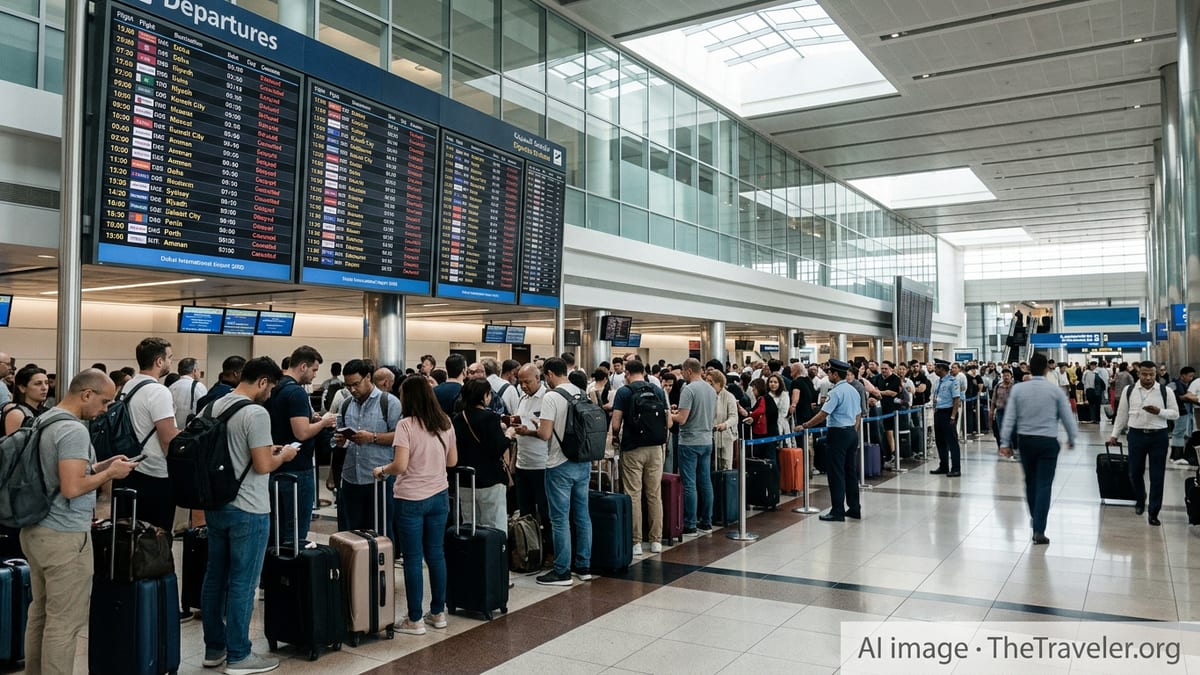
Regional attacks rattle Gulf airspace again
Publicly available reports from regional and international media on June 10 indicate that Iran’s Revolutionary Guard has launched new drone and missile attacks against locations in Bahrain, Kuwait and Jordan, described as targeting United States military assets. Air raid sirens reportedly sounded in several cities, and local air defenses engaged incoming projectiles amid heightened tensions following recent American strikes on Iranian territory.
Coverage from news outlets based in the Gulf and beyond describes missiles and drones aimed at facilities including the US Fifth Fleet’s base in Bahrain, the Ali Al Salem base in Kuwait and an air base near Azraq in Jordan. While damage assessments remain fluid and in some cases unconfirmed, the renewed exchanges underline how quickly the security picture in the northern Gulf and Levant can shift, even after periods of relative calm.
These latest incidents follow earlier strikes in late May and early June that already tested a fragile ceasefire. Prior attacks saw drones hit infrastructure at Kuwait International Airport and prompted temporary airspace closures in parts of the region, as aviation authorities moved to shield civilian traffic from potential spillover.
For airlines and passengers, the core concern is not only the direct risk to airports and flight paths, but also the possibility of sudden regulatory decisions that close or restrict key flight information regions, forcing widespread diversions and cancellations at short notice.
Dubai operations wobble as airlines adjust schedules
Dubai International Airport, one of the world’s busiest long haul hubs, remains technically open and handling traffic, but operations have been volatile. Recent industry and media updates describe a pattern of rolling delays, cancellations and diversions as carriers react to shifting risk assessments and airspace advisories across the wider Middle East.
Travel industry briefings indicate that some Gulf carriers temporarily halted or limited services at various points in recent days, particularly on routes over or into higher risk areas such as Bahrain, Kuwait, Jordan and parts of Iraq and Iran. In at least one instance, a major Dubai based airline briefly paused departures before resuming limited operations after reassessing the threat level and coordinating with aviation regulators.
At the same time, specialist travel-security firms report that as of early this week, most Gulf airspace, including over the United Arab Emirates, Jordan, Saudi Arabia, Kuwait, Bahrain, Qatar and Oman, has been formally open. However, they also note that airspace status has changed more than once since the Iran conflict began in late February, and that any renewed wave of ballistic or drone strikes could trigger rapid, temporary closures.
For passengers, the immediate impact is visible in longer flight times, last minute gate changes and, in some cases, unexpected layovers as aircraft reroute around sensitive corridors or wait for clearance to depart. Even travelers whose journeys do not touch the Gulf directly may feel knock-on effects as aircraft and crew rotations are disrupted at Dubai and other major hubs.
Impact on routes to Bahrain, Jordan and Kuwait
Flights directly serving Bahrain, Jordan and Kuwait are among the most exposed to the current escalation. Published schedules and airline notices over recent weeks show recurring suspensions or sharp reductions on services to Manama, Amman and Kuwait City, particularly by European and Asian carriers that have adopted more conservative risk thresholds for overflying conflict zones.
Some long haul airlines that previously operated non stop services to these cities have extended earlier suspensions into the summer season, citing the broader Iran conflict and security concerns around US and allied facilities in those countries. Regional carriers have in many cases maintained limited connectivity but with flexibility built into timetables, allowing them to push departures back, consolidate flights or reroute via alternative air corridors when tensions spike.
Earlier Iranian attacks on Kuwait International Airport, including damage to a passenger terminal and airport fuel infrastructure reported at the start of June, already forced a temporary halt to flights and raised insurance and operational costs for airlines serving the country. Bahrain, which hosts significant US naval assets, has similarly experienced intermittent disruption as air defenses respond to missile and drone launches and authorities balance security measures with efforts to keep Bahrain International Airport functioning.
Jordan’s position as a longstanding logistical hub for US and coalition forces means that reported missile activity near its air bases has immediate implications for civilian aviation planners, who must factor in both direct safety risks and the possibility of preemptive restrictions on nearby airspace, particularly for night operations.
Knock on effects for global travelers and aviation networks
The renewed flare up comes on top of months of war related disruption that has reshaped flight patterns across the Middle East. Since the United States and Israel first began large scale strikes on Iran in late February, published data from aviation tracking services and industry bodies has pointed to thousands of cancellations and diversions across the region, affecting not only Gulf carriers but also European, Asian and African airlines that traditionally rely on the area’s hub airports.
Earlier in the conflict, multiple states including Iran, Iraq, Israel, Jordan, Kuwait, Qatar, Bahrain and the United Arab Emirates either fully or partially closed their airspace for periods, forcing airlines to route around large sections of the Gulf and Levant. That initial wave of disruption stranded large numbers of travelers in hubs such as Dubai, Abu Dhabi and Doha and pushed up flight times and fuel costs on popular Europe Asia and Africa Asia corridors.
Although many of those airspace closures have since been lifted, the current round of strikes against Bahrain, Jordan and Kuwait reinforces a pattern in which access can be curtailed abruptly and then reopened with limited notice. For network planners, the result is an operating environment that demands daily, sometimes hourly, adjustments to routings, crew schedules and fleet deployment.
Travel risk analysts note that while Dubai and most other Gulf airports are currently functioning, the wider system remains fragile. Even a short term closure of a single national airspace or a temporary suspension by a major regional carrier can create ripple effects across global timetables for days, particularly during the busy northern summer travel period.
What travelers should expect in the coming days
Available guidance from airlines, airports and travel security providers as of June 10 stresses that travelers should be prepared for short notice operational changes as the security situation develops. Carriers are advising passengers to monitor their booking details closely, ensure contact information is up to date and arrive at airports with additional time in case of enhanced security checks or schedule adjustments.
Industry commentary suggests that further temporary suspensions on certain routes into Bahrain, Jordan and Kuwait are possible if missile and drone activity continues. Even if Dubai remains open, flights that would normally overfly higher risk areas may be rerouted, adding time to journeys between Europe, Asia and Africa and occasionally requiring refueling stops at alternative hubs.
Travel risk firms also highlight the importance of flexibility in current conditions. Passengers connecting through Dubai or other Gulf hubs may benefit from booking itineraries that allow changes without high penalties, and from selecting flights earlier in the day where possible, as these can offer more rebooking options if schedules deteriorate later on.
For now, publicly available information indicates that airports across the United Arab Emirates are operating, and that major Gulf carriers are striving to maintain as much of their long haul network as security assessments allow. However, with US Iran tensions again at a peak and attacks extending to Bahrain, Jordan and Kuwait, the region’s aviation sector remains exposed to sudden shocks that can rapidly cascade through global travel plans.