


More news on this day
Eastern Europe’s already fragmented skies are entering a new phase of volatility as the war in and around Ukraine intensifies, prompting tighter airspace controls, mounting navigation risks and growing concern over the potential for large scale disruption to global travel flows.
Get the latest news straight to your inbox!
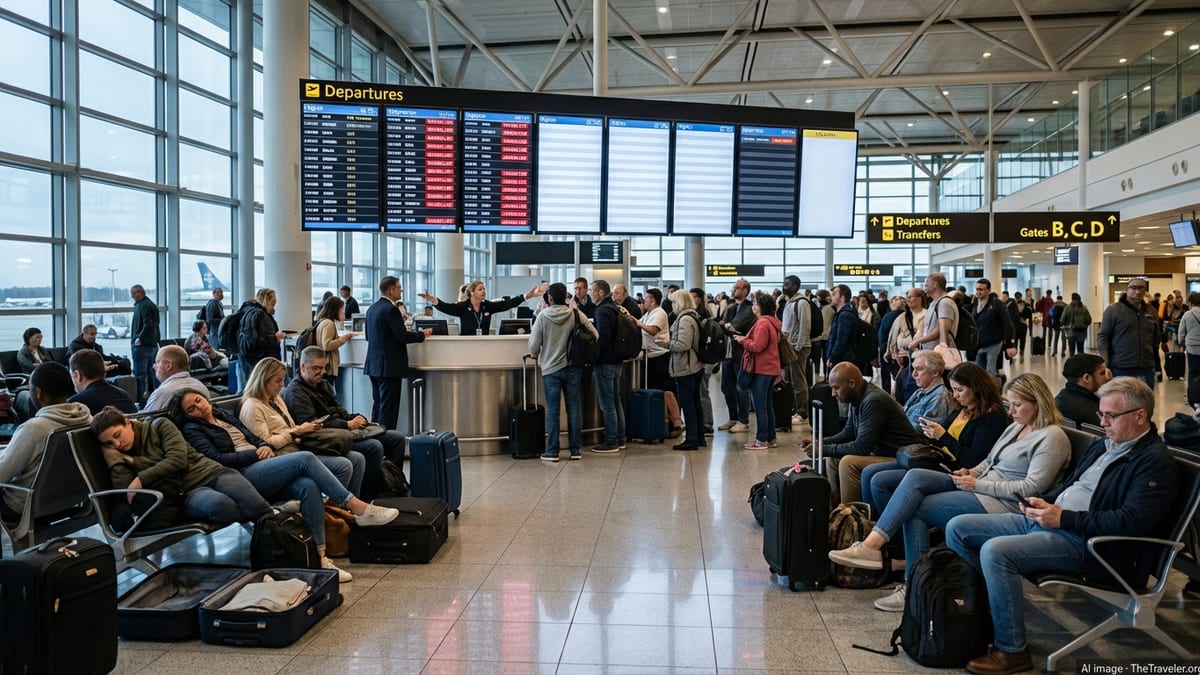
Network on Alert as Conflict Edges Closer to EU Skies
European aviation planners are quietly repositioning the continent’s air traffic network for a more contested era, as military activity and security incidents on the eastern flank increasingly overlap with major civil corridors. Publicly available information from Eurocontrol shows that the European air traffic management network is now managed under rolling disruption planning assumptions that explicitly factor in armed conflict and sudden airspace closures as routine scenarios, rather than exceptional shocks.
Risk assessments conducted for 2026 describe the war in and around Ukraine as the dominant security challenge for European aviation, with conflict spillover, drone incursions and missile debris all cited as triggers for short notice restrictions. The full closure of Ukrainian airspace to civil traffic since 2022 remains in force, and observers note that no commercial airport in the country has handled scheduled passenger flights for more than four years.
As the ground war has evolved, so have concerns about its reach. Reports on recent drone and missile incidents in Romania and the Baltic region underscore the proximity of security events to key air corridors, reinforcing the perception among risk analysts that parts of Eastern Europe are operating under a permanently heightened alert posture.
Network managers are responding with a mix of capacity planning, crisis coordination mechanisms and collaborative decision making that aim to keep traffic flowing while retaining the ability to reroute large volumes of flights with minimal notice.
Expanding Airspace Restrictions and Border Buffer Zones
While most large commercial jets continue to transit above 26,000 feet across much of Eastern Europe, the patchwork of restricted zones beneath them is expanding. In March 2026, new rules in eastern Poland tightened low altitude access along stretches of the borders with Belarus and Ukraine, sharply curtailing light aircraft and drone operations and adding layers of coordination for cross border logistics flights.
Similar temporary restrictions have periodically appeared in the Baltic states and around segments of the Black Sea, often in response to drone activity or missile tests linked to the broader conflict. Publicly available notices to air missions show recurring altitude caps, night time prohibitions and exclusion areas that can be activated and lifted within hours, leaving smaller operators and business aviation particularly exposed to last minute disruption.
These measures exist on top of long standing bans on overflying Ukraine and large portions of western Russia for European operators. Regulatory summaries indicate that European Union sanctions still prohibit the export of aircraft and aviation technology to Russia and restrict Russian aircraft from entering EU airspace, effectively locking in a reconfigured east west traffic pattern that forces many long haul flights onto more southerly or northerly routes.
Airlines have managed the immediate impact through schedule adjustments and fuel planning, but analysts warn that any further expansion of no fly zones on the EU’s eastern flank or in adjacent Russian regions could compress remaining corridors and rapidly degrade punctuality across the network.
Navigation Under Pressure from GNSS Interference
Beyond visible airspace closures, a less obvious threat is shaping route choices and cockpit procedures: persistent interference with satellite navigation signals around Eastern Europe. Joint publications by the European Union Aviation Safety Agency and Eurocontrol describe signal jamming and spoofing on the edges of conflict zones as a regular occurrence, affecting aircraft far from the immediate front lines.
Monitoring data compiled by aviation risk consultancies suggests that disruptions to global navigation satellite systems have been recorded over a wide arc stretching from the Baltic Sea through Poland and Romania to the eastern Mediterranean and Black Sea. These events can force flight crews to revert to conventional navigation aids and can degrade automated landing capabilities at affected airports, particularly in poor weather.
Authorities have responded with a joint action plan to improve detection, reporting and operational guidance for airlines, including common data sharing platforms and recommendations for contingency procedures on routes where interference is most frequent. The plan stops short of mandating large scale reroutings, but network managers acknowledge that prolonged or intensified interference could ultimately require structural changes to how aircraft are sequenced through some choke points.
For passengers, most of this activity remains invisible, yet it contributes to longer flight times, additional fuel burn and the growing likelihood of delays when multiple risks intersect, such as storms, traffic congestion and security alerts on the same day.
From Regional Crisis to Global Travel Ripple Effects
Although the epicenter of the current tensions is in Eastern Europe, aviation analysts stress that the implications are global. The closure of Ukrainian airspace and restrictions on Russian routes have already reshaped long haul flows between Europe and Asia, pushing some services north of Scandinavia and others along more southerly tracks via the Middle East and Central Asia.
Eurocontrol network overviews for 2026 indicate that these detours, combined with congestion over certain alternative waypoints, have become a structural feature of European aviation rather than a temporary anomaly. Airlines are factoring in extra flight times, higher fuel costs and increased crew duty margins as standard assumptions when planning transcontinental schedules.
Insurance dynamics add another layer of fragility. Specialist aviation risk reports note that war risk premiums for operations touching Eastern Europe, the Black Sea and parts of the eastern Mediterranean rose sharply in 2024 and have remained elevated through 2026. Any further escalation of the conflict, including the expansion of active combat zones or high profile incidents involving civil aircraft, could prompt insurers to reassess coverage in neighboring regions, potentially forcing carriers into fresh waves of rerouting or temporary suspensions.
For global travelers, the result may be a gradual erosion of resilience. Individual incidents might translate into only modest delays or isolated cancellations, but as the system absorbs more structural constraints, the margin for absorbing additional shocks without visible disruption diminishes.
Industry Braces for a Prolonged High Alert Environment
Within the industry, there is growing acceptance that a return to pre 2022 airspace patterns in Eastern Europe is unlikely in the near term. Policy papers assessing options for eventually reopening Ukraine’s skies highlight formidable security, insurance and regulatory barriers, including the challenge of guaranteeing protection from missile and drone attacks and the difficulty of quantifying residual risk for underwriters.
In parallel, network planners are refining contingency playbooks that can be activated if hostilities escalate or spread. These include predefined rerouting scenarios to shift flows south through the Balkans and Turkey or north via Scandinavia and the North Atlantic, as well as mechanisms to prioritize humanitarian, military and essential cargo operations if capacity becomes constrained.
Observers point out that Europe’s crisis coordination architecture was strengthened in the wake of earlier shocks such as the 2010 volcanic ash crisis, but that the current situation is different in one key respect: rather than a single, time limited disruption, airlines now face an open ended, politically driven risk environment that could tighten or ease with little warning.
For now, commercial flights continue to cross Eastern Europe in large numbers, and major hubs remain open and connected. Yet the combination of expanding buffer zones, navigation interference, sanctions linked routing constraints and the possibility of sudden border incidents has left the region’s skies on a sustained high alert footing, with potential consequences for global travel if the conflict takes a sharper turn.