


Ask ten people where to stay in Barcelona and you will likely hear the same two names on repeat: Eixample and the Gothic Quarter. Both districts sit in the city’s heart and both promise big "this is Barcelona" moments, yet they feel like different worlds. One is a 19th century grid of airy avenues and Modernista mansions. The other is a medieval maze of alleys, hidden squares and echoing church bells. Choosing between them is less about which is "better" and more about which fits the way you actually like to travel.
Get the latest updates straight to your inbox!
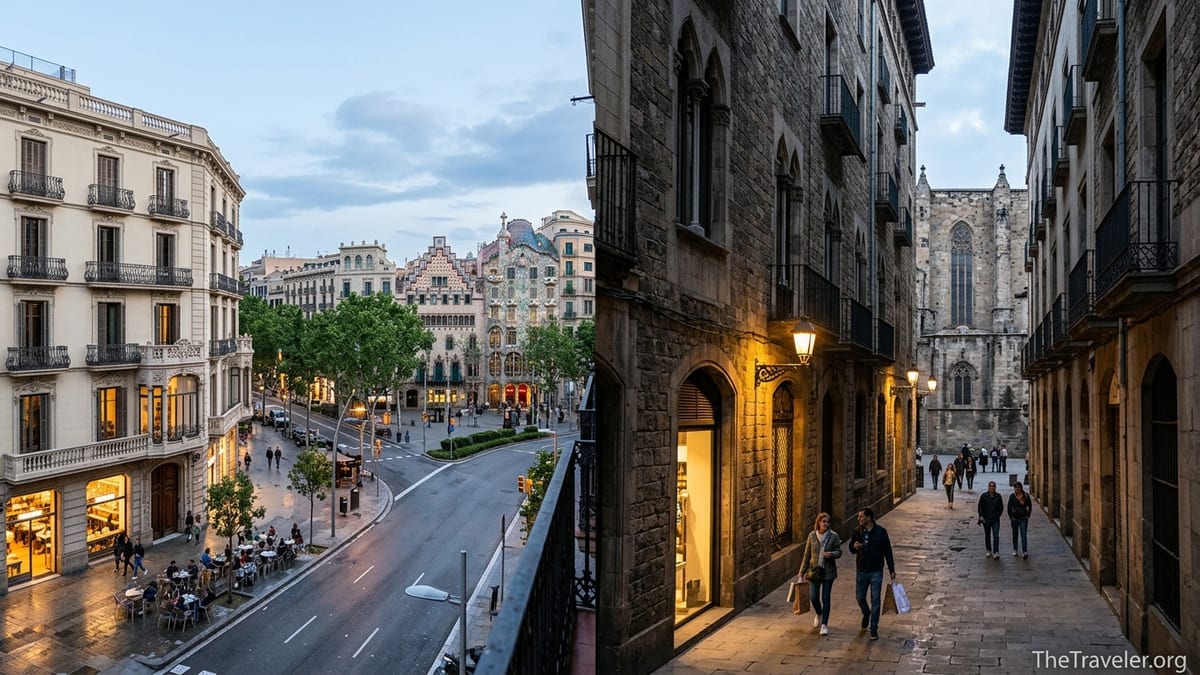
Getting Your Bearings: Two Very Different Barcelonas
Eixample was laid out in the mid 19th century as Barcelona burst beyond its old city walls. Civil engineer Ildefons Cerdà designed a vast grid of chamfered blocks, wide streets and interior courtyards, a radical contrast to the cramped medieval core. Today this district stretches between the old town and former villages like Gràcia and Sants, and is known for its grand avenues such as Passeig de Gràcia and Rambla de Catalunya, elegant residential blocks and abundance of Modernista architecture.
The Gothic Quarter, or Barri Gòtic, is the polar opposite. This is the historic core of Barcelona, built over the Roman settlement of Barcino. Within its tangle of lanes between La Rambla and Via Laietana you find fragments of Roman walls next to Gothic palaces, the spires of Barcelona Cathedral, and small, stone-lined squares like Plaça Sant Felip Neri that feel centuries removed from the traffic just a few streets away.
For a first visit, the simplest mental map is this: stand in Plaça de Catalunya. Walk downhill along La Rambla and you skim the western edge of the Gothic Quarter. Walk uphill along Passeig de Gràcia and within a few blocks you are firmly in Eixample, surrounded by upscale boutiques and landmark buildings like Casa Batlló. The two areas are technically neighbors, but their atmosphere, pace and even the kind of traveler they suit can be very different.
Because Barcelona is compact, you can stay in either area and still explore the other easily. The real question is what you want on your doorstep first thing in the morning and last thing at night: sunrise over quiet courtyards and wide pavements, or the glow of lanterns in twisting stone alleys.
Atmosphere & Vibe: Clean Lines vs Medieval Maze
If you are drawn to order, light and a feeling of space, Eixample will likely speak your language. Streets here are broad and straight, with generous sidewalks and plenty of street trees. The blocks are cut at the corners, so intersections open up like small squares, letting in sunlight and air. In practical terms this means easier navigation, more visible crosswalks, and a sense of security that comes from being able to see a long way down the street. Cafés spill out onto terraces on roads like Rambla de Catalunya, where locals linger over cortados while shoppers drift between Zara Home and independent design stores.
The Gothic Quarter is romantic, atmospheric and, at times, intense. Many streets are barely the width of a car, and some are pedestrian-only. You might turn a corner from a noisy bar on Carrer Ferran straight into a silent, almost echoing side alley lined with centuries-old stone. Sunlight can be scarce on the narrowest lanes, which gives them a moody charm in the afternoon and a slightly mysterious feel at night. Street performers cluster in squares like Plaça del Rei, while buskers play guitar beneath the Pont del Bisbe near the cathedral.
Travelers who enjoy wandering without a fixed plan often fall hard for the Gothic Quarter. Getting lost here is half the point, stumbling into little plazas packed with locals taking a vermut at tiny bars. But if you dislike crowds or feel uneasy in confined, unpredictable spaces, Eixample’s ordered streets, more regular traffic and wider sidewalks can feel calmer and more manageable, especially after dark.
A good rule of thumb: if your dream Barcelona image is the façade of Casa Milà against a blue sky, you are probably an Eixample person. If it is a shadowy archway opening into a hidden square with a lone street lamp and a church façade, then the Gothic Quarter may be your natural home base.
Location, Landmarks & What You See When You Step Outside
Eixample is where you wake up a short walk from some of Barcelona’s biggest architectural icons. Passeig de Gràcia alone holds Casa Batlló and Casa Milà (La Pedrera), two of Antoni Gaudí’s most visited works, plus other Modernista masterpieces like Casa Amatller. Many Eixample hotels and apartments sit within a 10 to 15 minute walk of Sagrada Família, whose spires you can sometimes glimpse framed between apartment blocks when you turn down certain streets. Staying here often means that a self-guided Gaudí morning is as simple as walking from one side of the neighborhood to the other.
The Gothic Quarter trades Gaudí for Gothic. From many hotels you can reach Barcelona Cathedral in under five minutes, weaving through streets that reveal flying buttresses and gargoyles piece by piece. Squares like Plaça del Rei, with its medieval palaces, and Plaça Sant Jaume, the seat of city and regional government, anchor the district. The Roman Temple of Augustus hides behind an unassuming doorway on Carrer del Paradís, and sections of Roman wall still appear along the route toward the sea. If your interest is the story of Barcelona from antiquity through the Middle Ages, the Gothic Quarter places you right in the middle of it.
In both districts you are close to the city’s broader highlights. From central Eixample you can stroll to Plaça de Catalunya in about 10 to 20 minutes depending on where you are, then continue into the Gothic Quarter or down La Rambla. From the heart of the Gothic Quarter, a 10 to 15 minute walk up to Plaça de Catalunya drops you at the gateway to Eixample and its Gaudí landmarks. Many visitors end up moving between the two on foot for most of their sightseeing days, simply because the distances are shorter than they look on a map.
Budget, Hotels & What You Get for Your Money
Accommodation prices fluctuate across the year, but some patterns are consistent. In Eixample you will find a broad mid to upper range of hotels. In high season, a well-rated three star hotel a few blocks off Passeig de Gràcia might run in the region of 180 to 230 euros per night for a standard double, while polished four star boutique properties along Rambla de Catalunya or near Diagonal can easily climb into the 260 to 350 euro bracket. You pay for larger rooms, modern lifts, better soundproofing and, often, rooftop terraces with small pools or bars.
The Gothic Quarter tends to offer a mix of small hotels, renovated historic properties and compact apartments set in older buildings. A simple but central three star hotel near Plaça Reial or close to the cathedral might be in a similar price band to a mid-range Eixample property in peak months, despite the rooms usually being smaller. What you are really paying for here is atmosphere and closeness to the historic fabric: thick stone walls, wooden beams and views over tiled rooftops or intimate squares.
For budget travelers, Eixample often has the edge in value, particularly if you are willing to be a few blocks away from the most famous streets. You can find private rooms in smaller pensions or modest two star hotels at lower prices than many equivalents inside the Gothic Quarter, with the trade-off being a slightly longer walk to the old town. Apartments can be more practical in either area if you are staying several nights and want a kitchen, but be aware of Barcelona’s strict regulations and licensing; always confirm that a short-term rental is legal and clearly registered.
If you are the type of traveler who spends little time in your room and cares more about stepping straight into the old city every morning, the Gothic Quarter premium may be worth it. If you prefer a bit more space, stronger air conditioning, elevators large enough for luggage and, often, better soundproofing, Eixample’s newer building stock generally delivers more comfort per euro.
Food, Nightlife & Daily Convenience
Eating well is easy in both districts, but the feel is different. In Eixample, restaurants range from classic tapas bars on side streets to Michelin-starred destinations clustered around streets like Carrer d’Enric Granados and the blocks near Passeig de Gràcia. You will also see plenty of contemporary bistros, vegan cafés and international cuisines that reflect the area’s role as a working and residential neighborhood. Coffee bars with laptop-tapping locals, neighborhood bakeries, and relaxed vermuterías make it simple to settle into a daily routine.
The Gothic Quarter’s food scene leans into its tourist-heavy character near La Rambla, where you will find menus in multiple languages and paella advertised at lunchtime on streets just off the main drag. Walk a few minutes deeper into the quarter, however, and you will encounter smaller tapas spots, wine bars in vaulted stone basements and simple Catalan restaurants serving dishes like escalivada or botifarra with white beans. The area’s density means that, within a five minute walk, you can move from a lively square like Plaça Reial, with its colonnades and palm trees, to a quiet corner bar where most customers are speaking Catalan or Spanish.
Nightlife in Eixample is more dispersed and often more local. Cocktail bars dot the avenues, late-opening bars around Universitat and Gayxample cater to LGBTQ+ visitors and residents, and club venues tend to be larger and more modern. Crucially, going out here usually means walking along wide, well-lit streets or taking short taxi or metro rides, which some travelers find more comfortable late at night.
In the Gothic Quarter, many evenings naturally unfold as bar-hopping. It is easy to drift from a glass of cava near Plaça del Pi to a craft beer bar on a nearby lane, then on to a late-night spot near the cathedral. The atmosphere can be electric at weekends, but narrow streets amplify noise, and late-night revelry sometimes continues beneath apartment windows. If you are sensitive to sound, an interior room or a stay on a quieter side of the quarter toward the cathedral may be preferable to a balcony directly over La Rambla or Plaça Reial.
Transport, Safety & Getting Around
Eixample is one of Barcelona’s best-connected areas for public transport. Multiple metro lines cross the district, with key hubs such as Passeig de Gràcia and Diagonal linking several lines and commuter trains. This makes it straightforward to reach further-flung sights like Park Güell, Camp Nou or the beaches without complex transfers. From the airport, many visitors take the airport train to Passeig de Gràcia, or use the Aerobús to Plaça de Catalunya and then a short taxi or metro ride into Eixample, which keeps door-to-door travel simple even with luggage.
The Gothic Quarter is slightly more tucked away from heavy transport infrastructure, but still well served. Metro stations such as Jaume I and Liceu sit on the perimeter, and Plaça de Catalunya, with its tangle of metro, commuter trains and buses, is only a 10 to 15 minute walk uphill. Most of the quarter itself is pedestrian, which is wonderful once you have arrived but means you will often finish your journey on foot from the nearest station or taxi drop-off point at the edge of the old town.
On safety, both areas are generally safe in terms of violent crime, but each carries different everyday annoyances to manage. In Eixample, the main issues are typical of any busy European city: occasional bag snatching on crowded metro lines or on popular shopping streets, and pickpocketing around major sights like Sagrada Família. Broad pavements and good lighting, however, mean many travelers, including solo visitors, feel comfortable walking back to their accommodation at night along main avenues.
The Gothic Quarter has long been known as a hot spot for pickpockets, especially in tightly packed alleys and crowded squares near La Rambla and Plaça Reial. Solo travelers, particularly at night, often report feeling safer sticking to more trafficked streets and avoiding obviously intoxicated crowds. Practical steps help: carry valuables in a crossbody bag worn in front, avoid leaving phones on café tables at the edge of busy plazas, and be cautious if anyone creates a distraction in close quarters. For most visitors, these are manageable adjustments rather than reasons to avoid the area altogether.
Who Each Neighborhood Fits Best
Imagine an early morning in Barcelona. In Eixample, you step out onto a wide pavement, the sun already catching balconies lined with potted plants. A bakery on the corner sells still-warm croissants, and within minutes you are walking past Casa Batlló before the tour buses arrive. You have café terraces for a relaxed breakfast, straightforward metro connections for wherever you are going, and a relative sense of calm despite being in the city center. This suits travelers who like structure: families who value stroller-friendly sidewalks, business visitors who need easy transport links, first-timers who prefer a "soft landing" into the city, and anyone who plans to focus heavily on Gaudí and Modernista architecture.
In the Gothic Quarter, your morning might begin with the sound of church bells and the clatter of shutters opening above a narrow stone lane. You walk out into a shaft of sunlight in a small square, grab a coffee from a hole-in-the-wall café, and watch delivery carts rumble past as the day slowly starts. Your main pleasures are slow wandering, photography, the feeling of stepping through layers of history, and quick access to Barcelona’s waterfront and neighboring El Born district. This base often works best for travelers who prioritize character over convenience: couples on shorter romantic trips, urban explorers who like getting lost, and repeat visitors who know how to dodge the busiest corners.
If you are planning a packed sightseeing schedule that spans Sagrada Família, Park Güell, Montjuïc and the beaches, Eixample’s transport connections, central position and relative quiet at night can make life easier. If your ideal trip is more about slow mornings, historic discoveries and evenings drifting between atmospheric bars, the Gothic Quarter puts that version of the city right outside your door.
For many travelers, the perfect solution is a compromise: stay in Eixample but within a 10 to 15 minute walk of Plaça de Catalunya so that the Gothic Quarter is always close, or choose a Gothic Quarter hotel on a quieter side street closer to Via Laietana, where you can reach Eixample on foot or by metro in minutes. Your choice does not have to be absolute; small shifts in location within each district can drastically change your day-to-day feel.
The Takeaway
Choosing between Eixample and the Gothic Quarter is really choosing what you want your Barcelona days and nights to feel like. Eixample offers space, order and comfort, with Modernista icons on its avenues and strong transport links that make the rest of the city feel close. The Gothic Quarter offers intimacy, history and sensory overload, where almost every street seems to hold a story or a surprise.
If you value larger, more modern rooms, easier navigation and quieter nights, Eixample is likely your better fit. If you crave atmosphere even at the cost of convenience, and you like the idea of wandering home through stone passages that have seen centuries of life, the Gothic Quarter may be the place where Barcelona truly comes alive for you.
In practice, you cannot make a completely wrong choice. Barcelona is compact enough that whichever area you choose, the other will still be within easy reach for day and evening explorations. Think honestly about your travel style, visualize what you want when you step outside each morning, and let that image guide your booking. The city will take care of the rest.
FAQ
Q1. Is Eixample or the Gothic Quarter better for a first-time visitor to Barcelona?
For most first-time visitors, Eixample is slightly easier because of its wide streets, good transport and abundance of hotels, while still being walking distance from the Gothic Quarter. If your main interest is medieval history and you are comfortable with crowds and narrow alleys, the Gothic Quarter offers a more immersive old-town experience.
Q2. Which area is safer to walk around at night?
Both areas are generally safe in terms of serious crime, but Eixample’s wider, better-lit streets usually feel calmer after dark. The Gothic Quarter can be more intense, with busy nightlife and a higher risk of pickpocketing in crowded lanes and squares. In either district, sticking to main streets, avoiding obvious intoxication and keeping valuables secure are usually sufficient precautions.
Q3. Where will I get more for my money on hotels, Eixample or the Gothic Quarter?
Eixample often offers better value for the same budget, especially if you stay a few blocks from the most famous avenues. Rooms tend to be larger and more modern, with better soundproofing. In the Gothic Quarter you may pay similar rates for older buildings and smaller rooms but gain character and proximity to the medieval core.
Q4. Is the Gothic Quarter too noisy to sleep?
Noise varies a lot by street. Rooms overlooking La Rambla, Plaça Reial or busy bar streets can be loud until late, especially on weekends. However, many hotels and apartments are on quieter lanes or offer interior rooms that stay relatively peaceful. If you are sensitive to noise, look for accommodation on less trafficked streets and consider using earplugs.
Q5. Which neighborhood is better for families with children?
Families usually find Eixample more practical. Wide pavements make pushing strollers easier, crossings are clearer, and it feels simpler to navigate with kids. Many family-friendly hotels and apartments are based here, and having metro hubs close by helps with day trips. The Gothic Quarter can still be magical with children, but its narrow, crowded lanes require more vigilance.
Q6. How easy is it to get from Eixample to the Gothic Quarter and back?
It is very easy. On foot, it can be a 10 to 20 minute walk between many points in Eixample and the heart of the Gothic Quarter via Plaça de Catalunya. Several metro lines also connect the areas, and taxis are plentiful. Many visitors stay in one district and spend parts of most days exploring the other.
Q7. Which area is better for nightlife?
That depends on your style. Eixample is better for spread-out bars, cocktail lounges and clubs, including LGBTQ+ venues, mostly along major avenues. The Gothic Quarter is ideal for bar-hopping in dense, historic streets, with plenty of lively spots in and around Plaça Reial and near the cathedral. If you prefer a quieter base, Eixample has the advantage.
Q8. Where will I find more authentic local life, Eixample or the Gothic Quarter?
Both districts have strong local communities, but Eixample, especially away from the main tourist avenues, feels more like everyday Barcelona, with neighborhood shops, schools and cafés. The Gothic Quarter, particularly close to La Rambla, is heavily touristed, though quieter corners and residential pockets still exist if you wander away from the busiest routes.
Q9. Which area is closer to the beach?
The Gothic Quarter is marginally closer, especially from its southern end near the waterfront, where you can walk to Port Vell and continue toward Barceloneta beach. From central Eixample the beach is still reachable by a direct metro ride or a longer walk, but if daily seaside strolls are a priority, basing yourself nearer the old town shortens the journey.
Q10. If I split my stay, should I start in Eixample or the Gothic Quarter?
Many travelers like to start in Eixample to settle in, get their bearings and visit major Gaudí sites, then move to the Gothic Quarter for a more atmospheric finish once they know the city better. This sequence offers convenience first, then immersion, but you can happily reverse it if you prefer to dive straight into the medieval core.