


Most visitors experience Barcelona’s Eixample as a backdrop. They cross its broad streets on the way to Sagrada Família, point their cameras at Passeig de Gràcia, then disappear underground to the metro. Yet behind those uniform facades and at the corners of its perfect grid, the district hides the everyday spaces that locals actually use: courtyards turned into gardens, speakeasy bars behind barbershops, tiled markets reborn as food halls and air shafts reborn as pocket parks. This is an Eixample of small-scale pleasures, and it rewards anyone willing to turn down the side streets and step through an open doorway.
Get the latest updates straight to your inbox!
Why Eixample’s “In Between” Spaces Matter
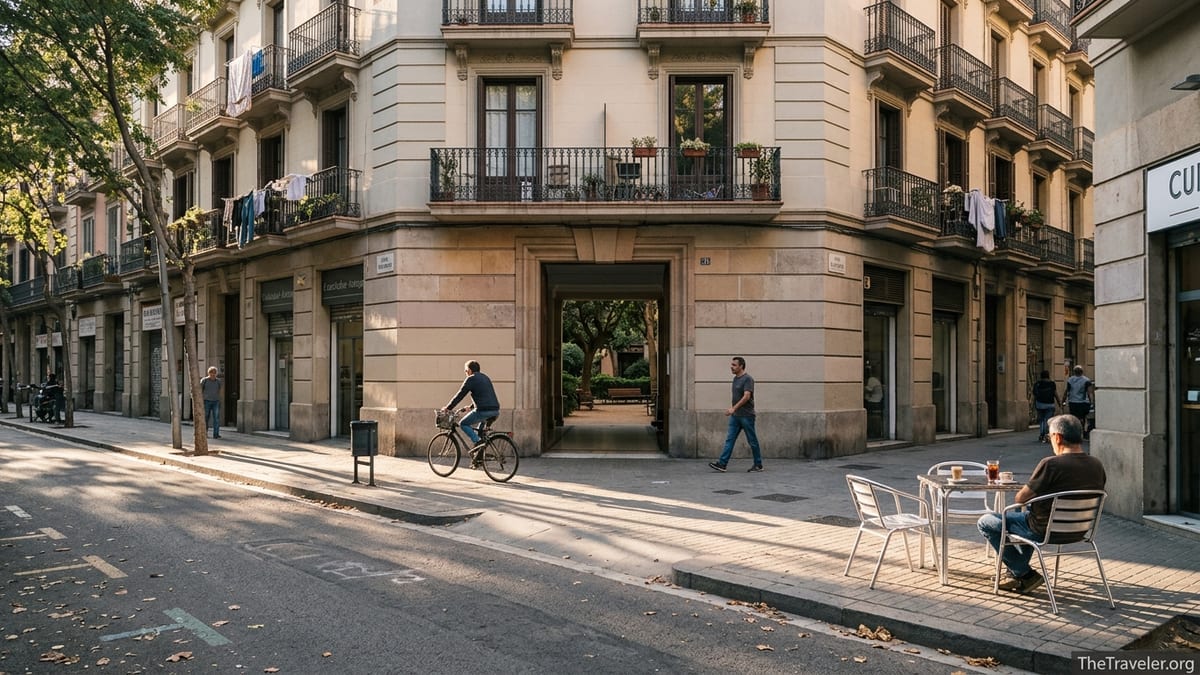
On a map, Eixample looks almost clinical: a chessboard of repeating blocks and chamfered corners laid out in the 19th century to ventilate and modernize Barcelona. At street level, though, life happens in the gaps. The ground floors are a patchwork of locksmiths and cafés, bakeries and hardware stores. Above your head, wrought-iron balconies sag with laundry and potted geraniums. Walk just three or four blocks away from Passeig de Gràcia or Plaça de Catalunya and the tour groups thin out dramatically, replaced by parents with strollers, office workers on lunch break and couples heading out for vermouth.
Because so many travelers focus on the famous modernist landmarks, they miss the quieter, more local pieces of the puzzle: inner courtyards open to the public at certain hours, residential passages that feel like small villages, modest modernist buildings whose only clue lies in a sculpted doorway. This is not the Eixample of bucket-list attractions and ticketed entry times. It is a district best approached with curiosity and a willingness to duck into doorways that look, at first glance, like they might be private.
Exploring these hidden corners also changes how the city feels. Rather than marching between monuments, you start to notice rhythms: the smell of roasted coffee drifting from a side-street roastery, the quiet around schools at siesta time, or the moment around 8 p.m. when blinds roll up on neighborhood bars. The grid stops being a corridor to somewhere else and becomes a place worth lingering in its own right.
Passatge de Permanyer and the Village Inside the Grid
One of Eixample’s strangest illusions is that of a small 19th-century village tucked inside the modern grid. A short stroll from the roar of Gran Via, Passatge de Permanyer is a narrow, brick-paved lane lined with English-style terraced houses. Tall palm trees, wrought-iron lamps and low railings give the impression you have wandered onto a quiet movie set. Most walking tours sweep past the nearest main streets without ever mentioning it, leaving this little passage to dog walkers and neighbors heading home with groceries.
The houses themselves are private, but the passage is public, and it is worth timing a visit for late afternoon when the sun slides between rooftops and the facades glow a soft terracotta. Benches at either end of the lane invite you to sit for a few minutes and watch everyday scenes play out: a courier dropping a package, a teenager steering a scooter, a resident pausing to chat with the building porter. There is nothing to “do” here in the conventional sense, which is precisely the point. In a city where many plazas can feel like backdrops for social media, Passatge de Permanyer is still just a place people live.
Practicalities are refreshingly simple. You do not need a ticket or a guided tour, just common courtesy: keep voices low, avoid photographing into windows and remember that residents use the passage as their front yard. Combine a stop here with a wander toward neighboring side streets, where small bakeries and corner bars offer cheap coffees and daily menus that rarely appear in English.
Jardins de la Torre de les Aigües: Eixample’s “Beach” Between the Blocks
Many guidebooks mention that Eixample has few parks, then move on without explaining how locals solved that problem. One of the most charming answers hides inside a residential block just off a busy shopping street: the Jardins de la Torre de les Aigües, nicknamed the “Eixample beach.” Behind high walls and a modest gate, a 19th-century brick water tower rises above a sandy courtyard with a shallow pool. In summer the space fills with families seeking shade and somewhere for children to splash without trekking to the coast.
The atmosphere is a long way from the curated drama of Barceloneta. You will see toddlers in floaties, parents in work clothes checking their phones from shaded benches and older neighbors reading newspapers in the dappled light. The pool itself is usually just knee-deep, more paddling pond than swimming facility, but on a hot July afternoon it feels like a small miracle. Admission, when charged, is generally just a few euros, and capacity is limited, so you may find a short queue on peak days. Out of season, the water may be drained, but the space still works as a quiet courtyard for a picnic or a rest.
Because the entrance blends into the surrounding facades, most casual passersby never realize the courtyard exists. If you are wandering the grid, look for municipal signage indicating “jardins” and be willing to follow an arrow through a passage that looks like it might lead to a parking garage. Often, it leads instead to tucked-away gardens like this one, where Eixample’s orderly exterior briefly gives way to something softer and more improvised.
Inner Courtyards and Secret Gardens Open to the Public
When city planners laid out Eixample’s blocks, each was designed with a hollow interior to provide light and air. Over time, many of these interior spaces were filled in with garages or extensions, but a surprising number survive as shared gardens and public courtyards. The trick for visitors is knowing that you are allowed inside. Look for open doorways in civic buildings, cultural centers and municipal libraries; often a dim corridor leads to a bright, tree-lined patio at the heart of the block.
Near the intersection of several of Eixample’s main avenues, for example, a local civic center hides a large inner courtyard where office workers eat takeout lunches under plane trees and children race around on scooters. The facade from the street gives little away, but step through the glass doors and you find a cloister-like patio fringed with benches. Similar spaces exist in association buildings, neighborhood schools and small museums scattered through the district. Entry is usually free, and no one looks twice at a respectful visitor sitting quietly with a book.
Exploring these courtyards is both a way to escape traffic noise and to understand how residents reclaim space in such a dense neighborhood. You might find small vegetable plots, community noticeboards advertising Catalan classes, or murals painted by local artists. Bring a takeaway coffee from a nearby café and treat these patios as your temporary living room, remembering to leave them as tidy as you found them. For many locals living in compact apartments, these light wells are the closest thing they have to a private garden.
Sant Antoni: A Market District Hiding in Plain Sight
At the south-west edge of Eixample, Sant Antoni has quietly transformed from a working-class market district into one of the city’s most livable corners. Many tourists only encounter it by accident, passing a few blocks of cafés on their way between Montjuïc and the Old City. Those who stop discover an area organized around the restored Mercat de Sant Antoni, a vast 19th-century iron-and-glass market hall whose renovation completed in 2018 turned it into a community anchor. Under its star-shaped roof, traditional produce stalls sell fish, vegetables, olives and cured meats, while a ring of small bars offers everything from simple grilled sandwiches to natural wine by the glass.
Prices here tend to be friendlier than in the central Boqueria. A plate of market-fresh calamari or a bocadillo filled with tortilla and roasted peppers might cost just a few euros, and there is usually room to stand at the counter even at peak lunch hours. On Sunday mornings, the streets around the market fill with book and comic vendors, a longstanding fair where neighbors browse for secondhand novels and vintage magazines. The scene feels more like a weekly ritual than an attraction, and you will hear as much Catalan as Spanish in the buzz of conversation.
Beyond the market, Sant Antoni’s grid hides a dense network of small bars and bistros. A typical evening might start with a vermut and a bowl of olives at a corner bodega, continue with a “menu del día” of three courses and wine for a modest fixed price, and end with a craft beer in a bar where the only English words are on the chalkboard listing international IPAs. It is a comfortable, walkable area to explore at night, with well-lit streets and plenty of people around, yet it still feels largely residential once you step away from the main avenues.
Behind Unmarked Doors: Eixample’s Discreet Bars and Cafés
Barcelona has no shortage of cocktail bars with glossy interiors and waiting lists, but Eixample’s most interesting drinking spots are often the ones you would walk past without a second glance. A good example is a speakeasy-style bar hidden behind the facade of a traditional barbershop, which has been drawing a loyal following with classic cocktails and low lighting. From the street, you see only mirrors and barber chairs. Push through an unmarked door at the back, however, and you step into a snug bar with cut-crystal glassware and a carefully tuned soundtrack. Drinks there usually cost in the low to mid-teens in euros, comparable to other serious cocktail venues in the city, but the atmosphere is more relaxed than theatrical.
Elsewhere in Eixample, side streets shelter tiny wine bars with just a handful of tables and blackboards listing Catalan and Spanish bottles by the glass. Many offer simple tapas built around quality ingredients: pan con tomate rubbed with ripe tomatoes and olive oil, wedges of local cheese, or a plate of boquerones in vinegar. Expect to pay the price of a good coffee for a glass of house vermouth and between 3 and 7 euros for small plates, depending on how elaborate they are. Because these places rely on neighborhood regulars, they tend to open on the later side in the evening and can be surprisingly empty right after work, making them ideal for travelers who like a quiet drink.
When exploring, trust your eyes more than online reviews. Avoid spots with plastic photo menus and staff beckoning from the doorway. Instead, follow locals down side streets like Carrer del Parlament or into the quieter stretches between grid intersections. If a bar’s window is fogged with conversation and the chalkboard outside is written in Catalan first, you are likely in the right place. Even one or two blocks away from major intersections, prices drop noticeably and staff are more inclined to chat about their favorite bottles or dishes.
Modernism Without the Crowds
For many visitors, Eixample is synonymous with Gaudí’s major works and the grand façades of Passeig de Gràcia. Yet the district is scattered with modernist buildings that receive only a fraction of the attention. Some belong to architects inspired by Gaudí’s organic lines, others are more restrained, with subtle floral reliefs or stained-glass transoms over front doors. Walk the length of a side street and you might pass three or four such buildings without another traveler in sight.
One lesser-known example frequently recommended by architecture enthusiasts is Casa Comalat, a residential building with sinuous balconies and colorful ceramic ornamentation that echo Gaudí’s style while remaining distinctly its own. There is no elaborate visitor center or timed entry. You simply stand across the street, take in the asymmetry and playful details, and perhaps share the pavement with a neighbor walking their dog. Nearby, smaller gems like Casa Thomas reveal themselves through whimsical stone columns and carved floral motifs over doorways. Bronze “Ruta del Modernisme” medallions embedded in the pavement help guide you between these addresses if you look down as you walk.
These stops are particularly rewarding in the morning, when angled sunlight catches stained glass and cast-iron balconies. With no tickets to book and no lines to queue in, you are free to linger, circle a block for a different perspective or step into a nearby bakery for a croissant and coffee before continuing. Seen this way, Eixample’s modernism feels less like a museum circuit and more like an open-air gallery woven into ordinary life.
Practical Tips for Exploring Eixample’s Quiet Corners
To get a feel for the district beyond the postcard views, plan at least half a day of unstructured wandering. Start mid-morning, when cafés are in full swing and markets are busy but not yet overwhelmed. Use major avenues like Gran Via or Carrer d’Aragó only as reference lines, then deliberately spend most of your time on the smaller cross streets. When you see the word “passatge” on a street sign, follow it; passages often indicate semi-pedestrian lanes or interior routes that feel more intimate than standard blocks.
Eixample is safe to explore in daylight and early evening, but as in any big city, keep a hand on your bag in crowded markets or on busy corners. Pickpocketing in Barcelona tends to concentrate in the most tourist-heavy zones, which is another argument for straying a few blocks off the main routes. Use common sense at night: stick to well-lit streets, avoid walking alone down completely empty alleys and, if you are staying far from the center, consider using public transport or taxis to return after midnight rather than crossing the city on foot.
Budget-wise, one of the pleasures of Eixample’s hidden spots is how affordable they can be. A simple breakfast of cortado and a pastry in a local café often comes in under 5 euros. At lunchtime, look for chalkboards advertising “menú del dia”, a fixed-price meal typically available on weekdays that can run from around 12 to 18 euros and includes two courses, bread, dessert or coffee, and sometimes wine. Neighborhood bars and bodegas outside the main avenues often pour generous glasses of house vermouth for less than the cost of a soft drink on La Rambla.
The Takeaway
Seeing Eixample only as the area you cross between monuments is like skimming the cover of a book without opening it. The real character of the district reveals itself in places most visitors ignore: a quiet passage lined with townhouses, a hidden pool at the base of an old water tower, a courtyard where neighbors share benches under young trees, or a speakeasy bar humming behind the facade of a traditional shop. None of these sites demand a half-day or a special trip on their own. Together, though, they form a portrait of a lived-in city that continues just beyond the edge of the obvious.
Next time you find yourself marching along Eixample’s right angles toward a famous landmark, slow down. Turn one block off the main avenue. Duck into that open doorway marked as a civic center. Follow the sound of clinking cups to a side-street café, or the smell of grilled fish to a market stall. The joy of Eixample’s hidden gems lies not in ticking them off, but in realizing how many of them you would have walked past if you had not started paying attention.
FAQ
Q1. Is Eixample a good area to stay in for first-time visitors?
Eixample is an excellent base for first-time visitors because it is central, walkable and well-connected by metro and bus, yet generally quieter and less hectic than the Old City at night. You can reach major sights like Sagrada Família, Passeig de Gràcia and the Gothic Quarter on foot while enjoying a neighborhood atmosphere on your doorstep.
Q2. How can I find hidden courtyards and gardens if most are unmarked?
The easiest strategy is to keep an eye out for municipal buildings, civic centers and libraries, then step inside to see if there is a courtyard beyond the entrance hall. Look for signage mentioning “jardins” or “patí” and do not be shy about exploring open corridors, as many of these spaces are explicitly open to the public during daytime hours.
Q3. Are the hidden spots in Eixample safe to explore alone?
By day, Eixample is one of Barcelona’s safer areas, with broad, busy streets and plenty of people around. As always, keep an eye on your belongings in markets and crowded cafés, and at night stick to well-lit routes. If a passage or park feels completely deserted after dark, choose another street or use public transport or a taxi.
Q4. What time of day is best for visiting places like Passatge de Permanyer or inner courtyards?
Late morning and late afternoon are ideal. In the morning, light is softer and crowds are thinner, making it easier to take photos without disturbing residents. In late afternoon, the sun slants between buildings and inner courtyards feel pleasantly shaded, with locals coming and going from work and school.
Q5. Do I need to book in advance for markets and hidden bars?
Traditional markets like Mercat de Sant Antoni do not require reservations, although individual bars or food counters inside may fill up at peak times. Hidden or speakeasy-style cocktail bars sometimes accept reservations but often keep space for walk-ins on weeknights. At weekends or for larger groups, it is wise to check ahead or arrive early in the evening.
Q6. How much should I budget for eating and drinking in Eixample’s lesser-known spots?
In local cafés and tapas bars away from the main avenues, a basic breakfast often costs under 5 euros and a weekday set lunch between roughly 12 and 18 euros. Simple tapas like pan con tomate or olives are usually just a few euros, while classic cocktails in discreet bars tend to be priced similarly to other major European cities.
Q7. Are there particular streets that are good starting points for exploring hidden gems?
Streets running parallel to major avenues, such as those a block away from Gran Via or Diagonal, are often rich in local cafés and small modernist buildings. In Sant Antoni, the grid around the market and along quieter sections of Carrer del Parlament offers a concentration of neighborhood bars and bakeries that make a good starting circuit.
Q8. Can I visit modernist buildings in Eixample that are not major tourist attractions?
Many lesser-known modernist buildings remain private residences or offices, so interior visits are not possible. However, their facades are fully visible from the street, and following pavement medallions for the “Ruta del Modernisme” can lead you to doors, balconies and window details that you can enjoy without tickets or queues.
Q9. What should I keep in mind to be respectful when exploring residential passages and courtyards?
Remember that many of these spaces are effectively extensions of people’s homes. Keep noise low, avoid photographing directly into windows or at children, do not smoke where it is prohibited, and follow any posted opening hours. If an entrance is clearly marked private or a door is closed, do not force your way in.
Q10. How long should I set aside to explore Eixample’s hidden gems?
If your schedule is tight, you can weave a few hidden spots into a half-day itinerary on your way between major sights. For a more immersive experience, plan a full day centered on Eixample, with time for a morning market visit, a slow lunch, an afternoon of wandering courtyards and passages, and an evening in a local bar or restaurant.