


From the airplane window, Barcelona’s Eixample looks like a futuristic circuit board: flawless squares, clipped corners, and straight lines marching toward the sea and the hills. I expected that part. What I did not expect was how deeply this perfect grid, designed in the 19th century by engineer Ildefons Cerdà, would choreograph the quiet routines of daily life: when cafés fill, how neighbors shop, even how sunlight enters a bedroom in midwinter. Walking Eixample is less about sightseeing than tuning into a district whose steady urban rhythm is set, block by block, by one of the most radical street plans Europe ever built.
Get the latest updates straight to your inbox!
A City That Suddenly Starts Making Sense
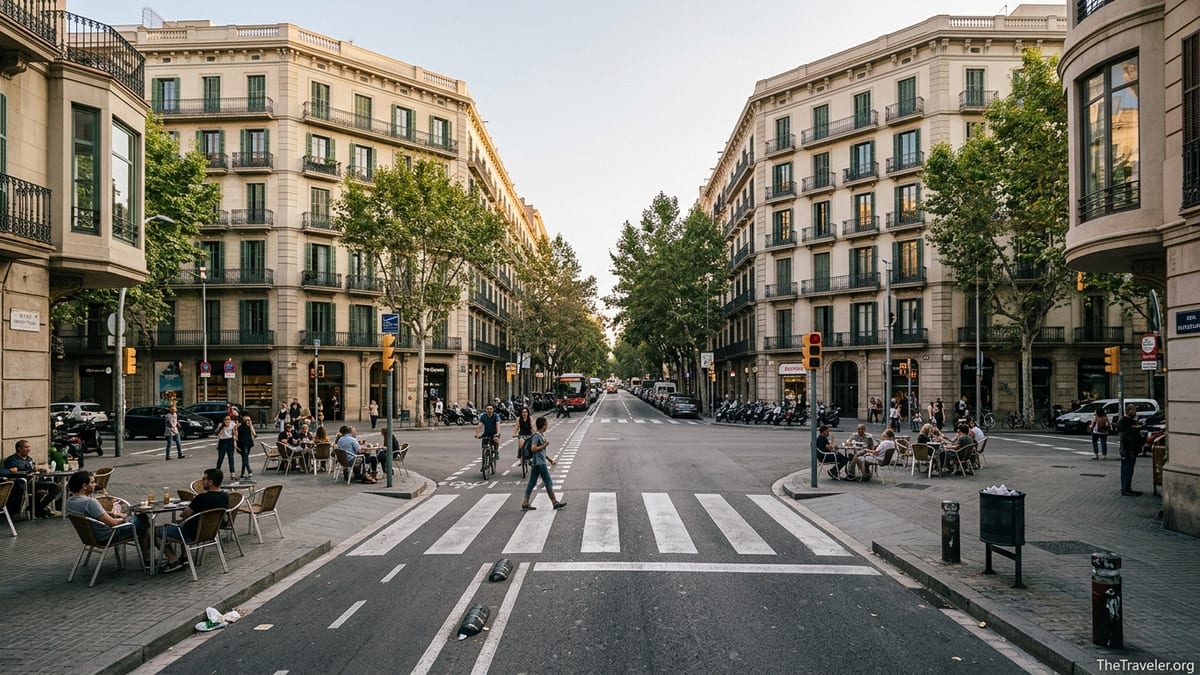
The first surprise hits the moment you emerge from the metro at Passeig de Gràcia or Girona. After the compressed medieval streets of the Gothic Quarter, Eixample feels almost implausibly rational. Long, straight avenues extend in ruler-straight lines, every cross street arriving at a perfect right angle. Each block is roughly the same size and shape, creating an immediate sense of orientation even for first-time visitors. You can walk in any direction and trust the city to behave.
This order is no accident. In 1859, civil engineer Ildefons Cerdà won the competition to extend Barcelona beyond its demolished medieval walls, proposing a vast grid of square blocks with 45-degree chamfered corners. His goal was hygiene, light, and mobility in a city that had been dangerously overcrowded. Today, those “cut” corners create the octagonal intersections that are so distinctive in aerial photos of Barcelona, but at street level they feel surprisingly human: they widen your field of view, open corners to sunlight, and carve out tiny plazas where people actually linger.
Compared with other planned cities, like the monumental boulevards of Paris or the diagonal avenues of Washington, Eixample’s genius is less about spectacle than usability. You feel it the first time you realize that from a random café on Carrer de València you can walk straight to the Sagrada Família without constantly checking your phone. The grid gently teaches you the logic of the city and turns what could be a confusing metropolis into a place where even visitors quickly develop a reliable mental map.
For travelers on a tight schedule, that clarity has a practical advantage: you spend less time lost and more time absorbing the atmosphere. It is remarkably easy to string together a day that moves from Casa Batlló on Passeig de Gràcia to a vermut on Enric Granados, then dinner near Hospital Clínic, simply by following a couple of straight streets. Eixample invites you to walk, and it rewards that trust with a constant, legible rhythm.
The Chamfered Corner: Everyday Life in an Octagon
Those chamfered corners, which Cerdà introduced to ease turning for horse-drawn carriages and later trams, might sound like a dry planning detail. In practice, they shape the feel of nearly every intersection. Instead of confronting a tight 90-degree corner, pedestrians step into an open octagonal space where four streets meet. The result is a sequence of outdoor rooms: small plazas, not grand squares, recurring every block or so.
Stand at the crossroads of Carrer d’Enric Granados and Carrer del Consell de Cent on a late afternoon and you see how much life these corners host. A bike courier waits in the shade of a street tree, parents pause with strollers at the edge of a chalk-drawn hopscotch game, and office workers cluster around high tables for a quick cortado at a corner café. The chamfer creates just enough extra space for two or three parking spots or a handful of café tables, loosening the street and offering micro-places where city life can pause and recombine.
In recent years, Barcelona’s “superblock” program has intensified this effect in parts of Eixample by calming traffic and reclaiming intersections as people spaces. Around Carrer del Consell de Cent, for example, some intersections have been paved with colored concrete, dotted with planters, and given priority to pedestrians and cyclists. You still recognize Cerdà’s grid, but the mood shifts from through-traffic to neighborhood square, especially on weekends when kids race between planters and older neighbors claim chairs in the sun.
For visitors, these corners are incredibly useful wayfinding anchors. You may forget the exact name of a bar, but you remember that it was “on the chamfer opposite the little bakery with the blue awning” or “one block down from the pharmacy on the wide corner.” When every intersection is a small plaza, your mental map becomes a chain of lived-in spaces rather than just lines on a GPS screen.
Mornings in the Grid: Bakeries, School Runs, and Quiet Light
Eixample’s perfect geometry reveals itself slowly in the morning. Around 7:30, the streets are still half-empty, the tall residential facades catching the first light as it filters down the long corridors of Carrer d’Aragó or Carrer de Mallorca. Many traditional buildings have interior courtyards and light wells, and the grid’s regularity means that even apartments on lower floors get slanting sunlight for at least part of the day, something Cerdà obsessed over when he studied the health effects of dark medieval streets.
On the ground floors, metal shutters roll up as neighborhood bakeries come to life. You can feel the routine repeat itself along entire streets: at one corner a Forn de Pa lays out trays of croissants and pa de vidre; on the next, a café like Morrow Coffee on Carrer de València pulls its first espressos for commuters grabbing takeaway cups. Prices are surprisingly consistent from block to block. A cortado tends to hover around two euros, a croissant around one and a half, and a simple desayunar menu with coffee, toast, and juice is usually under six euros.
By 8:30, the grid belongs to the school run. Parents stream along the broad pavements, often walking two or three blocks in a straight line to reach a local primary school tucked into the middle of a block. Because traffic on side streets is generally one-way and relatively slow, children navigate crossings with more confidence than in many cities. At chamfered corners, the extra visibility comes into its own: you can see a car approaching from further away, and drivers have a clearer view of pedestrians stepping off the curb.
From a traveler’s perspective, these morning hours are when Eixample feels most like a lived-in neighborhood rather than a sightseeing district. If you stay in a small hotel or apartment on a side street, such as near Girona or Rocafort metro stations, you join this rhythm almost automatically: coffee downstairs, a straight walk to the nearest metro, sunlight channeling down the avenue. The grid becomes not just something you see on a map but an invisible script guiding your day.
Afternoons Between Icons and Everyday Errands
In the middle of the day, the tension between Eixample as postcard and Eixample as working neighborhood becomes clear. Along Passeig de Gràcia, throngs gather outside Gaudí’s Casa Batlló and Casa Milà, and queues form at the entrances despite timed tickets. Just a few blocks away on Carrer de Provença or Carrer del Rosselló, life is strikingly ordinary: someone is picking up dry cleaning, a delivery truck is double-parked on a chamfer, and neighbors chat under the awning of a small frutería that spills melons and peaches onto the sidewalk.
One of the clever consequences of the grid is how evenly daily services are distributed. Almost every residential block seems to host some combination of supermarket, pharmacy, café, and bar at street level. Idealista’s 2026 data shows that Eixample is one of Barcelona’s pricier districts in terms of rent and property values, yet the everyday retail landscape still feels surprisingly democratic. You might find a Michelin-starred bar like Mont Bar tucked into a street near Carrer de la Diputació, but only a couple of doors away there will likely be a no-frills menú del día around 14 or 15 euros.
Because the blocks are uniform, a typical errand loop rarely exceeds a few hundred meters. A resident can leave an apartment on Carrer de Mallorca, buy vegetables at the corner shop, pick up a pre-paid parcel from a kiosk on the next chamfer, and stop for a coffee on the way back, all while staying within a two- or three-block radius. It explains why so many Eixample locals walk rather than drive, despite the district’s centrality and density. The grid compresses daily needs into a compact, predictable footprint.
For visitors who want to feel the rhythm of local life rather than chase only architectural icons, a simple tactic works surprisingly well: pick a cross street like Enric Granados or Girona and just walk it for 30 or 40 minutes, stopping wherever looks busy with locals. You will pass designer boutiques and hardware stores, sleek specialty coffee bars and old-school bodegas with dusty bottles lined up behind zinc counters, all laid out in a sequence that feels logical rather than curated for tourists.
Evenings on Enric Granados and the Social Life of the Grid
If there is a single street that captures Eixample’s daily rhythm, it is Carrer d’Enric Granados. Running roughly north-south between Diagonal and Consell de Cent, it was progressively calmed to traffic in the 2010s and early 2020s, with wider pavements, bike lanes, and stretches where cars are guests rather than rulers. By early evening, especially on Thursdays and Fridays, the street fills with a shifting crowd of after-work drinkers, parents with strollers, and couples meeting for dinner.
Around 7:30 p.m., bars and restaurants along this axis begin to hum. Terraces from places like Hummus Barcelona or informal wine bars near Provença metro spill into the chamfered corners, blurring the line between sidewalk and square. It is easy to trace a tapas crawl by simply walking straight, choosing one terrace per block: a vermut and olives at the first, patatas bravas and a glass of Rioja at the second, perhaps grilled calamari or bombas at the third. Expect to pay between three and five euros for a glass of wine and around seven to ten for a shared tapa in a mid-range spot.
What surprised me most is how punctual the transition feels. Around 8 p.m., small grocery stores and bakeries lower their shutters one after another, yet the same corners do not go dark. Instead, the social energy transfers seamlessly to the bars and ice-cream parlors. The grid, with its repeated pattern of narrow residential facades and active ground floors, ensures that no stretch of street feels abandoned or desolate. You are rarely more than a block away from a place to sit and watch the city.
On weekend nights, this rhythm intensifies but remains relatively contained compared to the old town’s party streets. People meet under the street trees by habit: “See you on the chamfer by the gelateria” is a phrase you actually hear. The geometry of the district, originally conceived for traffic flow and sunlight, has become a subtle social organizer, concentrating evening life where the grid offers just a bit more space.
Interiors of the Block: Quiet Courtyards and Superblocks
Cerdà imagined each block with only two or three sides built up, leaving large interior gardens for ventilation and recreation. Speculation quickly overruled that ideal, and many blocks were closed on all four sides over the decades. Yet traces of his intention remain. Step into a 19th-century building through a high wooden doorway on Carrer de la Diputació or Carrer del Bruc, and you often find yourself in a tranquil courtyard before reaching the stairwell or elevator.
From above, satellite images reveal a surprising number of green or semi-open interiors: school playgrounds, community gardens, swimming pools, and light wells. Some blocks hide pocket parks like the Jardins de la Torre de les Aigües, accessible through narrow passages that suddenly open into a tree-shaded space with benches and, in summer, a shallow pool. For residents of dense stone-fronted buildings, these inner sanctums provide the kind of quiet that the lively grid sometimes denies.
The city’s superblock strategy, which links groups of nine Cerdà blocks into pedestrian-priority zones, is another way the interior logic of Eixample is evolving. Within these superblocks, through traffic is filtered to the perimeter, speed limits are reduced, and street space is reallocated to benches, planters, and play areas. Around the Sant Antoni and Consell de Cent areas, this has produced a softer daily rhythm: delivery vans still arrive, but children can play closer to their front doors, and cafés colonize the reclaimed corners with an ease that would have startled 19th-century planners.
For a traveler, stumbling into one of these pacified intersections feels like discovering a living design experiment. You might come from the noise of Gran Via, step just two blocks inside the superblock, and find people playing table tennis on a former car lane or seniors chatting on new benches in the middle of what used to be a turning circle. The grid remains, but its function has shifted from moving vehicles to anchoring daily community life.
Moving Through the Matrix: Walking, Cycling, and Metro Routines
Eixample’s grid not only structures static life; it also shapes how people move. Many of the narrower streets operate as one-way corridors, but pedestrians and cyclists enjoy a remarkably predictable environment. Bike lanes have multiplied along key axes like Carrer d’Aragó, Carrer de València, and Gran Via, and the city’s shared bike system, Bicing, is integrated into this logic with docking stations placed at regular intervals, often on the chamfered corners.
The metro network overlays this grid with simple, repetitive habits. Stations like Passeig de Gràcia, Universitat, and Hospital Clínic become anchor points in the daily routine, with most journeys costing under three euros for a single ticket and less per trip with multi-ride passes. A resident in central Eixample might walk six straight blocks to the nearest station every weekday morning, switch lines once, and repeat the journey in reverse at day’s end, rarely needing a car. Visitors quickly adopt the same pattern, using diagonal avenues like Avinguda Diagonal and Gran Via de les Corts Catalanes as reference lines for both underground and surface routes.
Because the blocks are relatively small, walking often rivals public transport in efficiency for short trips. It typically takes about 12 to 15 minutes to walk from Passeig de Gràcia to the Sagrada Família, or from the Rocafort area to Plaça d’Espanya, following just two or three streets. The consistent block size means you can convert distance to time in your head after only a day or two: four blocks, roughly five minutes; eight blocks, about ten.
Traffic, while constant on major arteries, tends to be predictable as well. Weekday rush hours see a pulse of cars along Gran Via and Aragó, but step one or two blocks inward and the atmosphere softens. For travelers wary of traffic noise, choosing accommodation on a smaller cross street like Carrer del Bruc, Carrer de Casanova, or Enric Granados can make a tangible difference to sleep quality, even though you remain only a short walk from main transport corridors.
The Takeaway
What surprised me most about Eixample was not its famous aerial view, but how thoroughly that mathematical grid seeps into daily human rhythms. Cerdà’s 19th-century obsessions with light, air, and movement still dictate where the morning sun falls on a balcony, how safely a child can cross a street, and where friends naturally gather for a drink after work. The district works not because every block is beautiful, but because every block is legible.
For travelers, that legibility is liberating. Staying in Eixample means you quickly learn a handful of straight-line routes that connect icons like Casa Batlló and the Sagrada Família with the bakery you visit each morning and the bar you return to at night. You may arrive drawn by the postcard grid, but you leave with a memory of small, repeating rituals: the sound of shutters rolling up at dawn, the tempo of school runs along tree-lined pavements, the glow of corner bars occupying chamfered intersections after dark.
In an era when many cities chase novelty through isolated architectural statements, Eixample offers a different lesson: that a well-designed, modestly scaled grid, repeated patiently over hundreds of blocks, can create a deeply humane urban rhythm. It is not only a triumph of planning on paper. It is a framework in which everyday life, in all its unremarkable richness, can unfold predictably and well.
FAQ
Q1. What exactly is Eixample in Barcelona?
Eixample is a large central district of Barcelona designed in the 19th century by engineer Ildefons Cerdà, characterized by a strict grid of square blocks with chamfered corners, wide streets, and many modernist buildings, including several by Antoni Gaudí.
Q2. Why do the corners of the blocks in Eixample look cut off?
The corners are chamfered at 45 degrees so intersections form octagons. Cerdà introduced this to improve visibility, allow smoother turns for vehicles, and let more light and air into the streets.
Q3. Is Eixample a good area to stay in for first-time visitors?
Yes. Eixample is central, relatively safe, and very easy to navigate thanks to its grid. You can walk or take short metro rides to major sights while enjoying a more local, everyday atmosphere than in the crowded medieval center.
Q4. How expensive is Eixample compared with other parts of Barcelona?
According to recent property reports, Eixample is among the more expensive districts for both renting and buying. However, everyday costs for cafés, bakeries, and small restaurants remain broadly similar to the rest of the city, with coffee around two euros and simple set lunches under fifteen in many places.
Q5. What are some good streets to experience daily life in Eixample?
Enric Granados is especially atmospheric for evening strolling, with many terraces and reduced traffic. Other good options include Carrer de Girona, Carrer del Bruc, and sections of Carrer del Consell de Cent where pedestrian-priority “superblocks” are being developed.
Q6. How long does it take to walk across Eixample?
The district is large, but thanks to the grid you can estimate walking times easily. A typical block takes about a minute to walk, so a trip of ten to twelve blocks usually takes around ten to fifteen minutes, depending on stops and traffic lights.
Q7. Is Eixample safe at night?
Generally, yes. Eixample is a busy residential and commercial area, with people out on the streets until late, especially around restaurants and bars. As in any city, standard precautions apply, but most visitors find it comfortable to walk in the main streets after dark.
Q8. How do I reach Eixample using public transport?
Eixample is served by numerous metro stations, including Passeig de Gràcia, Universitat, Girona, Rocafort, and Hospital Clínic, among others. Single metro tickets cost under three euros, and multi-trip cards reduce the price per journey.
Q9. Are there green spaces inside the Eixample grid?
Yes, although they are more discreet than in some cities. You will find small interior block gardens such as Jardins de la Torre de les Aigües, school playgrounds, and tree-lined streets, along with newer pedestrian-priority intersections created by the superblock program.
Q10. What makes Eixample different from other planned cities?
Unlike some grand but impersonal plans, Eixample combines strict geometry with a fine-grained mix of housing, daily shops, and services on almost every block. The result is a highly walkable district where the grid not only looks impressive from above but quietly organizes everyday life at street level.