


First-time visitors to Barcelona tend to obsess over the Gothic Quarter, La Rambla and the city’s beaches, treating everything in between as a corridor to power through. That “in between” is Eixample, the 19th century expansion district that locals consider the city’s most comfortable place to actually live. Skip it, and you miss not just some of Barcelona’s greatest architecture, but the quieter, greener, slower city that residents fight to protect.
Get the latest updates straight to your inbox!
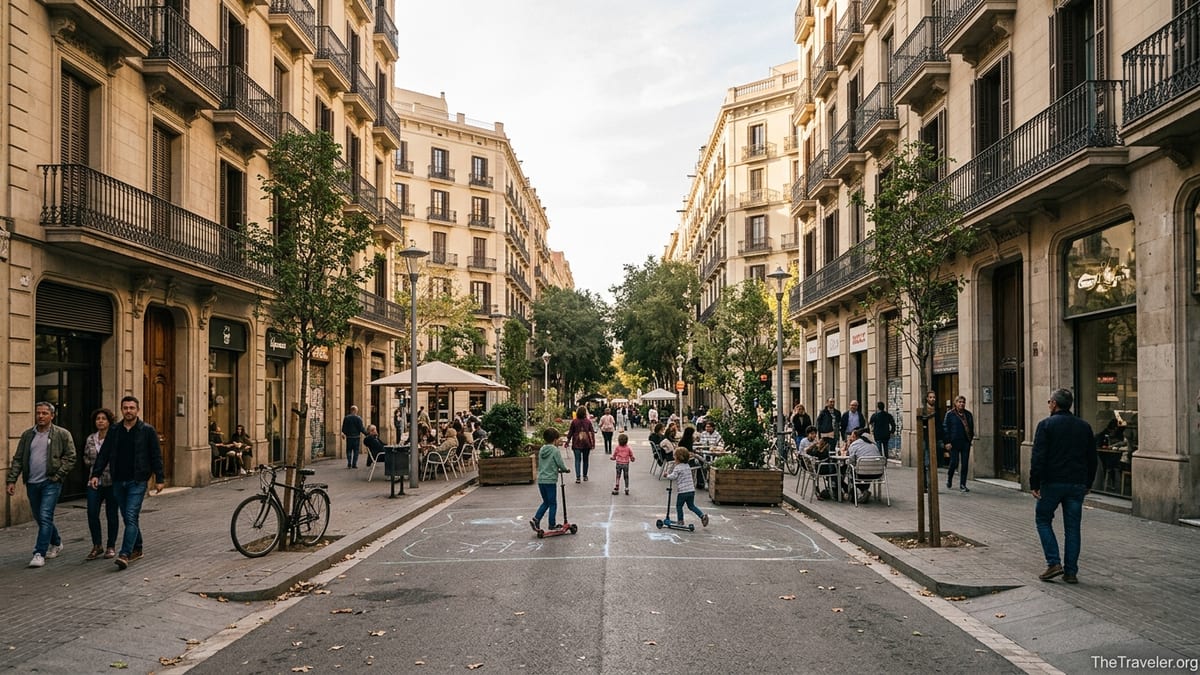
Eixample: The Framework of a Livable Barcelona
Eixample, literally “the expansion,” is the grid that unfurls between the medieval core and the once-separate villages of Gràcia, Sants and Sant Andreu. Designed in the mid 19th century by engineer Ildefons Cerdà, it was conceived as a health-minded alternative to the cramped old town, with broad streets, chamfered corners and inner courtyards to encourage light and air. Today, that same plan underpins what many residents consider the city’s most livable everyday landscape, even as tourists hurry through on the way to marquee sights.
Walk a few blocks away from Passeig de Gràcia and the mood shifts from sightseeing corridor to lived-in neighborhood. In La Nova Esquerra de l’Eixample, families push strollers under plane trees, office workers crowd traditional lunch spots that still offer a fixed menú del dia for around 15 to 20 euros, and older residents occupy the same cafe tables every morning. For visitors who stay here rather than just transit across it, the city’s rhythms become legible: bakeries opening at seven, school bells at nine, kids playing on corner squares until late evening in spring and autumn.
Because of its central position, Eixample also stitches together the pieces of Barcelona that short-stay visitors often keep separate. From a hotel near Girona or Universitat metro, you can walk to the Sagrada Família in around 20 minutes, wander down to the Gothic Quarter in roughly the same time, or head up to Gràcia’s village-like streets without ever needing a taxi. For many residents, this walkable connectivity is not just a convenience, it is part of what makes the district livable: the city’s highlights are close, but home streets remain primarily for locals.
Cafes, Markets and Everyday Life Between the Icons
Guidebooks steer you to Gaudí landmarks such as Casa Batlló and La Pedrera along Passeig de Gràcia, but life in Eixample is often most visible between those famous postcards. Around the Mercat del Ninot in Esquerra de l’Eixample, for instance, workers in reflective vests rub shoulders with suited office staff as they pick up produce, fresh fish and cut-to-order jamón. Visitors who rent nearby apartments quickly learn that a morning coffee at the market bar, for around 1.50 to 2 euros, is as much a ritual of greetings and gossip as it is a caffeine stop.
In Sant Antoni, on the southwest edge of Eixample, the restored iron-and-glass market hall anchors one of the district’s most beloved areas. On Sundays, the perimeter fills with stalls selling second-hand books and comics, a tradition that long predates low-cost flights. Around it, streets such as Carrer del Parlament and Comte Borrell have evolved into a strip of brunch cafes, natural wine bars and Catalan bistros that stay resolutely grounded in the neighborhood. Prices reflect a local clientele: you might pay 12 to 15 euros for a generous weekend brunch plate, or share a bottle of Catalan wine with tapas for under 30 euros at a small bar where the staff greet regulars by name.
By late afternoon, you see another side of Eixample’s livability: grandparents collecting children from school, then detouring to playgrounds built into the interiors of blocks or onto pocket plazas where cars have been restricted. Parents linger on benches while children climb low walls and improvise games. For visitors staying in buzzy but more tourist-heavy zones like Barceloneta or El Born, spending an early evening hour on one of these Eixample squares can feel like stepping briefly into the city’s family living room.
Superblocks and Green Axes: How Eixample Is Being Reclaimed
Over the past decade, Eixample has become central to Barcelona’s high-profile Superilla, or superblock, program. City planners have been selectively transforming sections of the grid by restricting through traffic on certain streets, widening sidewalks and adding trees, benches and play areas. The Sant Antoni superblock, around the market of the same name, is one of the most visible examples: once a busy car corridor, it is now a network of calmer streets where children scooter in chalked play zones and cafe terraces spill into former parking spaces.
Another emblematic project is the conversion of long stretches of Carrer del Consell de Cent into a so-called living street. Here, car access is limited and much of the asphalt has been quietly handed back to pedestrians through patterned paving, planters and frequent crossings. For travelers, this means you can walk from Passeig de Sant Joan across parts of Eixample towards Plaça d’Espanya almost entirely along human-scale streets, rather than navigating traffic-clogged junctions. The transformation is ongoing and sometimes contentious, but it underlines a political priority: keeping the district livable for residents as visitor numbers climb.
These superblocks are not grand set-piece parks. They are tactical adjustments woven into the everyday grid, intended to improve air quality and reduce noise in what was historically one of Barcelona’s most traffic-choked districts. For a visitor sitting under a young jacaranda tree on a former traffic lane in Sant Antoni, the impact is tangible rather than theoretical. You hear conversations rather than engines, and the soundtrack is skateboard wheels on pavement, dogs’ collars clinking, and the hiss of the coffee machine at the corner bar.
Architecture Beyond the Postcards
Eixample’s reputation is often reduced to a checklist of Modernisme icons. While Casa Batlló, La Pedrera and the Sagrada Família are essential, the district’s architectural interest runs far deeper and is part of why locals value it. Many residential buildings from the late 19th and early 20th centuries share elegant stone or stucco facades with wrought-iron balconies and carved doors, even when their ground floors now house a neighborhood bakery or a modest locksmith instead of bourgeois salons. Strolling streets such as Carrer d’Enric Granados or Carrer de València, you can glimpse tiled vestibules and original lifts behind heavy wooden doors left ajar in the heat.
The grid itself shapes how people live with architecture. Chamfered corners create small extra spaces at every intersection, often used for cafe terraces or taxi ranks, while interior courtyards offer residents rare pockets of shared greenery and quiet. This mixture of monumental and domestic architecture is one reason why locals often describe Eixample as both “elegant” and “normal” in the same breath. You can do your weekly grocery shop in a ground-floor supermarket beneath an ornate façade that, in other cities, might be reserved for a museum.
For travelers who care about built environments, using Eixample as a base allows for incremental discovery rather than a single, concentrated visit. One day you might tour a famous Modernista house with a timed-entry ticket; another, you might simply look up while walking to dinner and notice how a row of balconies curves like a stone wave along an otherwise unremarkable residential block. Many of these quieter facades are unlisted in guidebooks, yet they are part of the reason residents are willing to defend building regulations and height limits that maintain light and ventilation between blocks.
Staying in Eixample: What It Feels Like on the Ground
In practical terms, choosing to stay in Eixample rather than inside the medieval tangle of the Gothic Quarter changes the feel of a Barcelona trip. Accommodation here ranges from design-led boutique hotels off Passeig de Gràcia to simpler pensions and short-term rentals on residential streets like Carrer de Còrsega or Gran Via. Nighttime noise levels are typically lower than in the old town or along the seafront, with many side streets quiet after midnight except for the occasional motorbike or late diner heading home.
From a visitor’s perspective, walkability and transport access are key advantages. Metro lines and bus routes lace through the neighborhood, but many major sights are close enough to reach on foot. From a hotel near Provença or Diagonal, for example, the walk to Sagrada Família might take about 15 minutes, while Casa Batlló is perhaps 10 minutes in the other direction and the Gothic Quarter 20 to 25 minutes downhill. That means fewer transfers on public transport and more time experiencing the city at street level, where you are more likely to pause at a local bakery or wine shop than if you simply surfaced at the nearest metro station.
Prices in Eixample tend to reflect its centrality and comfort. A mid-range hotel room in high season may cost from around 150 to 250 euros per night, occasionally more along Passeig de Gràcia where luxury brands cluster. Food, however, can be surprisingly reasonable away from marquee avenues: a set lunch with starter, main, dessert and wine at a long-established neighborhood restaurant might run 15 to 20 euros, and a glass of vermut at a standing-only bar is often under 3 euros. For many travelers, that balance of slightly higher accommodation costs with more down-to-earth daily spending feels like a fair price for sleeping where locals live.
Micro-Neighborhoods: Sant Antoni, Esquerra and Dreta
Eixample is not a monolith, and understanding its sub-districts helps travelers match the area to their style. Sant Antoni, at the southwestern edge, is fashionable but grounded, known for its iconic covered market, the pedestrian-friendly streets of the superblock, and a mix of brunch spots, natural wine bars and traditional bodegas. It suits visitors who enjoy being surrounded by young local families and creative professionals, and who do not mind walking or riding a few metro stops to the beach.
Esquerra de l’Eixample, the “left” side looking uphill from the sea, is largely residential and slightly calmer, with clusters of restaurants and bars around streets such as Carrer d’Enric Granados and Aribau. Parts of it have a lively LGBTQ+ scene, especially on weekend nights, while other stretches feel almost sleepy. For many residents, it is a place where you can live close to the center while still knowing your baker, pharmacist and cafe owner by name. Visitors who choose this area often mention how easy it feels to return late at night compared with some of the more touristed quarters.
Dreta de l’Eixample, the “right” side, contains many of the district’s most photographed Modernista buildings and several of its grandest hotels. Passeig de Gràcia and Rambla de Catalunya form busy spines of shopping and dining, where international brands and fine-dining restaurants occupy heritage buildings. Just one or two streets back, however, you quickly find residential blocks with simpler local restaurants, greengrocers and household shops. Staying here suits travelers who want fast access to major sights and do not mind brisker foot traffic during the day, but who still value the relative calm of side streets at night.
Why Skipping Eixample Distorts Your Picture of Barcelona
When visitors confine their stay to the Gothic Quarter, El Born or the seafront, they often leave with a specific and sometimes skewed impression of Barcelona: a dense, relentlessly busy, nightlife-driven city with narrow alleys and little space to breathe. While those areas are important chapters in Barcelona’s story, they represent only one side of it. Eixample offers a counterweight, revealing a city that is orderly rather than chaotic, residential rather than purely touristic, and increasingly focused on walkability and public space.
By ignoring Eixample, you also miss how Barcelona is trying to manage tourism at scale. The spread of hotel development along main Eixample avenues, and the creation of pedestrian-priority streets and green axes within the grid, are deliberate attempts to distribute visitor pressure while improving conditions for locals. Seeing this in person, rather than just reading about it as an abstract policy, can change how you understand the city. A walk along a newly calmed section of Consell de Cent, lined with trees and benches where there were once four lanes of traffic, tells you as much about Barcelona’s future as any museum exhibition.
Finally, Eixample is where many of the city’s daily negotiations between tradition and change play out. Longstanding bodegas coexist with contemporary natural wine bars, and old-fashioned dairy shops survive beside international coffee chains. For a traveler, spending even a few days based here can make the city feel less like a stage set and more like a place where people build lives. That sense of continuity and everyday routine is as much a reason to travel as any monument.
The Takeaway
No single neighborhood can stand in for Barcelona. The Gothic Quarter, El Born, Barceloneta and Gràcia each add their own texture. Yet Eixample, with its rational grid, evolving superblocks, Modernista facades and unselfconscious daily life, is the framework that binds the city together. To treat it as merely the space you cross between sights is to miss the very qualities that make Barcelona livable for the people who call it home.
Choosing to stay, eat and linger in Eixample allows you to experience the city’s quieter tempo, from morning coffee rituals at local bars to evening strolls along traffic-calmed streets that still smell faintly of orange blossom in spring. It puts you within easy reach of major attractions while surrounding you with the routines of residents rather than the itineraries of tour groups. For many repeat visitors, that combination is what transforms Barcelona from a spectacular weekend destination into a city they imagine themselves inhabiting.
FAQ
Q1. Is Eixample a good area to stay in for first-time visitors?
Yes. Eixample is central, well connected by metro and bus, and offers a quieter, more residential atmosphere than the Gothic Quarter or the beachfront while still being within walking distance of major sights.
Q2. How expensive is it to stay in Eixample compared with other parts of Barcelona?
Accommodation in Eixample generally costs a bit more than in some outlying neighborhoods, especially along Passeig de Gràcia, but prices are often lower than waterfront luxury hotels and similar to or slightly above those in the Gothic Quarter.
Q3. Is Eixample safe at night?
Eixample is widely regarded by locals as one of Barcelona’s safer central districts, with broad, well-lit streets and a largely residential population, though normal big-city precautions still apply.
Q4. What is the easiest way to get from Eixample to the beach?
You can take the metro from Eixample stations such as Passeig de Gràcia, Universitat or Girona to Barceloneta or other seaside stops in around 20 to 30 minutes, or use buses that run down to the waterfront.
Q5. Are there many restaurants and cafes in Eixample, or will I need to go elsewhere to eat?
Eixample is full of local cafes, bakeries, tapas bars and restaurants, from traditional Catalan dining rooms to modern brunch spots, so you can easily eat most meals within a few blocks of where you stay.
Q6. What is a superblock, and where can I see one in Eixample?
A superblock is a group of streets where through traffic is restricted to create more space for pedestrians, greenery and play areas; in Eixample, the Sant Antoni superblock and sections of Carrer del Consell de Cent are good examples to explore.
Q7. How long does it take to walk from Eixample to the Gothic Quarter?
From many points in central Eixample, such as near Universitat or Passeig de Gràcia, the walk to the Gothic Quarter typically takes around 15 to 25 minutes, depending on your exact location and pace.
Q8. Is Eixample suitable for families with children?
Yes. Eixample’s wide sidewalks, frequent playgrounds, calmer superblock streets and easy access to parks and public transport make it a practical and comfortable base for families.
Q9. What kind of nightlife can I expect in Eixample?
Eixample’s nightlife is more focused on bars, wine spots and late dinners than on large clubs, with some livelier areas, especially around parts of Esquerra de l’Eixample, but overall a more relaxed scene than in El Raval or along the beachfront.
Q10. If I have only two days in Barcelona, is it still worth spending time in Eixample?
Yes. Even with a short stay, basing yourself in Eixample or dedicating a half day to walking its streets lets you see how locals live and understand the city beyond its most crowded tourist zones.