


More news on this day
A simulated train derailment on a Huntsville-area rail corridor has put first responders and emergency managers through a demanding regional drill designed to test how well the community could cope with a real rail disaster.
Get the latest news straight to your inbox!
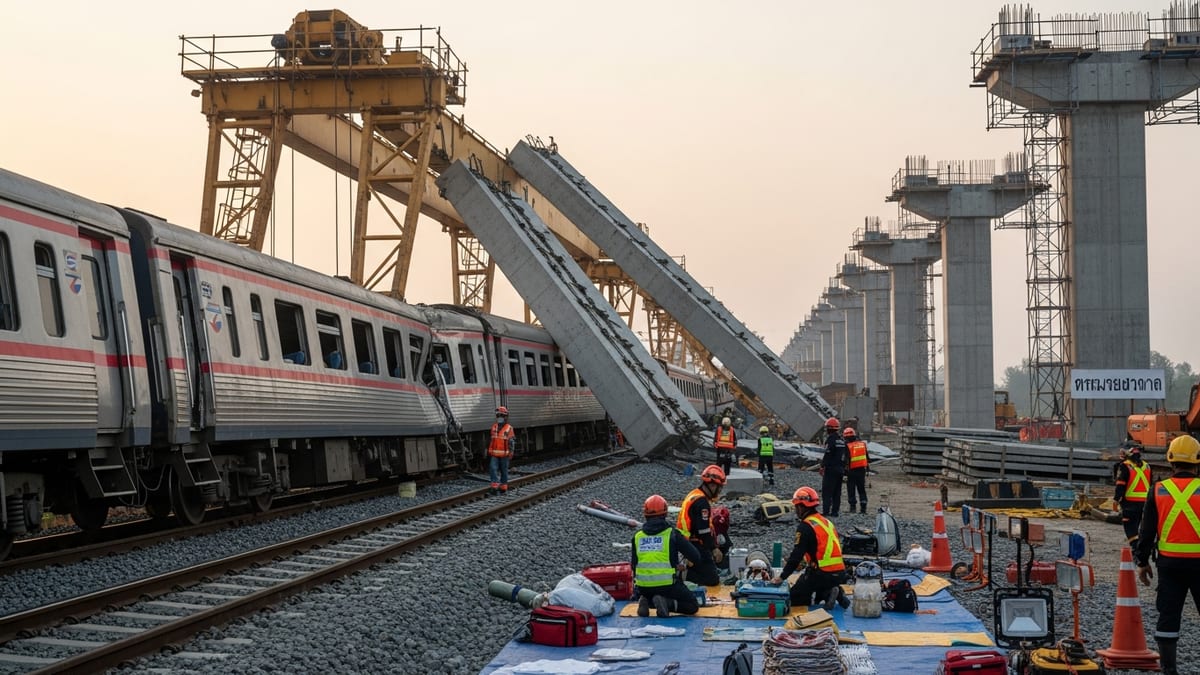
Complex rail scenario staged for first responders
The recent exercise centered on a mock derailment involving multiple freight cars along a busy line serving the Huntsville region. Planning materials show that the scenario was built to mirror realistic risks facing communities where heavy freight, industrial shipments and growing commuter traffic converge near residential neighborhoods and key roadways.
Publicly available information indicates that participants were asked to manage a derailment that blocked road crossings, created a mass-casualty potential and raised initial questions about possible hazardous materials. Organizers structured the drill so that dispatch centers, on-scene commanders and regional coordinators had to make rapid assessments with limited early information, reflecting the confusion typical of an actual incident.
Exercise documentation and regional planning guidance suggest that the training followed national standards for full-scale drills, including scripted injects, safety controllers on site and independent evaluators tracking the performance of each participating agency.
Multiple agencies converge on simulated disaster
The drill brought together a broad mix of agencies that would likely respond to a real Huntsville-area derailment. Regional fire departments, emergency medical services, law enforcement, local emergency management officials and hospital representatives trained alongside rail personnel and hazardous materials specialists.
According to published coverage of similar exercises in Alabama and other states, these multiagency drills are designed to test not just technical skills but also how well organizations communicate during a fast-moving crisis. Radio interoperability, common terminology and clear incident command roles are recurring points of emphasis.
Observers note that the Huntsville area sits at the intersection of key transportation and industrial corridors, which increases the importance of coordination between municipal agencies, county emergency management offices, state partners and rail operators. The drill environment allowed those relationships to be tested in real time, without the consequences of an actual emergency.
Focus on hazardous materials, evacuation and medical surge
Recent national guidance on rail incidents highlights three critical challenges for communities: hazardous materials, evacuation decisions and medical surge. The Huntsville-area drill incorporated each of these elements to give responders an opportunity to practice complex decision making.
Scenario planners introduced the possibility of hazardous cargo in the rail consist, requiring teams to identify railcars, consult reference materials and coordinate with railroad representatives. Responders were encouraged to think through protective actions for the public, including when to shelter nearby residents in place and when to consider evacuation of homes, schools or workplaces along the rail corridor.
Medical components of the exercise stressed triage, treatment and transportation of simulated patients to Huntsville-area hospitals. Regional healthcare preparedness plans call for hospitals to be able to absorb a sudden surge of patients from incidents such as a derailment, and drills of this type provide an opportunity to test registration, decontamination procedures if needed, and communication between field units and emergency departments.
Lessons tied to broader Alabama preparedness efforts
The drill also linked into broader emergency preparedness efforts underway across Alabama. State and regional programs promote regular full-scale exercises for rail, highway and industrial incidents, and the Huntsville exercise fit within that larger framework of training and planning.
Publicly available materials from state emergency management and health preparedness initiatives describe a push to strengthen local planning around transportation corridors, especially where freight traffic passes close to populated areas. The Huntsville-area rail line used for the drill is one of several in north Alabama that carry significant freight volumes, reinforcing the relevance of the scenario.
Exercise after-action processes are expected to identify where communication, training or equipment can be improved. Communities that have conducted similar drills often report changes to local response plans, updates to contact lists with rail companies, and additional training for front-line firefighters and medics as direct outcomes.
Technology, training and community awareness
The Huntsville-area derailment drill also underscored the growing role of technology in rail emergency response. National rail safety initiatives promote the use of specialized applications and digital tools that help first responders quickly determine what a train is carrying and what protective actions may be required.
Regional training efforts encourage responders to combine those tools with traditional skills such as railcar identification, plume modeling and field monitoring around a derailment site. Exercises like the one conducted near Huntsville are designed to ensure that those methods can be applied under pressure, with multiple agencies working side by side.
For local residents, the drill serves as a reminder that rail safety planning stretches well beyond rail crossings and signals. Emergency managers often use these exercises to refine public alert procedures and to update guidance on how communities should respond if an actual derailment occurs nearby.