


More news on this day
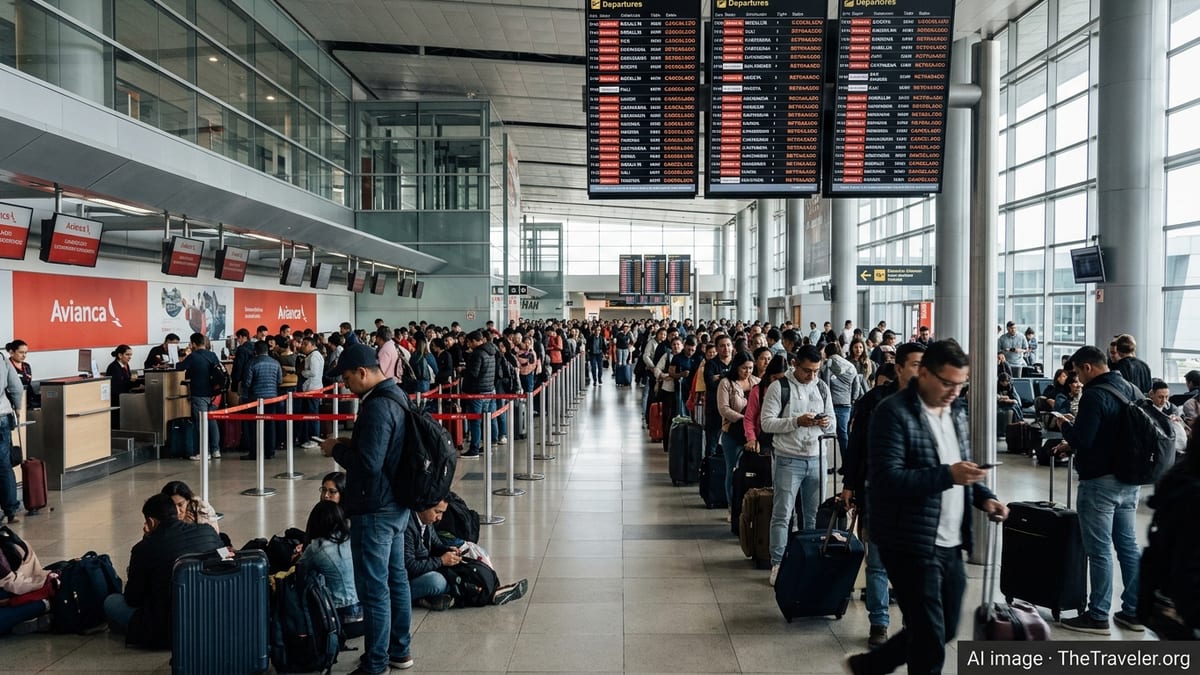
Operations at Bogotá’s El Dorado International Airport were severely disrupted on June 30, 2026, as publicly available data showed 102 delayed flights and seven cancellations affecting Avianca, LATAM Airlines, Iberia and several other carriers on key links to Madrid, Mexico City and regional hubs.
Get the latest news straight to your inbox!
Wide-Ranging Disruptions Across Avianca, LATAM and Iberia
The latest disruption at El Dorado International Airport has hit both domestic and international traffic, with hub carriers bearing the brunt of the operational strain. Reports indicate that Avianca, which uses Bogotá as its primary hub, accounted for the largest share of delayed and cancelled services, including long-haul departures and regional connections serving secondary Colombian cities.
LATAM Airlines services were also affected, particularly on high-frequency domestic routes linking Bogotá to Cartagena, Cali and Medellín, as well as selected regional links in northern South America. Iberia and other transatlantic operators saw knock-on effects on flights connecting Bogotá with Madrid and other European gateways, compounding congestion in already busy summer schedules.
The concentration of delays among hub airlines underscores how disruption at El Dorado rapidly cascades through the wider Latin American network. With Avianca and LATAM operating extensive banks of connecting flights, any prolonged irregular operation at Bogotá can quickly affect passengers traveling between South America, North America and Europe.
According to published coverage, airport management indicated that staff and airline employees continued normal processing of operations, even as the volume of delayed services placed visible pressure on ground handling, gate availability and passenger services across the terminals.
Long-Haul Routes to Madrid and Mexico City Under Pressure
Among the most closely watched services were flights between Bogotá and Madrid, a route jointly served by Avianca and Iberia and regarded as one of the most important long-haul corridors for Colombian travelers and Europe-bound transit traffic. Publicly available flight-status information showed schedule changes and extended ground times, increasing uncertainty for passengers with onward connections in Spain and across the European network.
Mexico City links were similarly affected, with delays reported on services connecting Bogotá to the Mexican capital and beyond. These routes are critical for business and leisure travelers moving between the Andean region, Central America and North America, and any operational bottleneck in Bogotá can quickly ripple across itineraries involving multiple carriers and alliance partners.
Industry observers note that long-haul flights are particularly vulnerable during large-scale disruption because they often operate at or near full capacity during peak seasons. When a flight is significantly delayed or cancelled, rebooking options may be limited, leaving travelers stranded or requiring overnight stays as airlines attempt to reposition aircraft and crew.
Analysts tracking flight performance at El Dorado point out that the airport’s elevation, weather patterns and dense traffic mix increase the complexity of managing punctuality on intercontinental routes. When irregular operations occur on the ground, knock-on effects can appear hours later at distant hubs such as Madrid and Mexico City, where crews, aircraft rotations and connecting passengers must be re-accommodated.
Passenger Experience: Missed Connections and Overnight Disruptions
The scale of Monday’s disruption left many travelers facing missed connections, extended layovers and last-minute itinerary changes. Travel forums and social media posts from recent weeks already reflect growing concern about tight connection windows at El Dorado, with some passengers highlighting experiences in which even two- to three-hour layovers proved insufficient when delays accumulated across the network.
In this latest episode, the 102 recorded delays triggered a familiar pattern: passengers racing between gates, long lines at airline service counters and increased demand for hotel accommodation and meal vouchers as schedules unraveled. For those connecting to long-haul flights to Europe or North America, a missed departure often meant waiting until the following day, given limited seat availability in the peak season.
Publicly available information on airline customer policies shows that carriers such as Avianca and LATAM typically offer rebooking on the next available flight, and in certain cases refunds or rerouting options, when disruptions meet defined thresholds. However, recent passenger accounts suggest that high call volumes, congested airport counters and limited spare capacity can make it challenging to secure swift alternatives during widespread disruption.
Consumer advocates note that the experience at El Dorado mirrors patterns seen at other major hubs when multiple airlines are affected at once. Travelers are urged to monitor flight status frequently, maintain extra buffer time for connections in Bogotá and consider travel insurance or flexible tickets that allow changes when irregular operations occur.
Operational Strain at a Key South American Hub
El Dorado International Airport is one of Latin America’s busiest hubs and a critical connector for traffic between South America, North America and Europe. Publicly available airport data highlight its role as a base for Avianca and LATAM’s Colombian operations, as well as a key station for foreign carriers linking Bogotá with cities such as Madrid, Mexico City, Miami and São Paulo.
The current flare-up of delays follows earlier episodes in 2026 in which weather, airspace restrictions and isolated operational incidents, such as temporary airspace closures related to drone sightings, have periodically strained the airport’s capacity. Each event has contributed to a narrative of mounting pressure on Bogotá’s primary gateway, particularly during peak travel periods.
Analysts who track regional aviation performance point out that operating a high-altitude, high-traffic airport such as El Dorado requires robust coordination between air traffic management, airport operators and airlines. When demand is strong and schedules are tightly banked to facilitate connections, any disturbance can quickly overwhelm available slack in the system, producing clusters of delayed departures and arrivals.
Recent on-time performance data for some Avianca and LATAM flights operating from Bogotá show modest average delays, but with significant variability from day to day. The June 30 event, with more than one hundred flights delayed, illustrates how volatility rather than long-term averages often defines the passenger experience at major hub airports.
What Travelers Through Bogotá Should Expect Next
With summer demand building across Latin America and the transatlantic market, industry observers expect continued pressure on Bogotá’s hub operations in the coming weeks. Airlines are likely to review aircraft rotations, crew schedules and contingency plans to reduce the risk of cascading delays similar to those seen on June 30.
For travelers with upcoming itineraries through El Dorado, publicly available guidance from airlines and travel experts emphasizes several practical steps. These include selecting itineraries with more generous connection times, regularly checking flight status on official airline channels and arriving early for check-in and security, particularly for morning and late-evening departure banks when congestion is often highest.
Travel planners also caution that disruptions in Bogotá can generate secondary effects on other hubs, including Madrid and Mexico City, as late-arriving aircraft and displaced passengers strain capacity on subsequent departures. Passengers beginning their journeys in Europe or North America are therefore encouraged to keep an eye on conditions at El Dorado even if their own departure airport appears to be operating normally.
While Monday’s wave of delays and cancellations has highlighted the fragility of tightly scheduled hub operations, it has also renewed discussion in Colombia about long-term infrastructure needs, airspace modernization and the balance between aggressive network growth and operational resilience. For now, travelers passing through Bogotá are likely to factor greater uncertainty into their plans as airlines work to stabilize their schedules after the latest disruption.