


Across the Hudson River from one another, New Jersey’s Empty Sky Memorial in Liberty State Park and New York City’s 9/11 Memorial at the World Trade Center both confront visitors with the absence left by September 11, 2001. Many travelers with limited time in the area ask a surprisingly difficult question: which experience feels more powerful? The answer depends on what kind of encounter you are seeking with that history, how much time you have, and even how you feel about crowds, cost, and emotional intensity.
Get the latest updates straight to your inbox!
Understanding the Two Memorials
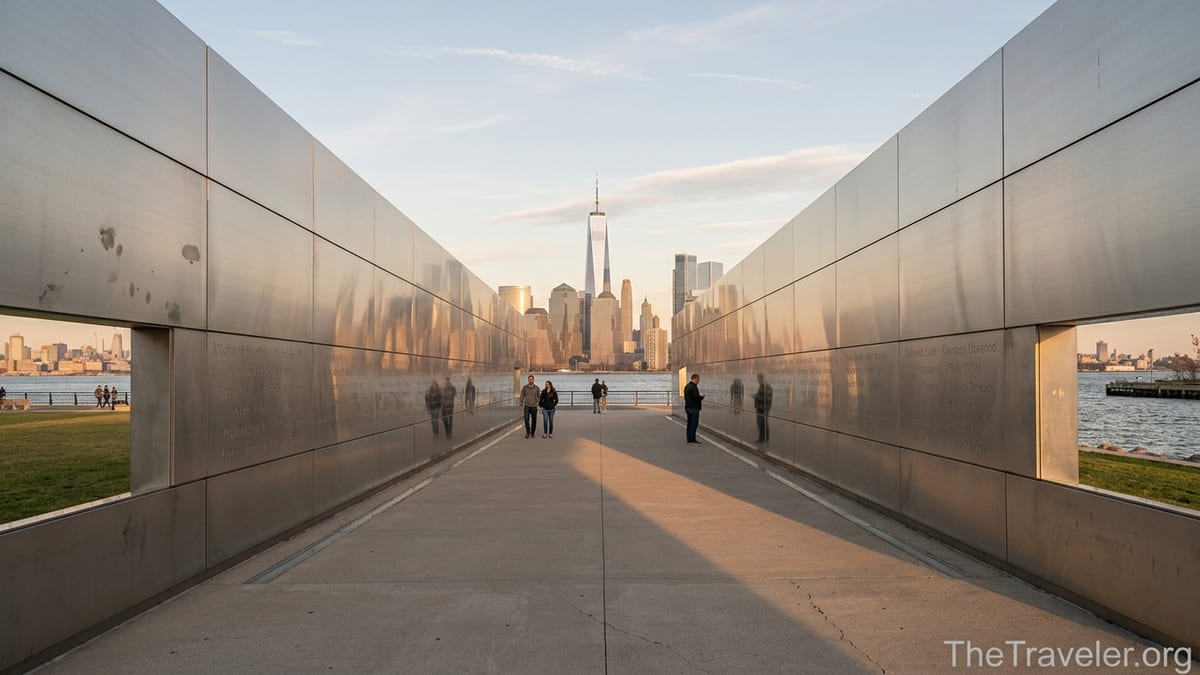
Empty Sky is New Jersey’s official 9/11 memorial, set inside Liberty State Park in Jersey City, directly across the Hudson River from Lower Manhattan. Two parallel stainless-steel walls, each about 210 feet long and 30 feet high, form a corridor that points your gaze toward the spot where the Twin Towers once stood. The names of the 749 New Jersey residents who died in the attacks are etched into the inner surfaces of those walls at hand height, inviting quiet touch and close reading.
The 9/11 Memorial in New York, officially the National September 11 Memorial, occupies the exact footprints of the Twin Towers at the World Trade Center site. Here, two vast square reflecting pools, each nearly an acre in size with waterfalls plunging into a central void, sit within a plaza planted with hundreds of swamp white oak trees. The bronze parapets around the pools carry the names of 2,983 people killed in both the 2001 attacks and the 1993 World Trade Center bombing.
Both memorials opened in 2011, on or around the tenth anniversary of the attacks, after international design competitions. Each is free to visit and permanently open as a public space, though they sit in very different urban contexts. Empty Sky occupies a broad waterfront park used by joggers, cyclists and local families; the 9/11 Memorial anchors one of the busiest redevelopment projects in the United States, surrounded by office towers, the Oculus transit hub and a stream of commuters and tourists.
Because of that difference in setting, many travelers experience Empty Sky as a more contemplative, almost hidden site, and the 9/11 Memorial as a central civic space that folds remembrance into the daily life of New York. Which one feels more powerful to you may come down to whether you lean toward intimate reflection or standing at the literal center of the story.
Atmosphere and Emotional Intensity
Empty Sky’s power is bound up in its quiet. On a weekday morning, you may find only a jogger passing by or a single visitor standing in the corridor, reading a name. The polished steel reflects the changing sky and the Manhattan skyline behind you, while the open lawn and river soften city noise. Travelers often note that they can hear footsteps and wind, but little else. If you want space to process memories or talk in a low voice with family, this memorial gives you room to do that without feeling watched or hurried.
The 9/11 Memorial in Lower Manhattan is rarely quiet in the literal sense. The steady roar of the twin waterfalls may drown out some of the street sounds, but you are typically sharing the space with hundreds of other visitors, tour groups and office workers cutting across the plaza. The hum of different languages mixes with the sound of the water. For some visitors, that living urban backdrop reinforces the memorial’s meaning: life has returned to the site, but the pools remain as a permanent absence at its center.
Emotional intensity at the New York memorial often spikes if you visit the underground museum as well. After spending an hour or more among artifacts like twisted steel beams, damaged fire trucks and recorded phone calls from that day, stepping back out to the pools can feel overwhelming. Many people report that they need time to decompress afterwards, perhaps by walking down to the nearby waterfront or sitting quietly in Battery Park.
In contrast, Empty Sky offers a gentler arc of emotion. Travelers staying in Jersey City or visiting the Statue of Liberty from Liberty State Park sometimes wander over to the memorial without fully planning to, then find themselves unexpectedly moved by the names and the direct view of the gap in the skyline. Because there is no museum attached, you can easily stay ten minutes or an hour, depending on how you feel, without having to commit to a long indoor visit.
Design, Symbolism and How They Shape Your Experience
The design of Empty Sky focuses your body and your gaze in one direction. Entering the corridor, you walk on a gently sloped path that was once a grassy embankment. The height and length of the walls echo the Twin Towers, but instead of mass, you are surrounded by reflected light and engraved names. Looking straight ahead, the opening at the far end frames the Manhattan skyline and the place where the towers stood, now largely occupied by One World Trade Center. It is a deliberate act of alignment between New Jersey and New York, victims and site.
The 9/11 Memorial’s pools embody a different kind of symbolism. Each waterfall flows down the inner walls and then disappears into a smaller square void in the center, a “void within a void” that many interpret as representing lives cut short and stories that can never be fully known. The parapets are designed so visitors can touch the cut-out names, and on birthdays, staff place a white rose in the slot of the name being remembered that day. This small human ritual, easy to spot from the edge of the pools, often catches visitors by surprise.
Because the New York memorial sits exactly where the towers rose, your experience is shaped by that direct physical continuity. Many visitors who watched the attacks on television or lived in the city at the time describe a visceral sense of orientation there: you are standing where the events unfolded. By contrast, Empty Sky’s power lies in distance. You occupy the vantage point from which many in New Jersey watched the smoke and falling towers across the river on 11 September 2001.
In practice, that means Empty Sky may resonate more deeply if you are curious about how the tragedy affected communities beyond Manhattan or if you prefer symbolism that leaves more room for personal interpretation. The 9/11 Memorial, particularly when paired with the museum, offers a more explicit narrative about the events and aftermath, supported by detailed exhibits and official timelines.
Practicalities: Cost, Access and Crowds
Both memorial plazas are free to enter. Empty Sky sits inside Liberty State Park, which charges a modest weekday parking fee at its main lots but is otherwise open to the public. You can reach it by car in around 15 to 25 minutes from many parts of Jersey City or Newark, depending on traffic, or by taking the Hudson-Bergen Light Rail to Liberty State Park station and walking or biking through the park. Visitors catching the Statue of Liberty or Ellis Island ferry from Liberty State Park often plan time at Empty Sky before or after their boat trip.
The 9/11 Memorial plaza in Manhattan also has no admission fee and is open daily with set visiting hours that change seasonally. However, many travelers choose to add the 9/11 Museum, located beneath the plaza. Adult tickets are around the price of a typical New York museum visit, with discounts for children, students and seniors, and free timed entry on select weekday evenings that must be reserved in advance. For budget-conscious travelers, third-party attraction passes sometimes bundle the museum with observatories or harbor cruises, but you should check whether that forces you into specific time slots.
Crowds are a key difference. At Peak times like weekend afternoons in spring and fall, the 9/11 Memorial and surrounding streets can feel as busy as Times Square, especially when school groups and international tours converge. Security screening for the museum adds another layer of queuing and bag checks. At Empty Sky, by contrast, “crowds” might mean two or three other families spread out along the corridor. On cold winter days or early mornings, you may have the memorial almost to yourself.
If you are particularly sensitive to noise or prefer to grieve or reflect in private, that contrast matters. Some travelers who found the New York site emotionally important but logistically overwhelming later describe Empty Sky as the visit where they could finally take a deep breath and sit with their feelings.
Travel Scenarios: Which Memorial Fits Your Trip?
Imagine you are in New York City for a first-time, four-day visit, staying near Midtown and relying on the subway. In that scenario, the 9/11 Memorial is the obvious choice. You can ride a downtown train to the World Trade Center, spend 30 to 60 minutes walking the plaza, and decide on the spot whether to visit the museum based on time and emotional bandwidth. You are close to other major sights like Wall Street, the Staten Island Ferry and the Brooklyn Bridge, so the memorial can anchor a full day in Lower Manhattan.
Now picture a family from New Jersey staying with relatives in Jersey City who want to honor 9/11 without navigating Manhattan with young children. For them, Empty Sky might be the better primary destination. They can drive to Liberty State Park, let kids run off energy on the lawns or playgrounds, then walk together to the memorial. From the corridor, parents can quietly explain where the towers once stood, pointing across the river. If everyone feels ready, they can take a short ferry ride to the Statue of Liberty from the same park, linking the story of loss with symbols of resilience and freedom.
Another common scenario involves repeat visitors to New York. Many travelers who have already been to the 9/11 Memorial and Museum later seek a different perspective. On a second or third trip, they might book a hotel in Jersey City near the Exchange Place or Grove Street PATH stations, enjoy views of Manhattan from a quieter waterfront, and walk or bike along the Hudson Riverfront Walkway to Empty Sky around sunset. Seen this way, the New Jersey memorial becomes part of a slower, more reflective urban escape.
In each case, the “more powerful” experience is not fixed; it depends on how the memorial meshes with the rest of your day, your companions and your own relationship to the events of 2001. Treat both spaces not as quick photo stops but as intentional pauses, and you are more likely to find meaning whichever side of the river you stand on.
Time of Day, Weather and Photography
At both memorials, natural light and weather dramatically influence the mood. At Empty Sky, early morning often brings soft, slanting sunlight that glances off the stainless-steel walls and creates long shadows in the corridor. On clear days, the skyline appears crisp in the opening at the far end, and reflections of clouds trace across the metal. Around sunset, golden light catches the names and warms the otherwise cool surfaces, while the towers of Lower Manhattan begin to glow behind you.
The 9/11 Memorial’s reflecting pools are particularly striking in late afternoon and at dusk, when office lights blink on in the surrounding towers and the waterfalls take on a slightly luminous quality. On overcast or rainy days, the falling water and dark stone feel even more somber, and visitors with umbrellas tend to move more slowly and speak more softly. Snow can transform the plaza into a monochrome landscape, with the pools and Survivor Tree standing out in stark contrast.
Photographers should be mindful that both sites are places of mourning, not backdrops. At the New York memorial, security staff may intervene if behavior feels disrespectful, such as climbing on parapets or staging playful group shots. A good rule of thumb is to photograph as you would at a war cemetery or Holocaust memorial: focus on details, avoid posing on names, and keep flashes off inside the museum. At Empty Sky, where there is less oversight, the responsibility falls even more on visitors to maintain a respectful tone.
From a purely visual standpoint, Empty Sky offers more expansive skyline compositions, especially if you walk a few steps away and frame the corridor with the Hudson River and One World Trade Center in the distance. The 9/11 Memorial, hemmed in by tall buildings, lends itself to closer, more abstract images: water streaming over stone, fingertips tracing a name, a single rose in bronze. Either way, try to allow time without the camera as well, so you can experience the spaces directly.
Combining Both Memorials in One Day
Travelers with a full day to devote to 9/11 remembrance can experience both memorials without rushing, especially if they start early. One practical route from Manhattan is to visit the 9/11 Memorial and Museum in the morning, then take the PATH train from the World Trade Center to Exchange Place or Grove Street in Jersey City, followed by the Hudson-Bergen Light Rail or a taxi to Liberty State Park. From there, it is a short walk to Empty Sky along paths with uninterrupted skyline views.
Doing the day in that order means you encounter the most intense, information-heavy experience first, then walk and ride your way into a calmer, more spacious setting. After the museum’s underground galleries, stepping into Liberty State Park’s open fields and river breezes can feel like a release. Many visitors find that standing at Empty Sky in late afternoon light helps them process what they saw earlier beneath the World Trade Center plaza.
Budget-wise, this combined itinerary adds only local transit fares and perhaps parking at Liberty State Park if you are driving. Food options are more abundant around the New York memorial, so consider having a proper meal after your museum visit before heading to New Jersey. In Liberty State Park, seasonal kiosks and nearby neighborhoods offer limited but sufficient choices, or you can pack a simple picnic to eat on the grass overlooking the water.
If your time is shorter, you might need to choose. In that case, ask yourself: do you want the depth of an internationally recognized museum, artifacts and extensive interpretation, or a leaner, more symbolic encounter where the landscape and skyline carry much of the story? Your answer will point you toward the memorial that is more likely to feel powerful for you.
The Takeaway
Standing at Empty Sky and at the 9/11 Memorial are not interchangeable experiences, even though they honor the same day. The New York memorial and museum immerse you in the epicenter of the attacks, surrounded by the architecture and energy of post-9/11 Manhattan. The scale, the crowds and the density of information can produce a profound, sometimes exhausting emotional impact that many travelers remember for years.
Empty Sky, meanwhile, offers a different kind of power. Its long, reflective walls and direct axis toward the missing towers create a frame for your own thoughts rather than a structured narrative. The setting in Liberty State Park, away from the skyscrapers and tourist infrastructure, gives you time and silence, with only the wind and the river to accompany you.
If you can, visit both, ideally on different days or with several hours in between. Let the museum and large memorial plaza in New York help you understand the scope of the tragedy and the stories of those who died, then allow Empty Sky to help you sit with that knowledge in a more personal way. Neither experience replaces the other, and together they form a powerful dialogue across the Hudson about memory, loss and how cities choose to remember.
FAQ
Q1. Is Empty Sky Memorial free to visit?
Yes, Empty Sky is free to visit. It sits inside Liberty State Park, which is open to the public, though parking in the main lots typically carries a modest fee.
Q2. Do I need tickets for the 9/11 Memorial or just for the museum?
The outdoor 9/11 Memorial plaza with the reflecting pools is free and does not require tickets. Timed tickets are required only for the underground 9/11 Museum.
Q3. Which memorial is better if I am short on time in New York City?
If you are based in Manhattan and have limited time, the 9/11 Memorial is more convenient, since it sits at the World Trade Center and connects easily to other downtown sights.
Q4. Can I realistically visit both memorials in one day?
Yes, many travelers visit the 9/11 Memorial and Museum in Manhattan in the morning, then travel to Liberty State Park in the afternoon to see Empty Sky, allowing several hours for each.
Q5. Which experience is more suitable for sensitive visitors or children?
Empty Sky is generally gentler and less intense, with no indoor exhibits or graphic material, making it a better first step for sensitive visitors or younger children.
Q6. How do I get to Empty Sky Memorial without a car?
You can take the PATH train from Manhattan to Jersey City, then transfer to the Hudson-Bergen Light Rail or a taxi to Liberty State Park and walk to the memorial.
Q7. Is photography allowed at both memorials?
Photography is allowed at both, but visitors are expected to behave respectfully. Flash and certain types of equipment may be restricted inside the 9/11 Museum.
Q8. What is the best time of day to visit for a quieter experience?
Early morning or late evening tends to be quieter at both sites. Weekdays outside school holidays are usually calmer than weekend afternoons.
Q9. Does visiting the 9/11 Museum add significantly to the emotional impact?
Yes, the museum’s artifacts, testimonies and detailed exhibits often make the experience much more intense and personal compared with visiting the memorial plaza alone.
Q10. If I can only choose one, which memorial usually feels more powerful to visitors?
Many find the New York 9/11 Memorial and Museum more powerful because it sits at the original site and offers extensive context, while others feel most moved by Empty Sky’s quiet reflection and skyline view.