


Endicott Arm and Dawes Glacier give Alaska travelers a classic tidewater glacier experience in a narrow granite fjord, often without leaving the comfort of a cruise ship. This guide explains how this scenic day typically works, what you are likely to see, and how to decide if a Dawes Glacier sailing fits your style of Alaska adventure.
Get the latest updates straight to your inbox!
Where You Are Going: Endicott Arm, Dawes Glacier and the Tongass
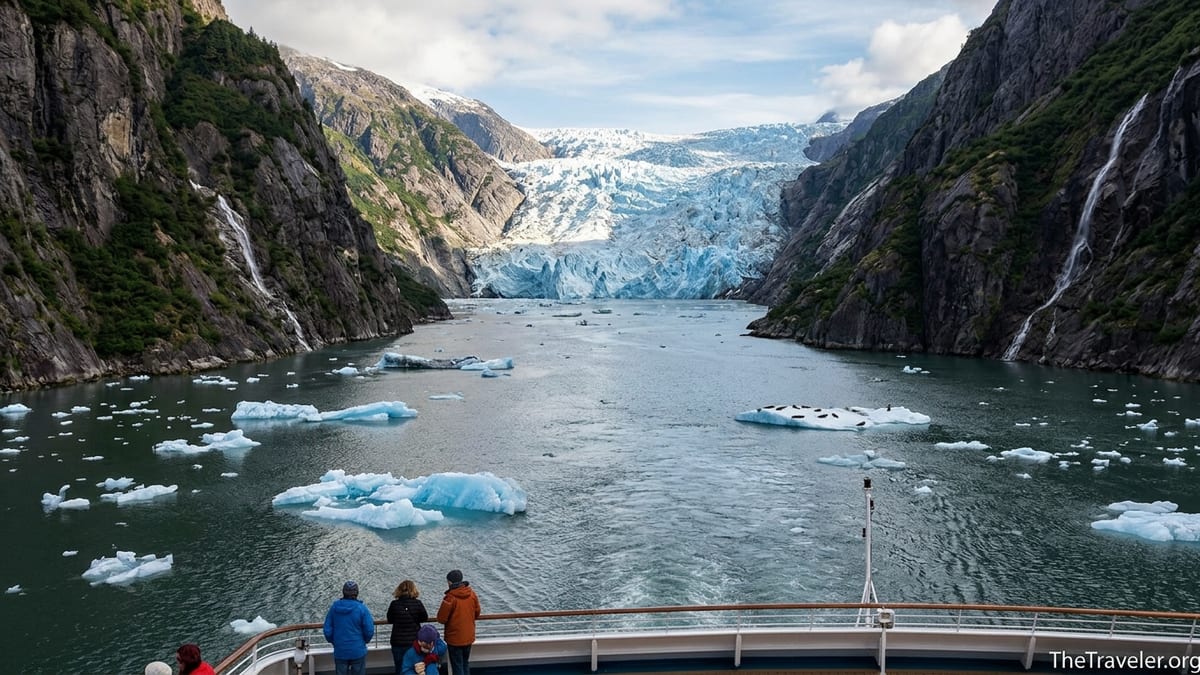
Dawes Glacier is an actively calving tidewater glacier at the head of Endicott Arm, a long and narrow fjord roughly 30 miles south of Juneau in the Tracy Arm–Fords Terror Wilderness of Tongass National Forest. The fjord itself runs for many miles through steep granite walls before ending at Dawes’ icy face, where blue seracs, crevasses and frequent cracking noises remind visitors that this is a living river of ice rather than a frozen backdrop.
Most travelers experience Endicott Arm and Dawes Glacier from the water, either on a large cruise ship or a smaller tour vessel. There are no traditional cruise piers or port facilities inside the fjord, and landings are extremely limited. On mainstream big-ship itineraries, you should assume you will remain on board while the ship sails in, lingers near the ice if conditions allow, then turns around and exits.
The broader Tracy Arm–Fords Terror Wilderness also includes nearby Tracy Arm and Holkham Bay. The United States Forest Service manages the area for both conservation and carefully controlled visitation, with voluntary best management practices that commercial operators agree to follow. These guidelines emphasize slow speeds, managing noise and respecting wildlife such as harbor seals, which haul out on floating ice in the inlets, especially in late spring and early summer.
Because this is a dynamic glacial environment, every visit looks a little different. Ice conditions, weather, fog and wildlife patterns change from day to day and even hour to hour. Any guide or brochure image captures only one possible version of what you might see.
Scenic Cruising, Not a Port: How Endicott Arm Fits into Itineraries
Endicott Arm and Dawes Glacier are listed on most cruise schedules as “scenic cruising,” not as a conventional port call. On many seven night Inside Passage round trips from Seattle or Vancouver, the ship devotes roughly a half day to sailing in and out of the fjord, with no chance to step ashore unless you have booked a separate small boat excursion operated from the ship.
Royal Caribbean provides clear examples of this pattern. Its seven night Alaska Adventure sailings on ships such as Quantum of the Seas and Ovation of the Seas typically run round trip from Seattle, with a day labeled “Endicott Arm & Dawes Glacier (Cruising)” bracketed by port days in Juneau, Skagway or Sitka and Victoria. Published schedules often show scenic cruising in Endicott Arm in the morning, followed by an afternoon or evening arrival in Juneau on the same day, underscoring that Dawes is an at sea experience rather than a stop.
Princess Cruises uses a similar model. In recent seasons its seven day Inside Passage with Endicott Arm itineraries from Seattle list “Endicott Arm and Dawes Glacier Scenic Cruising” between Southeast Alaska port calls such as Ketchikan, Juneau and Skagway, with Saturday or Sunday departures. Longer “Ultimate Alaska” voyages add Endicott Arm as one glacier day among others like Glacier Bay or Hubbard Glacier, but the Dawes segment is still framed as scenic cruising time rather than a port visit.
Beyond the big ships, small ship expedition lines and independent Juneau based day cruises also operate into Endicott Arm when conditions allow. These vessels, usually carrying dozens or a few hundred guests at most, can maneuver closer to ice and shoreline than large cruise ships, but they still must respect the same safety and wildlife considerations and sometimes turn back early. When comparing itineraries, pay attention to whether Endicott Arm is your primary glacier day or one of several, and whether your chosen line tends to pair the fjord with a same day Juneau call.
How Close You May Get: Ice, Safety and Turn Backs
No cruise line or tour operator can guarantee how close your ship or boat will get to Dawes Glacier on a specific date. The approach route often weaves through fields of floating ice, ranging from small “bergy bits” to larger blocks that require slow, careful navigation. When ice concentrations become too thick, captains must stop well short of the face or, occasionally, turn back before reaching the usual viewing area.
In recent seasons traveler reports describe the full range of outcomes. On some days large cruise ships have been able to nose in toward the inner arm, holding position for an hour or more with excellent views of the glacier front and occasional calving visible even from upper decks through binoculars. On other departures, the same class of ship stopped several miles farther out among dense ice, with Dawes visible but relatively distant. Guests on small boat excursions launched from the ship or from Juneau have likewise reported both spectacular close approaches and conservative stand offs when ice, fog or shifting winds made a nearer run unwise.
Safety regulations and company policies give captains wide discretion. Besides hull safety, they also consider harbor seal concentrations and federal wildlife viewing guidelines. During sensitive times such as the pupping season, voluntary measures encourage vessels in glacial fjords to minimize disturbance, which can further influence how close operators choose to go and how long they remain in one spot.
When booking, treat any brochure language or past trip photos as examples, not promises. Ask your cruise line or tour company how much time they typically budget in Endicott Arm and whether they offer a small boat glacier excursion, but understand that even those excursions can be shortened, rerouted or canceled on the day. If seeing ice at extremely close range is your absolute top priority, factor this uncertainty into your broader Alaska planning.
What the Day Is Like: Timing, Scenery and Wildlife
On large ship cruises, entry into Endicott Arm often begins very early, sometimes around sunrise, though specific times vary by line, ship and tide conditions. Some recent schedules for Seattle based itineraries list scenic cruising from roughly 7 in the morning until around noon, with the ship then exiting toward Juneau. Others begin even earlier, with announcements that scenic viewing will start before 6. It is worth checking your detailed daily program on board, as the most dramatic light and quietest moments often come during the first hours in the fjord.
As the ship turns into Holkham Bay and then Endicott Arm, the shoreline closes in. Sheer granite cliffs rise on both sides, streaked with waterfalls that appear and disappear with rain and snowmelt. Where side valleys join the main fjord, hanging glaciers and snowfields are sometimes visible high above. The water gradually fills with floating ice, from small crystal clear chunks to larger, blue tinted pieces that carry resting harbor seals, especially in late May and June.
Wildlife sightings are never guaranteed, but this area can be good for harbor seals on ice floes, bald eagles on treetops or rocky outcrops, and occasionally mountain goats clinging to steep slopes. Guests with binoculars often spot details that naked eye viewers miss, such as seals nursing pups or birds nesting on cliffs. Whales are more commonly seen in the outer approaches to the fjord and nearby Stephens Passage than in the narrowest reaches, though an occasional humpback may surface in the deeper basins.
Once the ship reaches its safe stopping point, it usually swings slowly to give both port and starboard sides a chance at forward facing glacier views. Typical linger times near the ice are on the order of an hour or two, though this window can expand or contract with conditions and overall itinerary commitments. You may hear crackling and booming as ice fractures, even if large calving events remain distant or partially hidden behind moraines.
When to Go: Alaska Cruise Season, Ice and Wildlife
The core Alaska cruise season for itineraries that visit Endicott Arm runs from roughly late April or early May through late September. Ship deployment varies by line and year, but most seven night Seattle and Vancouver round trips that include Dawes Glacier operate within this late spring to early fall window. Shoulder season sailings at the edges of this range can feel considerably cooler and may encounter more variable weather.
In general, earlier season departures in May and early June often coincide with heavier ice in glacial fjords and peak harbor seal pupping. This can mean a wonderfully wild, icy landscape but also a higher chance that ships, especially larger ones, will need to hold farther back or alter their plans to avoid disturbing seals on ice. Midseason trips in July and early August may find somewhat more open water but also increased overall visitor numbers, both in Juneau and on the most popular cruise routes.
Later season sailings in late August and September can bring crisper air, longer shadows on fjord walls and a higher chance of rain or low cloud. Wildlife patterns shift as pups grow and some species begin seasonal movements. Because conditions change year to year, it is wise to cross check any month specific wildlife claims with recent guidance from regional agencies and your chosen operators, who see the fjords daily and adapt to current patterns.
When choosing dates, balance your tolerance for cool, sometimes wet weather with your interest in ice filled scenery and wildlife behavior. There is no single “best” month for Dawes Glacier, but there may be a best trade off for you once you consider school schedules, daylight hours, crowd levels and your broader Alaska route.
Endicott Arm, Tracy Arm and Glacier Bay: How They Relate
Endicott Arm and Tracy Arm are sibling fjords within the same Tracy Arm–Fords Terror Wilderness, both draining tidewater glaciers toward Holkham Bay south of Juneau. Tracy Arm ends at the twin Sawyer and South Sawyer Glaciers, while Endicott Arm terminates at Dawes Glacier. For years many cruise itineraries highlighted Tracy Arm, but navigational challenges and changing ice and landslide risks have prompted a shift.
In 2025 a significant landslide in the Tracy Arm area increased concerns about safety and ice disruption in that fjord. In response, several major cruise companies, including Royal Caribbean, Holland America and Carnival, announced they would substitute Endicott Arm and Dawes Glacier for Tracy Arm on affected itineraries until conditions stabilize. Recent traveler communications show similar substitutions continuing for future seasons, and occasional last minute switches between fjords when conditions warrant.
Glacier Bay, by contrast, is a large national park farther northwest, reached by a smaller number of permitted large cruise ships each day. While Glacier Bay also offers tidewater glaciers and abundant wildlife, it has a broader, more open layout and a different regulatory structure, including onboard park rangers offering commentary. Some longer itineraries visit both Glacier Bay and Endicott Arm, while many seven night Seattle based routes pair Dawes Glacier with ports like Juneau and Skagway instead of Glacier Bay.
For planning, it is crucial to read your specific itinerary closely. If it names Tracy Arm, Endicott Arm or Glacier Bay, treat that as the line’s intent but not an absolute promise. Ask your travel advisor or cruise line how they handle substitutions and what alternatives are likely if a particular fjord is off limits on your sailing.
Making the Most of the Day: Viewing Spots, Gear and Comfort
The best vantage point for Dawes Glacier depends on your ship type and personal preferences. On large cruise ships, upper level outdoor decks near the bow often provide the widest panoramas as you sail in, while side promenades can be excellent once the ship has turned and is holding position. Many photographers favor one deck below the very top so that wind is slightly reduced and railings frame shots more easily.
Balcony cabins are highly convenient on scenic cruising days, especially in cool or damp weather. You can step outside quickly when the view is best, retreat inside to warm up and avoid jostling for space at railings. The tradeoff is that you only see one side at a time unless you move about the ship. If your itinerary includes a full spin in front of the glacier, both port and starboard balconies will have some glacier facing time, but the exact sequence can vary.
Whatever your cabin type, treat outdoor public decks as your primary viewing arena and your room as a base for breaks. Layers are essential. Plan on a moisture wicking base layer, insulating mid layer and a wind and water resistant outer shell, along with a hat and thin gloves that still let you operate a camera or phone. Waterproof or at least water resistant footwear is useful on wet decks, and binoculars significantly enhance both wildlife viewing and appreciation of textures in the ice and rock.
Because the day can start early and temperatures may stay in the single digits Celsius or low 40s Fahrenheit, pace yourself. Take breaks indoors to warm up with hot drinks, review photos and simply let your eyes rest, then head back out when the ship changes orientation or a new stretch of fjord comes into view. Announcements from the bridge or naturalists, when allowed, can help you time these transitions so you do not miss key moments.
Environmental and Safety Considerations
Endicott Arm is more than a scenic backdrop. It is a sensitive wildlife habitat and part of a federally designated wilderness. Harbor seals use the ice floes near tidewater glaciers as safe platforms for resting, giving birth and nursing pups. Research in Tracy Arm and Endicott Arm has shown that frequent or close vessel approaches can prompt seals to flush from ice, using energy and potentially increasing their vulnerability to predators and cold water.
To reduce disturbance, the United States Forest Service, National Oceanic and Atmospheric Administration and local tourism partners have developed best management practices and voluntary guidelines for glacial fjord operations. These include maintaining prudent distances from seals, avoiding sudden changes in speed or direction near wildlife, minimizing loudspeaker use in the most sensitive inner fjord zones and coordinating traffic among operators so that animals are not repeatedly approached by multiple vessels in quick succession.
For passengers, the most important environmental steps are simple. Choose operators that publicly commit to responsible wildlife viewing and wilderness best practices. Follow crew instructions about where you can stand safely, keep personal noise down on open decks when seals or other animals are nearby and avoid attempting to entice wildlife with food or sounds. Photographers should rely on zoom lenses or binoculars rather than pressuring crew to move closer than is advisable.
Safety wise, trust that captains and pilots know the fjord and its moods far better than any individual visitor. If conditions force a more distant viewing point or an early exit, it reflects real time assessments of ice, weather, tides and wildlife obligations. Pack warm, weather appropriate clothing and stable footwear, use handrails on wet, sometimes icy decks and keep an eye on children near railings, especially when the ship is maneuvering among ice.
Is Dawes Glacier Right for You?
Endicott Arm and Dawes Glacier will appeal most to travelers who love narrow fjords, dramatic rock walls and the evolving choreography of ice, water and weather. If you are comfortable accepting some uncertainty about how close you will get and willing to bundle up for hours of watching from railings or a balcony, this scenic day can be one of the highlights of an Inside Passage cruise.
Compared with Glacier Bay or Hubbard Glacier, Dawes offers a more intimate, enclosed feeling, with high cliffs close on both sides and a twisting approach that gradually reveals the glacier. At the same time, the viewing distance and duration are more vulnerable to ice conditions than at some other Alaska glacier destinations, and the experience usually lacks the on board park ranger commentary and multiple glacier basins that define a full day in Glacier Bay.
If your dream is a guaranteed, prolonged look at massive tidewater glaciers from relatively open waters, or if the idea of rising before dawn to stand on a chilly deck does not appeal, you may prefer an itinerary centered on Glacier Bay or Hubbard Glacier, covered in detail in a separate guide. If, however, you are drawn to the idea of a winding fjord where every turn reveals new waterfalls, cliffs and floating ice, and where success is shared between captain, crew and nature on the day, then an Endicott Arm and Dawes Glacier cruise may be exactly the right Alaska glacier experience for you.