


More news on this day
Italy is preparing to switch on the last segment of European Rail Traffic Management System signalling between Rome and Florence in April, a milestone that will bring the entire high-speed corridor under one modern control system and reshape rail travel on one of Europe’s busiest tourism routes.
Get the latest news straight to your inbox!
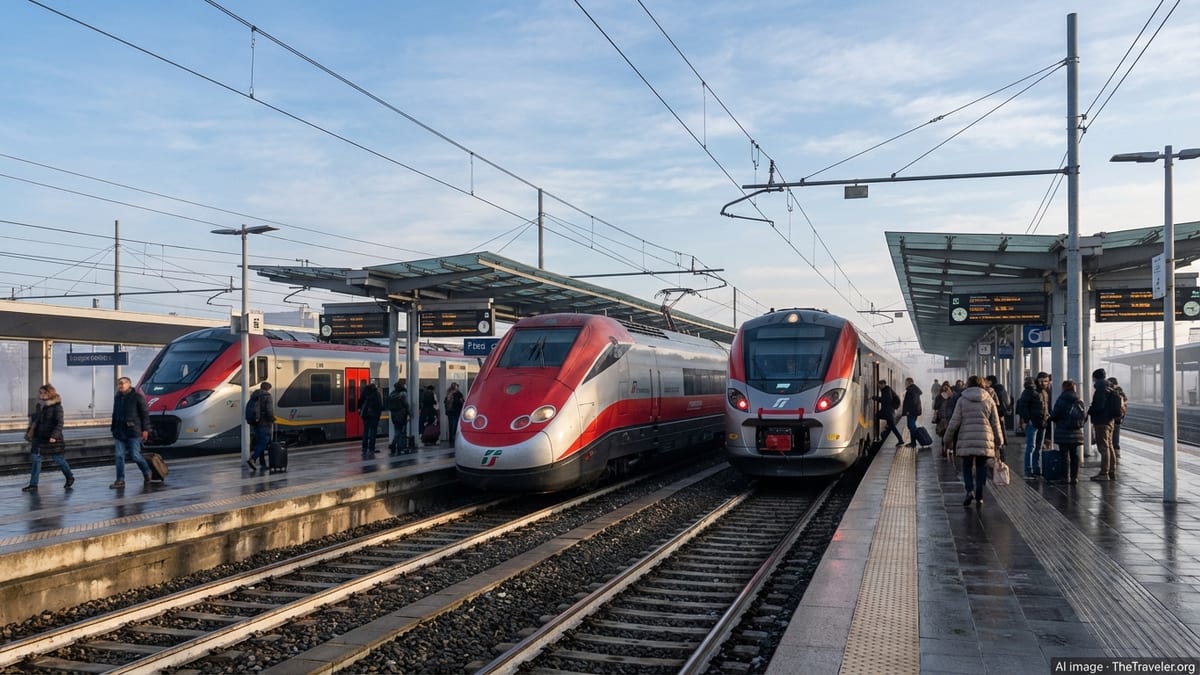
Final unequipped stretch targets April activation
According to multiple project updates, the remaining unequipped section of the Rome–Florence high-speed line lies between Orvieto and Settebagni, north of the Italian capital. This stretch, part of the historic Direttissima corridor, is the final gap before European Rail Traffic Management System coverage extends across the full high-speed route.
Publicly available information indicates that activation works are scheduled for a mid-April weekend, with infrastructure manager planning an intensive possession to commission the technology. The focus is on integrating the new digital signalling with existing line equipment so that trains can switch seamlessly to ERTMS as they traverse the upgraded section.
Once the system goes live, trains running between Rome and Florence are expected to operate entirely under the same European-standard signalling used on Italy’s newer high-speed lines. This alignment is designed to simplify operations, reduce the need for legacy systems, and enable more flexible train paths along a corridor that serves both domestic and international passengers.
The Rome–Florence high-speed link, opened in stages from the late 1970s, has long been a backbone of Italian rail travel. Completing its migration to ERTMS has been presented in technical briefings as the final step in bringing this early-generation high-speed corridor in line with newer routes such as Milan–Bologna and Turin–Milan.
Weekend closures and reduced services for travellers
To complete the commissioning, infrastructure planners have scheduled temporary closures on both the high-speed and conventional Rome–Florence lines over an April weekend. Notices published ahead of the works describe a full suspension of high-speed traffic between Rovezzano, on the Florence side, and Settebagni near Rome, from just after midnight on a Saturday until mid-afternoon on the Sunday.
On the conventional network, the parallel Orte–Roma Tiburtina section is also due to close for part of the same period so that engineers can align systems and verify interfaces. During the shut-down, most long-distance trains are expected either to be cancelled or diverted, with operators pointing travellers toward alternative routes on the Tyrrhenian coastal line where capacity allows.
Timetable information released in advance suggests that services will begin to resume gradually after the works window, with some delays and extended journey times likely as operations stabilise. Normal levels of high-speed service are expected to return within a couple of days once testing confirms that the new signalling is functioning as intended.
Travel advisories circulating in Italian media have urged passengers heading between Rome, Florence and further north to check journey details carefully around the mid-April dates. The Rome–Florence axis is one of the most heavily used rail corridors in the country, carrying both business travellers and international visitors connecting to cities such as Venice, Milan and Naples.
What ERTMS brings to Italy’s high-speed heartland
ERTMS, and its onboard component ETCS, is the European standard for signalling and train protection and has been progressively deployed across Italy’s newer high-speed lines for nearly two decades. Technical documentation describes it as a system that supervises train movements through continuous communication and cab signalling, replacing many traditional lineside signals.
On the Rome–Florence route, the shift to ERTMS is expected to enhance reliability and punctuality by enabling more consistent train regulation and reducing the risk of signal failures that can disrupt dense traffic. The system also gives drivers real-time speed guidance in the cab, which can help optimise braking and acceleration and smooth out traffic flows during busy periods.
Industry factsheets on Italy’s rollout highlight additional benefits, including the potential for incremental capacity gains as operating rules are refined under the new digital regime. While maximum speeds on the Rome–Florence line are not expected to change immediately, the upgraded signalling is intended to support efficient use of every available path on a corridor shared by high-speed and fast intercity services.
For the wider European network, Rome–Florence represents another step toward a more interoperable rail system, since ERTMS is designed to allow international rolling stock to move across borders with fewer bespoke signalling adaptations. Although the Rome–Florence market is largely domestic, its role as part of the north–south axis through Italy gives the project wider strategic relevance.
Tourism and passenger experience on a key corridor
The Rome–Florence route is not only a technical test bed but also one of Europe’s signature tourist journeys, linking the Italian capital with Tuscany’s art capital in around 90 minutes on high-speed services. Travel reports routinely describe it as a core leg for visitors combining Rome, Florence and Venice in a single itinerary.
By completing the ERTMS rollout on this line, Italy is aiming to provide a more predictable experience for both domestic passengers and international tourists unfamiliar with the network. Fewer unplanned delays, clearer real-time information and smoother operations can make tight connections to regional trains or onward high-speed services more manageable.
The April commissioning window does bring short-term disruption for travellers, particularly those whose plans fall on the affected weekend. However, operators have framed the works as part of a long-term modernisation effort intended to secure the corridor’s role as a fast, low-carbon alternative to short-haul flights between central Italy and major northern cities.
In the longer term, the full ERTMS upgrade on Rome–Florence is expected to complement other improvements across the Italian network, including extensions toward the Adriatic and Alpine corridors. For visitors planning Italian itineraries in the coming years, the line’s completed modernisation should further strengthen the case for choosing rail as the primary way to move between the country’s landmark destinations.
A flagship element in Italy’s national rollout
Published deployment plans show that the Rome–Florence upgrade forms part of a national strategy to extend ERTMS beyond dedicated high-speed lines to conventional main routes, backed in part by European and national recovery funds. The programme covers thousands of kilometres of track and is regarded as a central pillar of Italy’s railway digitalisation agenda.
Rome–Florence holds particular symbolic weight because the Direttissima was one of Europe’s earliest purpose-built fast lines. Bringing it under the same digital umbrella as newer routes is seen in project material as a way to bridge generations of technology and present a more unified network to passengers and operators.
As ERTMS spreads across Italy, the experience gained on this complex corridor is likely to inform future commissioning projects, from managing service suspensions to communicating with the travelling public. The April activation on the Orvieto–Settebagni section will therefore serve both as an operational milestone and as a template for how the country continues to modernise its rail backbone.
For travellers watching Italy’s rail developments, the Rome–Florence ERTMS switch-on in April marks a clear signal that the country’s high-speed era is entering a more integrated and digitally managed phase, one in which a historic line is being adapted to meet the expectations of today’s tourism and mobility landscape.