


Adolfo Suárez Madrid Barajas is one of Europe’s busiest hubs, and in peak season its size and crowds can catch even seasoned travelers off guard. With a little preparation, though, you can move through its four terminals quickly, make tight connections with confidence and get into central Madrid without wasting time or money. This guide focuses on practical, real world strategies that reflect how the airport operates in 2026 so your journey is as fast and stress free as possible.
Get the latest updates straight to your inbox!
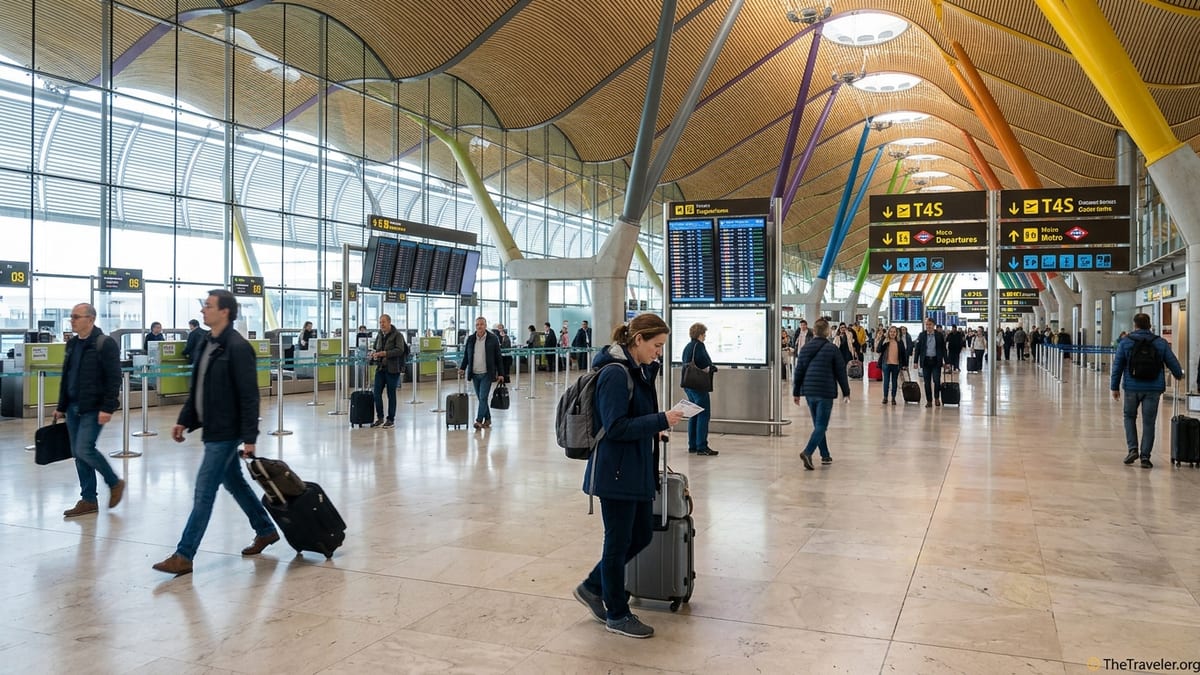
Know the Layout: Terminals T1, T2, T3, T4 and T4S
Madrid Barajas is spread across two main terminal clusters. Terminals T1, T2 and T3 form one long interconnected building, while Terminal T4 and its satellite T4S sit several kilometers away in a separate complex. Knowing which group you are using is the first step to a smooth journey, especially if you have a connection. Many long haul and oneworld flights, including Iberia and some American Airlines services, use T4 and T4S, while a mix of European and non Schengen carriers operate from T1 to T3.
Inside the T1–T3 cluster, walking between terminals is straightforward. A passenger arriving on a Schengen flight at T2, for example, can follow the internal signage and walk to check in desks in T1 without leaving the building. This is useful if you are picking up a rental car based near T1 but land at T2, or if you are meeting someone arriving on a different airline within the same cluster.
T4 and T4S operate as a more modern but separate world. T4 is the main check in and arrivals hall, designed with high ceilings, natural light and clearly color coded zones to reduce stress. T4S is the satellite used primarily for many non Schengen departures and arrivals. An underground people mover connects T4 and T4S airside; transfer time on the train is only a few minutes, but queues in peak periods can add another 10 to 20 minutes, so factor that in when connecting between a Schengen flight at T4 and a long haul departure at T4S.
Because of this split layout, always verify your departure terminal on your booking or airline app before you arrive. Turning up at T1 for a flight leaving from T4, or vice versa, can easily cost you 30 minutes or more once you add the time needed to locate and wait for the inter terminal shuttle bus.
Moving Between Terminals Without Losing Time
When you need to switch between the T1–T3 cluster and T4, the free green inter terminal shuttle bus is usually the fastest option. Buses run 24 hours a day and loop between T1, T2, T3 and T4, typically every 5 to 10 minutes at busy times and every 15 to 20 minutes overnight. In practice, travelers report that a full circuit from T1 to T4 takes around 15 minutes once you are on board, but you should add time to find the stop and wait for the bus, especially if you have checked luggage and arrive at a crowded time of day.
Imagine you land on an international flight at T1 at 12:15 and have a separate ticket to Mallorca departing T4 at 15:45. You will need to collect bags, clear passport control, walk out to the arrivals curb to find the shuttle stop, ride to T4, check in again and clear security. Under normal conditions this can be done in about 90 minutes to 2 hours, but any flight delay, long queues at passport control or slow baggage delivery will eat into your margin. In this situation, three and a half hours is considered reasonable but not generous; booking a later onward flight or keeping plans flexible is wise.
Within the T1–T3 building, most transfers can be done on foot in 10 to 15 minutes. A traveler arriving at T1 and connecting to a Schengen flight at T2 on the same ticket generally follows “Flight connections” signage and re clears security in the connections area, staying airside. However, if you are on separate tickets, you will normally need to exit, collect luggage and re check, which means allowing extra time and possibly walking landside between terminal sectors.
Some travelers consider using the Metro between T1–T3 and T4, but for pure terminal to terminal transfers this is rarely faster than the free shuttle. You must navigate down to the station, buy a ticket with the airport supplement and potentially change trains later, compared with simply waiting at the curb for the dedicated airport bus. The Metro becomes more attractive once you are actually heading into the city, rather than just moving around the airport.
Beating Security and Passport Control Queues in 2026
Passenger numbers at Madrid Barajas have risen close to the airport’s designed capacity, and this is especially noticeable at security checkpoints in summer mornings and Sunday evenings. The good news is that recent investments in new 3D EDSCB scanners, rolled out first in T4 in 2026, are starting to speed things up by allowing passengers to keep liquids and laptops inside bags in many lanes. Where these scanners are in use, the security experience feels closer to a simple bag scan than the traditional unpack and repack ritual.
That said, you cannot yet rely on every lane in every terminal using the newest scanners. To move quickly, assume you might still be asked to remove laptops or large electronics, wear shoes that are easy to slip off if requested and keep your jacket and belt simple. At busy times, staff sometimes direct families and passengers needing more time to specific lanes to keep the main line moving. Watching which lanes are processing passengers fastest and following staff directions can shave several minutes off your wait.
Fast track security is available in T1, T2 and T4 for eligible passengers, including many business and first class tickets and certain frequent flyer status holders. Some airlines also sell standalone fast track access or include it with flexible economy fares. For example, a traveler on a corporate ticket with Iberia often finds a separate fast track entry near the main security area in T4, while a family flying a low cost carrier from T1 might purchase single use fast track passes through the airline or an airport services provider to avoid long school holiday queues.
Passport control times vary significantly depending on your passport and time of day. Citizens of the European Union and some other eligible nationalities can often use automated e gates, which can cut wait times to a few minutes in off peak periods. Non EU travelers arriving early morning or late evening sometimes report 30 to 60 minute queues in T1 or T4, particularly when several wide body flights arrive at once. If you have a tight onward connection that requires immigration, build this uncertainty into your schedule and avoid scheduling important meetings in Madrid too soon after arrival.
Smoother Check in, Baggage and Connections
One of the biggest time savers at Madrid Barajas is online check in. Most major airlines operating from MAD open online check in 24 hours before departure, and some allow digital boarding passes to be stored in airline apps or smartphone wallets. If you are traveling with only hand luggage and already have your boarding pass, you can often proceed straight to security, walking past busy check in queues in the central halls of T1 or under the distinctive bamboo roof of T4.
For travelers with checked luggage, self service bag drop machines are increasingly common, especially in T4 where Iberia and oneworld partners dominate. In practice, though, not all passengers are comfortable with self tagging bags, and staff availability can vary, so queues may still form in front of traditional counters. If you are traveling during peak holiday periods, arriving at the airport at least 2 to 3 hours before a European flight and 3 to 4 hours before a long haul service remains prudent, even if standard guidance suggests slightly shorter times.
When planning connections, pay attention to whether your itinerary is on a single ticket. A traveler flying from New York to Madrid on Iberia and then on to Seville also on Iberia, all on one ticket, will typically have luggage tagged through to the final destination and can follow signs for “Connections” without collecting bags. In contrast, someone who buys a separate low cost ticket from Madrid to Lisbon after arriving on a different airline will generally need to collect checked bags, go landside, change terminals if necessary and re check in, bearing full responsibility if delays cause a missed flight.
Baggage delivery times in Madrid are usually reasonable but can lengthen when several large flights arrive back to back. If you are in a hurry, standing close to the baggage belt where bags first emerge and double checking the screen for your flight number can help you grab your suitcase quickly. Delays or mishandling do occasionally occur, so keeping essentials such as medication, a change of clothes and important documents in your cabin bag is wise, especially if you have a same day connection onward by train from Madrid’s Atocha or Chamartín stations.
Fast and Simple Transport Between the Airport and Madrid
Madrid Barajas offers a choice of predictable, fixed price transport options into the city. For many travelers, the simplest is the official white and red taxi. As of 2026, there is a fixed flat fare of around 33 euros from the airport to any destination within the M 30 ring road, which covers most central neighborhoods such as Sol, Gran Vía, Salamanca, La Latina and Chamberí. The fixed rate applies in both directions and includes luggage, so you can budget ahead without worrying about the meter route.
If you prefer public transport, the Metro and the Airport Express bus are both efficient. Line 8 of the Madrid Metro serves stations at T1–T2–T3 and T4, connecting to central hubs like Nuevos Ministerios in roughly 15 to 20 minutes. Regular Metro fares apply, plus a small airport supplement on tickets and travel cards that do not already include the zone. For a traveler staying near Gran Vía, a common route is to take Line 8 to Nuevos Ministerios and then change to Line 10 or another central line, finishing with a short walk to the hotel.
The yellow Airport Express bus is another good option, especially at night when Metro services are less frequent. It runs 24 hours a day between the airport and central stops such as Cibeles and Atocha, with a flat fare around 5 euros payable on board. The bus has luggage racks and is popular with budget conscious travelers and students, but can be crowded after the arrival of several late evening flights. Boarding at T4, where the bus starts, often gives you a better chance of finding a seat than waiting at T1 or T2.
Rideshare and private transfer services are widely available, particularly serving T4 where many international travelers arrive. Prices vary with demand and time of day, and you should factor in potential traffic on the M 30 and city center streets during weekday rush hours. For very early morning departures, staying at one of the airport hotels near T1–T3 or in the business area close to T4 can reduce both cost and stress, since complimentary hotel shuttles often run directly to the correct terminal.
Smart Ways to Use Airport Services and Amenities
Because Madrid Barajas is a major hub for connections between Europe and Latin America, dwell times in the terminals can be long. Knowing how to use airport services efficiently can make these waits more comfortable and productive. Free Wi Fi is available throughout the airport, although speeds can slow at busy times; premium high speed connections may be offered by some lounges and paid services. Charging points are scattered through seating areas, but bringing a small multi plug or USB hub helps when outlets are in use.
Lounges can be particularly valuable if you have a long layover or need to work. In T4 and T4S, several airline operated and independent lounges offer showers, hot meals, quiet zones and faster Wi Fi. Access may come with your business class ticket, frequent flyer status or a lounge membership card. For example, a traveler connecting from Bogotá to Rome via Madrid on a oneworld airline could access an Iberia lounge to shower and eat between overnight and daytime segments, rather than searching for a seat in the general terminal.
Families and travelers with reduced mobility benefit from planning ahead. The airport provides assistance services that must generally be booked in advance through airlines or the airport operator, including wheelchair support and help navigating between terminals. Children’s play corners and family friendly seating exist in some departure areas, particularly in T4, but they are not present at every gate. If you are traveling with young children, consider locating these areas shortly after clearing security so you know where to return if boarding is delayed.
Food and shopping options are extensive, especially in T4 and T4S, where you will find everything from quick coffee counters and Spanish sandwich chains to tapas style restaurants and duty free shops. Prices are higher than in the city but broadly similar to other major European hubs. For a fast, lower hassle meal before an early flight, many travelers choose a simple bocadillo and coffee at a landside café in T2 or T4, eating after security only if time allows.
The Takeaway
Madrid Barajas can either be a source of stress or a smooth gateway to Spain and beyond, depending largely on how well you understand its layout and processes. The split between T1–T3 and T4/T4S, rising passenger volumes and varying security and passport control times all matter when you are trying to move quickly. A few deliberate choices, such as checking your terminal before you leave, allowing extra time for inter terminal transfers and using online check in, can make a noticeable difference.
Think in terms of buffers rather than minimums. If an airline suggests arriving two hours before departure, consider whether crowds, checked baggage and inter terminal travel mean you should add 30 to 60 minutes. If you are booking separate tickets or planning to catch a train from the city after landing, give yourself enough margin to absorb delay without turning a missed connection into a crisis.
Finally, remember that comfort supports speed. A traveler who knows where to find the shuttle stop, has a bottle of water, keeps documents organized and has already decided whether to take a taxi, Metro or Express bus is less likely to freeze up under pressure. With realistic expectations and a few smart habits, Madrid Barajas can be an efficient, even pleasant, part of your journey rather than an obstacle.
FAQ
Q1. How much time should I allow to transfer between T1 and T4 at Madrid Barajas?
For most travelers, allowing at least 90 minutes to 2 hours between flights is sensible if you need to go from T1 to T4, collect luggage and re check in. If your flights are on separate tickets or you are arriving from outside the Schengen area, consider 3 hours or more to account for passport control, baggage delivery and the inter terminal shuttle.
Q2. Is the inter terminal shuttle bus at Madrid Barajas free and how often does it run?
Yes, the green inter terminal shuttle bus that connects T1, T2, T3 and T4 is free for all passengers. It operates 24 hours a day, with buses typically arriving every 5 to 10 minutes during the day and every 15 to 20 minutes overnight. Journey time between T1 and T4 is usually around 15 minutes once you are on board.
Q3. Do I still need to take liquids and laptops out of my bag at security in Madrid?
Madrid Barajas has begun using new 3D scanners, especially in T4, that often allow passengers to leave liquids and laptops inside bags. However, not every lane in every terminal uses this technology yet. Follow the instructions shown on signs and from staff; if in doubt, be ready to remove electronics and liquids to avoid delays at the checkpoint.
Q4. What is the fastest way to reach central Madrid from the airport?
The fastest option for most visitors is usually a taxi using the fixed fare to the city center, which takes about 25 to 45 minutes depending on traffic. The Metro can be almost as quick to certain neighborhoods, especially around Nuevos Ministerios, while the Airport Express bus offers a good balance between speed and cost if your hotel is near Cibeles or Atocha.
Q5. How early should I arrive at Madrid Barajas before my flight?
In general, plan to arrive at least 2 hours before departure for European flights and 3 hours for long haul journeys. During peak holiday periods, early morning waves or if you need to change terminals or check in luggage, adding an extra 30 to 60 minutes provides a safer buffer, especially if you are not familiar with the airport.
Q6. Are there good options for overnight or long layover stays near the airport?
Yes, several hotels cluster near the T1–T3 complex and around T4, many offering free shuttle buses directly to the terminals. These are popular with travelers catching very early flights or arriving late at night, since they avoid a long taxi or Metro ride into the city and back. Booking ahead is advisable during busy trade fair weeks and summer holidays.
Q7. Can I rely on e gates at passport control in Madrid Barajas?
Automated e gates are available for many European Union citizens and certain other eligible nationalities, and they often speed up the process significantly. However, the number of open gates and staffing levels change throughout the day, so queues can still form. Non EU travelers should be prepared for manual checks and potentially longer waits, particularly when several long haul flights arrive close together.
Q8. Is it safe to take public transport from the airport late at night?
Madrid’s Airport Express bus runs 24 hours a day and is commonly used at night, with security cameras and drivers experienced in airport traffic. The Metro runs until late but does not operate all night, so you should check operating hours for your arrival time. Many travelers arriving after midnight choose a taxi or pre booked car both for convenience and to avoid waiting in quieter stations.
Q9. What should I do if my luggage is delayed or lost at Madrid Barajas?
If your luggage does not appear on the belt, go directly to your airline’s baggage service desk in the arrivals hall before leaving the secure area. Provide your baggage tag, boarding pass and a local contact address such as your hotel. Most airlines can deliver delayed bags to central Madrid within 24 to 48 hours. Keeping essential items and a change of clothes in your cabin bag reduces the impact of any delay.
Q10. Are there showers and quiet places to rest inside Madrid Barajas?
Showers are available in several airline and independent lounges, particularly in T4 and T4S, and access may be included with premium tickets or lounge memberships. Quiet seating areas exist near some gates, but they fill quickly at busy times. If you have a long layover and no lounge access, consider booking a short stay at an airport hotel or using a pay per use lounge for more comfort and privacy.