


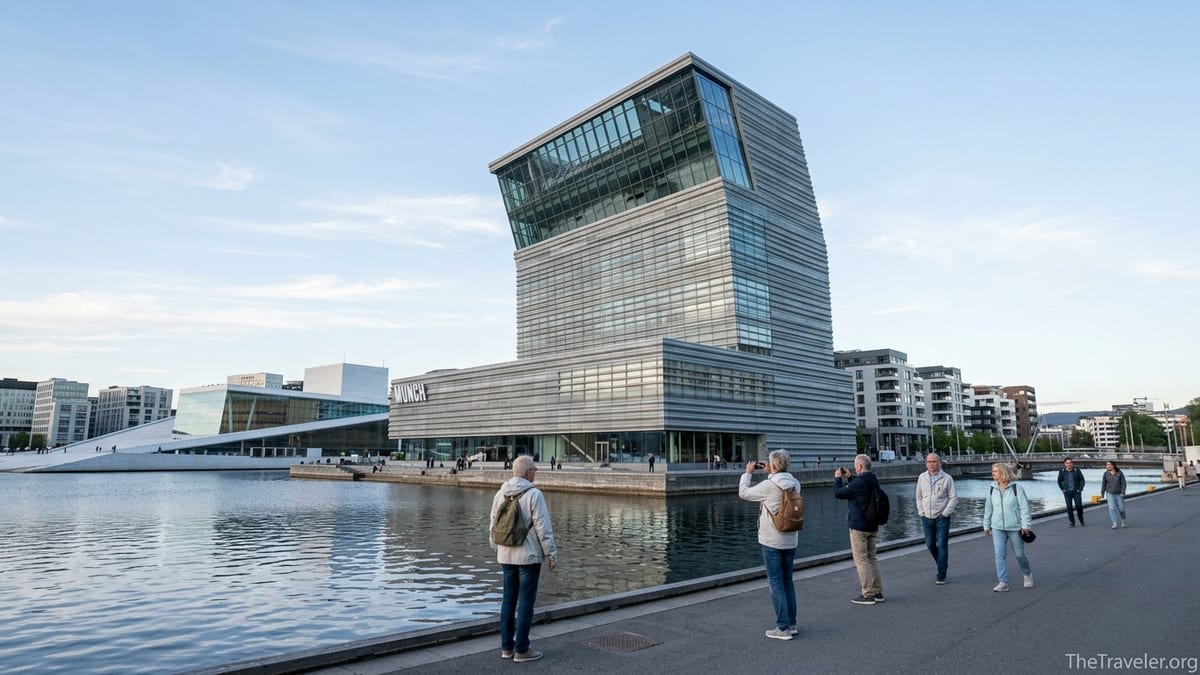
Perched on Oslo’s waterfront in Bjørvika, the shimmering tower of MUNCH is hard to miss. Inside, you’ll find the world’s largest collection of Edvard Munch’s work, dramatic fjord views, and twelve floors of galleries, events, and dining. But before you click “buy” on those tickets, a bit of planning can save you money, stress, and time in line. Here are the visitor tips that matter most before you book.
Get the latest updates straight to your inbox!
Know Your Ticket Options Before You Buy
MUNCH sells timed-entry tickets that give access to all open exhibitions and interactive experiences in the building. As of 2026, standard adult admission purchased directly from the museum is around 220 NOK, with discounted tickets for visitors under 25 at roughly 100 NOK. Children and teens aged 0 to 17 enter free with a ticket, which makes family visits surprisingly good value in an otherwise expensive city.
If you are visiting Oslo for more than a quick layover, it is worth comparing single-entry tickets with a city pass. The official Oslo Pass includes free entry to the new MUNCH museum along with more than 30 other attractions, plus public transport for 24, 48, or 72 hours. For travelers planning to combine MUNCH with the National Museum, Holmenkollen ski jump, or a fjord island hop on city ferries, the pass often works out cheaper than buying separate tickets, and you avoid fumbling with individual purchases at each site.
There is also a lighter option: the Oslo Light Pass. It focuses on public transport in central Oslo and skip-the-line entry to two top attractions, such as MUNCH and the National Museum. This can be ideal if you are in the city for just one full day but still want a structured plan: morning at MUNCH, afternoon at a second museum, with tram and metro rides included.
However you buy, pay close attention to whether your ticket is tied to a specific time slot. MUNCH’s own tickets and some passes require you to pick a date and time, while others allow more flexibility within a day. If your itinerary includes tight connections, such as an airport train from Oslo Central Station later that afternoon, you will want to lock in a slot that leaves enough buffer for your visit and the short walk back to the station.
Choose the Right Day and Time to Visit
Not all hours at MUNCH are created equal. The museum’s regular opening schedule has it open daily, typically from 10:00, with closing at 18:00 on Sunday through Tuesday and later hours, often until 21:00, from Wednesday to Saturday. These extended evenings change the crowd dynamics and can dramatically shape your experience.
Wednesday evenings are one of the most important time-related tips to know before you book. On most Wednesdays, from 18:00 to 21:00, general admission is free on a first-come, first-served basis, except in July and August when this offer usually pauses. If your schedule allows, this can save a couple or a family a substantial amount. The trade-off is that you cannot pre-book a free ticket on those nights, and you may face a short wait if the current time slot is already full when you arrive.
For a quieter experience, aim for weekday mornings outside peak holiday periods. For example, a Monday or Tuesday visit in May or September, right at opening time, often means you can move at your own pace and linger in front of key works without a wall of smartphones around you. In contrast, mid-afternoon on a Saturday in July is when families, cruise passengers, and city-break visitors tend to collide, especially around The Scream and the top-floor viewing spaces.
If you are visiting with children or anyone who is easily overwhelmed by noise and crowds, think in terms of energy levels: arrive early, do the key galleries before lunch, and leave the more flexible parts of the museum, like the shop or café, for later in the day when your group may be tired. Booking a morning time slot gives you the broadest options to adjust on the fly.
Use Passes and Free Entry Strategically
Before paying full price for tickets online, consider how a city pass might fit into your overall Oslo plan. A 24-hour Oslo Pass, for example, can cover entry to MUNCH, the National Museum, and the Fram or Kon-Tiki museums on the Bygdøy peninsula, plus all the tram and metro rides between them. If you were planning to pay separately for a full-price MUNCH ticket, a single journey on the metro, and another major museum, the pass can quickly become the better-value option.
There is also a recurring local campaign called “Tourist in Your Own City,” which gives holders of a validated Oslo Pass free entry to MUNCH during specified dates, again based on time slots available on-site. If your visit happens to coincide with this, it can be a windfall. The catch is that these tickets cannot be booked in advance; you simply present your activated pass at the museum, and if the current slot is full, you may be asked to wait for the next one, usually 15 to 30 minutes.
For budget-conscious visitors not using a pass, remember the regular Wednesday free hours in the early evening. A traveler staying near Oslo Central Station can, for instance, spend the day discovering neighborhoods like Grünerløkka or the waterfront promenade and then walk five minutes from the station to MUNCH for a free evening visit. Just expect lines at peak times and keep dinner flexible in case you need to shift by an hour.
Memberships also exist for those spending longer in Oslo or returning often, but for most international visitors on a short city break, calculated use of a day pass, a light pass, or the free Wednesday evening window will deliver the best value.
Plan Around The Scream and Other Star Works
Many travelers book MUNCH tickets with one main goal: to stand in front of The Scream. The museum manages a rotating display of its different versions and related works, so what you see on a given day can vary. There is also a famous version held by the National Museum, a separate institution a short walk away. If seeing a specific version matters deeply to you, check current exhibition notes on both museums’ official sites shortly before your travel dates and adjust your bookings accordingly.
Inside MUNCH, the permanent exhibition “Edvard Munch Infinite” is the place most visitors head first, as it gathers many of the iconic motifs in one sequence. At busier times, this is where bottlenecks form. Consider starting your visit one or two floors away from the main flow instead, then circling back when the immediate rush has thinned. For example, you might ride the elevator to a high floor first to enjoy the panoramic fjord views and large-scale “Monumental” works, then descend to the core Munch collections mid-morning.
Photography is allowed in many areas, but not all, and staff may ask visitors to avoid flash and to keep phones low to prevent blocking others’ views. Instead of fighting for the perfect shot of The Scream in a crowded room, treat the encounter like a brief, quiet moment. Take in the painting at different distances, notice the surface and color, then step aside to make space for those behind you. You will remember how it felt to be there more than yet another photo on your phone.
When planning your time slot, build in at least two to three hours if you want to explore both the major Munch exhibitions and one or two temporary shows. Many visitors emerging from the elevator at ground level underestimate how high the building is. Moving between floors, pausing at window viewpoints, and reading texts all add up, and you do not want to rush the very works you came to see.
Understand Security, Bags, and Comfort Rules
Norwegian museums tend to be relaxed but firm on practical rules, and MUNCH is no exception. Before you book, it helps to know what you can comfortably bring. Large backpacks and bulky luggage are not allowed in the exhibition spaces. Instead, you will find lockers and a cloakroom near the entrance where you can store daypacks, umbrellas, and coats. If you are arriving straight from Oslo Airport with a suitcase, it is simpler to use left-luggage facilities at Oslo Central Station and walk to the museum unencumbered.
Open drink containers and food are not permitted in the galleries. This includes refillable water bottles in many cases, which must be kept sealed and left in your bag or locker. Security and gallery staff do spot checks, and you may be asked to leave items outside exhibition areas. Plan to hydrate before you enter or schedule a break in the café partway through your visit.
Photography rules can change depending on the exhibition, especially when loans from other institutions are involved. As a general guideline, non-flash photography for personal use is widely tolerated in permanent collection spaces, but tripods, selfie sticks, and large camera bags are discouraged. If you are a keen photographer carrying a DSLR or mirrorless camera with multiple lenses, travel light on the day you visit and avoid gear that could obstruct others in narrow rooms.
Comfort is another factor that many travelers overlook when booking. Floors are hard, and you may find yourself standing for longer than you expected. Wear comfortable shoes rather than stylish but unforgiving options. In winter, expect to shed several layers at the cloakroom; the museum itself is kept at stable, artwork-friendly temperatures that can feel warm after walking in from the cold Oslo air.
Time Your Visit With Food, Views, and Surroundings
Booking your ticket is not just about entering the building, it is about how your museum visit fits into the larger day. MUNCH has a café on the ground floor and a restaurant higher up in the tower, both with views toward the fjord and the city. Prices are typical for Oslo: a coffee and slice of cake might run you the equivalent of a light lunch in many other European cities. Many visitors choose to book a midday ticket so they can arrive late morning, explore a few floors, then break for lunch with a view before continuing.
Just outside, the Bjørvika waterfront and nearby Opera House create a natural extension to your museum visit. A practical approach is to book a late-morning time slot, spend two to three hours inside, then walk over the sloping roof of the Opera House afterward. This way, you get both cultural landmarks in the same compact area without extra public transport.
If you are visiting on a short winter day, daylight is a limited resource. Booking a late-morning or early-afternoon ticket lets you enjoy fjord views from the upper floors while the sun is still up, then watch the city lights flicker on as you exit. In midsummer, long evenings open up the opposite strategy: reserve an early evening slot, visit the galleries as the low sun warms the rooms, and then stroll along the harbor promenade as locals sit at outdoor bars and swim in the nearby sea baths.
Think, too, about your onward plans. If you are catching an evening train or flying out that night, avoid the very last admission slot. While the museum will not push you out the door, you want to leave yourself at least 45 minutes between when you expect to finish and when you need to be at Oslo Central Station or the airport train platform.
Accessibility, Families, and Special Needs
MUNCH’s new building was designed with step-free access from the entrance and elevators serving all main exhibition floors. If someone in your group uses a wheelchair, mobility scooter, or stroller, this is one of Oslo’s more manageable large museums. There are accessible toilets on multiple levels, and staff at the entrance can point you toward the easiest routes between floors if you want to avoid escalators or crowded elevators.
Families with children will find dedicated tips and interactive elements scattered through the museum. Many parents choose to bring small strollers or foldable buggies, especially for toddlers, as little legs can tire quickly when moving across several levels. Note that some temporary exhibitions and more fragile spaces may restrict strollers, in which case you can usually park them in designated areas and carry very young children through in arms or carriers.
For visitors who are sensitive to noise, bright lights, or crowding, timing is again the best tool. Early weekday mornings generally mean fewer people, making it easier to take breaks in quieter corners of the building. The lobby and main circulation areas can feel lively and echoing during peak hours, but once inside many of the galleries, lighting is softer and sound more controlled, which can be calming for some guests.
If you rely on audio descriptions, plan to use the museum’s official audio guide on your own smartphone with personal headphones. This reduces the need to handle shared equipment and lets you manage volume and pacing. Downloading or checking the app details before you arrive avoids leaning on museum Wi-Fi at the last moment, when you may be eager to head straight into the art.
The Takeaway
Before you book MUNCH museum tickets, think beyond the simple question of “What day are we free?” and consider how timing, passes, and your personal travel style shape the experience. A well-chosen time slot, smart use of the Oslo Pass or Wednesday free hours, and realistic expectations about crowds around The Scream can transform a rushed checkbox visit into a memorable highlight of your Oslo trip.
Reserve enough time to move slowly through the building, from the monumental canvases and intimate prints to the cafés and fjord views. Pack light, wear comfortable shoes, and arrive with a flexible attitude. With a bit of planning before you click “buy,” your visit to MUNCH can be less about logistics and more about what really matters: encountering Edvard Munch’s art in the city he called home.
FAQ
Q1. Do I need to book MUNCH tickets in advance, or can I just show up?
You can usually buy tickets on-site, but advance booking for a timed slot is strongly recommended, especially on weekends, holidays, and during major exhibitions, to avoid waiting and to guarantee entry at your preferred time.
Q2. Is the MUNCH museum included in the Oslo Pass or Oslo Light Pass?
Yes. The full Oslo Pass includes free entry to MUNCH along with many other attractions and public transport. The Oslo Light Pass typically offers public transport plus skip-the-line entry to a limited number of top attractions, often including MUNCH, which can be cost-effective for short visits.
Q3. When is it free to visit the MUNCH museum?
MUNCH offers free general admission on most Wednesday evenings between 18:00 and 21:00, except in July and August. These free visits are drop-in only, with tickets collected on-site, and entry is subject to space in each time slot.
Q4. How much time should I plan for a visit to MUNCH?
Most visitors find that two to three hours is a comfortable amount of time to see the main Edvard Munch exhibitions, explore at least one temporary show, and take short breaks. If you want to enjoy lunch, the shop, and multiple floors in detail, plan for half a day.
Q5. Will I definitely see The Scream if I book a ticket?
MUNCH rotates its versions of The Scream and related works, and another famous version belongs to the National Museum nearby. While the museum usually has a version or related piece on display, it is wise to check current exhibition notes shortly before your visit if seeing The Scream is a top priority.
Q6. Can I bring a backpack, suitcase, or water bottle into the museum?
Large backpacks and suitcases are not allowed in the exhibition areas and must be left in lockers or the cloakroom near the entrance. Open drink containers and food are not permitted in the galleries, and even sealed water bottles may need to be stored before entry, so plan to travel light on the day of your visit.
Q7. Is the museum suitable for visitors with limited mobility?
Yes. The MUNCH building has step-free access, elevators connecting all main floors, and accessible toilets. Staff can assist with directions and suggest easier routes between exhibitions. Wheelchairs and strollers can usually be used in most galleries, though some fragile spaces may have specific guidelines.
Q8. What is the best time of day to visit to avoid crowds?
Early weekday mornings outside major holidays tend to be the quietest, especially Monday and Tuesday right after opening. Mid-afternoon on weekends and in peak summer is typically busier, particularly around the most famous works and the floors with the best views.
Q9. Can I take photos inside the museum?
Non-flash photography for personal use is generally allowed in many permanent collection spaces, but rules can vary for temporary exhibitions and loaned works. Tripods, selfie sticks, and large camera setups are discouraged, so it is best to bring only a small camera or smartphone and follow staff instructions.
Q10. How close is MUNCH to central Oslo and public transport?
MUNCH stands in the Bjørvika district, about a five-minute walk from Oslo Central Station. It is easily reached on foot from central hotels, and trams, buses, and regional trains all converge at the station, making it straightforward to combine your visit with other parts of the city.