


Oslo’s skyline is modest, but its church towers quietly trace a thousand years of Norwegian history. For many visitors with only a day or two in the city, the question quickly becomes practical: should you devote your limited time to Oslo Cathedral alone, or is it worth seeking out other historic churches such as Old Aker Church or Trinity Church as well? This guide compares the main contenders and helps you decide which sacred landmarks to prioritize, depending on your schedule, interests and route through the city.
Get the latest updates straight to your inbox!
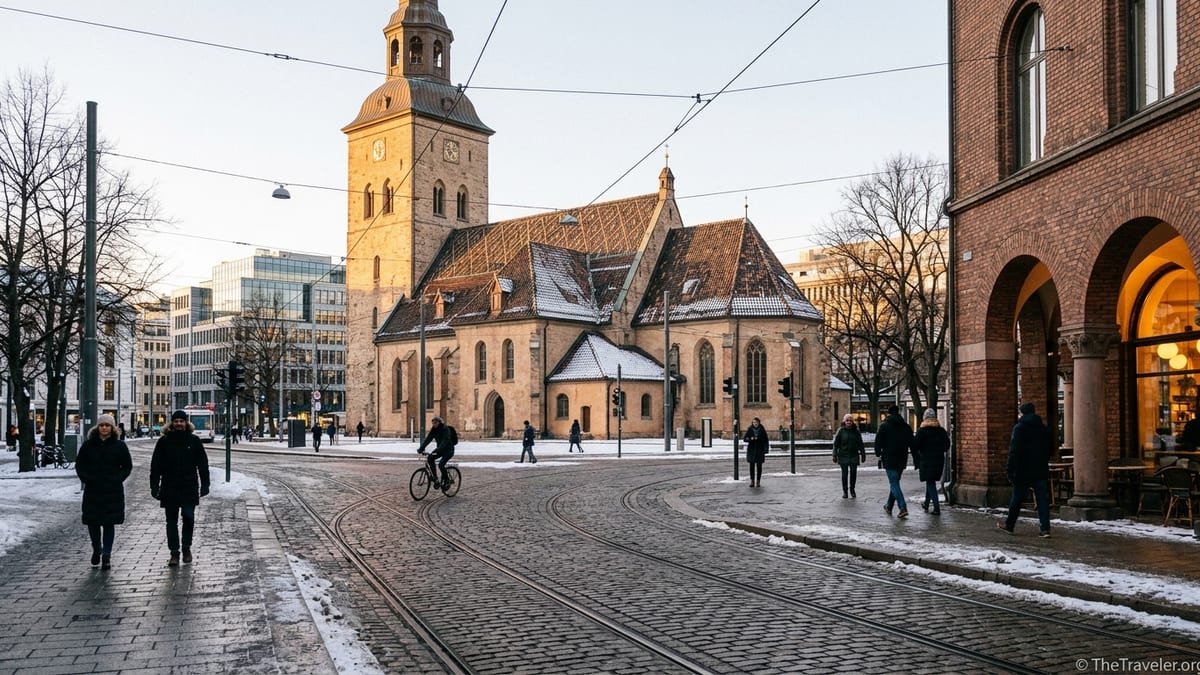
Oslo’s Sacred Landmarks at a Glance
Most first-time visitors will encounter Oslo Cathedral almost by accident. The baroque church, completed in 1697, sits right beside the central shopping streets and the Stortorvet tram stop, a five-minute walk from Oslo Central Station. Its tower, frescoed ceiling and busy calendar of services make it both a working parish church and the city’s ceremonial cathedral for state occasions. Entry is typically free, and the doors are open daily for quiet visits between services, which makes it extremely easy to fold into any city walk.
Just a short tram or bus ride away, however, stand several other churches that tell different chapters of Oslo’s story. Old Aker Church, dating from the 12th century and considered the oldest surviving building in the city, crowns a low hill above the Grünerløkka district. Trinity Church rises near the government quarter in raw red brick, one of Oslo’s largest churches with an octagonal plan and space for around a thousand worshippers. Further afield, churches such as Grønland Church or Østre Aker Church add layers of 19th-century growth and industrial history.
If you have only a few hours in Oslo, visiting the cathedral alone is often enough to get a sense of Norway’s church tradition. With a full day, it becomes realistic to pair Oslo Cathedral with Old Aker and one other church along your walking route. In practice, your choice usually comes down to convenience versus depth: the cathedral is right where you already are, while churches like Old Aker reward a deliberate detour with medieval stonework, sweeping views and a calmer local atmosphere.
Because these churches are living places of worship, opening hours and access to specific areas can shift slightly with the liturgical calendar. Before you set out, it is wise to check the week’s program for Oslo Cathedral or the parish pages for Old Aker and Trinity Church, especially if you hope to attend a concert, evensong or special service rather than simply slip in for a quick look between sightseeing stops.
Why Oslo Cathedral Often Deserves First Place
If you have to choose just one historic church in Oslo, the cathedral is usually the most logical priority. It stands in the very heart of the compact city center, between the main train station and the Royal Palace, so you are likely to pass nearby on your way to the opera house, Akershus Fortress or the National Museum. You do not need to plan special transport or carve out a half-day. Many visitors simply drop in for 20 to 30 minutes between other sights, using it as a quiet break from Karl Johans gate shopping or the nearby covered food halls.
Inside, Oslo Cathedral offers a blend of baroque and 20th-century art that feels more ornate than most Norwegian parish churches. The richly painted ceiling, with its swirling biblical scenes, and the stained glass by Emanuel Vigeland immediately catch the eye. Wooden galleries ring the nave, and the altarpiece and pulpit are decorated with carvings that reward a slow walk around. For travelers who have already seen medieval stone cathedrals in other European capitals, the more intimate Norwegian interpretation here offers an interesting contrast.
For many, the most memorable way to experience Oslo Cathedral is to sit quietly during a brief weekday service or evening musical devotion. The cathedral routinely hosts organ recitals, choral evensong and occasional free or low-cost concerts. A typical visitor might step in at 4:45 p.m., find a seat as the organist rehearses, and stay through a 30-minute liturgy without feeling they have sacrificed sightseeing time. The acoustics and the sense of shared, everyday worship can be more powerful than the architectural details alone.
From a practical perspective, the cathedral’s surroundings also matter. Just across the street is a long-established cafe that uses vaulted, brick-lined rooms associated with the cathedral complex, popular with locals for coffee and a pastry or a light lunch. A traveler could easily plan a relaxed morning that combines a visit to the cathedral, a coffee break there, and a short stroll onward to the Oslo City Hall, all without needing public transport or complex navigation.
Old Aker Church: Oslo’s Oldest Building and Hilltop Refuge
Where Oslo Cathedral tells the story of a baroque trading city, Old Aker Church takes you back to medieval Norway. Set on a modest hill in the St. Hanshaugen district, the limestone basilica dates from around the 12th century and is widely regarded as the oldest surviving building within today’s Oslo boundaries. Its thick walls, simple Romanesque arches and sloping cemetery immediately feel older and more rural than the tidy streets below, even though you are only about 20 to 25 minutes on foot from the city center.
For visitors willing to make the detour, Old Aker often becomes a trip highlight. The walk up from the city center can be part of the experience: one popular route follows Telthusbakken, a narrow street lined with colorful wooden houses that survived the great 19th-century rebuilding. As you climb, views begin to open over the Oslo basin, and by the time you reach the churchyard you can look back toward the fjord, the opera house and the rising glass towers of Bjørvika.
Inside, Old Aker feels markedly quieter than the cathedral. When no service is in progress, you may share the space with just a handful of other visitors or a volunteer caretaker. There is little in the way of signage or visitor infrastructure beyond a basic leaflet and occasional guided tours arranged by local organizations. Instead, the appeal lies in the atmosphere: a narrow chancel, the cool stone floor, and a sense that this is a parish church that has seen everything from medieval pilgrims to Reformation preachers and modern city dwellers from the surrounding neighborhoods.
Because Old Aker functions as an active parish church with a smaller staff and fewer daily visitors than the cathedral, opening hours can be more limited, especially outside major holidays and summer weekends. Travelers with a tight schedule might wish to check parish announcements or time their visit for a Sunday service, even if they simply sit in the back and quietly observe. Doing so not only guarantees access but also offers a glimpse of contemporary Lutheran worship in a truly ancient setting.
Trinity, Grønland and Østre Aker: Alternative Historic Stops
Trinity Church, not far from the government quarter, offers yet another angle on Oslo’s religious architecture. Completed in 1858 in a neo-Gothic style with an octagonal plan, it is among the city’s largest churches, with around a thousand seats. The exterior is striking: raw red brick, pointed arches and a tall central tower rising above the surrounding streets. Inside, galleries and vaults create a vertical sense of space quite different from the relatively low, compact interior of Oslo Cathedral or the heavy stone of Old Aker.
Because of its size and central location, Trinity Church is frequently used for major services, civic events and choral performances. Travelers with an interest in 19th-century city planning may also appreciate its intended role: the church was designed to occupy a symbolic central place in Christiania, as Oslo was then called, echoing earlier cathedrals. For example, a visitor exploring the nearby memorials and government buildings could easily add a 20-minute visit inside Trinity to round out an afternoon in the area.
To understand Oslo’s growth as an industrial city and later as a diverse, multicultural capital, it is worth looking beyond the traditional tourist core. Grønland Church, built in the 19th century in a brick neo-Gothic style, stands in the historically working-class Grønland district, today one of the city’s most ethnically varied neighborhoods. A traveler might combine a visit to the church’s exterior and simple interior with exploring nearby food shops, markets and inexpensive eateries that reflect Oslo’s newer immigrant communities.
Further out, Østre Aker Church in the northeastern part of the city offers a more suburban perspective, with a tall spire visible from surrounding highways and industrial zones. It is less convenient for short stays but can appeal to architecture enthusiasts or repeat visitors who want to see how church building continued into the era of railways and factories. Realistically, though, most first-time travelers with limited time will find that the cathedral, Old Aker and perhaps Trinity Church cover the main historical arcs without needing to travel far from the city center.
Planning Your Route: Time, Transport and Typical Costs
Oslo’s historic churches are compact sights, but planning your route well can keep your day flowing smoothly. Oslo Cathedral, located between Oslo Central Station and the National Theatre area, should anchor your schedule. If you arrive in the city by train or airport express, you can walk there in roughly five to seven minutes. Many visitors duck in with their luggage before hotel check-in, as there is no strict dress code beyond normal respectful attire and no ticketing process. Security at the door is light, and there is usually only a brief pause to allow previous services to finish.
From the cathedral, a relaxed walking circuit to Old Aker and back through Grünerløkka makes for a rewarding half-day. One realistic example: start at the cathedral mid-morning, spend 30 minutes inside, then walk north via the river Akerselva or via the St. Hanshaugen park to reach Old Aker in about 25 minutes. After a 30 to 45 minute visit there, descend through the wooden houses of Telthusbakken and into Grünerløkka for a late lunch at one of the many cafes on or near Thorvald Meyers gate. From there, trams run frequently back toward the city center, usually with journey times under 10 minutes.
Public transport costs in Oslo are fairly straightforward. A single adult ticket on local trams, buses or the metro within the central zone typically costs the equivalent of the high single digits in US dollars, and day passes can quickly become economical if you expect to ride more than a couple of times. Many visitors, however, find that they can cover Oslo Cathedral, Old Aker, Trinity and the Grünerløkka churches entirely on foot, especially in spring and summer when daylight hours are long and sidewalks are well maintained.
Most Church of Norway buildings, including Oslo Cathedral and Old Aker, do not charge an entrance fee for casual visits, though donations are encouraged and collection boxes are clearly visible near the doors. Special concerts or guided tours may carry modest ticket prices, comparable to a cinema ticket or a simple sit-down meal. If budget is a concern, a good strategy is to focus on free daytime visits to churches for architecture and atmosphere, then allocate paid cultural spending to one or two bigger-ticket attractions such as museums or fjord cruises.
Matching Churches to Traveler Types
Choosing which Oslo churches to prioritize often comes down to your own interests and travel style. If you enjoy people-watching and seeing how locals use historic spaces in everyday life, Oslo Cathedral is hard to beat. Office workers drop in at lunchtime, wedding parties may gather on Saturdays, and small groups of tourists wander quietly beneath the painted ceiling. The location also makes it easy to combine with shopping, cafes and other central sights, so it suits travelers who like to keep things flexible.
History-focused travelers, particularly those fascinated by the early medieval period, will likely get more out of Old Aker Church. Standing in what was once countryside outside the early city, it preserves a direct line to the 1100s with its Romanesque layout and ancient graveyard. Pairing a visit there with a wander through the nearby historic streets offers a sense of how Oslo grew from a small settlement to a capital. Repeat visitors to Norway, who may have already seen stave churches or cathedrals elsewhere in the country, often rank Old Aker among their favorite Oslo spots precisely because it feels authentic and slightly removed from the busiest tourist paths.
Architecture and design enthusiasts may want to compare several churches deliberately. A thoughtful route might include the baroque interior of Oslo Cathedral, the medieval stone of Old Aker, the neo-Gothic brick of Trinity Church, and a quick look at Paulus Church in Grünerløkka with its tall, narrow tower inspired by German Gothic examples. Observing how each building reflects its era’s materials, urban planning and religious life can make for a rewarding self-guided tour without the need for a formal guide.
Finally, travelers who wish to attend a Christian service while in Oslo have additional factors to consider. Sunday morning liturgies at Oslo Cathedral can be quite formal and may include more music, while smaller parish churches such as Old Aker or Grønland may feel more intimate. Most services are in Norwegian, but visitors who are comfortable following the broad structure of Lutheran worship often find the experience meaningful even without full language comprehension. Checking weekly schedules in advance can help you choose a church and service time that fits with your overall itinerary.
The Takeaway
If your time in Oslo is very limited, Oslo Cathedral should be your first priority. It combines convenient location, distinctive baroque and modern interior decoration, and a lively role in the city’s daily life. You can see it thoroughly in under an hour, and it fits naturally into almost any walking route through the compact city center.
When you have half a day or more and enjoy historic architecture, adding Old Aker Church to your plan is highly recommended. The walk there introduces you to quieter residential neighborhoods, and the church itself offers a rare glimpse into Oslo’s medieval past as the oldest surviving building in the city. Pairing the cathedral with Old Aker gives you a satisfying contrast between the ceremonial heart of modern Oslo and the stone roots of the earlier settlement.
Beyond those two essential stops, other churches such as Trinity, Grønland and Østre Aker are appealing extras rather than core priorities, best suited to travelers with specific architectural interests or ample time. Approached thoughtfully, Oslo’s churches can be more than quick photo stops; they can frame your understanding of how this Nordic capital grew, rebuilt after fires, and adapted to changing times while preserving a quiet continuity of worship.
FAQ
Q1. If I only have two hours in Oslo, should I visit Oslo Cathedral or Old Aker Church?
If you have just two hours, prioritize Oslo Cathedral because it is in the city center near the main station and other key sights, allowing you to combine it easily with a short walk around the core of the city.
Q2. How much time should I plan for a visit to Oslo Cathedral?
Most visitors spend about 20 to 40 minutes inside Oslo Cathedral, a bit longer if they sit through part of a service, listen to an organ rehearsal or study the art in more detail.
Q3. Is Old Aker Church worth the walk from the city center?
Yes, if you enjoy history and local neighborhoods. The walk to Old Aker takes roughly 20 to 25 minutes, passes wooden houses and viewpoints, and rewards you with Oslo’s oldest building and a peaceful churchyard.
Q4. Can I attend a church service at Oslo Cathedral as a visitor?
Visitors are generally welcome to attend services at Oslo Cathedral. You are expected to sit quietly, avoid flash photography and follow basic church etiquette, even if you do not understand Norwegian.
Q5. Are there entrance fees for Oslo’s historic churches?
Entrance to Oslo Cathedral, Old Aker Church and most other Church of Norway buildings is usually free for casual visits, although donations are encouraged and some special concerts or guided tours may charge a fee.
Q6. Which Oslo churches are best for architecture lovers?
Architecture enthusiasts should prioritize Oslo Cathedral for its baroque and modern art mix, Old Aker Church for its Romanesque stonework, and Trinity Church for its large red-brick neo-Gothic octagonal design.
Q7. Are the churches in Oslo easy to reach by public transport?
Oslo Cathedral is within a short walk of the main train station and several tram stops. Old Aker, Trinity and the churches in Grünerløkka and Grønland are all reachable by frequent trams and buses in under 15 minutes from the center.
Q8. Is there a dress code for visiting Oslo Cathedral and other churches?
There is no strict formal dress code, but visitors are expected to wear respectful, modest clothing that covers shoulders and avoids beachwear, especially if entering during services or special ceremonies.
Q9. Can I take photos inside Oslo’s historic churches?
Photography is typically allowed for personal use when no service is in progress, but flash and tripods are discouraged. During services or concerts, it is best to keep your phone and camera put away unless staff indicate otherwise.
Q10. How should I prioritize churches if I have a full day in Oslo?
With a full day, a good sequence is to start at Oslo Cathedral, walk or ride to Old Aker Church and its hilltop cemetery, then continue through Grünerløkka or past Trinity Church, adjusting the route to match your interest in architecture, local cafes and neighborhood exploration.