


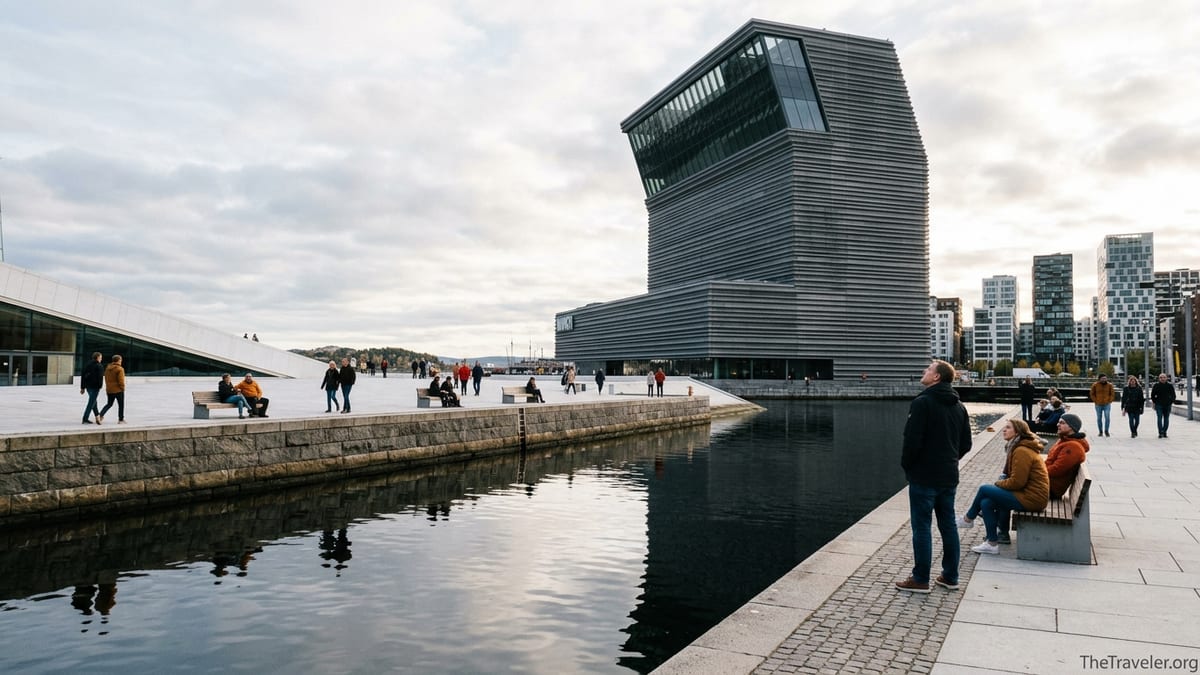
Standing on Oslo’s waterfront, the Munch Museum – branded simply as MUNCH – does not look or feel like the quiet, horizontal palaces of art you find in Paris, Vienna or Madrid. Its tilted tower of dark aluminum rises 60 meters above the Bjørvika district, facing the fjord like a brooding monolith. Inside, zigzagging escalators, black-box galleries and panoramic lounges create an experience that is closer to riding an emotional elevator through one artist’s life than strolling through a typical European collection. For travelers used to the Louvre, the Prado or the Uffizi, MUNCH can be a jolt. Here is why this museum feels so different, and how to make the most of that difference on your next trip to Oslo.
Get the latest updates straight to your inbox!
A Vertical Tower Instead of a Palace of Rooms
Most major European art museums occupy sprawling buildings that invite you to wander laterally. At the Louvre, you might cross seemingly endless wings from the Italian Renaissance to 19th century France. In Florence, the Uffizi’s long corridors guide you chronologically from medieval altarpieces to Botticelli and beyond. MUNCH in Oslo takes the opposite approach. The museum is a 13 floor tower whose core idea is to stack experiences vertically rather than arrange them in a flat maze.
Designed by Spanish firm Estudio Herreros and opened to the public in 2021, the building rises about 60 meters above the harbor, clad in recycled aluminum panels that shift with the light. Many visitors enter on the ground level and then ride a series of zigzag escalators that slice up through the building, pausing at different floors for exhibitions, cafés and event spaces. Instead of one grand enfilade of rooms, you move floor by floor, like chapters in a book you must physically climb.
This vertical model changes how you pace your visit. Travelers with just two hours often choose a few key levels, such as the main Munch retrospective and the floor with The Scream, and then head straight up to the top-floor bar for views of the Oslofjord. In a traditional museum, you might feel guilty skipping whole wings. At MUNCH, the architecture almost invites you to curate your own route, pressing elevator buttons the way you might tap through tracks on a playlist.
The tower format also contrasts sharply with Oslo’s own National Museum, a large, low building where Munch’s 1893 painted version of The Scream hangs among other Norwegian and European works. There, Munch is part of an art-historical story. At MUNCH, he is the story, and the building itself is his dedicated stage set.
Immersive Light, Dark and Movement Instead of Neutral White Cubes
Many European art museums rely on a familiar formula: softly lit, neutral white rooms where the architecture steps back and the art takes center stage. MUNCH leans into a more theatrical rhythm of bright and dark, movement and stillness. The circulation spaces, with glass walls and views across the fjord, are often bathed in natural daylight. Step through a doorway into a gallery, and the environment abruptly darkens as carefully controlled artificial light isolates the paintings and prints.
The lighting design was a central part of the concept. A typical exhibition floor links two gallery spaces with a corridor that creates a loop from the escalators, through the art, and back again. Designers speak of “dynamic” zones, where you move in bright public spaces, and “static” zones, where you slow down in darker rooms with focused spotlights trained on the works. This contrast is especially noticeable on the floors dedicated to Munch’s more psychologically intense pieces, where the gloom of the gallery amplifies the emotional charge of canvases like Anxiety or The Sick Child.
Travelers who have just come from, say, the Alte Pinakothek in Munich or the Kunsthistorisches Museum in Vienna often remark on how MUNCH feels less serene but more cinematic in its sequencing. You might catch a glimpse of Oslo’s Barcode skyscrapers through a window, then step into a near-black space where a single lithograph glows. The experience can heighten your emotional response, particularly when you finally enter the small, dimly lit room where one version of The Scream is displayed behind glass.
This play of light and dark differs from the fully immersive projection shows some travelers associate with “new” art attractions such as Van Gogh Experiences. At MUNCH you still encounter real objects, original canvases and prints, but the building uses light, shadow and spatial compression more aggressively than most historic art museums to guide how you feel as you move.
An Artist’s Life in Layers Rather Than a Chronological Survey
Walk into many European museums and you will be guided chronologically: early Renaissance, High Renaissance, Baroque, and so on. Even institutions dedicated to one artist, such as the Van Gogh Museum in Amsterdam, tend to organize works according to periods of the artist’s life. MUNCH takes a more thematic approach that feels closer to an emotional biography than a textbook.
Across the tower, Munch’s art appears in multiple long term exhibitions with titles such as “Edvard Munch Infinite,” where works are grouped by recurring motifs and obsessions rather than strictly by date. You might find several versions of The Kiss near works that explore loneliness, illness or the fear of loss, even if they were painted years apart. Other floors focus on his experiments with photography and film, including grainy self-portraits he made after buying a Kodak Brownie camera around 1902, which visitors sometimes compare to proto selfied snapshots.
This layered storytelling means you encounter Munch as a restless experimenter rather than a linear success story marching toward a masterpiece. A traveler used to the straightforward narrative at, for example, Vienna’s Belvedere or Madrid’s Thyssen-Bornemisza may find themselves doubling back between rooms at MUNCH to connect themes instead of simply following arrows from early to late work. The museum’s curatorial team has described it as a “paradise for curators,” where they can constantly reconfigure Munch’s huge bequest of around 26,000 works and objects into new constellations.
Practically, this affects what you see on any given day. Rotating selections mean that even signature subjects might appear in different media or combinations over time. Regular visitors in Oslo sometimes return just to see how familiar motifs like the Oslofjord, sickrooms or lovers in the forest have been rehung, in ways that most traditional museums could not easily manage within their more rigid, period-based galleries.
The Scream as a Ritual Moment, Not a Trophy in a Crowd
In many blockbuster European museums, the star works are hung in relatively busy rooms where crowds cluster with cameras raised. Travelers know the scene at the Louvre’s Mona Lisa or the Prado’s Las Meninas. At MUNCH, the museum’s most famous image, The Scream, is treated almost as a ritual encounter that you ascend to, rather than stumble upon.
The museum owns several versions of The Scream in different media, including a painted version, a crayon version and a lithograph. Because these works are extremely light sensitive, the curators typically display only one version at a time, keeping the others “resting in the dark.” Visitors ride up to the designated floor, then step into a small, darkened room where the single Scream on view appears in a controlled glow. The effect is more chapel than gallery, especially compared with the National Museum’s more open Munch room elsewhere in Oslo.
This setup can surprise travelers who expected to see all three versions side by side. Staff are used to explaining why that is not possible for conservation reasons. For some, the restriction adds to the intensity of the visit: you know that what you are seeing is one fragile appearance in an ongoing rotation. For others, it may feel like a letdown compared with the “greatest hits” galleries in other European museums, where several masterpieces compete within the same space.
The way MUNCH stages The Scream also reflects a broader shift away from viewing art as trophies on a checklist. There is no huge label screaming “most famous painting here” in bright colors. Instead, dark walls, limited capacity and an almost hushed atmosphere set the tone. It is a stark contrast with, for example, the open, high ceilinged rooms of the Rijksmuseum in Amsterdam, where Rembrandt’s The Night Watch commands a wide hall surrounded by other major works and a constant buzz of visitors.
A Social, Urban Living Room Instead of a Quiet Temple
Traditional European museums grew out of royal collections and princely galleries. Many still feel like formal spaces where voices drop a notch and you leave everyday life at the door. MUNCH, by contrast, was conceived as part of a new waterfront district that includes the Oslo Opera House and the Deichman public library. From the beginning, the museum’s brief was to act as a social hub as much as a gallery.
Several floors function as public spaces where art, food and city views blend. On the upper levels, a bar and restaurant with floor to ceiling windows look out over the Oslofjord and the islands beyond. Visitors, including locals who might not even buy a full exhibition ticket, come in to meet friends, have coffee or a drink and watch ferries and commuter boats slice across the water. On warmer days, people spill out onto the outdoor terraces, using the museum almost like a vertical town square.
The programming reinforces this role. Alongside the permanent Munch displays, the museum regularly hosts concerts, DJ nights, film screenings and family workshops that draw crowds who might not usually spend an afternoon in a gallery. Recent seasons have included contemporary art installations alongside Munch that spark dialogue about mental health, climate anxiety or urban life. These events echo trends at other forward looking institutions, but at MUNCH they feel especially baked into the building’s identity as a cultural meeting place embedded in Oslo’s daily rhythm.
For travelers, this means the atmosphere at MUNCH can feel more relaxed and mixed than in the hushed salons of, say, the Musée d’Orsay. You may find teenagers gathered around a performance stage on one floor, a couple having an informal lunch among design objects on another, and a group of cruise passengers quietly contemplating a monumental painting on yet another. The museum becomes a place you can dip in and out of during a day exploring Bjørvika, rather than a single intense pilgrimage that you check off and leave behind.
A Contemporary Landmark With a Controversial Face
Part of what makes MUNCH feel different is that the building itself is a talking point in a way older European museums rarely are today. The tower leans slightly toward the fjord, its upper section kinked as if in a cautious bow. Clad in greyish, ribbed aluminum that can read as either shimmering or severe depending on the weather, it divides opinion among locals and visitors. Some see it as a bold new landmark that signals Oslo’s confidence. Others compare its looming form and narrow windows to an office block or even a prison.
Compared with the classical facades of the Prado or the National Gallery in London, which long ago settled into the cityscape, MUNCH still feels new and sometimes contentious. Travelers who arrive by boat often spot it immediately as the most striking object on the skyline after the low, white oslo Opera House. Online forums include comments from Oslo residents who joke that the tower embodies the anxiety and melancholy in Munch’s work, while others praise its energy efficient design, with passive house standards and a targeted reduction in carbon emissions compared with similar buildings.
This contested status affects the visitor experience. Approaching the museum, you walk through a district of sharp-edged modern buildings in glass and steel, rather than leafy historic streets. The entrance plaza spills directly onto the waterfront promenade, where people stroll, jog and sit on steps leading down to the water. Entering MUNCH can feel like stepping into the vertical climax of this new Oslo rather than escaping into a preserved past. For travelers who love architecture and urban change, the building itself becomes as much a reason to visit as the art on the walls.
The contrast with smaller, older European collections is striking. Think of the Musée de l’Orangerie in Paris, housed in a modest 19th century building in the Tuileries Gardens, where Monet’s water lilies envelop you in softly curving rooms. At MUNCH, the sensation is more like standing at the edge of a northern city that is still defining itself, with Munch’s troubled, experimental spirit as one of its guiding reference points.
Practical Details: Visiting MUNCH Versus Other European Museums
On a practical level, visiting MUNCH also feels different from a day at larger European museums simply because of its scale and focus. The museum’s total area is over 26,000 square meters, but because it is stacked, you rarely feel lost in endless corridors. Most travelers report spending between two and four hours, including time for breaks in the café or on the terraces. Compared with the Louvre, where a whirlwind visit can stretch to a full day, MUNCH is compact enough that you can realistically see its main Munch exhibitions and a temporary show in a single afternoon.
Ticket pricing is in line with other major European museums, though exact amounts change periodically. Expect to pay roughly what you would for a single adult ticket to a flagship institution in cities like Berlin or Amsterdam. Buying tickets online in advance is advisable, especially in summer or on weekends, since special events and popular time slots can sell out. Timed entry helps keep the vertical circulation from becoming congested, which makes the experience feel calmer than the crowded crush around hits like the Mona Lisa or Michelangelo’s David.
Because the museum is dedicated largely to one artist, it may not replace a broader national collection for travelers seeking a survey of European art. Many visitors pair MUNCH with the National Museum, a short tram or bus ride away, on the same day. Doing both allows you to see how Munch’s work sits within Norway’s wider artistic story while also experiencing the more experimental, immersive approach at MUNCH itself.
The location in Bjørvika also shapes how you plan your day. It is easy to combine a visit with a walk up the sloping roof of the Oslo Opera House, a stop at the waterfront saunas, or an evening drink in the nearby Barcode financial district. Few big European art museums sit this directly on a working harbor, and the constant presence of water and boats just outside the glass walls becomes part of your visit.
The Takeaway
For many travelers, MUNCH feels different from most art museums in Europe because it asks you to climb into one artist’s psyche through a vertical sequence of spaces, lights and moods. Instead of wandering through centuries of European painting, you ride escalators past the Oslofjord into dark, carefully calibrated galleries where Munch’s obsessions with love, anxiety, illness and nature repeat in ever changing arrangements.
The tower’s polarizing architecture, its role as a social hangout for Oslo residents, and the ritualized encounter with The Scream all add to a sense that MUNCH is as much a contemporary cultural machine as a traditional museum. It does not replace the quiet grandeur of older European art temples, but it offers something different: an immersive, city facing exploration of how one artist’s inner life can still speak powerfully to a modern urban landscape.
If your travels usually take you to classic institutions like the Vatican Museums or the National Gallery, MUNCH will likely surprise you. Plan a few hours, allow time to sit with the fjord views between floors, and let the building’s vertical rhythm shape how you experience Munch’s work. The museum may not give you the comfort of familiar galleries, but it can leave you with a sharp, contemporary sense of how art, architecture and city life can intertwine.
FAQ
Q1. Where is the Munch Museum located in Oslo?
The museum sits on the waterfront in the Bjørvika district, next to the Oslo Opera House and close to the central station, within easy walking distance of many downtown hotels.
Q2. How much time should I plan for a visit to MUNCH?
Most visitors are satisfied with two to four hours, which usually allows enough time for the main Munch exhibitions, at least one temporary show, and a break in the café or at the rooftop bar.
Q3. Is The Scream always on display at MUNCH?
The museum owns several versions of The Scream, but only one is typically shown at a time for conservation reasons, rotated periodically and displayed in a small, dimly lit room.
Q4. Do I need to buy tickets in advance?
Advance purchase is recommended, especially in summer and on weekends, as popular time slots and special events can sell out and timed entry helps keep crowds manageable.
Q5. How does MUNCH differ from Oslo’s National Museum?
MUNCH focuses almost entirely on Edvard Munch in a contemporary tower, while the National Museum presents a broad survey of Norwegian and European art where Munch appears alongside many other artists.
Q6. Is the museum suitable for children and families?
Yes, many families visit, and the museum offers family friendly activities and spacious public areas, though some of Munch’s darker themes may be intense for very young children.
Q7. Can I visit MUNCH and the Opera House on the same day?
Yes, they are neighbors in Bjørvika, so it is easy to combine a tower visit at MUNCH with a walk on the Opera House roof or an evening performance nearby.
Q8. Are there good views from inside the museum?
Several floors feature large glass walls and terraces with wide views over the Oslofjord, the islands and the Barcode district, making the museum a popular spot even for locals.
Q9. Is photography allowed inside the galleries?
Photography is generally allowed for personal use in many areas, but flash and tripods are often restricted and special rules may apply near sensitive works like The Scream.
Q10. Is MUNCH worth visiting if I am not already a Munch fan?
Many visitors who arrive with only a vague sense of Munch leave impressed by the building, the fjord views and the emotional storytelling, so it can be rewarding even for casual art viewers.