


More news on this day
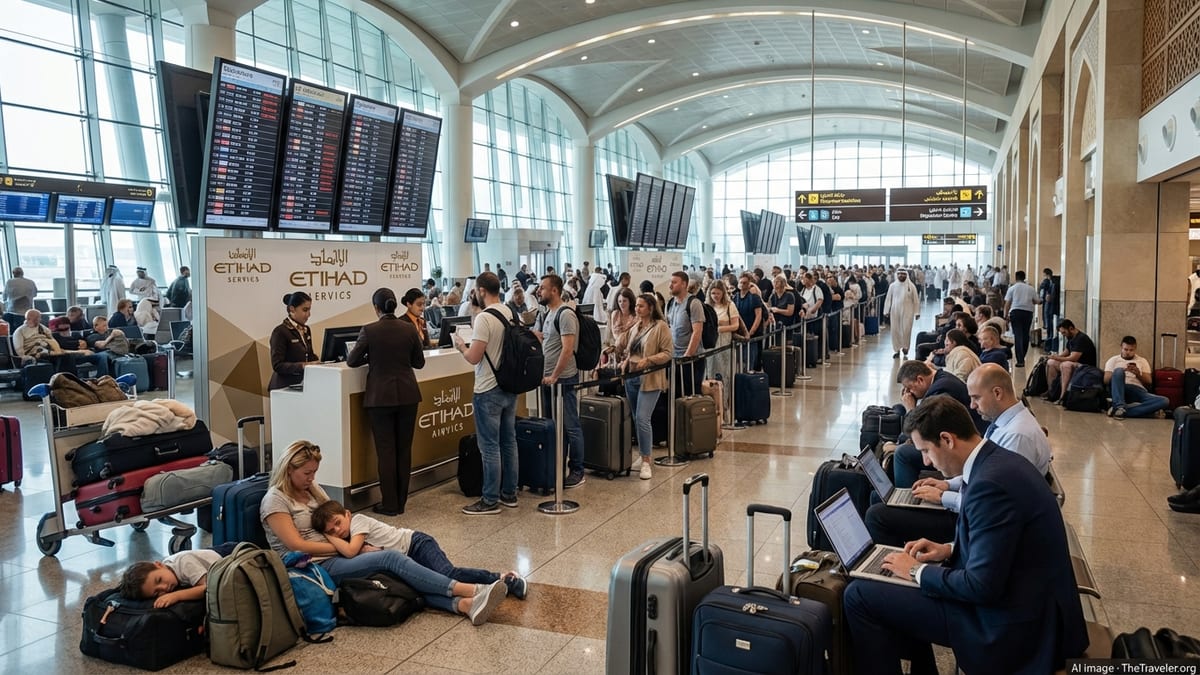
Etihad Airways cancelled a New Delhi to Abu Dhabi flight late Saturday, leaving roughly 200 travelers stranded at Indira Gandhi International Airport as broader disruption affecting Gulf aviation continues to ripple across schedules.
Get the latest news straight to your inbox!
What happened on the Delhi–Abu Dhabi service
Published coverage in India reported that Etihad flight EY217, scheduled to depart New Delhi around 9:15 p.m., was called off after passengers had boarded and later disembarked, with a technical issue cited as the trigger for the cancellation. The reports described long waits at the airport and passengers attempting to secure alternative arrangements.
Flight-tracking details referenced in the same coverage indicated the service was planned with a Boeing 787-9. The specific fault was not described in the publicly available reporting, and airline systems can show updates at different times depending on the channel used to check status.
While the Delhi cancellation was framed as a technical problem rather than an airspace closure, it occurred amid a period when multiple airports and carriers in the Gulf have been dealing with irregular operations, including delays, last-minute changes, and knock-on effects across networks.
Why “Gulf disruption” matters even when a flight is cancelled for technical reasons
Recent regional disruption has made airline operations less predictable, especially on high-volume corridors such as India–UAE. When carriers are managing tighter aircraft rotations, reroutes, and shifting slot availability, a single technical issue can cascade into cancellations rather than quick swaps, particularly if a replacement aircraft or crew is not immediately positioned at the departure station.
In early September, UAE-based reporting described significant flight disruption at both Abu Dhabi and Dubai, with Etihad among airlines showing impacted services on multiple routes, including certain Delhi–Abu Dhabi flights. That broader environment can increase the chance that an operational problem becomes a full cancellation, because recovery options can be limited when schedules are already stressed.
India’s aviation ministry has previously issued operational updates during earlier West Asia airspace disruptions, emphasizing that airline operations may be constrained by airspace and operational considerations and urging passengers to rely on airline flight-status tools before heading to airports. While those earlier advisories were tied to a specific period, they underscore how quickly conditions can change on Gulf routings.
What travelers should do right now if they were booked on EY217 or similar routes
Travelers affected by a cancellation typically need to confirm, in writing, whether the airline has rebooked them automatically, and whether the replacement itinerary keeps the same cabin and baggage allowance. For passengers with onward connections via Abu Dhabi, the key is to verify whether the entire ticket has been protected or only the first sector, since missed connections can trigger complex rebooking.
Etihad provides a flight-status tracker and “manage booking” tools that display changes and can prompt travelers to update contact details so notifications arrive quickly. When disruptions are ongoing, checking status frequently on the day of travel can be more effective than relying on a single earlier notification.
For passengers who choose not to travel on the revised plan, the practical next step is to confirm eligibility for a refund, voucher, or reroute on a later flight. Options can vary by fare rules and the reason recorded for the cancellation, and travelers may need to compare what is offered through the airline with what is available through the travel agent or booking platform used.
Wider operational picture: delays, reroutes, and pressure on India–UAE capacity
India–UAE is one of the busiest international travel markets for Indian travelers, used heavily for point-to-point trips and for long-haul connections via Gulf hubs. When even a small number of flights are cancelled or significantly delayed, replacement seats can tighten quickly across multiple carriers, particularly over weekends and during peak travel periods.
Etihad’s own published schedule and booking displays continue to show frequent service between Delhi and Abu Dhabi, reflecting the importance of the route and the expectation of ongoing demand. However, publicly available flight-status and disruption reporting in September shows that individual flights can be impacted without warning, depending on aircraft availability, airspace constraints, and airport congestion.
Travelers holding separate tickets, such as a Delhi–Abu Dhabi ticket plus a separate onward flight, face higher risk during disruption periods because missed connections are less likely to be protected as one itinerary. Those passengers may want to build longer connection buffers or consolidate bookings into a single ticket where possible to reduce exposure to cascading delays.
What to watch next for travelers heading to Abu Dhabi and the Gulf
For the coming days, the most reliable indicators for travelers will be real-time flight-status pages, airport departure boards, and carrier-issued service updates. UAE media reports earlier this month pointed to widespread delays and some cancellations across both Abu Dhabi and Dubai, suggesting conditions can fluctuate quickly even when airports remain open and operating.
Passengers on Delhi–Abu Dhabi flights should monitor not just their departure, but also arrival conditions at Zayed International Airport, since inbound disruption can affect gate availability and turnaround times for aircraft scheduled to operate return services to India.
With Gulf operations susceptible to sudden changes, travelers may also want to keep contingency plans ready, including flexible hotel arrangements for unexpected overnight delays, ensuring travel insurance documentation is accessible, and keeping airline contact details and booking references available for rapid rebooking if schedules shift again.