


More news on this day
European aviation regulators have extended security warnings for parts of Gulf and Middle Eastern airspace as tensions between the United States and Iran persist, prompting airlines to adjust routings and passengers to face longer journeys on key links between Europe, Asia and Australia.
Get the latest news straight to your inbox!
What Europe’s updated Gulf warning actually covers
The European Union Aviation Safety Agency has prolonged its Conflict Zone Information Bulletin guidance that advises airlines under its oversight to avoid the airspace over Iran, Iraq and Lebanon, while maintaining a more targeted warning for parts of the Gulf. According to publicly available advisories, the current recommendation runs until at least 30 September 2026, with the expectation that it will be reviewed again in the fourth quarter of the year.
Coverage of the latest revision indicates that the broad earlier warning to avoid the entire airspace of Bahrain, Kuwait, Qatar and the United Arab Emirates has been narrowed to focus on the airspace above Gulf waters within those countries’ flight information regions. Separate European conflict-zone bulletins continue to highlight elevated risks over the Persian Gulf and Gulf of Oman, particularly in areas close to the Strait of Hormuz and key shipping lanes.
These bulletins are not legal bans, but they carry significant weight for European carriers, their insurers and leasing companies. Airlines based in the European Union, along with non-EU airlines operating into the bloc under EASA authorisation, are expected to take the guidance into account in their risk assessments, which in practice often means avoiding the highlighted areas for scheduled passenger operations.
How US–Iran tensions are driving continued caution
The extension of the European warning reflects a security environment shaped by years of strained relations between Washington and Tehran. Public reporting over the past year describes periodic flare-ups around the Strait of Hormuz, the use of drones and missiles in regional proxy conflicts, and sporadic attacks on shipping and energy infrastructure. Although a framework understanding between the United States and Iran has periodically reduced the immediate risk of large-scale confrontation, various analyses by aviation and security specialists note that the situation remains fragile.
European safety bulletins emphasise the danger that military activity, including long-range missile launches and air-defense operations, can pose to civil aircraft flying at cruising altitude. The risk is not limited to deliberate targeting; several assessments refer to the possibility of misidentification or miscalculation in crowded skies where military and commercial traffic share limited corridors. That concern has been a consistent theme in conflict-zone guidance since the downing of Ukraine International Airlines Flight 752 near Tehran in January 2020.
US regulations contribute to the cautious approach. The Federal Aviation Administration maintains a specific prohibition on certain US civil flight operations in the Tehran and Baghdad flight information regions, as well as security notices covering the Persian Gulf and Gulf of Oman. While these rules apply directly to US operators, their rationale and detailed risk descriptions are widely consulted by non-US airlines and by European regulators when shaping their own assessments.
Routing changes and longer flights for passengers
For travelers, the most visible effect of the extended Gulf airspace warning is on routings rather than on ticket availability. European network data published by Eurocontrol in 2026 shows that hostilities and airspace closures in parts of the Middle East and Gulf region have led to extensive rerouting of flights linking Europe with Asia, Africa and Oceania, with more than a thousand flights per day affected at the height of recent crises.
Many European and Asian carriers now avoid direct overflight of Iran and Iraq on long-haul routes between Western Europe and destinations such as India, Southeast Asia and Australia. Instead, they rely more heavily on paths that track further north over Turkey and the Caucasus, or south via Saudi Arabia and the Red Sea, depending on the latest risk picture. These dogleg routes can add between 30 minutes and more than an hour of flying time, increasing fuel burn and, in some cases, requiring technical stops or payload restrictions on very long sectors.
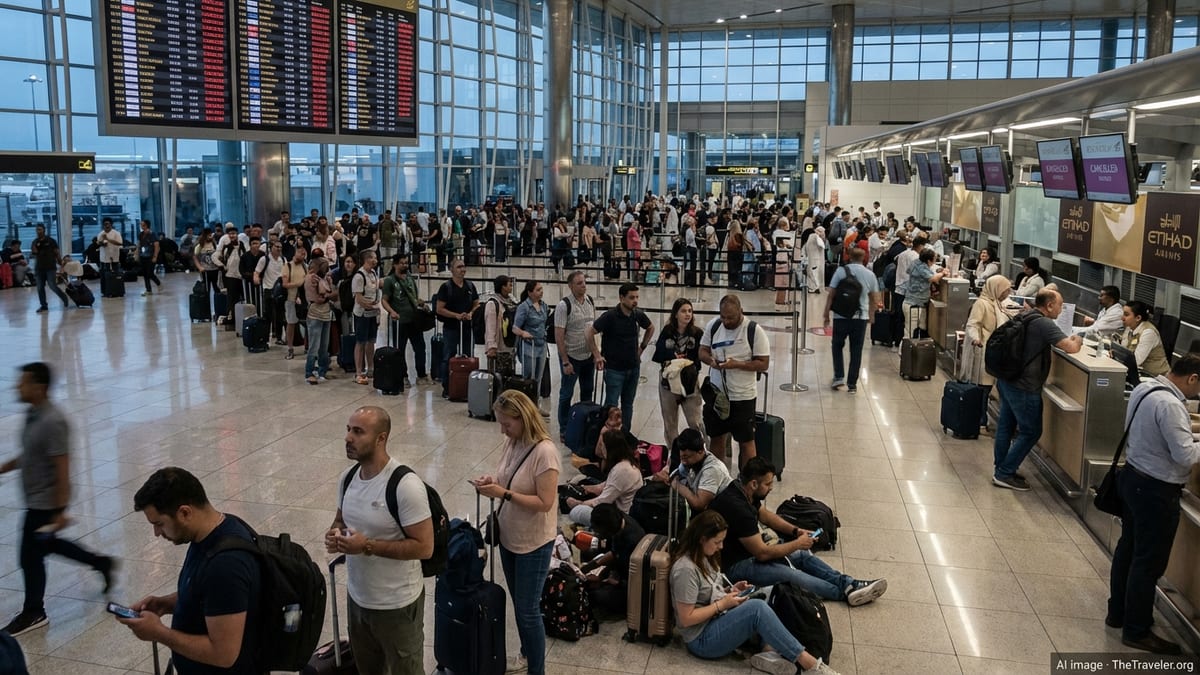
Gulf-based airlines continue to operate a substantial portion of their networks, according to regional aviation intelligence updates, but their operations have become more complex. Flight plans are reviewed frequently and can be adjusted at short notice to take account of new notices to air missions, temporary restrictions or military exercises. For connecting passengers, this can translate into schedule changes, longer minimum connection times and an increased likelihood of operational delays, even when departure and arrival airports remain open.
What this means for safety, costs and ticket prices
Aviation regulators consistently frame these airspace measures as a safety-first response rather than a political tool. Conflict zone bulletins stress that commercial aircraft at cruising altitude are vulnerable to long-range weapons and that the best mitigation is strategic avoidance of known high-risk areas. Airlines, in turn, balance the safety imperative with commercial pressures, but most large carriers have shown a willingness to absorb higher operating costs in exchange for lower overflight risk.
Those higher costs arise mainly from longer flight times and the need to carry more fuel. Industry analyses and airline financial updates show that extended routings can materially increase fuel expenses on intercontinental services, particularly for twin-aisle jets operating near their maximum range. When disruptions are prolonged, some of these additional costs may be reflected in fare structures, especially on routes where competitive alternatives are limited or where detours are most pronounced.
Insurance is another factor. Underwriters closely follow official risk assessments from bodies such as EASA and the FAA. When an area is subject to an active conflict-zone bulletin, war-risk premiums and coverage conditions for flights that still enter the affected airspace may change. In practice, this reinforces the incentive for mainstream carriers to comply with guidance and seek safer alternatives, even when local authorities have not closed their airspace.
Practical advice for travelers planning routes via the Gulf
For passengers booking trips that would normally rely on Gulf overflights or connections at regional hubs, the extended European warning does not automatically mean flights will be canceled. Schedules published by airlines and global distribution systems continue to show extensive service between Europe and major Gulf airports, although the pattern of frequencies and departure times has shifted several times over the past two years in response to security developments.
Travelers with tight connections may want to allow extra time, especially for complex itineraries linking North America, Europe and Australasia through a single Gulf hub. Publicly available timetable data and airline advisories indicate that some carriers have adjusted minimum connection times at their hubs and, during peak periods of disruption, have proactively encouraged customers to select longer layovers to reduce the risk of misconnecting.
Passengers who are concerned about flying near conflict zones can review the routing information that many airlines make visible during the booking process or in their mobile apps, and can monitor operational notices issued on the day of travel. Travel agents and corporate travel managers also increasingly rely on specialist aviation security briefings to help clients understand whether a particular itinerary is likely to transit airspace affected by the latest conflict-zone bulletins.