


More news on this day
Europe’s aviation regulator has extended a high-risk warning over parts of the Persian Gulf and Gulf of Oman as US-Iran tensions persist, prompting airlines to redraw routes between Europe, the Middle East and Asia and raising fresh questions for travelers transiting major Gulf hubs.
Get the latest news straight to your inbox!
What Europe’s extended Gulf warning actually says
The European Union Aviation Safety Agency (EASA) maintains Conflict Zone Information Bulletins, or CZIBs, to flag airspace where military activity poses a heightened risk to civil aviation. The latest list shows an active bulletin for the “airspace of the Persian Gulf and Gulf of Oman” under reference CZIB-2026-07R3, issued on 14 July 2026 and currently valid until mid-November 2026.
According to publicly available summaries of the July bulletin, EASA advises air operators not to fly at any altitude through the airspace of Bahrain, Kuwait, Qatar and the United Arab Emirates, as well as the airspace over the Gulf of Oman within the Muscat flight information region west of 58 degrees east longitude. Reports indicate that the warning is framed as a strong recommendation rather than a legal ban, but European carriers are expected to treat it as binding guidance for risk assessments.
EASA’s conflict zone database also lists separate active bulletins for the airspace of Iran, Iraq and Lebanon, reflecting concern that hostilities and military posturing extend beyond the immediate Gulf. Regional aviation notices circulated by national authorities in Europe refer operators back to these CZIBs and urge close monitoring of any further revisions.
The renewed Gulf-specific advisory replaces a broader temporary warning that had covered much of the Middle East and Persian Gulf region earlier in 2026. That earlier, wide-ranging CZIB expired in July and was replaced by more targeted documents as regulators sought to reflect shifting front lines while still highlighting areas of high risk.
How US-Iran tensions are shaping the risk picture
The latest European warning comes against the backdrop of an extended phase of confrontation between the United States and Iran. Open-source coverage describes weeks of US airstrikes on Iranian military targets and proxy forces around the region, Iranian missile and drone launches, and repeated incidents involving commercial shipping in and near the Strait of Hormuz.
Analyses of the CZIB text and accompanying expert commentary point to several key concerns: the presence of active air defense systems on both sides, extensive use of long-range missiles and armed drones, and the possibility that a civil airliner could be misidentified as a military aircraft. Regulators refer to the risk of debris from intercepts and the potential for rapidly evolving military operations in the same airspace used by scheduled flights.
The United States Federal Aviation Administration maintains its own advisories for US operators. Background material on earlier Gulf and Gulf of Oman advisories explains that, even when the risk of deliberate targeting of civil aircraft is assessed as low, intense military activity and elevated alert states can create a danger of miscalculation. That logic is reflected in the current European stance, which treats the Gulf as a zone where any surge in hostilities could quickly translate into hazards for civilian traffic.
While there is periodic talk of limited ceasefire arrangements or de-escalation, recent European and regional notices continue to describe the security situation as volatile. The decision to extend the Gulf warning into November 2026 signals that regulators do not expect a rapid or durable easing of tensions that would justify restoring routine overflights in the short term.
Impact on flights through Bahrain, Qatar, Kuwait and the UAE
The practical effect of the CZIB is most visible in the skies above some of the world’s busiest transit hubs. Bahrain, Doha, Kuwait City, Abu Dhabi and Dubai sit astride major corridors linking Europe with South and Southeast Asia, Australia and East Africa. With EASA advising European carriers to avoid the airspace of Bahrain, Kuwait, Qatar and the United Arab Emirates, many airlines have re-routed or adjusted services in and out of these markets.
Flight-tracking data compiled by independent airspace risk platforms in late September indicates that a significant number of European airlines are skirting the central Gulf, instead using more southerly routes over Saudi Arabia and the Arabian Sea, or northern arcs via Turkey, the Caucasus and, where allowed, parts of Central Asia. Some carriers continue to serve Gulf hubs but are adjusting their arrival and departure paths to keep time spent over the designated high-risk zones to a minimum.
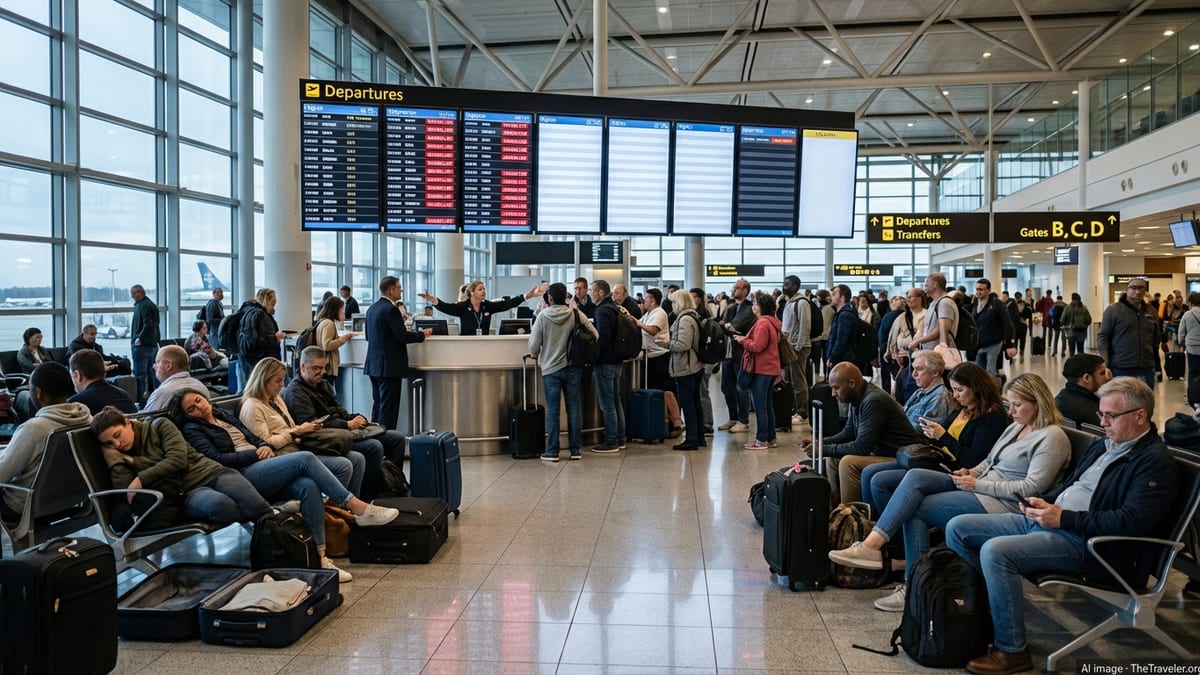
For travelers, the most immediate consequences are longer flight times, schedule tweaks and, in some cases, reduced frequencies. Industry briefings suggest that avoiding direct Gulf routings can add up to an hour or more to certain Europe–Asia sectors, with knock-on effects for aircraft rotations and crew duty times. Airlines must also factor in higher fuel burn, which can influence pricing, especially on competitive long-haul routes.
Not all operators are responding in the same way. Publicly available route maps show that some non-European carriers continue to fly through portions of the affected airspace, guided by their own national risk assessments. That divergence underscores that EASA’s role is to advise carriers under its oversight; other states may apply different thresholds when weighing the same risks.
What passengers need to know before booking
For passengers planning trips that involve Gulf hubs or overflights between Europe and Asia, the extended warning does not mean that all travel in the region has stopped. Major Gulf airlines continue to operate extensive networks, and many European carriers still fly to and from key cities in the area, albeit on adjusted routings.
Travelers may notice slightly longer advertised flight times on some routes, particularly those that previously crossed directly over the central Gulf or southern Iran. Some itineraries that once involved short, late-night connections through certain hubs may now feature longer layovers or rerouted segments. Where schedules have been compressed to accommodate new flight paths, airlines are also making short-notice changes as they fine-tune operations.
Public guidance from aviation safety bodies stresses that airlines remain responsible for conducting their own risk assessments and that any decision to operate flights near conflict zones should be based on the latest intelligence and regulatory advice. From a traveler’s perspective, this means that conditions can change quickly. It is prudent to monitor booking updates closely, ensure contact details are correct in reservations, and check flight status repeatedly in the days and hours before departure.
For those who prefer to avoid overflying high-tension areas altogether, one option is to look for routings that connect via southern Europe, North Africa or the Indian Ocean rather than the Gulf. However, these alternatives can involve longer journeys or higher fares, and availability will depend on the specific city pair and travel dates.
How long the disruption could last
The current Gulf and Gulf of Oman conflict zone bulletin is listed as valid until November 2026, but the end date is not a guarantee that restrictions will be lifted at that time. EASA typically reviews and, where needed, renews its advisories before they expire, based on updated security assessments and input from European states and international partners.
Recent history suggests that conflict-related airspace measures can remain in place for years. Separate bulletins for countries such as Libya, Yemen and parts of Ukraine have been renewed multiple times as the underlying conflicts persisted. Similarly, restrictions related to the Russia–Ukraine conflict and broader regional instability have forced long-term rerouting of Europe–Asia traffic, contributing to higher operating costs and more complex route planning.
The outlook for the Gulf will depend heavily on the trajectory of US-Iran relations, the behavior of regional armed groups and the success of diplomatic efforts to keep military activity away from key commercial corridors. Analysts note that even if large-scale hostilities ease, regulators may wait to see sustained calm and clearer separation between military and civil air traffic before relaxing their warnings.
For now, the extension of Europe’s Gulf airspace warning signals that regulators see continued, non-trivial risk in a region that is central to global connectivity. Passengers planning journeys through or over the Gulf in the coming months should expect airlines to keep adjusting and, in some cases, to trade speed and convenience for wider safety margins.