


More news on this day
Summer travel plans across Europe were thrown into disarray this week as a mix of severe weather, staffing bottlenecks and wider operational pressures triggered around 1,550 delayed flights and at least 28 cancellations, with disruption reported in Portugal, Belgium, Norway, Spain and Italy and knock-on effects for major carriers such as British Airways, KLM and easyJet.
Get the latest news straight to your inbox!
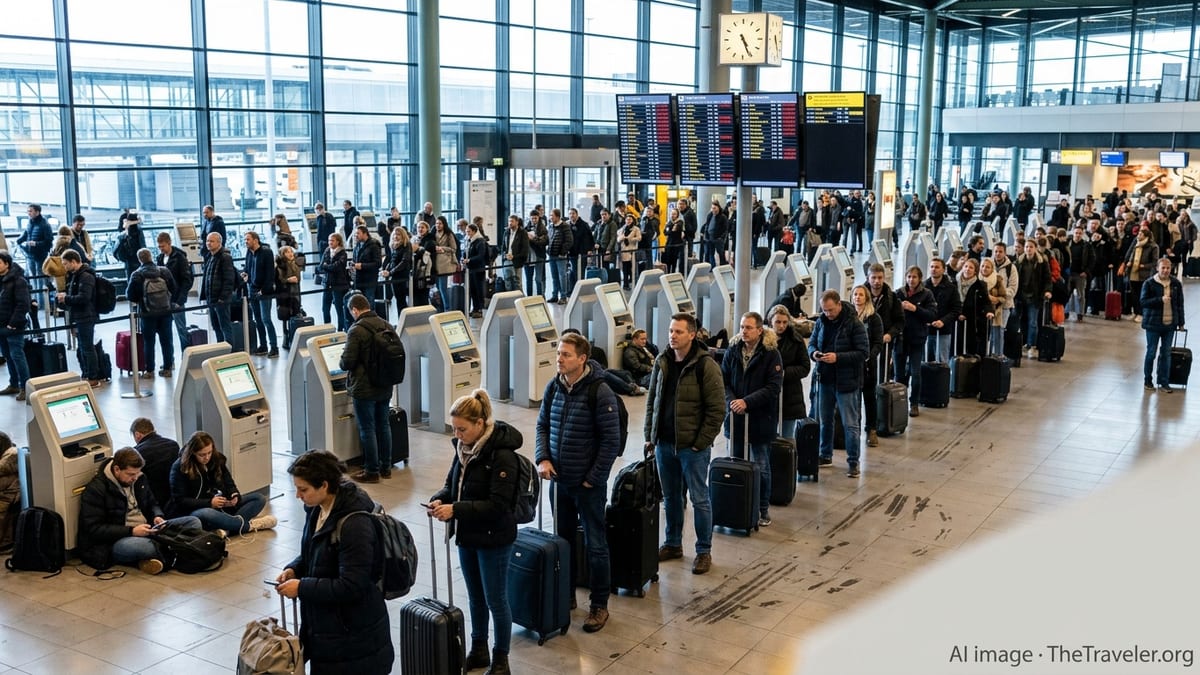
Weather and Operational Strains Collide Across the Continent
Published data and local media coverage indicate that weather remains one of the most immediate triggers behind the latest wave of disruption. In Portugal, strong winds at Madeira’s Cristiano Ronaldo International Airport continued to interfere with operations for a second consecutive day on 9 June, forcing multiple cancellations on routes linking the island to mainland hubs such as Lisbon and Porto as well as European cities including London, Basel and Lyon. Carriers have been attempting to use brief calmer periods to land aircraft, but hundreds of passengers have faced lengthy delays or diversions.
Elsewhere in Portugal, airport systems and border-control issues have added to the strain. Recent reporting from Lisbon and Faro highlights long queues and waiting times above one hour at passport control, with technical problems and heavy traffic combining to slow passenger flows during peak morning departures. Travellers transiting these airports onto connections for Madrid, Rome and other European cities have consequently faced a greater risk of missed flights and last-minute rebooking.
Across Europe, air traffic flow management data shows that delays are also being amplified by structural constraints in the network. Recent Eurocontrol overviews point to rising average delay minutes per flight compared with the same period last year, with some area control centres and busy hubs struggling to absorb strong seasonal demand on top of longer rerouting caused by restricted airspace over conflict zones. This backdrop has left airlines with less flexibility when local problems, such as storms or strong winds, strike key airports.
The cumulative result has been a sharp spike in disrupted services across several countries. Aggregated figures compiled from flight-tracking and passenger rights platforms suggest that, over a 24 to 36 hour window, around 1,550 flights were delayed and at least 28 cancelled at major European airports, including Madrid Barajas, Rome Fiumicino, Amsterdam Schiphol, Brussels, Oslo and Lisbon. While the numbers represent only a portion of overall traffic, they have been enough to cause visible crowding and schedule knock-ons at many terminals.
Major Carriers See Schedules Unravel in Madrid, Rome and Beyond
British Airways, KLM and easyJet sit among the carriers most exposed to multi-country disruptions of this kind, due to their extensive European networks and reliance on congested hubs. Recent tracking by consumer-advocacy and compensation platforms shows that these airlines, alongside other flag carriers and low-cost rivals, have together accounted for hundreds of delayed flights across the latest disruption window, with a smaller but significant set of outright cancellations.
Madrid and Rome have again emerged as key pressure points. Data collated earlier this year already identified both airports among the most delay-prone hubs in Europe, and the latest episode has reinforced those trends. Madrid has seen high volumes of late-running departures toward northern Europe and the UK, affecting British Airways services into London as well as codeshares and feeder flights operating on behalf of larger alliances. Rome Fiumicino, meanwhile, has reported knock-on delays across intra-European routes, complicating itineraries that involve tight connections onward to Scandinavia, Portugal or the Low Countries.
In the Benelux region, KLM has been working through a complex mix of challenges. Travel alerts published by the airline show an ongoing pattern of schedule adjustments in response to broader operational issues this year, including a global jet fuel squeeze that has already led some European and transatlantic carriers to thin out capacity. Separate aviation analyses of 2026 operations point to an uptick in cancellations at KLM and British Airways compared with pre-crisis norms, even as both airlines attempt to protect peak summer routes.
While easyJet has publicly stated in recent updates that its overall flying programme for 2026 remains broadly intact and that it has not faced the same degree of fuel-related disruption as some competitors, real-time disruption snapshots still show the carrier appearing prominently in delay statistics on busy days. As one of the largest operators at European leisure gateways, the airline’s performance is tightly bound to conditions at hubs like Amsterdam, Paris, London and major Mediterranean airports, where even modest slowdowns in handling or air traffic control can ripple through the network.
Portugal, Belgium and Norway Feel the Strain
The current disruption has underlined how secondary and regional airports across Portugal, Belgium and Norway can rapidly become pinch points for the wider European system. In Portugal, ongoing concerns about long queues and staffing at Lisbon, together with weather-sensitive operations in Madeira and the Azores, have drawn enough attention that the government recently announced plans to deploy more than 300 additional police officers to airports from early July to help ease border-control bottlenecks.
Belgium, sitting at the heart of Europe’s densest airspace, regularly experiences spillover from wider network issues. Brussels Airport is heavily dependent on carefully timed waves of arrivals and departures to feed both local traffic and connections via partner hubs such as Amsterdam, Paris and London. Industry reporting notes that even small disruptions in air traffic management or ground handling quickly lead to a buildup of delayed departures, which then feed into statistics showing hundreds of flights missing their scheduled slots across the region.
Norway, though less central than Belgium in terms of continental connectivity, has its own sensitivities. A combination of challenging weather conditions, long domestic sectors and reliance on connections through European hubs means that when flights into or out of Oslo and other key Norwegian airports are delayed, passengers often face complex rebooking situations. During the latest disruption phase, delays on services linking Norway to hubs like Amsterdam and London have further contributed to the total of more than 1,500 affected flights, despite relatively modest local traffic levels.
These country-specific pressures sit atop persistent structural factors that make rapid recovery difficult. Eurocontrol’s most recent European Aviation Overview notes that average delays per flight have crept higher this spring, partly reflecting lingering staffing gaps in some control centres, the need for longer routings around conflict zones and capacity limitations at several airports operating near their maximum sustainable throughput.
Knock-On Impact for Passengers and Summer Travel Plans
For travellers, the headline numbers on delays and cancellations translate into concrete and often stressful experiences at the airport. Social media posts and passenger forums over recent days have described long queues at check-in and security in Lisbon, anxious waits at departure gates in Madrid and Rome, and confusion around rebooking options when flights are cancelled close to departure time. With many services operating near full capacity at the start of the summer peak, finding alternative seats on the same day has in some cases proved difficult.
Consumer-rights organisations continue to emphasise that passengers affected by significant delays or cancellations on European carriers, or on flights departing from the EU or UK, may be entitled to assistance or compensation depending on the cause of the disruption. Publicly available guidance referencing the EU261 and UK261 frameworks notes that travellers should retain boarding passes and receipts, monitor airline apps and airport information screens closely, and document the length and nature of any delay when making a claim.
Analysts point out that the current turbulence is part of a broader pattern rather than a single isolated event. In recent months, separate data snapshots have documented several days with more than 700 delays and dozens of cancellations across Europe, often triggered by a mix of weather, staffing shortages, industrial action or airspace restrictions. Against that backdrop, the latest tally of roughly 1,550 delayed flights and 28 cancellations serves as another reminder that Europe’s aviation system remains vulnerable to shocks, even as overall traffic recovers.
Looking ahead, travel experts suggest that passengers build additional flexibility into itineraries for the coming weeks, especially when connecting through hubs known for congestion at peak times. Recommendations commonly include avoiding tight self-made connections, travelling with carry-on luggage when possible, and checking flight status frequently in the 24 hours before departure. With major carriers such as British Airways, KLM and easyJet all navigating a challenging operating environment, the expectation is that further disruption events, though not guaranteed, remain a realistic possibility as the busy summer season unfolds.