


More news on this day
Air travel across Europe faced another day of heavy disruption as major hubs including Paris Charles de Gaulle and Frankfurt recorded a combined 2,257 delayed flights and 78 cancellations, straining airline operations and summer travel plans.
Get the latest news straight to your inbox!
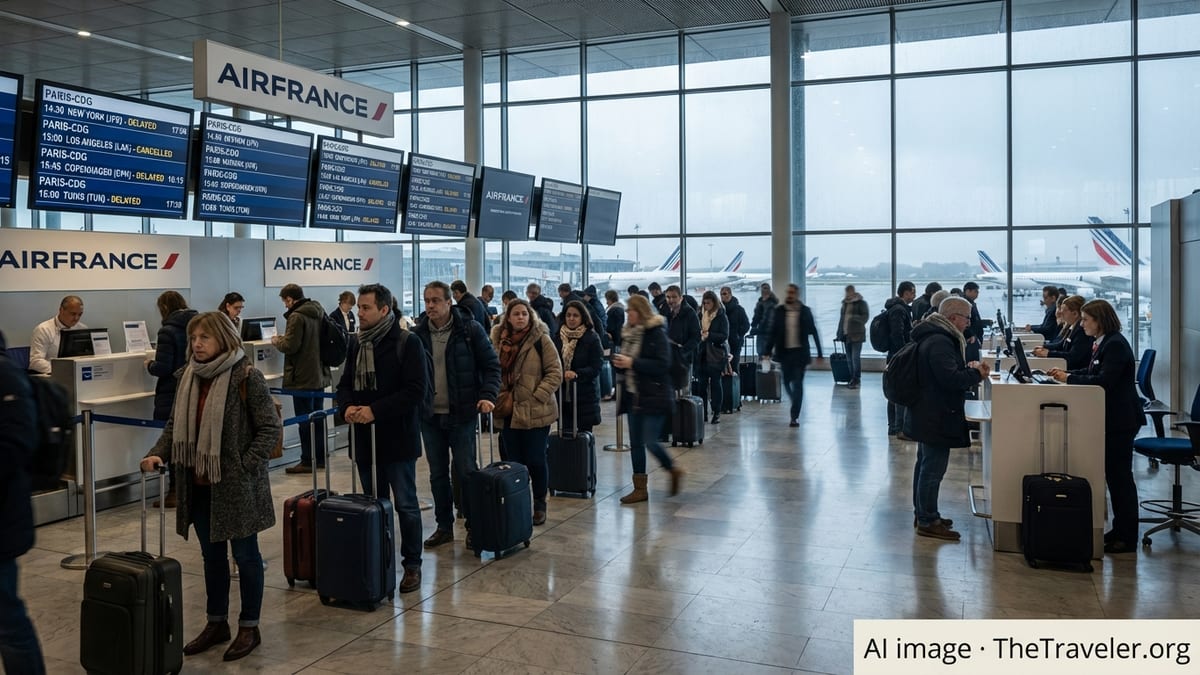
Major Hubs Lead a Continent-Wide Disruption Spike
Publicly available disruption trackers show that Paris Charles de Gaulle (CDG) and Frankfurt (FRA) were again among Europe’s most affected airports, as a wave of delays and cancellations rippled through at least 16 major hubs. Aggregated figures for the day indicate 2,257 delayed flights and 78 cancellations across the network, highlighting how quickly operational issues at a few large hubs can cascade across the continent.
Data from live airport monitoring services ranks CDG and FRA near the top of Europe’s disruption tables, with high proportions of departures and arrivals running late alongside a smaller but still significant number of outright cancellations. Other large airports including London Heathrow, Amsterdam Schiphol, Munich, Zurich, Barcelona, Athens, Brussels, Vienna, Lisbon and Rome reported elevated delay levels, confirming the broad geographic spread of the latest problems.
The pattern mirrors earlier disruption days this summer, when Europe-wide operational issues led to hundreds of delays and dozens of cancellations in a single 24-hour period. Previous incidents in June and July saw comparable totals of around 600 to 650 affected flights across multiple hubs, underlining that the current strain on Europe’s aviation system is not an isolated anomaly but part of a wider seasonal challenge.
While the majority of affected flights eventually departed, the concentration of late operations around peak travel windows led to noticeable crowding at gates, longer waits at security and border-control checkpoints, and mounting knock-on delays for connecting passengers heading to secondary European and long-haul destinations.
Airlines and Airports Struggle With Structural Bottlenecks
Industry analyses over the past two years point to a combination of factors behind Europe’s repeated bouts of disruption. Capacity limits and staffing constraints in air traffic control have become a prominent issue, with recent reports noting that total minutes of air traffic control delay in Europe have more than doubled over the last decade despite only modest growth in flight numbers.
Airports such as Paris and Frankfurt are especially vulnerable on days when traffic volumes are close to or above pre-pandemic levels, as even minor runway closures, thunderstorms or restricted airspace can quickly translate into long queues of aircraft awaiting departure slots. Punctuality reports compiled before the current summer season already highlighted both hubs as susceptible to en-route flow restrictions, low-visibility operations and reactionary delays driven by late-arriving aircraft.
On the airline side, tight scheduling and high aircraft utilization ratios mean there is limited slack to recover when early-morning flights run late. As rotations slip throughout the day, passengers on later departures often experience delays that are only indirectly related to the weather or technical issue that started the chain. These dynamics are particularly visible at multi-bank hubs such as CDG and FRA, where missed connections can further complicate crew and aircraft positioning.
Advocacy and data firms tracking performance argue that, while short bursts of severe weather are unavoidable, more resilient staffing and capacity planning at both airlines and infrastructure providers could reduce the scale of disruption on peak days. They also note that the cumulative effect of frequent medium-scale disruption is comparable for travelers to a smaller number of large-scale meltdown events.
Passenger Rights and What Travelers Can Expect
For travelers caught up in the latest wave of delays and cancellations, Europe’s EC 261 regulation remains the main framework governing assistance and compensation. Under these rules, passengers on flights departing the European Union, or operated by EU-based carriers, may be entitled to financial compensation of up to €600 when significant delays or cancellations are attributable to airline operations rather than extraordinary circumstances such as severe weather, airspace closures or security incidents.
Consumer-rights guidance notes that on disruption days like this one, mixed causes are common. Weather or air traffic control restrictions may play a role for some flights, while others are primarily affected by crew or aircraft availability, tight scheduling or operational decisions. In practice, this means compensation eligibility can vary even for passengers traveling from the same airport on the same day, depending on the specific reason recorded for their flight’s delay or cancellation.
Regardless of whether financial compensation applies, airlines are generally expected to offer care and assistance when delays extend beyond certain thresholds. This can include meal vouchers, refreshments, hotel accommodation when an overnight stay becomes necessary, and ground transport to and from that accommodation. Travelers are advised to retain boarding passes, delay notifications and receipts for any out-of-pocket expenses, as these may be needed to support later claims.
Specialist claims services continue to report strong demand from passengers seeking help in navigating EC 261 rules after major disruption days. They point out that even on days when cancellations are relatively limited, the sheer volume of delayed flights can leave customer-service channels overwhelmed, making it harder for travelers to obtain clear information and timely rebooking options.
Impact on Summer Travel Plans Across Europe
The latest disruption has added fresh pressure to an already busy late-summer travel period. With many schools still on holiday and business travel gradually returning, load factors on European routes remain high, leaving airlines with fewer spare seats to accommodate rebooked passengers when flights are canceled or heavily delayed.
At hub airports such as Paris and Frankfurt, this often means that travelers who miss onward connections must wait for later flights that may already be close to full. In some cases, passengers heading to smaller regional airports or leisure destinations face overnight stays or forced rerouting via alternate hubs, further complicating luggage handling and increasing the risk of mishandled bags.
Travel-data dashboards tracking average departure delays across Europe show that, even when headline cancellation numbers remain in double rather than triple digits, average delay times at key hubs frequently reach 20 to 30 minutes or more. On days when multiple airports across France, Germany, Italy and Spain record similar patterns, the cumulative effect can be significant for airlines trying to manage aircraft rotations and crew duty limits.
For travelers with imminent trips, industry guidance continues to emphasize checking flight status frequently in the 24 to 48 hours before departure, allowing extra time at the airport, and considering longer layovers for self-planned connections. Those booking new journeys in the current environment are also encouraged to factor in the potential value of flexible tickets or hotel reservations with more generous change and cancellation terms.
Why Europe Keeps Seeing Multi-Airport Disruption Days
Recent punctuality and disruption reports suggest that the pattern seen in this latest incident, with a relatively modest number of cancellations but a very high volume of delays concentrated at major hubs, is becoming a recurring feature of European aviation. Structural bottlenecks in air traffic management, airport capacity and ground handling resources intersect with sustained demand, leaving the system highly sensitive to localized shocks.
Studies of summer performance in previous years found that certain states and route clusters already accounted for a disproportionate share of Europe’s delay minutes, particularly in busy upper airspace sectors above France and Germany. When those sectors become constrained, either due to staffing limits or convective weather, large hub airports underneath or adjacent to them often experience immediate pressure on arrival and departure flows.
In parallel, the drive to rebuild schedules after the pandemic has, in some cases, outpaced investments in additional resilience. While airlines and airports have added staff, unions and industry bodies continue to highlight gaps in experienced personnel, especially in specialized roles such as air traffic control, security screening and ramp operations. These gaps tend to be most visible on peak travel days when every part of the system is running close to its maximum planned capacity.
Observers note that without targeted improvements in cross-border air traffic management and better coordination between airlines, airport operators and ground-handling providers, Europe is likely to see further days on which a limited number of cancellations mask a much broader landscape of delays. For travelers, the practical takeaway is that even flights which ultimately operate can still experience enough disruption to affect connections, meetings and holidays.
Flightradar24 Europe airport disruption map
AirHelp: Europe flight disruptions report, June 2026
AirHelp: Frankfurt and Zurich disruption analysis, July 2026