


More news on this day
An Amazon-branded cargo jet landing at Miami International Airport on Sunday overran a runway, burst into flames and crashed through a perimeter fence into nearby vehicles, killing five people and injuring five others, according to multiple news reports and official statements cited in published coverage.
Get the latest news straight to your inbox!
Runway Overrun Triggers Deadly Fireball Near Airport Perimeter
Publicly available information indicates the Boeing 767 freighter, operating as an Amazon Prime Air cargo flight, was arriving from San Juan’s Luis Muñoz Marín International Airport on the afternoon of September 6 when it attempted to land on a runway at Miami International Airport. Reports indicate the aircraft failed to stop within the available pavement, continued past the runway end and crossed an airport service area before breaching the perimeter.
According to published coverage from national and local outlets, the widebody jet struck multiple vehicles on a roadway that runs just beyond airport property. Images and video shared by broadcasters and online platforms show the aircraft engulfed in flames, with thick black smoke visible from nearby neighborhoods and terminals.
Emergency responders transported at least five injured people to area hospitals, while five fatalities were reported in the hours after the crash. Several accounts state that some of the dead and injured were in vehicles outside the airfield rather than on board the aircraft, underscoring how close the impact occurred to public roadways and airport-adjacent businesses.
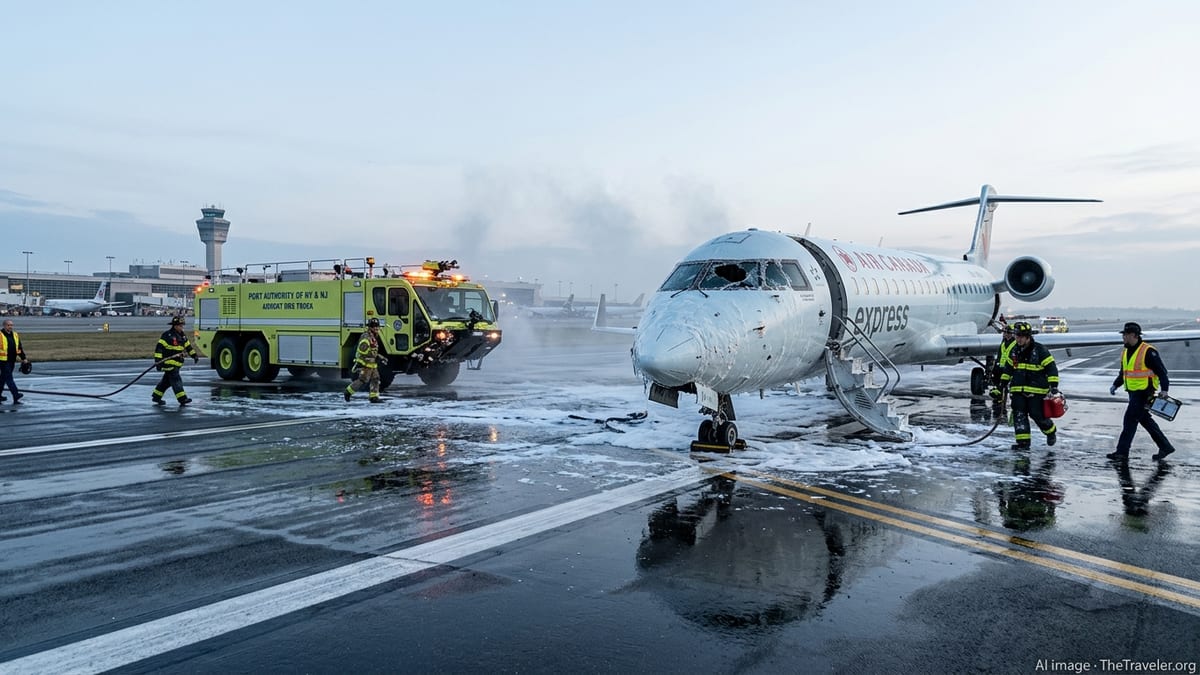
Fire crews at the airport and from surrounding Miami-Dade stations worked to control an intense fuel-fed blaze around the fuselage and wing area. Video taken shortly after the overrun shows fire-suppression foam blanketing the wreckage as responders move between pieces of the broken airframe and damaged cars near the airport fence line.
Flight From Puerto Rico Ends in Catastrophe at Major U.S. Hub
Tracking data and airline information compiled in media reports show the cargo flight originated in San Juan, Puerto Rico, and was nearing the end of a routine run into Miami, one of the busiest international gateways in the United States and a key cargo hub for Latin America and the Caribbean. Weather at the time of landing was widely described as typical for late-summer South Florida, with no immediate indication of severe storms on final approach.
Outlets citing aviation databases identify the aircraft as a Boeing 767-300 freighter operating under contract to Amazon’s air network, sometimes branded as Amazon Air or Prime Air. The jet carried only a small crew complement, as is standard for cargo operations, but the proximity of the runway end to public infrastructure meant that people on the ground bore the brunt of the impact when the jet left the paved surface.
Reports indicate the overrun forced a temporary shutdown of multiple runways at Miami International Airport while firefighters battled the blaze and investigators documented debris scattered across the runway safety area, service roads and an adjacent street. Some arriving flights were diverted to nearby airports, while departures experienced delays as airport operations worked around the damaged aircraft and continuing emergency activity.
The crash adds a new chapter to Miami International Airport’s long history as a cargo gateway, where freighters share runways with dense passenger traffic. Aviation analysts quoted in coverage emphasize that runway overruns involving large jets are rare in the United States, particularly at major hubs with modern runway safety enhancements, which has fueled public interest in how a cargo flight could travel so far beyond the runway end.
Early Investigation Focuses on Landing Distance and Braking
Federal investigators have opened a formal inquiry into the crash, with teams from national accident investigators and aviation regulators dispatched to Miami, according to publicly released information referenced in multiple reports. Early attention is centering on the landing phase of the flight, including the jet’s touchdown point, approach speed and the condition of its braking and thrust-reverser systems.
Analysts reviewing flight-tracking data cited in published coverage note that the aircraft appeared to be aligned with the runway on final approach but may have touched down later than ideal, leaving less runway available to decelerate a fully loaded freighter. Any contamination on the runway, such as standing water or rubber build-up, along with tailwind components, could also form part of the technical analysis.
Investigators are expected to recover the cockpit voice recorder and flight data recorder from the wreckage to reconstruct the crew’s actions and the aircraft’s performance in the minutes leading up to the overrun. Publicly available briefings suggest that maintenance records, crew training history and load documentation for the cargo on board will be examined to determine whether mechanical issues, human factors or weight-and-balance concerns contributed to the outcome.
Specialists in airport safety note that modern standards call for engineered materials arresting systems or extended safety zones beyond runway ends where space allows, designed to stop aircraft that leave the pavement. How the aircraft was able to pass beyond airport property and into a busy corridor with vehicles will likely receive close scrutiny as authorities map the exact path of the jet and the location of every impact point.
Impact on Travelers, Cargo Operations and Nearby Community
While the crashed freighter was not carrying passengers, the incident has had ripple effects for travelers passing through Miami International Airport. Airline statements summarized in media reports indicate a number of passenger flights experienced delays or diversions while emergency operations unfolded and debris removal continued. Some carriers advised travelers to check flight status updates and allow extra time at the airport as operations gradually normalized.
On the cargo side, Amazon’s air network and partner carriers rely heavily on Miami for cross-Caribbean and Latin American routes. Industry observers suggest that short-term disruption is likely as freight is rerouted through other hubs or shifted to alternative flights while investigators keep part of the airfield cordoned off. For shippers moving time-sensitive goods, including e-commerce parcels, perishables and medical supplies, any reduction in freight capacity through Miami can have knock-on effects across regional supply chains.
The communities surrounding the airport are also dealing with the immediate aftermath. Residents and workers described in news coverage reported seeing flames and smoke rising close to rental car centers, warehouses and hotel clusters that line the airport perimeter, highlighting how closely commercial development sits to active runways and flight paths. The collision with vehicles on a public road has renewed local conversations about land use, buffer zones and the risks borne by those who live and work under airport approach paths.
Travelers with plans to transit Miami in the coming days are being advised, in publicly available guidance, to monitor official airport and airline channels for updates about any continuing operational constraints. Although major U.S. hubs typically recover quickly from localized incidents, cleanup, inspection and investigative work in and around the affected runway can sometimes lead to lasting schedule adjustments.
Safety Record, Past Cargo Crashes and Next Steps
The Miami crash is drawing comparisons in coverage to previous cargo aviation accidents, including earlier Amazon-related freighter losses and historical incidents at or near Miami International Airport. Commentators have referenced the 2019 crash of Atlas Air Flight 3591, an Amazon-contracted Boeing 767 that went down near Houston, as well as earlier cargo disasters that underscored the particular risks of all-freight operations, which often take place at night or in challenging weather.
Miami itself has seen several high-profile aviation accidents over the decades, including both passenger and cargo flights, although U.S. commercial aviation safety has improved dramatically in recent years. Observers point out that large freighters frequently operate at or near maximum weight, giving crews less margin for error during landing, especially on wet or shorter runways and at airports surrounded by development.
In the coming days, investigators are expected to document the wreckage in detail before moving major components to a secure facility for further analysis. Interim findings from on-site work, weather data and radar records may appear in a preliminary report within weeks, though a full, final report identifying probable cause and safety recommendations typically takes many months.
For the travel and aviation sectors, the crash serves as a stark reminder that air cargo, though largely invisible to most passengers, is deeply interwoven with the functioning of global tourism and trade. As Miami International Airport restores normal operations, airlines, logistics providers and local officials are likely to face renewed questions about how to balance relentless growth in freight volume with the safety of people both on board aircraft and on the roads and businesses just beyond the runway lights.
CBS Miami coverage of the Amazon cargo plane crash
NBC 6 South Florida local reporting and video