


More news on this day
Air travel across Europe faced a fresh wave of disruption this week, with publicly available data indicating 103 flight cancellations and at least 2,724 delays affecting services in the Netherlands, Switzerland, the United Kingdom, Portugal and Greece, impacting carriers such as KLM, easyJet, airBaltic, Air France, SAS, Wizz Air and others.
Get the latest news straight to your inbox!
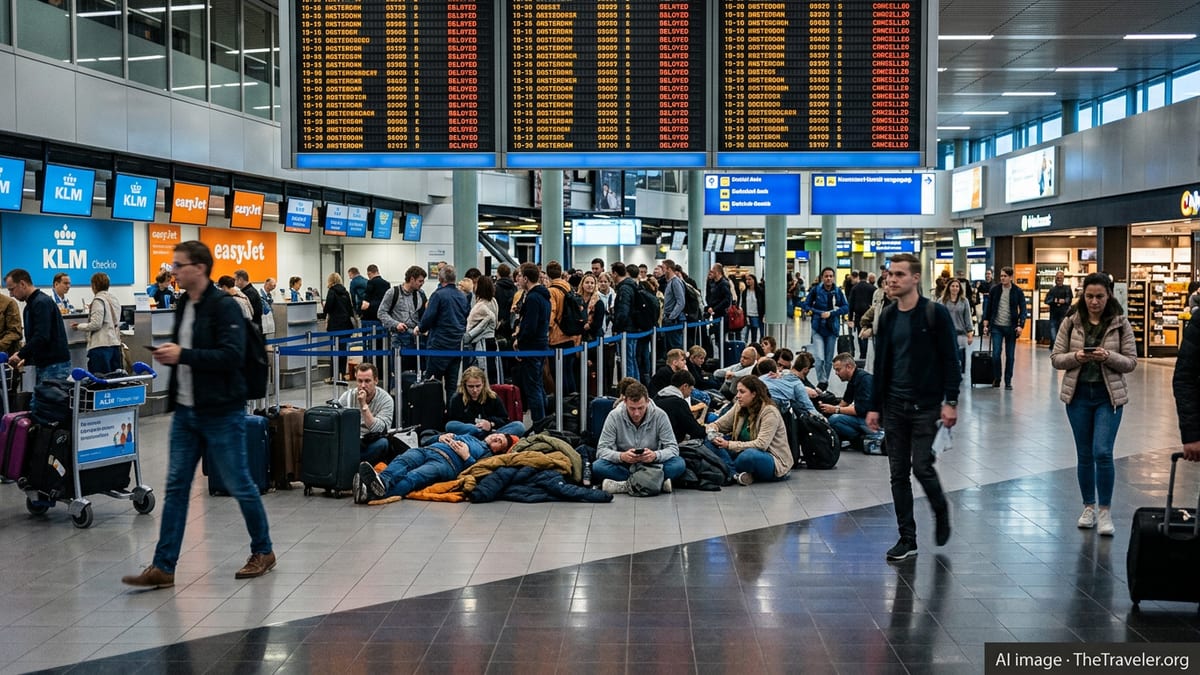
Major Hubs Buckle Under Mounting Operational Strain
The latest operational snapshots from flight-tracking and aviation analytics platforms show that disruption was concentrated at some of Europe’s busiest hubs, including Amsterdam Schiphol, Zurich, London airports, Lisbon and Athens. These airports already rank among the continent’s least punctual, leaving limited slack to absorb fresh shocks to the system.
Amsterdam, Lisbon and Zurich have all appeared in recent punctuality and delay reports as high-risk locations for schedule reliability, reflecting a mix of aerodrome capacity constraints, chronic congestion and complex air traffic control procedures. Network monitoring published by Eurocontrol also highlights these airports, along with Athens and London Gatwick, among the main contributors to air traffic flow management delays in recent months.
The latest figures suggest that more than 2,700 flights across Europe were delayed in a single operational period, creating rolling knock-on effects as late-arriving aircraft and crews propagated disruption from one hub to the next. With daily traffic volumes now tracking close to or above 2019 levels on peak days, even localised issues in one country can quickly spread across the wider European network.
Publicly available coverage indicates that London’s main airports, including Heathrow, Gatwick and Luton, experienced another day of elongated queues and late departures as delays radiated out from continental hubs. Similar patterns were reported at Zurich and Athens, where a combination of airspace constraints and ground handling bottlenecks contributed to mounting departure backlogs.
KLM, easyJet, Wizz and Legacy Carriers Among Those Hit
The disruption has affected a broad mix of airlines, from network carriers to low-cost operators. Data compiled from flight-status boards and third-party trackers indicates that KLM, Air France, SAS and airBaltic all faced cancellations or extended delays on European routes, particularly through Amsterdam, Paris, Copenhagen, Zurich and Baltic gateways linked to those hubs.
Low-cost operators including easyJet and Wizz Air also reported significant schedule pressure. Recent coverage of operations around London, Amsterdam and southern European leisure destinations has pointed to clusters of easyJet cancellations and late departures on short-haul routes, where tight turnarounds leave little margin when inbound flights run behind schedule.
Wizz Air’s network, heavily exposed to secondary airports and seasonal leisure traffic, has seen a pattern of extended delays on certain routes, with some services regularly arriving more than an hour late. Industry observers note that when a single aircraft rotation is disrupted on a dense low-cost schedule, subsequent legs across multiple countries can be pushed back, amplifying the total number of delayed flights without a corresponding rise in headline cancellations.
For travelers, the practical effect is similar regardless of airline model: missed connections, curtailed holidays and complex rebooking journeys. Publicly available guidance from major carriers such as KLM and Air France reiterates that passengers on flights cancelled or delayed by several hours may be eligible for refunds, rebooking and, in some cases, compensation under European air passenger protection rules.
Weather, Staffing and Capacity Constraints Combine
Reports from airport operators and regional media point to a familiar mix of causes behind the current spike in disruption. Localised severe weather has again forced suspensions and cancellations in coastal and island regions, with coverage from Portugal’s Madeira archipelago describing more than 20 flights cancelled in recent days due to strong winds, affecting services operated by TAP Air Portugal, easyJet, Ryanair, Wizz Air and other carriers.
At major mainland hubs such as Amsterdam and Lisbon, spring and early summer have already brought periods of intense pressure on runway and terminal capacity. Eurocontrol’s network overviews attribute significant minutes of delay at these airports to aerodrome capacity restrictions and air traffic control constraints, particularly during peak morning and evening waves when arrival and departure demand converge.
Staffing shortages in key functions such as security screening, ground handling and air traffic management continue to appear in punctuality analyses as aggravating factors. Even when headcounts are higher than during the immediate post-pandemic recovery, sustained traffic growth and complex rostering requirements mean that relatively small resource gaps can quickly translate into queues, longer turnaround times and, ultimately, delayed or cancelled flights.
Industry-focused commentary emphasizes that with airlines optimizing aircraft and crew utilization to keep costs in check, there is little buffer left in the system. As a result, any combination of adverse weather, capacity limits and staffing issues in the Netherlands, Switzerland, the United Kingdom, Portugal or Greece can ripple across the broader network, affecting carriers and passengers far beyond the immediate area of disruption.
Knock-On Effects Across Europe’s Interconnected Network
The latest pattern of 103 cancellations and more than 2,700 delays illustrates how tightly coupled Europe’s air transport system has become. Disruptions originating at Amsterdam, Zurich, London, Lisbon or Athens rarely remain confined to those hubs, as aircraft and crews cycle through multiple countries over the course of a single day.
Published travel reports describe how delays at Schiphol have recently spilled over to Paris Charles de Gaulle, Frankfurt and Zurich, where arriving aircraft from the Netherlands missed scheduled slots, forcing subsequent departures to be pushed back. Similar dynamics have been observed at London and Lisbon, where inbound delays from weather-affected islands or congested continental hubs have cascaded into late departures on onward legs.
For airlines such as KLM, easyJet, airBaltic, Air France, SAS and Wizz Air, this interconnectedness complicates recovery. Restoring punctuality at one base may still leave crews and aircraft out of position elsewhere, leading to selective cancellations designed to stabilize the wider schedule. Network managers then face difficult trade-offs over which routes to protect and which to trim when the system comes under strain.
Analysts following Eurocontrol data note that, as the 2026 summer season builds, days featuring more than 30,000 flights across European airspace are becoming more common. With demand rising and infrastructure largely fixed in the short term, experts expect additional episodes in which a few dozen cancellations and several thousand delays occur within a single day, particularly during busy weekends and holiday peaks.
What Travelers Can Expect in the Coming Weeks
Travel industry observers suggest that passengers planning trips through Amsterdam, Zurich, London, Lisbon, Athens and other busy hubs in the coming weeks should be prepared for occasional disruption, even when no major strike or storm is in the headlines. Recent experience shows that small operational issues can quickly escalate into widespread delays when airports are operating close to capacity.
Publicly available advice from airlines and consumer groups consistently highlights a number of risk mitigation steps. These include allowing longer connection times, avoiding the last flight of the day on critical legs where possible, and remaining flexible on routing in case rebooking via an alternate hub becomes necessary. Travelers are also encouraged to monitor their flight status closely via airline apps and airport departure boards in the 24 hours before departure.
Regulatory frameworks such as the European Union’s air passenger rights legislation continue to offer a degree of protection when flights are cancelled or subject to long delays. Information published by carriers shows that passengers whose flights are disrupted may in many cases request re-routing, refunds and, where applicable, standardised compensation, particularly when the cause is not classified as an extraordinary circumstance.
With the latest wave of 103 cancellations and 2,724 delays underscoring the fragility of Europe’s air travel ecosystem, industry analysts expect airlines, airports and air navigation service providers to come under renewed pressure to address capacity bottlenecks and staffing gaps ahead of the peak summer months. Until structural improvements are in place, however, travelers transiting the continent’s busiest hubs may continue to face days of heightened disruption with little advance warning.