


More news on this day
Air travel across Europe experienced another punishing day of disruption as more than 2,100 flights were delayed and at least 74 were canceled, affecting major hubs from Paris and Madrid to Rome, Munich and Dublin and disrupting schedules for carriers including ITA Airways, Lufthansa, Iberia and Ryanair.
Get the latest news straight to your inbox!
Network Strain Drives Fresh Day of Disruption
Tracking data and aviation operations dashboards for Wednesday, June 10, indicate a fresh spike in delays across European airspace, with around 2,120 flights running late and 74 cancellations recorded across the continent. The disruption, while not unprecedented for the busy late spring period, underscores how fragile the network remains as airlines and air traffic control systems cope with heavy schedules and ongoing reroutings.
Publicly available operational summaries show that France, Spain, Germany, Italy, Austria and Ireland were among the most affected states, reflecting the concentration of major hubs at Paris Charles de Gaulle, Madrid Barajas, Munich, Rome Fiumicino, Vienna and Dublin. Knock-on effects were also reported at secondary airports that feed these hubs, as late-arriving aircraft cascaded through schedules.
European network data published in recent weeks has highlighted that overall punctuality has improved compared with the worst of last summer, but delay minutes remain elevated on busy days as capacity pushes close to pre‑pandemic peaks. Air traffic management organizations have cautioned that factors such as convective weather, staff shortages in some control centers and complex rerouting around conflict zones continue to create pressure points in the system.
While the total number of cancellations remained relatively limited compared with the sheer volume of flights operating, the clustering of disrupted services at a handful of major airports on a single day translated into long queues, missed connections and significant schedule reshuffles for airlines and passengers.
Major Carriers Feel the Impact in Key Hubs
The latest wave of delays and cancellations has again hit Europe’s largest airline groups and national carriers. Schedules for Lufthansa at Munich and other German airports were still absorbing the consequences of recent operational issues, including a temporary evacuation of the control tower at Munich earlier in the week that forced a halt to movements and created a backlog of displaced aircraft and crews.
Italian flag carrier ITA Airways, which relies heavily on its Rome and Milan operations, also faced knock‑on disruption as crowded airspace over Italy and surrounding countries slowed traffic flows. The airline is already operating in a challenging environment shaped by ongoing diversions on some long‑haul routes and the gradual rebuilding of capacity on others.
In Spain, Iberia and low‑cost competitors reported schedule changes around Madrid and Barcelona as arrival and departure slots were adjusted. Around the wider network, Ryanair, which operates thousands of short‑haul sectors across Europe each week, was again exposed to congestion and resource constraints at certain airports, even as the airline has largely avoided the mass schedule cuts undertaken by some legacy groups for the summer season.
Operational data and recent industry reporting also show that many airlines are still carrying structural reductions from broader schedule trimming. Some groups, including Lufthansa, have removed tens of thousands of flights from their summer programs in advance, in part to avoid overpromising capacity on days when air traffic control and airport resources are already stretched.
Weather, Infrastructure and Route Changes Combine
The day’s disruption did not stem from a single, dramatic incident but from the accumulation of several familiar stress factors. Localized storms and unsettled conditions over parts of western and central Europe slowed traffic flows, while some airports continued to work through infrastructure or systems issues. In recent days, for example, flights in and out of Munich were constrained by airside safety measures, and inspections of navigation equipment have led to delays at other major gateways in the region.
At the same time, Europe’s air traffic managers are still juggling complex reroutings tied to geopolitical tensions and restricted airspace on long‑haul corridors to the Middle East and Asia. Airlines such as Lufthansa, SWISS and ITA Airways continue to suspend some services to the Gulf and adjust routings to avoid certain regions, adding extra flight time and complexity to their operations.
These structural challenges are layered on top of seasonal passenger surges as the school holiday period begins in several European countries. Industry studies published this spring have warned that without additional investment in staffing, training and technology, even modest shocks can quickly propagate through the network on high‑traffic days, producing exactly the kind of widespread but uneven disruption experienced this week.
Analysts note that the concentration of delays and cancellations in countries such as Spain, Italy, Germany, Austria, France and Ireland reflects not only weather and infrastructure, but also the role of these markets as key transit points. When a major hub or its airspace slows, the repercussions are felt across dozens of city pairs, many of them far from the original bottleneck.
Passenger Experience: Long Queues, Missed Connections
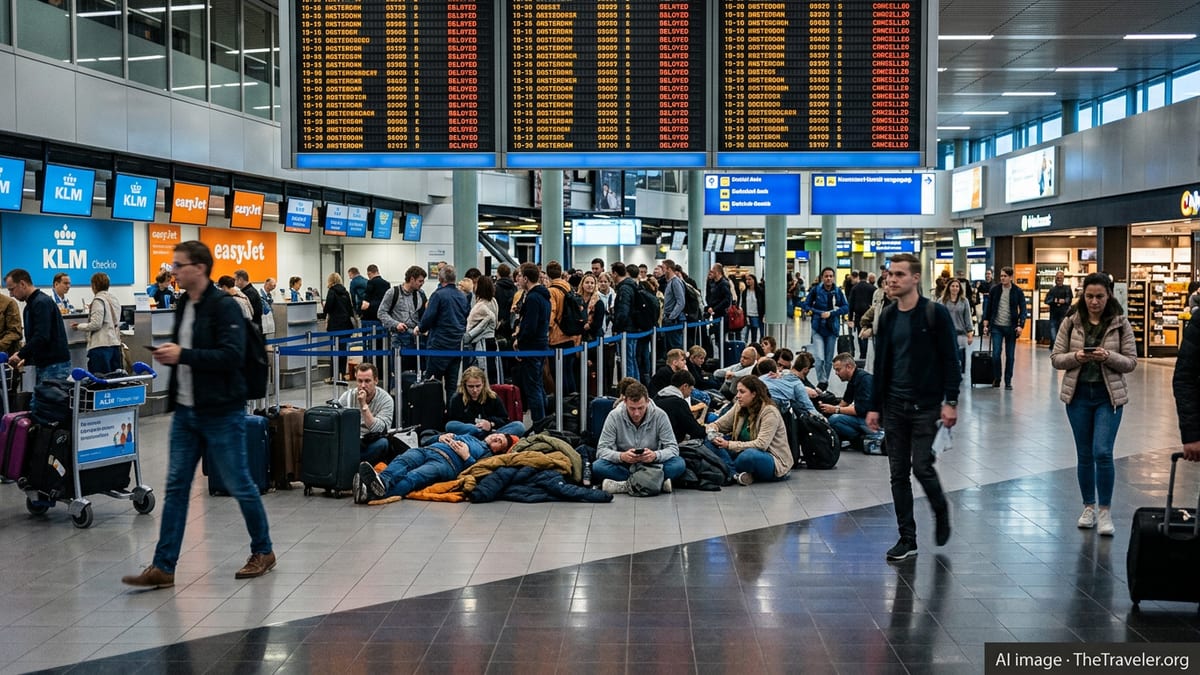
For travelers, Wednesday’s statistics translated into a familiar pattern of missed connections, extended waits at departure gates and overnight stays after last‑minute cancellations. Airports in Paris, Madrid, Rome and Munich reported crowded departure halls at peak times, while social media posts throughout the day showed extended lines at check‑in, security and border control in several terminals.
Recent travel reports from across Europe have highlighted that congestion is not limited to the airside environment. Staffing constraints and new border systems have contributed to heavy queues at passport control in some Schengen‑area airports, with passengers at hubs such as Milan Malpensa already being advised this season to arrive significantly earlier than in previous years to clear formalities.
When multiple short‑haul services are delayed or canceled, the impact is especially acute for connecting passengers using European hubs as stepping stones between regional airports. Missed onward flights can mean hours or even days of delay, particularly on routes where airlines have trimmed back frequencies or consolidated services as part of broader cost‑saving efforts.
Consumer rights organizations continue to remind passengers that European regulations offer protections in cases of significant delay or cancellation, although eligibility often depends on the specific cause and circumstances. Travelers are being encouraged to keep records of disruptions, monitor their airline’s app or website and be prepared with alternative routing options where possible.
What Travelers Should Expect in the Coming Weeks
With airlines now operating deep into the peak summer schedule and advance data pointing to near‑record traffic volumes, industry observers caution that further days of sizable disruption are likely in the coming weeks. Air traffic management forecasts show that Europe is running close to, and in some places above, pre‑pandemic flight levels, with only modest buffers in place to absorb sudden spikes in demand or local operational problems.
Some carriers have tried to get ahead of the issue by trimming future schedules, redeploying aircraft and concentrating capacity on core routes. Reports on the region’s aviation sector show that network airlines have cut certain frequencies and, in some cases, entire routes, while low‑cost operators seek to maintain growth but are increasingly exposed to constraints at congested airports.
Travelers planning to fly through hubs such as Paris, Madrid, Rome, Munich, Vienna or Dublin in the coming weeks are being advised by travel agencies and passenger rights groups to build additional time into connections, opt for earlier flights in the day where feasible and ensure that contact details are up to date with airlines for real‑time notifications. Those with critical onward plans, such as cruises or long‑haul departures, may wish to consider arriving at their departure city a day early to reduce the risk of knock‑on disruption.
While European aviation data indicates that the overall proportion of severely delayed or canceled flights remains lower than at the peak of last year’s crises, the latest figures from this week’s disruptions underline that the system still operates with little slack. For now, passengers can expect that days like Wednesday, with more than 2,100 delayed flights and dozens of cancellations across multiple countries, will remain an intermittent but real feature of the summer travel landscape.