

More news on this day
Europe’s peak travel season is colliding with an unusually disruptive mix of airport strikes, border control bottlenecks and volcanic ash, leaving passengers facing marathon queues, missed connections and unexpected bills that many airlines are not required to cover.
Get the latest news straight to your inbox!
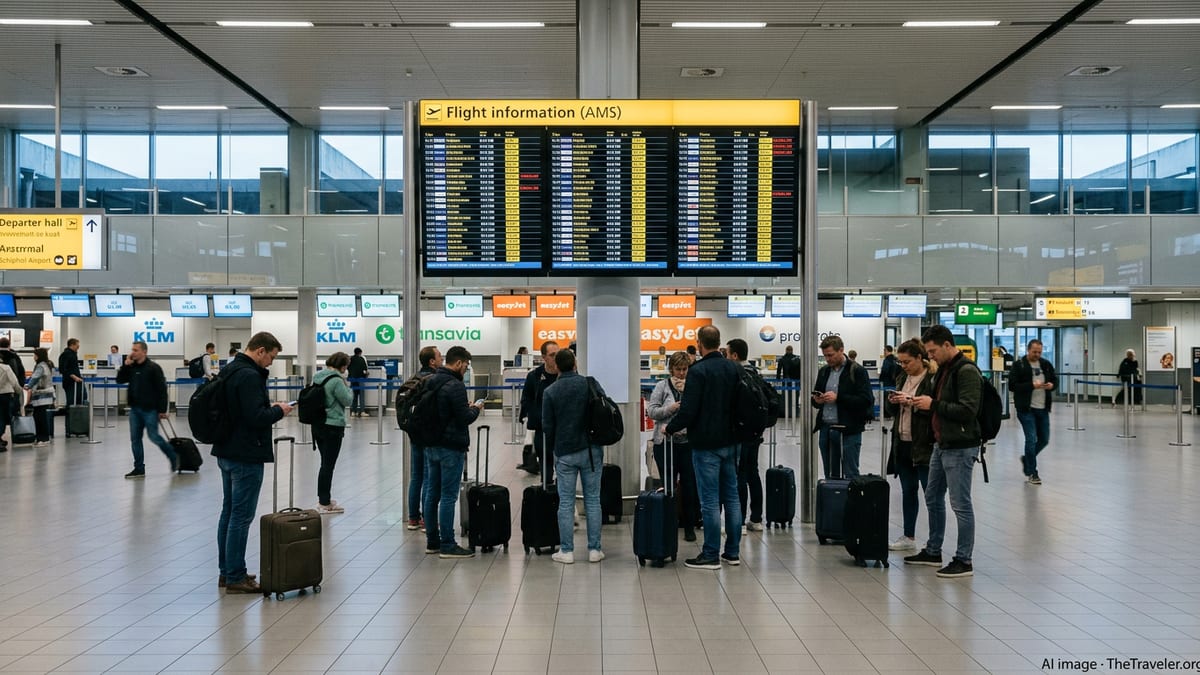
Strikes, Volcano Ash and New Border Rules Collide
Across Europe, several unrelated stress points are converging at once. A series of aviation strikes, including walkouts by air traffic controllers and ground staff in key hubs, is combining with the impact of a recent volcanic eruption in Italy and the rollout of new biometric border checks, according to recent industry statements and travel media reports. Together, they are producing a patchwork of disruption that can be hard for passengers to anticipate.
Reports from Italian and European outlets describe how activity at Mount Etna has periodically forced flight suspensions at Catania-Fontanarossa Airport, with ash clouds drifting across parts of Sicilian airspace and prompting temporary closures of runways. When that happens, airlines often reroute or cancel services at short notice, and passengers may have limited options beyond waiting or securing new itineraries on their own.
At the same time, air traffic control and airport staff in several European countries have staged or threatened industrial action over pay and staffing levels. Past stoppages have led to rolling delays across the continent, even for flights not directly touching the affected country, because of the tightly interconnected nature of European airspace and airport slot systems.
Layered on top of these familiar risks is a new source of strain: the European Union’s Entry/Exit System, or EES, which requires most non-EU visitors entering the Schengen Area to register fingerprints and facial images at border control. This change, fully in effect since April, is now facing its first sustained summer test and has been linked in travel coverage and industry briefings to longer queues and missed flights at some border points.
Biometric Border Queues Turn Tight Connections Into Missed Flights
In recent weeks, airport groups and airline associations have publicly warned of severe congestion at certain Schengen border crossings as EES scales up during the northern hemisphere summer. Joint letters from European aviation industry bodies highlight cases where passengers have waited up to two hours or more at border control at peak times, and some national media have reported waits approaching five hours at the most overloaded sites.
Travel publications and passenger accounts indicate that the impact is far from uniform. Some airports with extensive e-gates and additional staffing appear to be processing travelers with only modest delays. Others, particularly where space or staffing is constrained, have seen long, slow-moving lines as first-time visitors stop to enroll their biometrics before proceeding to baggage claim or onward connections.
Because border control is handled by national authorities rather than airlines, these delays generally fall outside the scope of standard airline responsibilities. Under European air passenger rules, crowding at passport control is treated as an external factor. That means a traveler who misses a connection solely because of a queue at the border often has no automatic right to compensation and may have to negotiate rebooking or buy a new ticket out of pocket.
Travel-rights specialists note that this distinction is catching some visitors by surprise. Many are familiar with Regulation EU 261, which can require airlines to provide care and, in some circumstances, cash compensation when delays or cancellations are within the carrier’s control. Long lines at a government-run checkpoint, however, are typically classified as an extraordinary circumstance beyond the airline’s control, leaving passengers to absorb hotel stays, meals and alternative transport unless another safety net applies.
Why EU 261 and Airline Policies Often Fall Short
EU 261 and related UK rules remain powerful tools for travelers when airlines cancel or significantly delay flights for reasons such as maintenance problems or crew mismanagement. In those cases, passengers departing from an EU or UK airport, or flying into one on an EU or UK carrier, may be entitled to set levels of compensation, assistance and rerouting. Consumer advocates point out that these rights compare favorably with protections available in many other regions.
The same rules, however, explicitly limit airlines’ obligations when disruption stems from events considered extraordinary, including airspace closures, severe weather and natural phenomena such as volcanic eruptions. Legal summaries of the regulation point to European court decisions around past ash-cloud events as examples: airlines had to provide care in some cases, but were not required to pay cash compensation for the underlying cause of the shutdown.
Strikes can occupy a grey zone. Walkouts by an airline’s own staff may trigger compensation duties if the disruption is deemed under the carrier’s control, while strikes by air traffic control or airport workers may be treated as external. Separately, when border-control technology slows down and forces hundreds of passengers into long lines, the resulting missed flights are generally not compensable under EU 261, because immigration and border checks fall outside airline operations.
As a result, travelers caught in the current mix of EES queues, third-party strikes and volcanic ash may find that the regulations they expected to rely on do not cover their specific situation. Airline “goodwill” policies vary, and some carriers may offer hotel vouchers, meal coupons or flexible rebooking on a case-by-case basis, but there is often no legal requirement for them to do so if the cause fits the extraordinary-circumstances category.
How Certain Credit Cards Fill the Gap
Against this backdrop, some travel-focused credit cards are emerging as an informal backstop when airlines and statutory compensation schemes will not pay. Financial publications and card benefit guides describe “trip delay” or “trip interruption” coverage offered on a number of premium and mid-tier cards. These benefits can reimburse reasonable costs such as hotels, meals and ground transport when a covered trip is delayed by a specified number of hours or requires an unexpected overnight stay.
Unlike EU 261, trip delay coverage is typically triggered by the fact of a delay or missed connection, not by whether the airline was at fault. Policies from major issuers generally list covered hazards that include severe weather, airline or airport strikes and, in some cases, shutdowns of airspace or airports due to natural disasters. If a flight is pushed back or cancelled because of volcanic ash, or if industrial action strands travelers overnight, these card benefits may help reimburse out-of-pocket expenses even when regulations classify the cause as extraordinary.
Benefit guides highlighted by independent legal and consumer sites indicate that coverage often begins after a minimum delay threshold, such as six, eight or twelve hours, depending on the card. Reimbursable expenses are usually capped per person per trip and may exclude prepaid items such as tours or nonrefundable hotels at the destination. Importantly, many policies require that the affected travel be paid for with the card providing the coverage, or with its associated points.
Experts in travel insurance stress that passengers should not assume all cards work the same way. Some entry-level products marketed as travel cards provide no delay protection at all, while a number of business and premium personal cards issued in the United States and Europe include relatively robust coverage. The precise list of covered reasons, claim deadlines and required documentation can differ significantly by issuer and by product.
Using Card Benefits Effectively During Europe’s Summer Squeeze
For travelers heading into Europe’s crowded airports this summer, understanding how to use these card protections can be as important as knowing their rights under EU 261. Consumer advocates recommend reading the benefit guide for at least one main travel card before departure, noting the delay threshold, the maximum reimbursement and the types of disruption that qualify.
During a disruption, specialists advise keeping all receipts for meals, hotels, taxis and other unexpected purchases, as well as copies or screenshots of airline notifications about delays or cancellations. Some card issuers and their insurance administrators also request proof of the cause and length of the delay, such as a written statement from the carrier, boarding passes and a final record of actual arrival time.
Travel experts also point out that card coverage is not a substitute for separate travel insurance in every case. Many card policies focus on short-term expenses arising from a delay rather than on large medical costs or full trip cancellations. For complex itineraries that rely on multiple tight connections, separate policies can complement card benefits by covering a wider range of scenarios, including missed tours or prepaid accommodations that cannot be recovered.
With Europe’s airports under strain from strikes, biometric bottlenecks and the unpredictable behavior of an active volcano, the gap between what airlines must provide and what travelers actually spend can widen quickly. For those who plan ahead, the right combination of statutory rights, airline policies and credit card protections may offer a more resilient safety net as the summer of 2026 unfolds.