


More news on this day
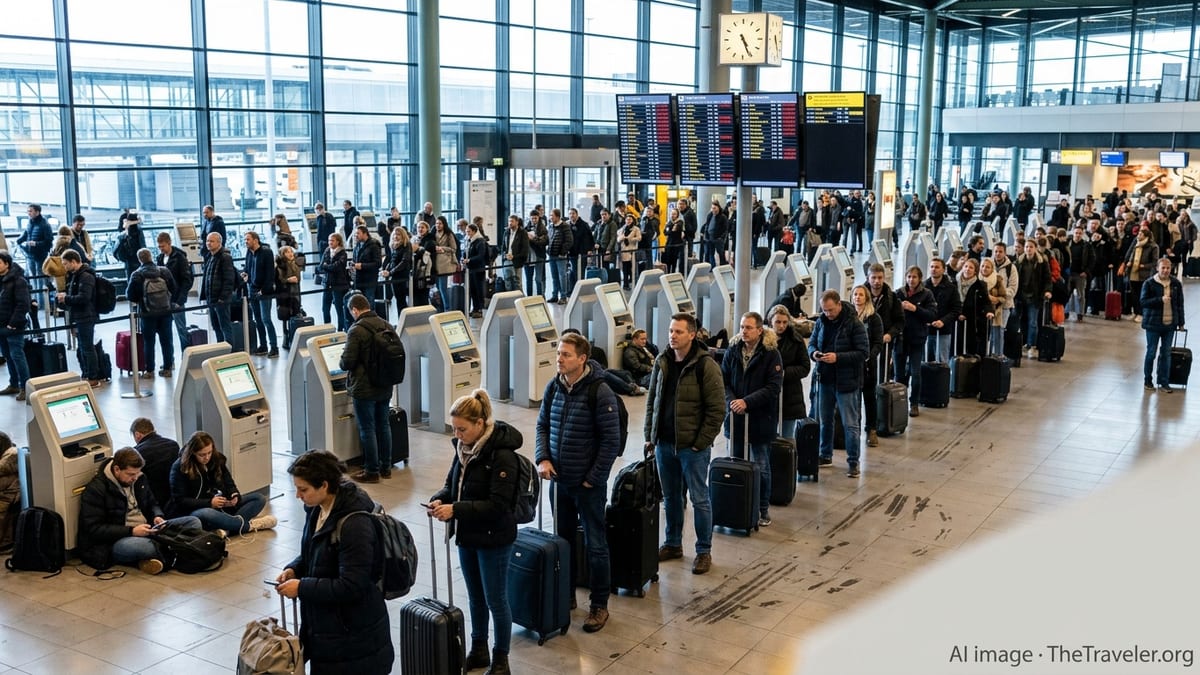
Europe’s summer travel season is facing new turbulence as major hubs report a sharp uptick in disruption, with publicly available tracking data indicating more than 823 flight delays and at least 38 cancellations across the continent in a single day, straining airport operations and passenger patience just as demand climbs.
Get the latest news straight to your inbox!
Weather, Strikes and Staffing Collide Across the Network
The latest disruption follows a familiar but potent mix of triggers for Europe’s aviation system. Recent severe thunderstorms over Belgium, documented in regional media coverage at Brussels Airport, have underscored how quickly local weather events can destabilize tightly timed schedules during peak periods when airspace is already congested.
At the same time, the aftershocks of industrial action are still rippling through the network. Early June saw air traffic controllers in Belgium stage an unannounced strike that temporarily halted traffic at key national gateways. Industry observers note that even short work stoppages can create residual imbalances in aircraft and crew positioning, leaving airlines more vulnerable to knock-on delays days later.
Staffing constraints in several markets are adding to the strain. Analyses published by European aviation bodies this spring describe continued challenges in aligning air traffic control capacity, airport staffing and airline schedules with demand that has climbed back to or above pre‑pandemic levels in parts of the network. That imbalance means that when bad weather or a local failure hits one hub, the resulting queues and reroutes are more likely to spill over into neighboring states.
Publicly accessible Eurocontrol briefings on recent weeks show that total air traffic flow management delay per flight in Europe has been trending above last year on some days, particularly when storms or local capacity issues emerge over major core-area states. The current bout of disruption appears to be amplifying those patterns, with en‑route controls forced to meter traffic flows into already saturated terminal areas.
Major Hubs Under Pressure as Delays Stack Up
Today’s flashpoint is Europe’s biggest connecting hubs, where airlines consolidate vast portions of their long‑haul and regional traffic. Tracking dashboards used by travelers and analysts alike point to significant delays clustering around airports in Belgium, Germany, France and the Netherlands, with departure and arrival banks running behind schedule as airlines battle to maintain rotation plans.
Operational summaries from Eurocontrol and national aviation authorities in recent months have repeatedly highlighted certain core-area hubs as primary contributors to network delay, largely because of their role in handling dense traffic flows. When thunderstorms, low‑visibility procedures, or runway constraints reduce capacity at those hubs, the impact is rarely confined to one country. Flights inbound from southern and eastern Europe are frequently held or rerouted, while outbound aircraft depart late and arrive out of sequence at downline airports.
The volume of delays now being reported, surpassing 823 across the European system, illustrates how quickly a tough operating day can evolve into a network‑wide problem. Airlines have limited flexibility to re‑time densely scheduled fleets, particularly as summer schedules are already running near full utilization, and ground handling resources can struggle to keep pace once rotations slip beyond a certain point.
For passengers, this translates into missed connections, extended waits at crowded terminals, and overnight disruptions when evening bank cancellations force rebooking into the following day. Travel forums and social media feeds on Saturday reflected a surge in complaints from travelers left searching for alternative routings after multiple late‑running flights converged at the same hubs.
Cancellations Used as a “Pressure Valve”
While delays have dominated the picture, cancellations are increasingly being used as a tool to stabilize operations. The tally of at least 38 cancellations recorded during the current wave reflects a strategy widely described in recent Eurocontrol and airline performance reports, in which carriers trim portions of their schedule to prevent a full collapse of punctuality.
By canceling rotations that are most vulnerable to cascading delays or that lack viable crew coverage, airlines can free aircraft and staff to protect higher‑priority services, such as long‑haul departures or heavily booked city‑pairs. This approach can reduce the average delay for the flights that do operate but at the immediate cost of leaving some passengers without same‑day options.
Studies and annual network operations reports released this spring emphasize that such cancellations often peak on days when air traffic flow management delay per flight spikes above seasonal norms. When weather, airspace restrictions or labor actions sharply cut the capacity of critical sectors, the network has limited ability to absorb the shock without selectively shedding flights.
In practice, this means that on days like today, travelers may see entire sequences of services scrubbed from departure boards at affected hubs, even as the majority of flights continue to operate with manageable though frustrating delays. For airport operators, the challenge becomes keeping terminal congestion under control and ensuring that stranded travelers receive clear information about their rights and rebooking options.
Structural Vulnerabilities Exposed Ahead of Peak Summer
The fresh wave of delays and cancellations is reigniting debate over the resilience of Europe’s air traffic system as it heads into the core summer months. Briefings from Eurocontrol on preparations for summer 2026 highlight the progress made in reducing en‑route delays last year through tighter coordination and new planning tools, yet also point to persistent vulnerabilities, especially around weather and staffing.
One recurring concern raised in those briefings is the growing influence of extreme weather on network performance. Past seasons saw convective storms and heat‑related capacity reductions account for a substantial share of all delay minutes. The disruptions currently linked to thunderstorms in central Europe fit that longer‑term pattern, suggesting that even as procedures improve, structural exposure to severe weather remains high.
Another issue is the concentration of traffic through a relatively small number of mega‑hubs. Although secondary and regional airports have absorbed some growth, long‑haul and connecting flows remain centered on a handful of major nodes. Industry analysts caution that without significant investments in both airspace modernization and ground capacity, each incremental rise in traffic volumes will magnify the impact of local incidents at those hubs.
Regulators and network managers are attempting to address these concerns through rolling network operations plans for 2026, which set targets for delay reduction and outline contingency measures for industrial action, airspace closures and weather events. The current disruptions will likely feed back into those plans, providing fresh data on where demand, infrastructure and staffing still fall out of balance on busy days.
What Travelers Can Expect in the Coming Days
With Europe moving deeper into the summer travel period, aviation analysts expect elevated risk of further pockets of disruption, even if today’s spike in delays and cancellations proves temporary. Demand for leisure travel remains strong, and schedules are tightly packed, leaving limited slack in the system when storms or operational problems arise.
Based on recent summers and the latest planning documents from European network managers, peak afternoon and evening bank periods at major hubs are likely to remain the most vulnerable times for significant knock‑on delays. Short‑haul feeders into those hubs can be particularly exposed, as any disruption may have immediate consequences for onward long‑haul departures.
Consumer advocates are already reminding passengers that European Union rules on air passenger rights continue to apply in cases of long delays and cancellations, although compensation eligibility depends on the cause of the disruption and whether it was within an airline’s control. Public guidance circulated in early 2026 stresses that travelers should keep documentation of delays, boarding passes and any extra expenses incurred while waiting for rebooking.
For now, the data pointing to more than 823 delays and 38 cancellations in a single operational day serves as a warning signal ahead of the peak summer surge. While Europe’s aviation network has invested heavily in new tools and coordination mechanisms, today’s turbulence shows that relatively small shocks can still snowball into continent‑wide travel headaches when capacity is stretched to its limits.