


More news on this day
Europe’s long-delayed Entry Exit System, a biometric border database for non EU visitors, is now rolling out across Schengen frontiers and early evidence shows it is producing hours-long queues, missed flights and rising concern about the impact on tourism at the start of the peak travel season.
Get the latest news straight to your inbox!
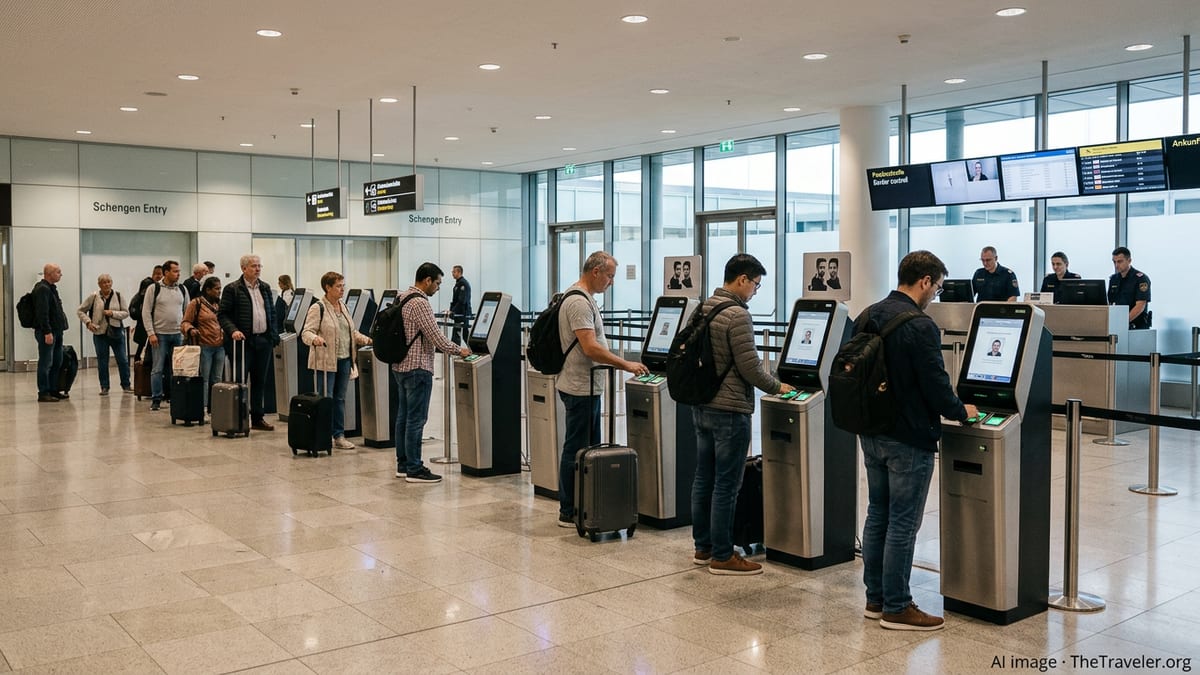
Biometric Border Checks Bring Three Hour Queues
The new Entry Exit System, or EES, began phased operation at external Schengen borders in October 2025 and became mandatory at many major airports in April 2026. The scheme replaces manual passport stamping for most non EU travelers with a digital record that includes facial images, fingerprints and personal data captured at the border.
According to recent coverage by European and international outlets, the move has coincided with sharp increases in waiting times at passport control. At airports in countries including France, Germany, Italy, Spain, Belgium and Greece, passengers are reported to be queueing for two to three hours, with lines at times spilling into general terminal areas during busy periods.
Industry bodies representing airports and airlines describe the current situation as significantly worse than initial planning assumptions. While European institutions promoted EES as a tool that would ultimately make crossings faster and more secure, operators argue that the system’s early performance has fallen short of those goals, particularly where infrastructure and staffing were already under strain.
Individual reports from hubs such as Milan, Frankfurt and Madrid describe a patchwork of experiences, with some travelers processed in minutes while others face repeated machine errors, system resets and additional manual checks. The uneven performance is adding unpredictability for both passengers and airlines attempting to manage connections.
System Glitches and Staffing Gaps Expose Weak Points
Publicly available information points to a combination of technical and operational issues behind the long queues. Airport associations have cited regular outages of the central EES platform and configuration problems at local installations, which force border officers to abandon automated kiosks and revert to slower manual procedures.
At the same time, many border checkpoints appear to have entered the rollout with limited contingency capacity. Airport groups have pointed to what they describe as chronic staffing shortages at control booths, meaning there are too few officers available to supervise kiosks, troubleshoot biometric failures and handle passengers who need extra help.
Reports from several European airports indicate that first time registration can take several minutes per traveler, rather than the roughly one minute anticipated by European institutions. When families or coach groups arrive together, this quickly multiplies into queues lasting several hours, particularly where hardware is limited or older facilities have not yet been fully redesigned around the new process.
Operational accounts also highlight the learning curve for both staff and travelers. Many non EU passengers are only discovering the new requirements when they arrive at the border, which can slow down each interaction as officers explain the process and guide people through fingerprint scans and photo capture.
Missed Flights and Fears for the Summer Peak
The immediate travel impact is already visible. Media reports from Italy and elsewhere describe flights where large numbers of passengers failed to board in time because they were still waiting at border control, including one widely cited incident in which more than one hundred travelers were left behind while only a fraction reached the gate.
Travel industry commentators warn that isolated cases of missed departures could become more frequent as volumes rise through late June, July and August. Airports and airline groups have jointly called for additional flexibility in the way EES is applied, including the option to ease or temporarily suspend registrations when waiting times exceed set thresholds during severe congestion.
Several airport trade bodies have suggested that, without changes, queues of up to four hours are plausible at some border posts during the busiest days of the summer. That prospect has prompted renewed calls for more staff, more kiosks and better coordination between national border police services and airport operators to keep passenger flows moving.
Travel agents and tour operators are already advising customers to arrive much earlier than usual for flights into or out of Schengen countries, particularly if they are non EU passport holders and have not yet been registered in EES. Some carriers have started sending additional pre departure messages warning about possible delays at border control.
Tourism Industry Worries About Deterrent Effect
The tourism sector across Europe and in key origin markets such as the United Kingdom has been tracking the rollout closely. Committees in the UK Parliament previously examined EES and heard warnings that lengthy border formalities at Channel ports and terminals could deter visitors, especially coach groups and families undertaking short breaks.
Destination marketing organizations and regional tourism boards in frontline areas, including northern France and parts of Spain and Italy, have expressed concern that reputational damage from images of long queues could undermine efforts to rebuild international arrivals after the pandemic. Some local business surveys referenced in recent reports suggest that past episodes of border congestion have reduced day trip and short stay demand.
Travel trade associations in Europe have also raised questions about how EES interacts with other upcoming changes, notably the planned European Travel Information and Authorisation System, which is expected to introduce a pre travel screening requirement for many non EU visitors later in 2026. Industry voices argue that any additional layer of complexity could further influence destination choice if not managed carefully.
For now, however, tourism bodies appear focused on the immediate challenge of stabilizing EES at airports, ferry ports and rail terminals before peak season. Many are urging clear, coordinated communication so that travelers know what to expect and can plan extra time for border formalities.
Security Goals Versus Passenger Experience
European institutions continue to frame EES as a cornerstone of a modernized border management strategy. Official documents emphasize that the system is designed to strengthen security, reduce irregular overstays by automatically recording entries and exits, and make it harder to use false identities thanks to biometric verification.
Early operational statistics cited in recent coverage point to tens of millions of border crossings already logged in the new database and thousands of cases where travel has been refused or flagged for further checks. Supporters of the system argue that such data will, over time, give authorities a clearer picture of movements into and out of the Schengen area.
The short term reality for passengers, particularly those unfamiliar with biometric procedures, is more mixed. Traveler accounts circulating in the media and on social platforms describe confusion around where to queue, uncertainty about whether automated gates are available, and frustration when technical failures force people to repeat scans or move between lines.
How quickly those pain points can be resolved may determine whether EES ultimately delivers on its promises without undermining Europe’s competitiveness as a tourism destination. For airlines, airports and tourism businesses, the coming peak summer months are shaping up as a crucial test of whether the new biometric border regime can be made to work at scale while keeping visitors willing to return.