


More news on this day
Coordinated airstrikes by the United States and Israel on Iran have cascaded into a deepening travel crisis across the Middle East, as airlines slash services, reroute long-haul flights and tourism operators warn of heavy financial losses while governments scramble to extract stranded citizens.
Get the latest news straight to your inbox!
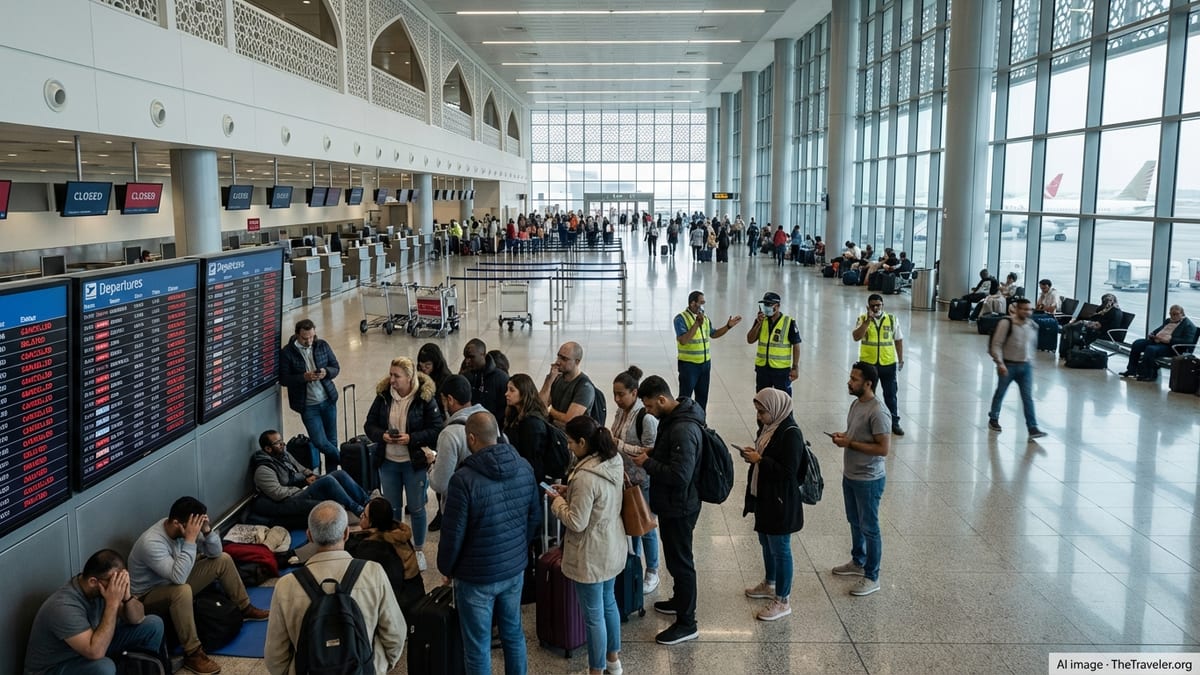
Air Campaign Triggers Regionwide Airspace Closures
The air campaign, launched on February 28 and followed by continuing strikes around the Strait of Hormuz, has reshaped the aviation map across the Middle East. Airspace closures in Iran, Israel and several Gulf and Levant states have severed some of the world’s busiest east–west corridors, forcing airlines to improvise longer and more complex routings.
According to published coverage, aviation regulators across Europe, Asia and the Gulf have issued conflict-zone advisories that warn airlines to avoid large swathes of Persian Gulf and Levant airspace. Notices to air missions and conflict-zone bulletins now cover Iranian, Iraqi, Israeli and parts of Gulf flight information regions, sharply limiting overflight options and concentrating traffic into narrower corridors over Saudi Arabia, Egypt and the eastern Mediterranean.
Publicly available flight tracking data indicates that thousands of flights have been cancelled or diverted since late February, with hubs such as Dubai, Abu Dhabi and Doha experiencing waves of ground stops and rolling delays. An analysis by industry trackers suggests that at the peak of the disruption more than 3,000 flights in a single day were either cancelled or significantly rerouted as carriers reacted to sudden airspace shutdowns and military activity.
Reports from aviation consultancies note that patterns first seen when Russian airspace closed to many Western carriers have intensified, with the loss of Iranian and Iraqi overflight forcing Europe–Asia services onto more southerly or northerly tracks. Flight times on some routes have lengthened by four to six hours, driving up fuel burn and squeezing aircraft and crew availability.
Global Airlines Cut Capacity and Reroute Long-Haul Networks
Major carriers in Europe, North America and Asia have responded with a patchwork of suspensions, diversions and emergency schedule changes. Published airline statements show that European groups such as Air France–KLM, Lufthansa and IAG have extended suspensions on services to Israel, Lebanon and parts of the Gulf while maintaining limited operations into relatively unrestricted airports using detours that skirt high-risk zones.
US carriers, including Delta Air Lines and United Airlines, have prolonged pauses on direct flights to Tel Aviv, with resumption dates pushed into late summer at the earliest. Travel waiver notices shared with customers outline flexible rebooking and refund options for itineraries touching Israel, Iran and neighboring countries, reflecting ongoing uncertainty about when regular schedules can safely return.
In the low-cost segment, operators that had aggressively expanded into the Middle East from Europe are now retrenching. Reports indicate that Wizz Air has suspended its Israel flights into late March and scaled back services to Dubai, Abu Dhabi, Amman and Jeddah into the second half of the year. Turkish Airlines and Gulf carriers have cut or consolidated frequencies on routes to Bahrain, Kuwait, Iraq and Jordan, often at short notice as airspace parameters change.
Industry analyses suggest that rerouting costs are mounting rapidly. Longer flight paths and unscheduled fuel stops are adding substantial jet fuel expenses, while aircraft tied up on detoured services reduce flexibility elsewhere in global networks. Research from aviation advisors indicates that airlines are weighing modest fare increases and capacity cuts on Europe–Asia and transatlantic itineraries that relied heavily on Middle East hubs, potentially pushing fares higher for travelers worldwide.
Tourism and Pilgrimage Markets Suffer Sharp Downturn
Beyond immediate operational disruption, the conflict is inflicting heavy damage on the region’s tourism economy at the start of what is typically a busy period for leisure and religious travel. According to travel industry assessments, hotel and tour bookings across Israel, Jordan, Lebanon and parts of the Gulf have fallen sharply since late February as travelers cancel or defer trips in response to security concerns and flight uncertainty.
Destinations that depend on multi-country itineraries, such as Holy Land and broader Levant tours, are particularly exposed. Operators report that itineraries combining Israel, Jordan, Egypt and Gulf stopovers have become difficult to guarantee, given that a single airspace closure can derail complex routing and transfer plans. Cruise lines with calls in the eastern Mediterranean and Red Sea are also modifying or truncating voyages to avoid ports seen as vulnerable to missile or drone activity.
Pilgrimage and faith-based travel is also under pressure. Public information from regional tourism boards points to a drop in group bookings for religious festivals and visits to key sites in Israel and surrounding countries. While some travelers are rerouting via Cyprus, Greece or Egypt to reach alternative gateways, the added time, cost and perceived risk are dampening demand.
Economic outlooks published by aviation and tourism analysts warn that prolonged instability could shave significant revenue from Middle East tourism for the remainder of 2026. Travel firms that had not fully recovered from earlier pandemic-era downturns now face another season of weak bookings, with small and mid-sized agencies and inbound operators seen as especially vulnerable.
Governments Race to Repatriate Citizens and Ease Disruptions
As commercial options evaporated in the first days of the strikes, governments around the world moved to organize special flights and evacuation efforts. According to open-source reporting on the 2026 Iran war evacuations, states across Europe, Asia, Africa and the Americas have chartered aircraft or worked with national carriers to repatriate citizens stranded at Middle Eastern hubs or trapped in conflict-affected countries.
Some governments have issued formal guidance urging citizens to leave certain parts of the region while commercial flights are still available, and to avoid nonessential travel to Iran, Israel, Iraq, Lebanon and Syria. Travel advisories maintained by foreign ministries now classify large portions of Middle Eastern airspace as high risk, and many warn that consular assistance may be limited if air routes close again with little notice.
In parallel, regulators and air navigation authorities are coordinating safety guidance for airlines. Publicly released conflict-zone bulletins from European and US aviation bodies outline recommended avoidance areas, altitude restrictions and so-called safe air corridors that carriers can use under specific conditions. Industry notes suggest that these frameworks are helping to restore limited connectivity to some cities, but officials caution that any new military escalation could trigger fresh closures.
The reliance on emergency state-backed repatriation underscores how quickly a regional security crisis can overwhelm commercial aviation. Analysts reviewing the evacuations describe a scenario in which hundreds of thousands of passengers were left seeking alternative routes at short notice, highlighting the challenges of coordinating civil and military airspace in a fast-moving conflict.
Travelers Face Longer Journeys, Higher Costs and Persistent Uncertainty
For travelers, the new reality is one of longer journeys, higher prices and greater uncertainty when flying through or near the Middle East. Consumer rights organizations and flight compensation services report increased inquiries from passengers dealing with last-minute cancellations, missed connections and significantly extended travel times.
Guidance published by travel advisory platforms urges passengers to check bookings frequently, monitor airline notifications and be prepared for itinerary changes even after check-in. Many airlines are offering free ticket changes, but the combination of reduced capacity and congested alternative routes means that replacement flights can be days away, especially for those traveling in large groups or during peak periods.
Sector forecasts issued in recent weeks indicate that if the conflict and associated air campaign continue, the knock-on effects for global connectivity could last well beyond the immediate crisis. With key transit hubs operating below normal capacity and major overflight corridors constrained, airlines may permanently reconfigure some networks, potentially diminishing the central role the Gulf once played in linking continents.
While no clear timeline has emerged for a return to normal operations, aviation experts note that the speed of recovery will depend on durable cease-fire arrangements and a sustained reduction in missile and drone threats. Until then, the US and Israeli air campaign in Iran, and Iran’s responses, are expected to keep casting a long shadow over travel plans, tourism revenues and the wider aviation industry across three continents.