


Landing at Buenos Aires’ Ezeiza International Airport can be disorienting, especially when you also have to navigate Argentina’s complex money landscape. The good news is that for most visitors in 2026, getting pesos and paying for everyday expenses has become simpler than in the past, but you still need a clear plan to avoid poor exchange rates, high ATM fees, and confusing taxi charges.
Get the latest updates straight to your inbox!
How Money Works in Argentina Today
The official currency in Argentina is the peso, usually written simply with the $ sign. Prices at Ezeiza Airport and around Buenos Aires are almost always listed in pesos, even when staff casually talk in dollars for comparison. In shops and restaurants you are expected to pay in pesos or by card, not in physical US dollars, although some tourist-facing services will quietly accept them at a rate they set themselves.
For years, visitors had to juggle an official exchange rate and a much better informal “blue dollar” rate, making cash exchanges on the street strangely attractive. Since capital controls were eased and multiple rates started to converge, that gap has mostly narrowed and foreign cards now get a far more competitive rate. The practical result for a short visit in 2026 is that you can usually treat Argentina like most other destinations: rely on your debit or credit card for the bulk of your spending, and carry a modest amount of pesos for small or cash-only transactions.
That said, Argentina’s economy is still volatile. Prices in pesos can move quickly from month to month, and travelers on online forums regularly report that what was true six months ago may no longer apply. Instead of memorizing a specific rate, focus on the principles: avoid exchanging everything at the airport, check what your own bank charges on foreign withdrawals and card payments, and be wary of anyone offering an unusually generous rate in cash on the street.
Another key point is that foreign bank cards are now widely accepted in Buenos Aires, particularly Visa and Mastercard. They are routinely used at supermarkets like Carrefour, chains such as McDonald’s and Starbucks, mid-range restaurants in Palermo or Recoleta, and ride-hail apps. American Express works in many hotels and higher-end restaurants, but acceptance is patchier in smaller businesses. Always carry at least one backup card from a different network in case one is declined.
Cash on Arrival at Ezeiza: First-hour Strategy
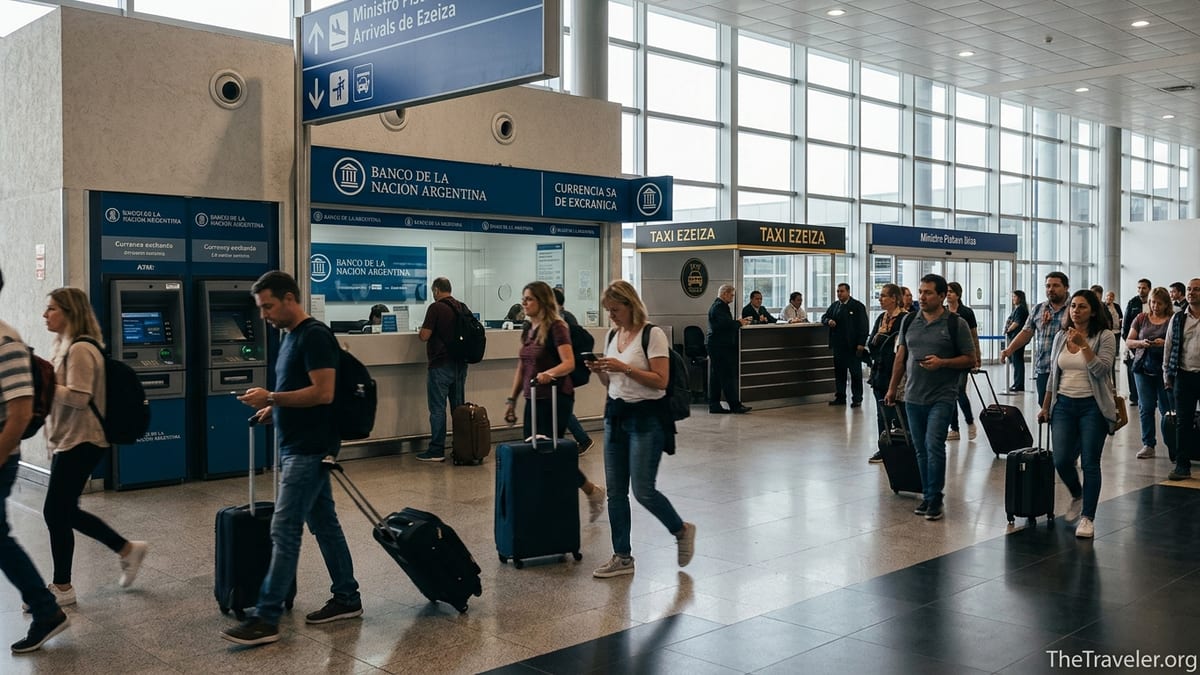
After you clear immigration and customs at Ezeiza (officially Ministro Pistarini International Airport), you step into the arrivals hall where your first decisions about money usually happen. In Terminal A, you will find a branch of Banco de la Nación Argentina, the state-owned bank that operates the main in-airport exchange counter, along with its ATMs. The counter follows the official rate and charges a commission; reviews from recent travelers suggest the rate is decent but not generous, very similar to what you would see in downtown banks but rarely better.
If you arrive with no local currency at all, it is reasonable to exchange a small amount at the Banco de la Nación desk to cover your first taxi, coffee, and contingencies. For example, exchanging the equivalent of 40 to 60 US dollars’ worth of your home currency will typically give you enough pesos to pay for a prepaid taxi ride into the city and still have spare cash for snacks or a SIM card. Avoid changing several hundred dollars here just for convenience: on a two-week trip, even a 5 to 10 percent worse rate at the airport can quietly cost you the equivalent of a good dinner for two in Palermo.
Near the exit doors you will also see independent currency booths advertising cambio or exchange, often with screens showing live rates. These counters may offer a slightly different rate from the Banco de la Nación rate, sometimes better and sometimes worse, and they may charge hidden commissions built into the quote. Staff might encourage you to switch entirely into pesos “before you leave the secure area,” creating a sense of urgency. It is rarely necessary. Once you are in the city you will find legal exchange houses and banks that provide comparable or better terms, and you will have more time to compare.
One trap reported by returning Argentines and tourists is being funneled toward an exchange desk for a small airport-only fee, such as a luggage trolley or a specific service that must be paid in pesos. If you only have foreign cash and can see an ATM nearby but are told you cannot walk over to use it until you pay, you are essentially being forced into a terrible rate. Push back politely, ask to pay by card, or look for an alternative provider. In almost all cases there is another way to settle that does not require an on-the-spot exchange at a premium.
Using ATMs at Ezeiza and in Buenos Aires
ATMs in Argentina are operated by two main networks, Banelco and Link, and you will find both networks’ machines at Ezeiza, in major shopping streets like Florida in downtown Buenos Aires, in malls such as Alto Palermo, and at bank branches across the city. Machines at the airport are usually from Banco de la Nación and sometimes from private banks. They support major international networks like Visa Plus, Mastercard Cirrus, and Maestro.
For foreign cards, ATM withdrawals typically come with two different kinds of fees: a fixed fee charged by the local bank per withdrawal, and whatever fees your own bank at home imposes on foreign ATM transactions. In Argentina, the local fee can feel steep because it is a flat amount in pesos. Travelers have reported total charges equivalent to around 6 to 10 US dollars per withdrawal after conversion, regardless of whether they took out a small or large amount, combined with relatively low per-transaction limits. In practice, that means withdrawing the maximum allowed by the machine, instead of many small withdrawals, is usually more cost-effective.
For example, suppose an ATM at Ezeiza lets you withdraw the equivalent of about 120 US dollars in a single transaction and charges a fixed local fee equivalent to 8 dollars, and your home bank adds a 3 percent foreign ATM fee. If you withdraw once for 120 dollars, your all-in cost might be around 11 or 12 dollars, roughly 9 to 10 percent. If you split that into three withdrawals of 40 dollars, you could easily lose over 20 percent of your money in fees. Before departure, check if your bank offers any reimbursement on foreign ATM charges or whether a separate travel debit card might reduce these costs.
Once you are in the city, consider using ATMs in secure, well-lit locations such as inside shopping malls or bank lobbies during opening hours. This is less about crime at the machine and more about avoiding shoulder surfers and skimming. When you use any ATM in Argentina, cover the keypad with your hand, avoid accepting offers of “help” from strangers, and decline any prompt that looks like dynamic currency conversion into your home currency. Always choose to be charged in pesos and let your own bank handle the conversion.
Exchange Counters and Where to Change Money in the City
Beyond the airport, your best bets for changing cash are official casas de cambio and bank branches in central neighborhoods such as Microcentro, Recoleta, and Palermo. In downtown Buenos Aires, streets like Sarmiento and San Martín host numerous legal exchange offices, many of them branded and with clear signage. In Palermo, you may find licensed counters inside shopping galleries or adjacent to banks. Staff will normally ask to see your passport before a transaction, and you will be given a printed receipt showing the amount you sold, the rate, and the pesos you received.
In recent years, the historic “blue dollar” spread has narrowed considerably, so the incentive to hunt for informal street exchangers has diminished. Many visitors now simply use a mix of ATMs and official exchange houses, accepting a small premium in exchange for safety and simplicity. On travel forums, visitors who tried to save a few percentage points by negotiating cash deals with men calling out “cambio, cambio” on Calle Florida often report stressful experiences, from bait-and-switch counting tricks to counterfeit notes that are difficult for foreigners to spot.
A more practical pattern for a week-long stay might look like this: arrive with a small amount of US dollars or euros in large, clean denominations; exchange the equivalent of 50 or 100 dollars at Ezeiza if you need instant pesos; then, once settled at your hotel or guesthouse, ask reception to recommend a nearby casa de cambio they trust. Use that for one or two larger exchanges that you can store safely in a hotel safe or money belt, while paying most everyday spending by card. This approach keeps your exposure to both bad rates and street scams low.
If you do carry sizable cash, pay attention to note quality. Old, torn, or heavily marked dollar bills are often rejected or given a worse rate, with 100-dollar bills usually preferred. For pesos, get a mix of smaller denominations because many taxi drivers and kiosks struggle to make change for higher-value notes on small purchases.
Paying by Card in Buenos Aires: When It Works Best
Compared with a few years ago, card acceptance in Buenos Aires is now broad and fairly reliable. Mid-range and upscale hotels, chain supermarkets, fashion stores in districts like Palermo Soho, and almost all sit-down restaurants in central areas accept foreign Visa and Mastercard credit and debit cards. Large taxi companies and taxi apps, ride-hail services, intercity bus companies, domestic airlines, and cultural venues such as major museums and theaters also generally allow card payments.
Using your card has two main advantages. First, you avoid carrying and exchanging large amounts of cash in a country where inflation and shifting rates can quickly erode the value of what you hold. Second, many foreign card networks apply an exchange rate that is now broadly aligned with financial-market rates used for investors, which historically have been closer to the old “blue” rate than to the strict official rate. In real terms, that usually means you get significantly more pesos for each dollar or euro you spend than you would have received in the days when only the official rate was applied.
However, there are caveats. Some foreign banks still add foreign transaction fees of 2 to 3 percent, and a smaller number even charge a separate currency conversion markup. Before you travel, check the terms of each card you intend to use. If one of your cards advertises “no foreign transaction fees,” prioritize that card in Argentina. Also, not all terminals and staff are familiar with contactless-only cards, so always be ready to insert a chip and enter your PIN. Having a physical plastic card is far safer than relying solely on a mobile wallet on your phone.
Smaller businesses can be more selective. Family-run cafés in quieter barrios, independent market stalls, and small neighborhood kiosks sometimes prefer cash, especially for low-value purchases like a bottle of water or a single empanada. Some restaurants may offer a discount for paying in cash, for example 10 percent off the bill if you settle in pesos rather than by card. That practice is legal and common in high-inflation economies, and it is another reason to keep at least a modest stash of local currency in your pocket even if you intend to use your card most of the time.
Airport Transfers and Taxi Payment Issues
The first big purchase most travelers make in Argentina is the trip from Ezeiza Airport to downtown Buenos Aires, a distance of about 30 to 35 kilometers. You essentially have four options: official prepaid taxis such as Taxi Ezeiza, private transfer companies and ride-hail services, the Manuel Tienda León shuttle bus, and regular city taxis. Understanding how each one handles payment can save you hassle and money.
Taxi Ezeiza operates a prominent desk in the arrivals area with blue-and-white branding and fixed prices by neighborhood. You book and pay at the counter, then receive a voucher to hand to your driver outside. The desk accepts cards and pesos, and in practice often accepts US dollars for the full fare at a rate they set internally. In mid-2026, visitors commonly report paying the equivalent of 25 to 40 US dollars for a one-way ride into central neighborhoods like Recoleta or Palermo, depending on traffic and the specific service class chosen. The benefits are clear pricing, no haggling with the driver, and the ability to pay by card before you get into the car.
Manuel Tienda León offers an airport coach service from Ezeiza to a central terminal near Retiro, with onward taxi or rides toward hotels. Tickets can be bought at their counters in the arrivals hall or online in advance. Payment is usually possible by card or in pesos at the airport desk. For solo travelers or couples arriving in daylight, this can be significantly cheaper than a private taxi, though less convenient if you have heavy luggage or are staying in a quieter neighborhood where you will still need a second taxi ride.
Regular city taxis officially operate with meters and should pick up passengers from designated ranks. Some of them now allow card payments through in-car terminals, but cash remains the norm. Language barriers can create confusion around whether a taxi genuinely accepts cards or whether the terminal is claimed to be “broken” once you are already on the road. For that reason, many visitors prefer to use ride-hailing apps that show the fare estimate and allow in-app card payments, avoiding disputes about change or surprise surcharges for luggage or tolls.
Whatever transfer option you choose, agree on the price or check the app estimate before departing. If you are paying cash, confirm whether tolls are included. If you want to pay by card, say so explicitly at the booking desk or when you first speak to the driver. Keep small denominations of pesos handy for tipping. A typical tip might be rounding up or adding 10 percent of the fare for good service, especially if the driver helps with heavy bags or navigates heavy traffic to drop you close to a hard-to-reach hotel entrance.
Common Scams and Money Mistakes to Avoid
Most visits to Buenos Aires are trouble-free, but the combination of a busy airport, tired arrivals, and a complex currency history creates room for mistakes and opportunistic scams. One classic error is stepping into an unregistered taxi outside the terminal because a driver approached you inside with an attractive quote in US dollars. Even if the quoted fare is fair, payment disputes at the end of the trip are common, often involving claims that the agreed rate was per person or that tolls and luggage fees are extra. Always book through official desks in the terminal or verified apps, and avoid any driver who insists you pay in foreign cash at an improvised rate.
Another pitfall is accepting dynamic currency conversion when paying by card. Some restaurants, shops, or online booking portals will offer to charge your card directly in your home currency instead of in pesos, promising “certainty” about what you will pay. In nearly all cases, the exchange rate used for this conversion is poor, erasing the benefits of the competitive rate you would otherwise get from your card network. When the terminal presents a choice, always select to be charged in Argentine pesos and let your own bank handle the conversion.
Street currency exchanges are a third source of problems. On busy pedestrian streets in central Buenos Aires, particularly Florida, you will hear dozens of voices calling “cambio, cambio” to anyone who looks like a foreigner. Some of these intermediaries will lead you to back room exchanges that are technically illegal but aim to offer better rates than banks. Even when these operations are not outright fraudulent, the environment is high-pressure and not suited to counting large sums of banknotes quietly and safely. Short-changing, sleight-of-hand swaps, and counterfeit notes are recurrent themes in traveler reports. In 2026, with small rate differentials, the extra risk and stress simply are not justified for most tourists.
Finally, do not underestimate day-to-day price movement. If you are staying for several weeks, the cost of a simple lunch in pesos might rise during your stay, even if it looks cheap in your home currency. Avoid prepaying everything in local currency long in advance, and be cautious about agreeing to pay in pesos at a fixed rate for a future service, such as an excursion scheduled ten days later. Paying closer to the date, especially by card, means your cost will better reflect the current reality rather than last month’s pricing assumptions.
The Takeaway
For visitors arriving at Ezeiza International Airport in 2026, managing money is much less of a game than it used to be. With foreign cards now widely accepted and offering more competitive exchange rates, you can largely treat Buenos Aires like any other big city: rely on a mix of cards and moderate amounts of cash, and avoid complicated schemes to chase marginally better rates.
A simple, effective plan looks like this: bring one or two low-fee cards from major networks, plus some clean US dollars or euros as backup; on arrival, get just enough pesos from the Banco de la Nación counter or an ATM to cover your first taxi and incidentals; use official prepaid taxi desks or ride-hail apps where you can pay by card; and once in the city, top up your cash either at ATMs in secure locations or at reputable exchange houses recommended by your accommodation.
If you stay alert to common pitfalls, decline dynamic currency conversion, avoid unauthorized taxis and street money changers, and double-check ATM fees and limits, you will likely find that Argentina’s once intimidating money system becomes just another part of the travel experience. With a bit of planning, you can focus less on exchange rates and more on the reasons you came: steak in San Telmo, tango in La Boca, and riverside sunsets along Puerto Madero.
FAQ
Q1. Do I need to arrive at Ezeiza with Argentine pesos already in my wallet?
It is not essential. Many travelers arrive with only foreign currency and cards, then change a small amount or use an ATM at the airport for their first expenses. Having the equivalent of 40 to 60 US dollars in pesos on arrival is convenient but not mandatory.
Q2. Is it better to use ATMs or currency exchange counters at Ezeiza?
For a small initial amount, either is acceptable. ATMs often give a fairer rate but can involve high fixed fees and low withdrawal limits, while the Banco de la Nación counter offers the official rate with a clear commission. For larger sums, it is usually better to wait and use ATMs or reputable exchange houses in the city.
Q3. Are foreign credit and debit cards widely accepted in Buenos Aires?
Yes. Visa and Mastercard are widely accepted at hotels, supermarkets, mid-range and upscale restaurants, major shops, and ride-hail services. American Express is accepted in many higher-end places but is less universal. Small neighborhood businesses may still prefer cash.
Q4. Can I pay for my taxi from Ezeiza by card?
At the official Taxi Ezeiza and other prepaid desks in the arrivals hall you can normally pay by card before boarding. Regular city taxis usually expect cash, and while some have card terminals, reliability is uneven. Ride-hail apps that charge your card in-app are a good alternative once you have mobile data.
Q5. Is the “blue dollar” still relevant for tourists?
The large gap between the official rate and the informal blue rate has narrowed significantly. For most short-term visitors, chasing the blue dollar through informal exchanges is no longer worth the risk, and using cards plus official exchanges provides a good balance of rate and safety.
Q6. How much cash should I carry day to day in Buenos Aires?
Many visitors are comfortable carrying the equivalent of 40 to 100 US dollars in pesos for routine expenses, while using cards for hotel bills, restaurant meals, and larger purchases. The exact amount depends on your comfort level and how often you want to visit ATMs or exchange houses.
Q7. Are there specific money scams I should watch out for at Ezeiza?
Be cautious of unofficial taxi drivers approaching you inside the terminal, any attempt to force you to change money at a particular desk for a small airport-only fee, and anyone offering a rate that seems too generous compared with what you saw online. Stick to official counters, ATMs, and branded taxi desks.
Q8. What is the best way to avoid bad exchange rates when paying by card?
When the payment terminal or website offers to charge you in your home currency, always decline and choose to pay in Argentine pesos. This avoids costly dynamic currency conversion and lets your card network use a more competitive rate.
Q9. Can I use US dollars directly to pay in shops or restaurants?
Outside of some hotels, high-end tourism services, and a few airport providers, shops and restaurants expect payment in pesos or by card. Even when they accept dollars, the rate is set by the business and is rarely favorable, so it is better to convert into pesos or use your card.
Q10. What should I do if an ATM at Ezeiza eats my card or fails after charging fees?
Note the bank name, location, and time, keep any error message or receipt, and contact your bank immediately using the number on the back of your card. If the ATM belongs to Banco de la Nación or another visible bank, you can also photograph the machine for reference and later file a claim, but your own bank will usually be your first point of contact.