


More news on this day
Formula 1’s 2026 Azerbaijan Grand Prix in Baku is going ahead this week despite heightened regional tensions, as governments update travel warnings linked to Iran and land borders across the South Caucasus.
Get the latest news straight to your inbox!
Saturday race in Baku anchors late-September schedule
The 2026 Formula 1 Qatar Airways Azerbaijan Grand Prix remains on the championship calendar as Round 15, scheduled in Baku from Thursday 24 September to Saturday 26 September. The event marks a decade of the street race on the shores of the Caspian Sea and forms part of a late-season sequence that moves from Europe to the Middle East and the Americas.
According to the published Formula 1 calendar and FIA sporting schedule, the switch to a Saturday race was confirmed after a request from local organizers and Azerbaijani stakeholders. The aim was to avoid a clash with a national observance, shifting the Grand Prix from the traditional Sunday finish to a Saturday main event with qualifying on Friday.
Formula 1’s official timetable for the weekend shows practice and support sessions beginning on Thursday, building to qualifying on Friday and the Grand Prix itself over 51 laps of the 6.003‑kilometre Baku City Circuit on Saturday 26 September. For international visitors, that compressed format concentrates race-day crowds and transport demand into a slightly shorter window than many European rounds.
Ticket distributors list grandstand and hospitality options around the Old City walls, the seaside boulevard and the high-speed main straight on Neftchilar Avenue, reinforcing Baku’s status as a hybrid of traditional street race atmosphere and modern event infrastructure.
Travel advisories highlight wider regional risk
While the Grand Prix proceeds as planned, governments have sharpened their language about the wider security environment in and around Azerbaijan. The latest advisory from the United States for Azerbaijan, updated in late April 2026, cites the regional impact of hostilities between the United States and Iran that began in February. Publicly available information notes an ongoing threat of drone and missile attacks originating from Iran, although no specific threat to the Baku race weekend has been identified.
The same advisory draws particular attention to roads near the Azerbaijan–Armenia border, where a history of clashes and unresolved issues around Nagorno‑Karabakh have periodically affected security conditions. U.S. government staff face restrictions on non‑official travel to those border regions, limiting the scope of any emergency assistance that could be provided there to visiting nationals.
Additional guidance issued for Iran stresses that crossings from Iran into neighboring states, including Azerbaijan, may be tightened during periods of heightened tension. A January 2026 security alert concerning land borders pointed to previous episodes during which U.S. citizens and other foreign travelers faced restrictions exiting Iran via Azerbaijan when regional tensions spiked.
For travelers combining an F1 trip with broader regional touring, these advisories effectively draw a line between central Baku, where events are staged along a secured circuit perimeter, and more remote frontier areas that carry a higher level of risk. Travel planners are increasingly steering visitors to route in and out of Baku by air, rather than overland from Iran or via sensitive border zones.
Azerbaijan urges citizens to avoid Iran as tensions rise
Security messaging is not one‑sided. In late February 2026, the Ministry of Foreign Affairs in Baku issued a formal travel warning about the Islamic Republic of Iran. The statement urged Azerbaijani citizens to refrain from traveling to Iran and encouraged those already in the country to depart using routes through Azerbaijan or Türkiye, depending on their location. The language reflected concern about the “heightened security situation” within Iran and the potential for spillover.
Although this advisory is primarily directed at Azerbaijani nationals, it offers a clear signal about the government’s view of current risks across the southern border. It also underscores why travelers considering overland itineraries that link Iran and Azerbaijan may find options constrained or subject to abrupt change, even if official border crossings remain technically open.
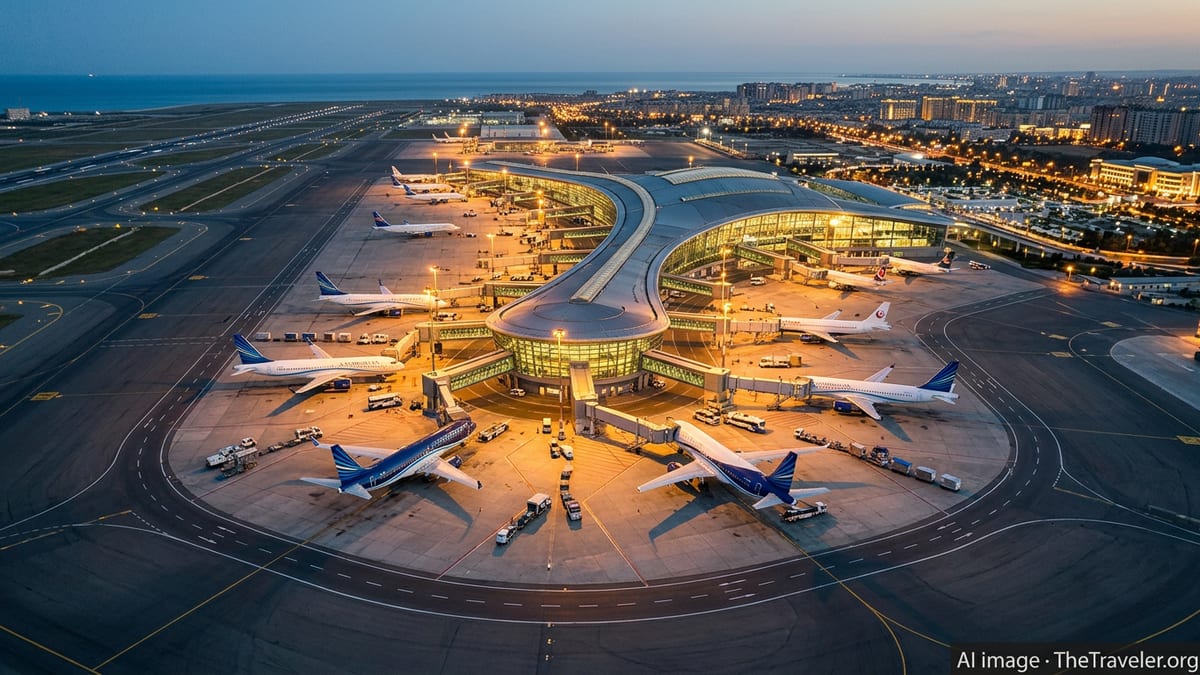
Travel industry reports indicate that some regional coach and private‑transfer operators have scaled back or suspended cross‑border services on Iran‑linked routes since the spring, focusing instead on domestic links and connections with Georgia and Türkiye. For visitors, this shifts the practical emphasis to flights into Baku’s Heydar Aliyev International Airport and to rail or road links that run north and west, away from Iran.
Against that backdrop, the F1 race weekend is taking place within a tightly managed urban environment, but in a country whose foreign ministry is explicitly discouraging travel in the opposite direction across one of its key borders. The juxtaposition highlights how large‑scale international events can proceed in cities that sit at the edge of complex geopolitical fault lines.
Implications for visiting fans and tour operators
Tour operators and independent travelers planning to attend the Azerbaijan Grand Prix are responding to the evolving picture by re‑evaluating routes, insurance and on‑the‑ground logistics. Package offerings that once combined Baku with overland trips through northern Iran are now being replaced by itineraries that pair the race with time in Tbilisi, Batumi or Istanbul, using established air and rail corridors that avoid border hotspots.
Travel insurance providers have begun updating policy language to reflect government advisories related to Iran and specific border regions. Policies sold in key F1 markets, including Europe, North America and parts of Asia, increasingly distinguish between standard cover for city‑break stays in Baku and more limited or excluded coverage for trips that involve travel through high‑risk areas or across certain land borders.
Air connectivity into Baku remains relatively robust, with national carrier Azerbaijan Airlines and several foreign airlines operating regular services from hubs such as Istanbul, Doha, Dubai and major European cities. Booking data compiled by ticketing platforms in recent months shows sustained demand for race‑week flights into Baku, suggesting that concerns about Iran have not substantially dented interest among core F1 audiences.
However, some regional travelers who might previously have considered driving from neighboring states report choosing to fly instead, citing both security considerations and the availability of competitively priced fares. For visitors already holding race tickets, the key adjustments involve allowing extra time for airport security and potential document checks, while avoiding nonessential trips away from the capital into more sensitive border districts.
Balancing spectacle and security in a strategic host city
Baku’s role as host of the Azerbaijan Grand Prix places a global spotlight on a city that bridges Europe and Asia and sits within reach of multiple areas of geopolitical friction. The 2026 event arrives as Azerbaijan recalibrates its security posture toward Iran and continues to manage unresolved tensions with Armenia, all while seeking to project stability as a venue for major sporting and cultural gatherings.
Publicly available race‑week communications from Formula 1 and the FIA emphasize the sporting spectacle, the unique characteristics of the Baku City Circuit and the logistical shift to a Saturday race. Security arrangements remain largely in the background, consistent with standard practice for international motorsport events hosted in urban environments.
For travelers, the key takeaway is that Baku itself is preparing for a full‑scale Grand Prix weekend, with the usual street closures, fan zones and hospitality offerings concentrated along the waterfront and the historic centre. At the same time, a patchwork of updated advisories related to Iran and sensitive border corridors is shaping how and from where fans choose to reach the race.
As the season’s only South Caucasus stop, the 2026 Azerbaijan Grand Prix illustrates how Formula 1’s global reach routinely intersects with complex regional dynamics. The ability of visiting fans to experience the event as planned will depend not only on the smooth running of the race, but also on careful attention to the evolving security and travel guidance that surrounds it.