


More news on this day
The Federal Aviation Administration is beginning to deploy a new artificial intelligence powered traffic management tool designed to spot bottlenecks hours in advance, giving controllers and airlines more options to prevent the flight delays that routinely snarl some of the busiest air corridors in the United States.
Get the latest news straight to your inbox!
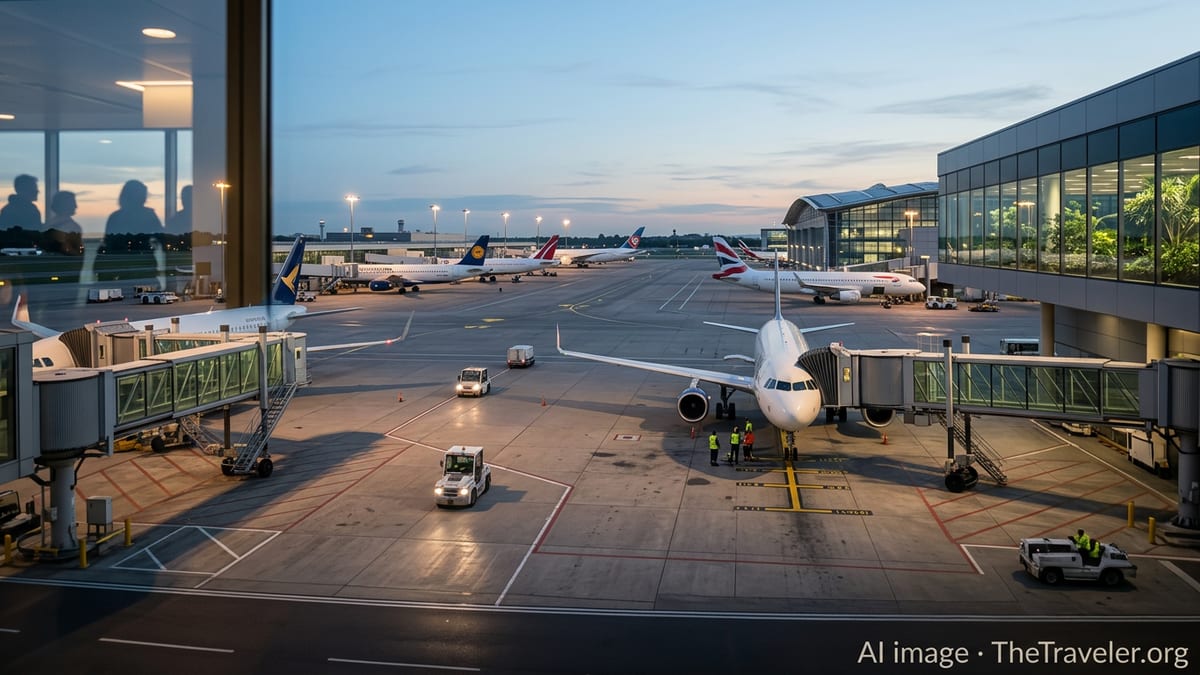
New AI platform targets chronic congestion
According to published coverage and federal budget documents, the AI platform is part of an $875 million modernization effort focused on managing demand across the National Airspace System. The software uses machine learning models to analyze airline schedules, historical traffic patterns, forecast and real time weather, airspace restrictions, and airport capacity limits to predict where congestion is likely to emerge.
Publicly available information indicates that the tool will initially be used in one of the country’s most heavily traveled corridors, connecting major hubs along the East Coast and Mid Atlantic. Federal planning documents describe the system as a strategic decision aid rather than a replacement for human controllers, giving traffic managers a more complete view of how individual delay programs at one airport can cascade across the network.
The new capability builds on a broader wave of decision support tools introduced under the FAA’s NextGen program, which has shifted U.S. air traffic management toward time based flow management and data driven coordination. Earlier implementations focused on en route spacing and airport surface movements; the new AI system extends those concepts by continuously updating predictions as conditions change throughout the day of operations.
Research plans published by the Department of Transportation describe related projects such as the Strategic Flow Management Application, which applies artificial intelligence and machine learning to balance demand and capacity nationally. The AI rollout positions the new tool alongside these efforts as another layer of automation meant to highlight options for controllers and airline operations centers before bottlenecks solidify into long departure queues and airborne holding.
How the AI tool is expected to reduce delays
Forecasts cited in recent reporting suggest that the AI system is intended to cut delays by giving traffic managers more time and more specific insights about where constraints will appear. Instead of waiting for weather to deteriorate or for departure banks to overwhelm key sectors, the tool evaluates thousands of potential scenarios to identify routes and timing adjustments that keep flows within safe limits.
Existing time based flow management tools already help controllers decide how long to hold departures on the ground and where to fit flights into constrained arrival streams. The new AI layer ingests a wider set of inputs, including airline scheduling choices, airport construction, special use airspace, and evolving convective weather, and offers what are described in public technical documents as optimized options for reroutes, speed changes, or changes in departure order.
For travelers, the practical impact could be fewer last minute cancellations and shorter ground holds at congested hubs when storms build along the East Coast or in the upper Midwest. Instead of large numbers of aircraft departing on schedule only to circle in airborne holding patterns, the AI system is designed to encourage more efficient strategies, such as redistributing some of the necessary delay to earlier phases of flight or shifting departure times to windows of available capacity.
Published research related to the program, including NASA’s work on airport surface modeling and collaborative digital rerouting tools, indicates that similar concepts have already demonstrated tangible benefits in field tests at large hubs. Those demonstrations reported reductions in taxi times, fuel burn, and pushback queues when airlines and controllers shared common, data driven views of predicted demand and capacity. The FAA rollout aims to extend these gains to a wider portion of the national network.
Deployment starts in key corridors before national expansion
Reports indicate that the initial deployment of the AI tool will focus on one of the busiest traffic corridors in the United States, with operations coordinated from a new office at the Department of Transportation headquarters in Washington, D.C. This corridor includes airports that routinely rank among the nation’s most delay prone because of dense schedules, complex airspace, and frequent convective weather.
Federal planning materials suggest that, after an initial shakedown period in this corridor, the FAA intends to expand the AI capability to additional regions by 2028. The phased approach allows the agency to evaluate how well the predictions match real world outcomes, and to refine how recommendations are presented to traffic managers, controllers, and airline operations centers.
Publicly available information emphasizes that the AI tool will be integrated into existing decision support systems rather than replacing them. Traditional traffic management initiatives, such as ground delay programs and airspace flow programs, will continue to be the primary mechanisms for controlling demand, with the AI system supplying more precise and earlier assessments of when and where those programs should be used.
The deployment also follows several years of joint work between the FAA and NASA, which field tested related tools that optimized departure sequences and shared surface status among controllers, airlines, and airport operators. Those tests informed both technical design and human factors considerations, such as how to present complex predictive information to busy traffic managers in a way that supports rapid, confident decisions.
Implications for airlines, airports, and travelers
Airlines have long pressed for more predictable traffic management, arguing that uncertainty in delay programs complicates crew scheduling, maintenance planning, and passenger reaccommodation. According to industry focused coverage, some carriers initially raised concerns about how aggressively an AI driven tool might reschedule flights in the name of efficiency. Subsequent reports indicate that the scope of the first deployment has been calibrated in response, emphasizing advisory support rather than automated changes to schedules.
For airports, the AI rollout fits into a wider push to use data and automation to improve surface safety and throughput. Recent FAA initiatives include new surface awareness displays that use ADS B data to show aircraft and vehicle positions at smaller towers, as well as runway safety tools that help controllers track occupied intersections. While the new AI system operates at a broader, network level, its predictions are expected to influence how individual airports stage departures and manage arrival peaks.
Travelers are unlikely to see the system directly, but its effects could show up in familiar metrics such as on time performance, completion factors, and average delay minutes during peak travel seasons. If the AI tool delivers the improvements described in planning documents, passengers flying through busy hubs during summer thunderstorm patterns or winter nor’easters may encounter fewer cascading disruptions that ripple across multiple connections.
Consumer advocates and aviation analysts will be watching closely to see whether the promised benefits materialize and how transparently the agency reports on performance. Public reporting from the NextGen program has historically included quantified estimates of delay reductions and fuel savings for new technologies, and observers expect similar metrics for the AI tool as it moves from pilot deployment to a standard feature of U.S. air traffic management.
AI in air traffic management and the limits of automation
The rollout of the FAA’s AI tool comes amid broader debate about the role of automation in safety critical systems. Research cited in academic and government documents stresses that artificial intelligence in air traffic management is being developed as a decision support capability that leaves human controllers firmly in charge of separation, clearances, and final routing choices.
Safety management frameworks used by the FAA call for new technologies to be evaluated through structured risk assessments, simulations, and phased operational trials. For AI driven tools, this includes scrutinizing model training data, monitoring prediction accuracy, and ensuring that recommendations are presented in ways that reduce workload rather than add confusion during busy traffic periods.
Technical papers associated with the program highlight emerging capabilities such as machine learning surface models that forecast how aircraft will move on the ground and language analysis tools that help interpret radio communications. These research activities are feeding into a family of tools intended to improve safety and efficiency across en route, terminal, and surface operations, with the new AI traffic management system representing one of the first large scale operational deployments.
As the system rolls out, analysts expect ongoing adjustments based on real world performance and feedback from controllers, traffic managers, and airline operations centers. For travelers planning trips through major U.S. hubs over the coming years, the evolution of this AI platform will be one of the less visible but potentially most consequential factors shaping how reliably flights arrive and depart.