


More news on this day
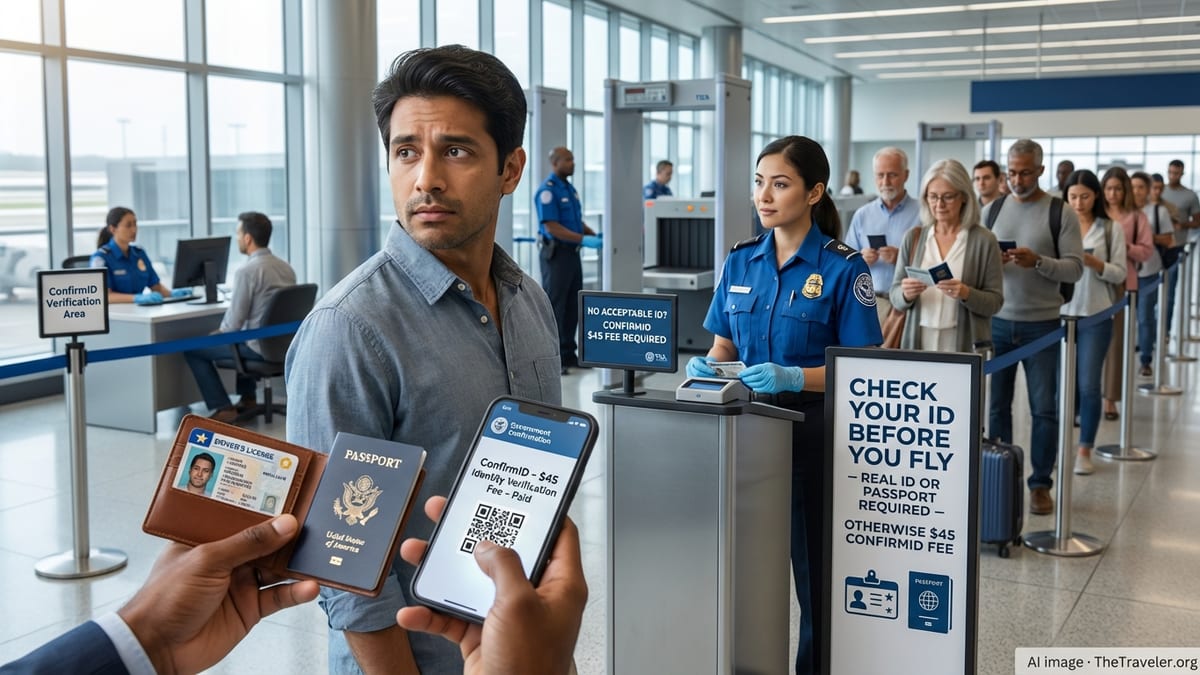
U.S. air travelers heading into the busy fall season are being urged to double-check their wallets, as those who show up at security with a non–REAL ID-compliant driver’s license or state ID may now be routed into a separate identity check that carries a $45 fee if they still want to fly.
Get the latest news straight to your inbox!
REAL ID enforcement and the new $45 fee
The federal REAL ID Act, passed in 2005, requires state-issued driver’s licenses and identification cards to meet higher security standards before they can be accepted for “official purposes,” including boarding domestic commercial flights. After multiple delays, full enforcement at airport checkpoints began on May 7, 2025, with a phased approach that limits how long noncompliant cards can still be accepted. Public regulatory summaries indicate that federal agencies must stop accepting non–REAL ID documents for official purposes no later than May 5, 2027, with Transportation Security Administration (TSA) checkpoints at the center of that effort.
To keep flights moving while enforcement tightens, TSA has added a pathway for travelers who arrive without an acceptable ID. According to publicly available agency materials and federal consumer guidance, passengers 18 and older who present a standard, noncompliant license or have no ID at all may be allowed to proceed only if they complete extra screening and pay a $45 identity verification charge.
Government fact sheets describe the new process as an option, not a guarantee. Travelers who cannot or will not complete the additional checks, or whose identity cannot be confirmed to the agency’s satisfaction, can still be denied access to the checkpoint. The $45 payment functions as a user fee for accessing the agency’s enhanced identity-verification system, rather than a conventional fine.
How TSA’s $45 Confirm.ID process works at the checkpoint
The modernized process, described in federal outreach materials under the name Confirm.ID, is designed to replace the older, manual “identity verification” routine that could involve long conversations with officers and visual review of paper records. Reports indicate that under the new system, a traveler without a REAL ID-compliant credential is referred to a separate screening area where personal information is verified against secure databases in near real time.
Consumer-facing guidance explains that travelers may be asked to provide biographical details such as full legal name, current address, and Social Security number, along with answering knowledge-based questions drawn from public and commercial records. The goal is to establish with sufficient confidence that the person at the checkpoint matches a verifiable identity record, even without a compliant physical ID card.
Once the system confirms identity and the $45 fee is paid, the passenger can generally proceed to standard security screening, although reports from recent travelers suggest that additional manual checks or secondary screening may still occur. The fee does not provide any shortcut through physical security procedures, and it does not serve as a substitute for REAL ID on future trips.
What this means for fall travelers in 2026
The fall travel period from September through Thanksgiving is historically one of the busiest stretches for U.S. airports, and this year it coincides with the first full holiday season in which the new REAL ID enforcement framework and $45 identity-verification option are in effect. Travel industry advisories note that even a small share of passengers arriving without compliant identification can create bottlenecks at checkpoints, as each Confirm.ID case takes extra time and dedicated staff.
Federal consumer information warns that relying on the $45 fee as a backup plan may significantly lengthen the time spent in security lines. Travelers who trigger the process are pulled out of the regular queue and must complete a series of questions before they can be cleared. During peak hours, such as early-morning banked departures and Sunday evenings, that could translate into missed flights for passengers who arrive close to departure.
There is also a financial impact to consider. For a family or group traveling together, multiple noncompliant adults could quickly add up to more than the cost of renewing or upgrading licenses at a state motor-vehicle office. Federal guidance emphasizes that the identity-verification fee is charged per traveler, per trip, and does not update or convert any state-issued document.
How to check if your ID is REAL ID-compliant
REAL ID-compliant driver’s licenses and identification cards are issued by state motor-vehicle agencies, but their appearance varies by state. Most, however, feature a small star in the upper portion of the card, often gold or black, which indicates that the credential meets federal security standards. Some states also issue separate “enhanced” licenses that satisfy REAL ID requirements and are marked accordingly.
Federal and state information hubs advise travelers to look closely at their card and compare it with examples posted on their state Department of Motor Vehicles (DMV) website or the national REAL ID portal. If a license states “Not for Federal Identification,” “Federal Limits Apply,” or lacks the star marking, it is typically not considered REAL ID-compliant for boarding flights, even if it remains valid for driving.
Travelers who are unsure are encouraged by public agencies to contact their DMV well in advance of upcoming trips, particularly for fall and winter holidays when appointment availability can tighten. Processing times vary by state, and some DMVs require specific original documents, such as a birth certificate, passport, or Social Security card, along with proof of residence, before issuing a REAL ID-compliant credential.
Alternatives to REAL ID and how to avoid the $45 fee
Even under full enforcement, a REAL ID-compliant license is not the only way to get through a TSA checkpoint without paying the new fee. Federal lists of acceptable identity documents include valid U.S. passports and passport cards, Department of Defense IDs, trusted-traveler program cards such as Global Entry, and certain other federal credentials. Travelers who already hold one of these documents can present it at security instead of a driver’s license.
Official guidance notes that there is currently no extra TSA charge for using a passport or other acceptable document at the checkpoint. For frequent travelers, keeping a passport up to date or applying for a passport card may provide additional flexibility, especially for those who anticipate moving between states or replacing licenses due to name or address changes.
Government consumer sites also point out that the $45 Confirm.ID fee can often be paid in advance through participating airlines or travel portals, which may help shorten processing time at the airport. However, advance payment does not eliminate the need for additional questions or potential delays at security, and it remains a single-trip solution rather than a permanent fix. For most travelers planning fall and winter journeys, upgrading to a REAL ID-compliant license or ensuring a valid passport is on hand remains the most straightforward way to avoid both the fee and the risk of being turned away at the checkpoint.
https://www.ecfr.gov/current/title-6/subtitle-A/chapter-I/part-37
https://www.tsa.gov/travel/security-screening/identification