


Landing at Faro Airport and heading into the city centre is straightforward, affordable and, in many cases, faster than many visitors expect. Regular urban buses connect the terminal with central Faro in around 20 minutes, and with a bit of planning you can step off your flight, buy a ticket from the driver and be rolling toward the marina while others are still queuing at the taxi rank. This guide explains exactly how the Faro Airport buses work in 2026, from stops and timetables to luggage rules, tickets and when it makes more sense to ride the bus than take a taxi or app-based car.
Get the latest updates straight to your inbox!
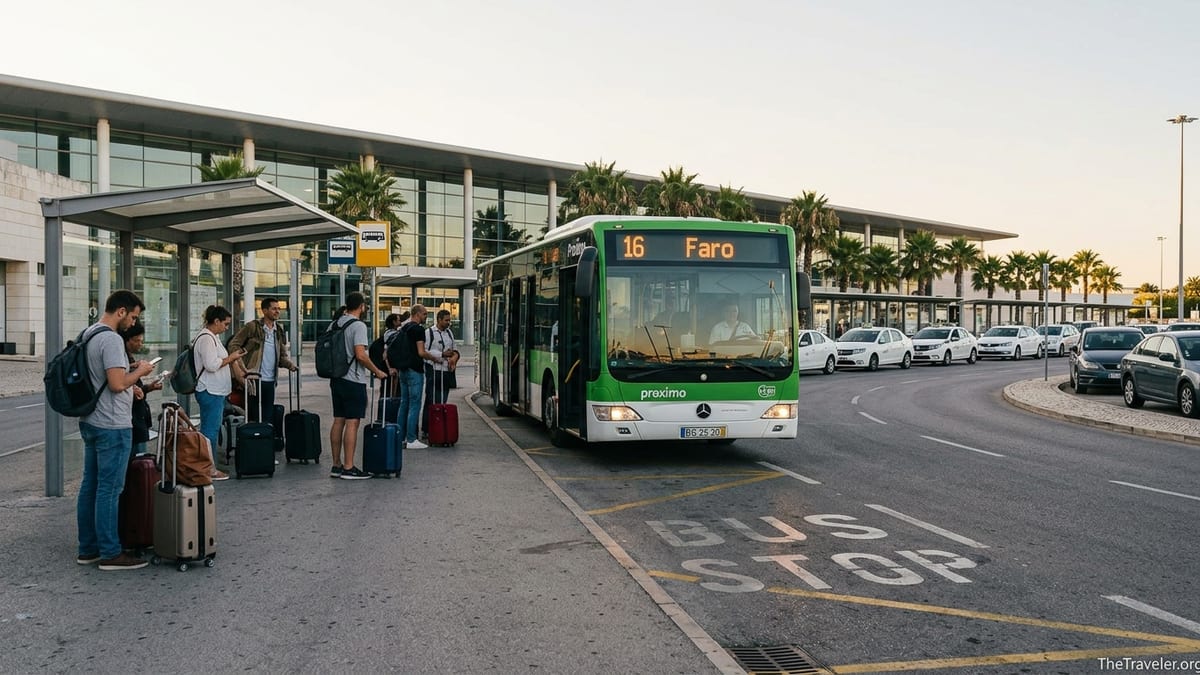
Faro Airport Bus Options in 2026: What Actually Runs
Faro Airport is linked to the city centre by two local bus lines, 14 and 16, operated under the Próximo brand. Both serve Faro Airport, central Faro and Praia de Faro (Faro Beach), but line 16 is the workhorse route that most arriving passengers use. In mid 2026, line 16 typically runs from early morning, around 05:20, until shortly after midnight, with services roughly every 30 to 60 minutes during the day. Line 14 offers an additional but less frequent option, often with more limited hours and fewer departures.
These airport buses are standard city buses rather than special airport coaches. They are designed for commuters, students and locals as much as for visitors, which helps keep prices low. The route between the airport and the city centre is about 6 kilometres and, under normal traffic, takes around 20 minutes. That duration can stretch slightly in peak summer traffic around August or on rainy days when congestion builds at the roundabouts leading into Faro.
In addition to the city buses, there are regional coaches that call at the airport, notably the Aerobus service on line 56 operated by Vamus Algarve, which connects Faro Airport with Albufeira, Lagoa, Portimão and Lagos. This Aerobus is not useful just to reach central Faro, because it is designed for onward travel along the Algarve coast, but it is worth knowing about if your final destination is a resort town rather than Faro itself.
When people talk about “the bus from Faro Airport to the city” they almost always mean line 16. If you arrive in the afternoon on a typical summer Saturday, you can expect a bus about every half hour, with a crowd of a dozen or so passengers waiting under the covered bus bay outside arrivals. At quieter times in low season, services thin out and waiting times can approach an hour, so checking the timetable before you land is important.
Finding the Airport Bus Stop and Understanding the Route
The airport bus stop is directly outside the arrivals hall at Faro Airport, under a covered area used by local buses and some long-distance coaches. Signage has recently been updated but can still feel confusing after a long flight. From baggage reclaim, you walk through customs into the arrivals hall, exit through the main sliding doors and follow the signs for “Autocarros / Buses.” The bus bays are a short, flat walk away, typically less than two minutes with luggage.
Both line 14 and line 16 display “Faro” on the front when heading toward the city. The driver can confirm you are on the correct bus if you simply say “Faro center” or show the address of your accommodation on your phone. The route into town runs past suburban areas such as Montenegro before entering Faro proper and continuing to the central bus terminal on Avenida da República, close to the marina and just behind the Hotel EVA and Faro train station.
The last stop in Faro for these airport buses is usually the central bus station, also known as the “Terminal Rodoviário” or “Próximo bus station.” For many visitors staying in the old town or around the marina, this terminal is within a 5 to 10 minute walk of most hotels and guesthouses. For example, from the bus station it takes about five minutes on foot to reach the main entrance to the walled Cidade Velha, and roughly the same to reach Avenida da República’s waterfront bars and restaurants.
If you are connecting to a regional Vamus Algarve coach towards Albufeira, Lagos or Tavira, most of these services also depart from or stop close to the central terminal. A common real-world scenario is arriving on line 16 from the airport, stepping off at the terminal, then walking a short distance to a Vamus or ALSA stand for an onward bus along the Algarve or even across the border to Seville.
Tickets, Prices and How to Pay on Faro Airport Buses
Tickets for lines 14 and 16 are bought directly from the driver when you board. Fares in mid 2026 for the short trip between Faro Airport and the central bus station are typically just a few euros per person, often around the price of a standard urban ticket rather than an airport premium. Children usually pay a reduced fare and small children may travel for free, but specific age thresholds can change and are best checked on arrival or on posted fare tables inside the bus.
Payment is most reliably made in cash, and it is sensible to carry small denominations such as 5 and 10 euro notes and coins. While some Portuguese urban networks are progressively introducing contactless card readers, visitors regularly report that Faro’s airport buses still rely heavily on cash payment. The driver issues a printed paper ticket that you should keep until the end of your journey, as occasional checks do occur.
Return tickets specifically aimed at tourists are not standard on these city routes. If you plan to use the bus again for your departure, you simply buy another single ticket from the driver when you travel back to the airport. For travellers staying several days in Faro and using the bus network frequently, there are local passes and multi-trip cards available from Próximo outlets in town, but most short-stay visitors find single tickets perfectly adequate.
On the Aerobus line 56 and other regional Vamus Algarve services that call at the airport, fares are higher and can vary by destination. For example, a 2026 fare from Faro Airport to Albufeira’s central bus station is typically in the single-digit euro range per person, making it highly competitive with private transfers for solo travellers or couples. Tickets for these regional services can often be bought online in advance or at counters in Faro, but drivers also usually sell tickets on board when seats are available.
Timetables, Frequency and Journey Time
The journey from Faro Airport to the central bus station in Faro usually takes around 20 minutes on line 16, slightly longer at peak times. This includes several intermediate stops in residential and university areas, as well as time spent navigating the main roundabouts on the way into town. In rush hour on a weekday or at the height of the August holiday season, it is prudent to allow 30 minutes from airport to city in case of traffic.
Line 16 serves the airport throughout the day. Typical schedules in 2026 show first departures from Faro toward the airport a little after 05:00, with the first airport-to-city bus soon after and continuing at 30 to 60 minute intervals into the late evening. The last departure from the airport into town is usually shortly after midnight, which is useful for many late-evening arrivals from northern Europe. Line 14 has a more limited timetable, with fewer departures and a pattern that can shift between seasons.
Because Faro is a holiday destination with marked seasonality, timetables often change between winter and summer, and sometimes at shorter notice. The winter schedule can mean gaps of up to an hour or more between buses, particularly in the middle of the day or late at night. Summer frequencies increase, but demand also rises sharply as hotels fill and flights run at capacity, so buses can become crowded at peak times such as Saturday afternoons and Sunday mornings.
If your flight is scheduled to land very early or very late, or you are traveling on a public holiday such as Christmas Day or New Year’s Day, it is essential to confirm the current timetable close to your travel date. A simple way to do this is to check the Faro Airport website’s public transport section or the Próximo timetable pages a few days before you fly, then cross-check these times against printed notices posted at the airport bus stop when you arrive.
Luggage, Comfort and What to Expect On Board
Because lines 14 and 16 are regular city buses, there is no dedicated underfloor luggage bay. Instead, travellers store bags in the internal luggage area if available, or keep them by their seat or in the open space near the central doors typically reserved for wheelchairs and standing passengers. A medium-sized suitcase or backpack is rarely a problem, and locals are accustomed to sharing space with visitors arriving from the airport.
If you are carrying multiple large suitcases, a surfboard bag or bulky sports equipment such as golf clubs, you may find the bus less comfortable, especially at busy times. Drivers generally exercise common sense: if there is space and your items can be stowed securely without blocking doors or aisles, they will usually accept them. In extreme cases where the bus is already very full, the driver may advise you to wait for the next service or suggest a taxi as a more practical option.
The buses themselves are modern low-floor vehicles with air conditioning that is usually switched on in summer. Seating is functional rather than luxurious, with plastic or fabric-covered seats arranged in standard city-bus configuration. Expect a mixed crowd of tourists, airport workers, students headed to the University of Algarve campus at Gambelas and Faro residents running errands in town.
Comfort levels are acceptable for the short ride, but this is not a premium airport coach experience. There is no on-board Wi-Fi and no toilets. If you are coming off a long-haul flight and prioritise a quiet, private space where you can immediately plug in your phone and decompress, a taxi, private transfer or hotel-arranged shuttle may suit you better than the public bus.
Faro Bus Terminal and Connections in the City
The city-end of the airport bus route is Faro’s central bus terminal, located on Avenida da República, a short walk from the marina and only a couple of minutes from Faro’s main railway station. The terminal is a compact, open-air facility with several bus bays, a small ticket office and basic amenities such as seating and public toilets. From here, Próximo city buses fan out across Faro’s neighbourhoods, while regional Vamus Algarve and ALSA coaches connect the city with other Algarve towns and with Spain.
Arriving on line 16 from the airport, you will typically be dropped off on one of the main bays facing the ticket office. From this point, reaching popular areas is easy on foot. The old town gateway at Arco da Vila is about a 7 to 10 minute walk, passing the marina and several cafe terraces. Hotels such as Hotel Faro & Beach Club, AP Eva Senses and smaller guesthouses in the historic streets behind the cathedral are all within a short stroll with wheeled luggage.
For onward travel, the bus terminal works as a hub. Travellers heading to the beach at Praia de Faro may stay on the airport bus as it continues its loop, while those moving on to Albufeira or Lagos can transfer to regional coaches that depart from nearby platforms. As an example, you might land at Faro at midday, catch the 12:30 Aerobus departure on line 56 from the airport, and arrive in Albufeira shortly after 13:00, then continue to Lagos by the same bus about an hour later.
If you prefer trains, Faro railway station is roughly 3 minutes’ walk from the bus terminal. This makes it simple to combine the airport bus with an onward train to destinations such as Lisbon, Portimão or Lagos. Many travellers use this combination to avoid renting a car, riding line 16 into town, walking across to the station and catching an Intercity or Alfa Pendular train north after a brief coffee break at the station cafe.
Bus vs Taxi or Ride-hail: When the Bus Clearly Wins
For solo travellers and couples staying in or near central Faro, the airport bus almost always wins on price and is often comparable in total door-to-door time. A taxi from Faro Airport to the city centre typically costs several times more than a bus ticket, especially in the evening or at weekends. By contrast, two single bus tickets usually amount to only a small fraction of that price, even after a modest fare increase.
Time-wise, if you land during the day and a bus is due within 15 to 20 minutes, the overall journey duration can be very similar. Imagine an arrival at 14:00 in July: by the time you clear passport control and baggage, it might be 14:30. If the next line 16 bus is at 14:40, you will likely be at the central bus station by slightly after 15:00 and walking to your hotel shortly after. A taxi would have you on the road a bit sooner but might reach the city only 5 to 10 minutes faster once you factor in queuing at the taxi stand and traffic lights into town.
The bus also wins for travellers who enjoy immediately getting a feel for the local environment. From the windows you see residential Faro, university buildings and everyday life that you would miss in a sealed private car. If your accommodation is close to the bus terminal or on one of the city-centre stops, you can step off and be in the middle of town without worrying about directing a driver to a small side street.
Where taxis or ride-hailing services like Uber and Bolt may be better is for late-night arrivals after the last bus, very early departures, families with small children and large amounts of luggage, or those with mobility issues who would struggle with the short walk from the bus station to their accommodation. In these cases, spending more on a door-to-door ride may be worth the convenience and comfort, especially after a long travel day.
Practical Tips and Common Real-world Scenarios
One common scenario is an evening arrival on a low-cost carrier from the United Kingdom or Germany. Many of these flights are scheduled to land between 20:00 and 23:00. In summer 2026, line 16 continues operating into this window, but buses can be crowded with both arriving tourists and airport workers changing shifts. If you are not in a rush and are comfortable standing for part of the ride, the bus remains a good choice. If you are exhausted and facing a long early start the next day, a taxi might feel like money well spent.
Another frequent pattern is a couple or small group planning to travel beyond Faro on the same day. For example, a pair of friends landing at 10:00 may take line 16 to the central bus station, store their bags in a hotel near the marina, have lunch in the old town and then catch a mid-afternoon Vamus Algarve coach to Lagos. The combined cost of the airport bus plus the regional coach ticket still usually stays far below that of a private transfer directly from the airport to Lagos.
Families with children often choose a hybrid approach. They may take a taxi from the airport into Faro on arrival, prioritising an easy start to the trip, and then use buses and trains for subsequent journeys once everyone has rested and adjusted. On departure, they might switch back to the bus if their flight time lines up nicely with a line 16 service, particularly if they have already become confident navigating Faro’s small bus terminal.
Seasoned Algarve visitors stress the importance of keeping plans flexible. Summer traffic, occasional delays on arrivals, and sporadic timetable changes mean that treating the published schedule as approximate rather than absolute is wise. Building in an extra 15 to 20 minutes as a buffer between bus arrival and a long-distance connection, or between hotel checkout and airport check-in, can turn a potentially stressful transfer into a relaxed part of your holiday.
The Takeaway
Faro’s airport bus connection to the city centre is one of the simplest and most budget-friendly airport transfers in southern Europe. Lines 14 and especially 16 provide a frequent, inexpensive link between the terminal and Faro’s central bus station, offering a 20-minute journey that, for many travellers, is almost as quick as a taxi at a fraction of the price. For solo visitors and couples staying near the marina, old town or train station, the bus is often the smartest choice.
That said, the bus is not ideal for every situation. It is a standard city service without special luggage facilities, and timetables thin out in low season and late at night. Travellers arriving very late, carrying bulky luggage or dealing with mobility or accessibility needs may be better served by taxis, ride-hail services or private transfers straight from the terminal.
Planning ahead is the key to making the right call. Checking the latest line 16 timetable a few days before you fly, carrying a small amount of cash in euros, and having your hotel address ready on your phone will make it easy to decide on the spot whether to head for the bus stop or the taxi rank. With realistic expectations and a little flexibility, the Faro Airport bus can be a smooth, authentic and wallet-friendly start or finish to your Algarve trip.
FAQ
Q1. How long does the bus from Faro Airport to the city centre take?
The journey on line 16 usually takes about 20 minutes from the airport to Faro’s central bus station, though at busy times it can stretch to around 30 minutes.
Q2. How much does the Faro Airport bus cost compared with a taxi?
A single bus ticket from the airport to central Faro costs only a few euros per person, while a taxi for the same journey typically costs several times more, especially in the evening or on weekends.
Q3. Where exactly does the airport bus drop me in Faro?
The airport buses usually terminate at Faro’s central bus station on Avenida da República, a short walk from the marina, the railway station and the historic old town.
Q4. Can I pay for the bus with a bank card or do I need cash?
Payment is most reliably made in cash, and it is wise to carry small euro notes and coins, as card readers are not consistently available on all services.
Q5. Is there space for large suitcases on the Faro Airport buses?
The buses are standard city vehicles without underfloor luggage holds, but medium suitcases and backpacks are generally accepted and can be stored in designated internal spaces if they do not block aisles or doors.
Q6. Do the buses run late at night from Faro Airport?
In 2026, line 16 usually operates until shortly after midnight, but services become less frequent late in the evening, so checking the latest timetable before travelling is important.
Q7. Which bus line should I take from Faro Airport to the city centre?
Line 16 is the main and most frequent service between Faro Airport and the city centre, while line 14 provides an additional but less frequent option on a similar route.
Q8. Is the bus a good option if I have a lot of luggage or small children?
For light to moderate luggage, the bus is fine, but families with several large suitcases or very young children often prefer a taxi or private transfer for comfort and convenience.
Q9. Can I connect to other Algarve towns by bus after arriving in Faro?
Yes, the central bus station where the airport bus stops is also a hub for regional coaches, including services to destinations such as Albufeira, Lagos, Portimão and Tavira.
Q10. When is it clearly better to take a taxi instead of the bus?
A taxi is usually better for very late or very early flights when buses are infrequent or not running, for travellers with mobility challenges, or when you want a fast, door-to-door journey to a specific hotel without any walking from the bus station.