


Landing at Faro Airport and heading into the city centre is usually quick and straightforward, especially by taxi. The ride is short, the official taxi rank is right outside arrivals, and there are plenty of alternatives if you land late at night or prefer to prebook. This guide walks you through what to expect on price, journey time, luggage, and how taxis compare with rideshares and private transfers so you can step off the plane in the Algarve with a clear plan.
Get the latest updates straight to your inbox!
Where to Find Official Taxis at Faro Airport
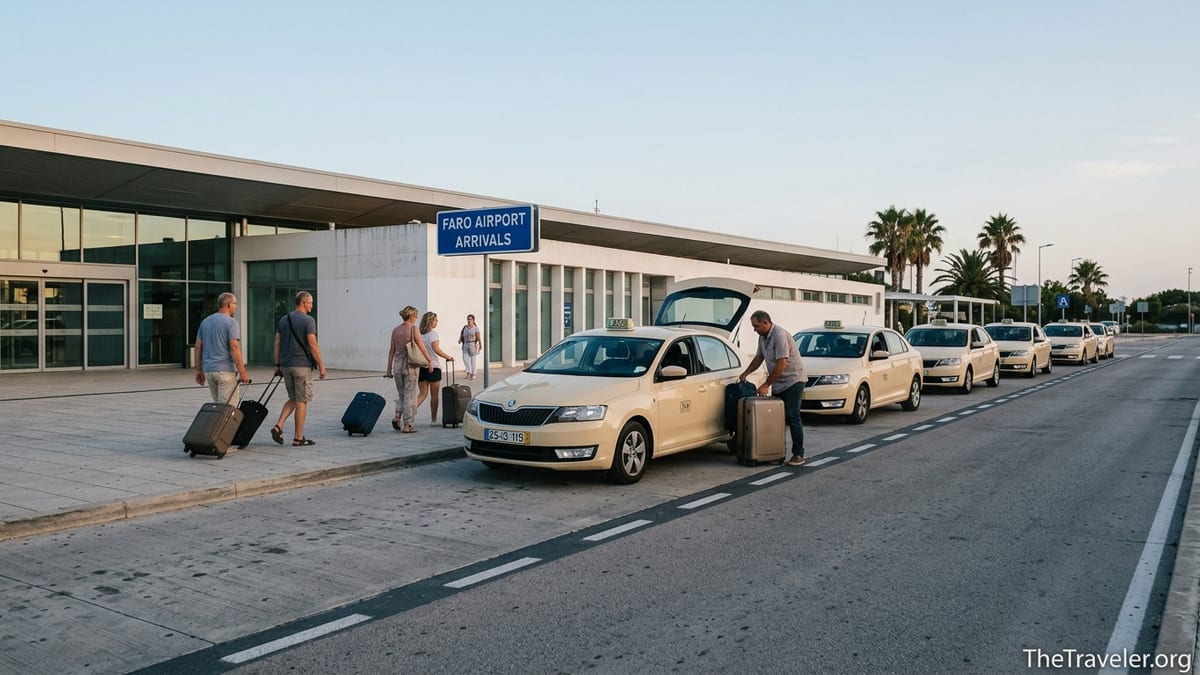
Faro Airport is compact, and the official taxi rank is easy to find. After you exit customs into the arrivals hall, follow the "Taxi" signs and walk straight out through the main doors. The rank sits just outside the terminal, beside the main passenger pickup area. You do not need to cross any major roads or walk far with luggage, which is welcome after an early flight from London or a late arrival from Dublin.
Taxis here operate on a metered system regulated by local authorities. Vehicles are typically beige or light-coloured with a roof sign and standard taxi markings. Drivers wait in a single file and take passengers in order; you simply join the front of the pedestrian queue and take the next available car. This system helps avoid haggling and makes it clear which drivers are licensed.
It is important to use only the official rank. Like at many European airports, you may occasionally be approached in the forecourt by someone offering an unlicensed ride, especially when flights arrive close together in peak summer. Politely decline and continue to the marked rank. Licensed taxis must display an identification plate and an illuminated meter inside the car; if you do not see these, choose another vehicle.
If you are travelling with a larger group or bulky sports equipment, you can request a bigger vehicle at the rank. Although most cars are standard sedans that carry up to four passengers, Faro also has some estate cars and vans that drivers rotate into the line. In busy periods you might wait slightly longer for a large-capacity taxi, but for two to four people, cars are almost always available within minutes.
Typical Fares from Faro Airport to the City Centre
The distance from Faro Airport to the city centre is short, roughly 6 to 8 kilometres depending on where you are staying. In normal traffic, this translates to a meter fare that is usually in the low double digits. As of mid‑2026, travellers commonly report paying around 10 to 15 euros for a standard daytime trip from the airport to a central hotel by the marina or in the Old Town, such as around Jardim Manuel Bívar or the pedestrian streets off Rua de Santo António.
At night or on Sundays and public holidays, taxi tariffs are slightly higher. Because the system is metered, you will see the base fare increase when the driver sets the night tariff, and a short city‑centre trip might come to approximately 12 to 18 euros, depending on traffic, routing and any short waits in queues at junctions. A solo traveller arriving on a late flight from Manchester at 23:30, for example, can normally expect to pay in this range to reach a guesthouse near Faro train station.
Fares for longer rides to nearby resorts rise accordingly. While this article focuses on the city centre, many visitors continue from Faro Airport to beach areas such as Praia de Faro or to resort towns like Vilamoura and Albufeira. For comparison, a metered taxi to Albufeira can easily reach several dozen euros, which is why many travellers heading that far prebook a fixed‑price transfer. Keeping the short city run in mind, however, makes it easier to recognise if a driver quotes you an unusually high price for a central Faro drop‑off.
Because meter tariffs can be updated, treat these amounts as typical rather than guaranteed. If you are concerned about budget, you can ask the driver for an approximate cost before setting off. Most will give a rough figure based on the address, and you can cross‑check against navigation apps that estimate distance and time. For central Faro, any quote far above the mid‑teens in euros for a normal daytime journey should be questioned politely.
Supplements, Luggage and How the Meter Works
Taxis from Faro Airport work on a clear meter system. The driver starts the meter when you set off, and the final price is the number shown when you arrive. Officially regulated supplements can apply on top of the distance and time charge, particularly for trips starting or ending at the airport, for large luggage and for night‑time or weekend travel. These extras are modest on a short city‑centre ride, but it is good to know they exist so you are not surprised.
One common supplement is for larger suitcases. Official guidance notes that baggage bigger than typical cabin size, roughly more than 55 by 35 by 20 centimetres, can attract a small extra fee per item. In practice, if two people share one large checked suitcase and a couple of backpacks, the driver might add only one or two small luggage charges, which on a short airport‑to‑centre route usually amounts to just a few euros. Hand luggage, daypacks and laptop bags are not normally charged.
Another detail is tolls. When taxis use the A22 motorway and pass electronic toll gates, those costs are added at the end of the journey. For the quick hop from Faro Airport to the city centre, drivers usually use local roads and there are no tolls involved, so you should not see any additional road fees on the meter. Tolls become relevant mainly if you are heading farther along the Algarve, for example to Lagos or Tavira, and choose the faster motorway route.
To keep everything transparent, glance at the meter as you get in. It should show the correct starting tariff for the time of day and be reset to zero or the fixed base fare. If you do not see the meter running once the car moves, ask the driver calmly to switch it on. This is part of normal practice and is something even local residents do when they notice a meter has been left off by mistake.
Travel Time from Faro Airport to Central Hotels
The journey from Faro Airport to the city centre is among the shortest airport transfers in Portugal. In light traffic, such as on a weekday mid‑morning, a taxi can reach most central hotels in about 10 to 15 minutes. For instance, a ride from arrivals to a hotel near the marina or the Old Town walls typically falls close to the 10‑minute mark, especially if the roads around Avenida Dr. Gordinho Moreira are clear.
During peak summer weekends or when several flights land together, the roads exiting the airport roundabouts and approaching central junctions can slow down. In those conditions, the same journey can creep towards 20 to 25 minutes, especially if you are staying in the historic core where access streets are narrow and occasionally congested. A family arriving on a July Saturday afternoon might notice the meter ticking a little higher as the taxi waits at lights or crawls behind buses heading for the bus station near Largo de São Francisco.
Late at night, traffic generally fades and journeys can be faster. A couple arriving on a 01:00 flight might find themselves at a guesthouse near Faro Cathedral in barely 12 minutes, with empty roads and a direct route. Even then, building in some margin for delays is wise if you are travelling in the opposite direction and need to catch a very early departing flight. For airport drop‑offs, many hotels recommend allowing at least 25 to 30 minutes door to door, which includes a small buffer for unforeseen traffic.
Overall, Faro is compact enough that taking a taxi from the airport rarely feels like a long slog after a flight. Compared with transfers from airports far outside their cities, such as some secondary European hubs where drives stretch to 45 minutes or more, Faro’s short hop is a practical part of your travel day rather than a major expedition.
Late‑Night Arrivals, Safety and What to Do if Ranks Are Busy
For late‑night arrivals, taxis are one of the most reliable ways into Faro. The official rank operates 24 hours a day, and even flights landing after midnight usually find a handful of cars waiting. If multiple late flights land close together in high season, you might briefly see a queue of passengers, but for destination addresses within the city, waiting times are usually modest.
From a safety perspective, using the official rank and a licensed taxi is the key step. The area is well lit, there are other travellers around and airport staff are nearby. Solo travellers, including women arriving alone, commonly take taxis into central Faro at all hours. As in any city, it helps to keep your phone handy, confirm your hotel’s address in advance and share your arrival time with someone at your accommodation, but most visitors report uneventful, straightforward rides.
If you come out of arrivals and find the rank temporarily empty, it is often because a batch of flights has just landed and the first wave of taxis has left full. In that case, more cars usually arrive within a few minutes. If you prefer not to wait, you can use a rideshare app that operates in Faro, such as Uber or Bolt, and request a pickup at the designated passenger meeting point outside the terminal. Many travellers use these apps late at night when demand briefly exceeds the taxis available at the rank.
On very late or delayed arrivals outside peak season, such as landing at 02:30 on a rainy Tuesday in November, some travellers choose to prebook a private transfer instead. The driver meets you in the arrivals hall with your name on a sign and escorts you directly to the vehicle. This removes any uncertainty about queues and can be especially reassuring for families with children or older travellers who want a guaranteed ride waiting regardless of how busy the airport is.
Private Transfers and Rideshares vs Regular Taxis
Besides the official taxis, Faro Airport is served by several private transfer companies whose main business is shuttling visitors to Algarve resorts. Even if you only need to reach the city centre, you can book these services in advance as a fixed‑price alternative. For example, companies that advertise transfers from Faro Airport to Albufeira for roughly 35 to 45 euros for up to four passengers often offer much lower inner‑city prices, so a central Faro drop‑off is typically at the bottom end of their price tables.
The main advantage of a private transfer is certainty. You receive a confirmation with your pickup details, the driver monitors your flight, and the price is agreed in advance for the whole vehicle, not per person. For a group of four friends arriving from Amsterdam and continuing straight to a holiday rental just inside the city walls, a prebooked sedan may cost only marginally more than a metered taxi while offering a meet‑and‑greet service and help with luggage.
Rideshare apps provide another option. In Faro, services like Uber and Bolt are widely used by locals and visitors for short urban trips. When the taxi rank queue is long, you might open an app and see an estimated fare that is similar to, slightly lower than or sometimes slightly higher than a metered taxi, depending on demand. For the airport‑to‑centre journey, app quotes commonly fall into the same general range as taxis, but the platforms give you the convenience of paying by card in‑app and tracking your car’s arrival on the screen.
There are a few trade‑offs. Some drivers decline very short rides when demand is high, and there can be brief surges in pricing during busy summer evenings. In contrast, official taxi meters follow regulated tariffs that do not surge based on demand. For many travellers, the ideal approach is flexibility: check the queue at the taxi rank, glance at your rideshare app’s estimated arrival time and fare, and choose whichever looks quickest and most comfortable at that moment.
Practical Tips for a Smooth Taxi Ride
A little preparation goes a long way to making your Faro taxi experience easy. Before you travel, save your hotel’s address on your phone and, if possible, note a nearby landmark such as "Faro marina" or "near the municipal market." When you get into the taxi, show the driver the written address and mention the area. Most drivers speak at least basic English, but having it written avoids any confusion with similar street names.
In terms of payment, many taxis accept card payments, but this is not universal, and card terminals can occasionally be offline. Carrying some euros in cash is sensible, especially for late‑night arrivals. As of mid‑2026, travellers still report that small notes between 10 and 20 euros are easiest to use. If you plan to pay by card, ask "Cartão, é possível?" before setting off, and if the driver prefers cash, you can decide whether to continue or choose another cab at the rank.
Tipping in Portugal is modest compared with some countries. Locals typically round up the fare or leave a small extra amount for good service, especially if the driver helps with heavy bags or provides local advice. On a 13‑euro fare, many travellers leave 1 or 2 euros as a gesture rather than a percentage‑based tip. There is no obligation to tip, and drivers do not generally expect large gratuities.
Finally, if any issue arises, stay calm and note the taxi’s license number, which is usually displayed on a plate inside the car or on the exterior. Hotels in Faro are used to helping guests resolve misunderstandings about routes or fares and can call the taxi company on your behalf. Problems are rare on the short airport‑to‑centre run, but this small bit of awareness can give you extra peace of mind.
The Takeaway
Taking a taxi from Faro Airport to the city centre is one of the easiest parts of visiting the Algarve. The official rank sits immediately outside arrivals, fares for the short hop into town are typically in the low double digits, and journey times are usually 10 to 20 minutes. For most travellers, this combination of convenience and cost makes a metered taxi the default choice on arrival, especially after a long flight.
If you land late at night, the same basic rules apply: head to the official rank, use a licensed taxi and expect only a modest increase in the fare due to night tariffs. For extra certainty, particularly in peak season or when travelling with family, a prebooked private transfer offers a fixed price and a named driver waiting in the terminal. Rideshare apps add one more layer of flexibility, letting you compare real‑time prices and waiting times with the taxi queue.
With these practical details in mind, you can step off the plane in Faro knowing exactly where to go, what you are likely to pay and how long the ride should take. That clarity means you spend less time worrying about logistics and more time enjoying your first evening among the cobbled streets, marina views and warm air of southern Portugal.
FAQ
Q1. How much does a taxi from Faro Airport to the city centre usually cost?
For a standard daytime ride to a central hotel, most travellers pay roughly 10 to 15 euros, rising to around 12 to 18 euros at night or on holidays.
Q2. How long does the taxi ride from Faro Airport to Faro city centre take?
In light traffic the journey takes about 10 to 15 minutes, and in busy summer periods or around peak arrival times it can stretch to roughly 20 to 25 minutes.
Q3. Where exactly is the taxi rank at Faro Airport?
The official taxi rank is directly outside the arrivals hall. After exiting customs, follow the taxi signs, leave the terminal through the main doors and you will see the rank on your right or directly ahead.
Q4. Do Faro Airport taxis charge extra for luggage?
Yes, taxis can charge a small supplement for larger checked suitcases above typical cabin size. Hand luggage and small backpacks are normally carried at no extra cost.
Q5. Are taxis available at Faro Airport late at night?
Yes, taxis operate 24 hours a day. Even after midnight there are usually cars at the rank, although in very late or off‑season arrivals you might wait briefly between waves of taxis.
Q6. Can I pay for a Faro Airport taxi by card?
Many taxis accept card payments, but not all. It is wise to carry some euros in cash and ask the driver at the start of the trip whether card payment is possible.
Q7. Are rideshare services like Uber available at Faro Airport?
Yes, rideshare apps such as Uber and Bolt operate in Faro. You can request a pickup outside the terminal and compare estimated prices and waiting times with the taxi rank.
Q8. Is it safe to take a taxi alone from Faro Airport at night?
Using the official rank and licensed taxis is generally considered safe, even late at night. The area is well lit, monitored and busy whenever flights are arriving.
Q9. Should I book a private transfer instead of taking a regular taxi?
If you want a fixed price, a guaranteed driver waiting in arrivals or you are travelling with family or lots of luggage, a prebooked private transfer can be a convenient alternative to a taxi.
Q10. Do taxis from Faro Airport use toll roads to reach the city centre?
No, the short trip into central Faro normally uses local roads with no tolls. Tolls only become relevant on longer motorway journeys to other Algarve towns.