


More news on this day
Passengers traveling with American Airlines through St. Croix this week say they were left sleeping in hotels and terminals for nearly two days after a mechanical issue grounded their aircraft, highlighting persistent questions about how major U.S. carriers handle extended disruptions in leisure destinations.
Get the latest news straight to your inbox!
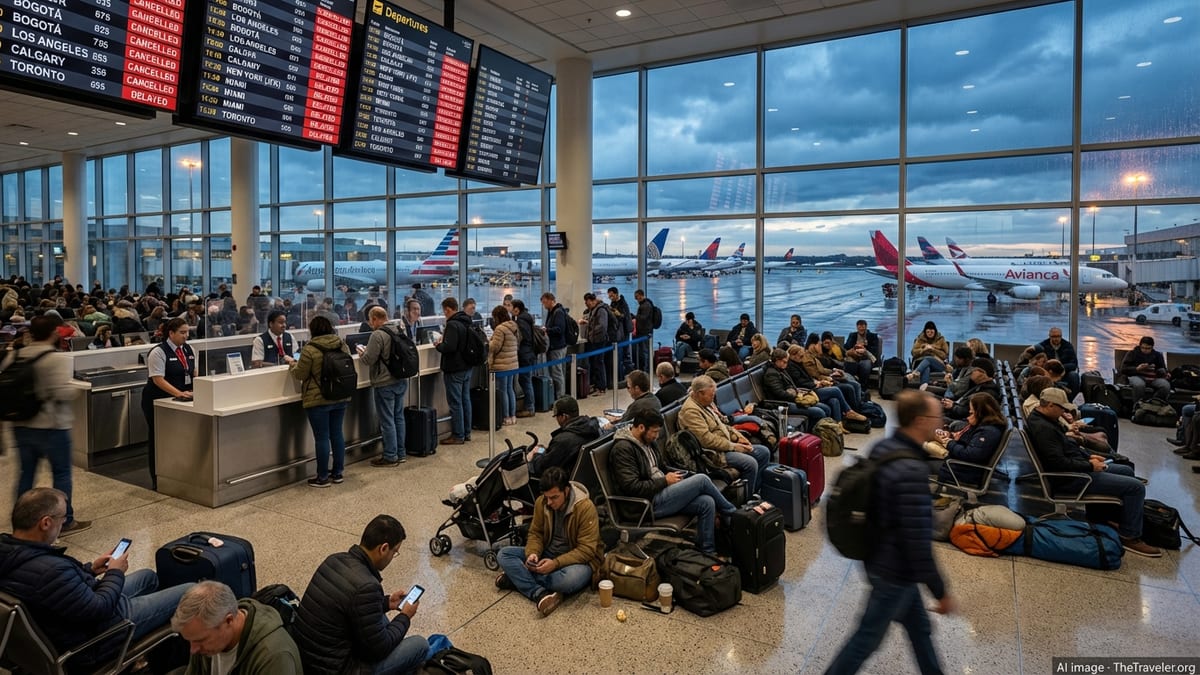
Mechanical Problem Turns Routine Flight Into Multi‑Day Ordeal
According to published coverage and social media posts, the disruption began when an American Airlines aircraft scheduled to operate between the mainland United States and Henry E. Rohlsen Airport on St. Croix experienced a mechanical problem that prevented it from departing as planned. The fault reportedly required the jet to be taken out of service while technicians assessed whether it could be repaired locally or needed a replacement aircraft.
Publicly available flight‑tracking data indicates that the affected service was one of the few daily links connecting the U.S. Virgin Island with major American hubs. When the aircraft was removed from rotation, the limited schedule meant there were few immediate options to move passengers off the island, especially during the busy summer period when many flights operate close to full capacity.
Reports indicate that the fault was classified as a controllable mechanical issue, rather than a weather or air‑traffic problem. Under American’s internal policies, mechanical failures generally fall within the airline’s responsibility for providing care such as meals and hotel accommodation when travelers are stranded overnight away from home, although the exact support can vary by case.
The incident unfolded as American has faced heightened scrutiny over the reliability of its operation, including several recent events where technical or maintenance problems have led to diversions, long delays and cancellations on other routes across the network.
Stranded On A Tourism‑Dependent Island With Limited Options
Travelers stuck in St. Croix described a scramble for hotel rooms and last‑minute transportation as the prolonged grounding stretched from hours into days. Because the island relies heavily on tourism, accommodation inventory can tighten quickly when an entire planeload of passengers suddenly needs somewhere to stay, particularly during peak season.
Accounts shared online suggest that some passengers were initially given hotel and meal vouchers, while others struggled to secure assistance at crowded airport counters or via call centers. With a finite number of seats leaving St. Croix each day, rebooking hundreds of disrupted travelers required multiple flights and complicated reshuffling of existing bookings.
Published guides to American’s current disruption policies note that when a delay or cancellation is deemed controllable, such as for a mechanical problem, the carrier may arrange or reimburse reasonable hotel stays and ground transportation for travelers stranded overnight away from home. However, passengers often report difficulty accessing that support in real time, especially when phone lines are overwhelmed and local airport staff are handling multiple disrupted flights simultaneously.
In small island markets like St. Croix, the knock‑on effects can be particularly severe. Once nearby hotels fill, travelers may face long taxi rides to more distant properties or, in some cases, choose to remain at the airport until a firm departure time is confirmed.
American’s Disruption Tools Under Pressure
The St. Croix episode coincides with American’s push to modernize how it handles irregular operations across its network. Recent industry coverage highlights the airline’s rollout of expanded self‑service tools that allow customers to see the stated cause of a disruption, view alternative flights and confirm a new itinerary from their phones without waiting in line for an agent.
These digital systems separate causes into broad categories such as weather, air‑traffic control, crew availability and mechanical issues. In theory, that transparency helps travelers understand what support they can expect, since federal rules and airline policies typically provide stronger protections for disruptions within a carrier’s control, such as maintenance‑related cancellations.
However, events like the multi‑day St. Croix delay demonstrate the limits of technology when there are simply not enough empty seats leaving a leisure destination to absorb an entire canceled flight quickly. Even when passengers can rebook themselves, the next available departure might be one or two days away, especially on routes served by only one or two daily frequencies.
Consumer advocates note that the impact of such delays is not limited to lost vacation time. Travelers can miss cruises, onward international connections, or critical work and family commitments on the mainland, often incurring out‑of‑pocket costs that may or may not be recoverable from the airline or travel insurance, depending on the circumstances.
Regulatory Landscape And Passenger Rights
Extended strandings have renewed focus on how U.S. rules treat passengers when flights are canceled or significantly delayed for reasons under an airline’s control. Unlike in the European Union, where regulations mandate standardized compensation in many disruption cases, American travelers rely largely on individual carrier policies and Department of Transportation guidance.
Publicly available DOT materials emphasize that U.S. airlines are free to set their own compensation rules, provided they honor their published commitments and do not engage in unfair or deceptive practices. Many major carriers, including American, have published customer‑service plans that outline when they may provide hotel rooms, meal vouchers or rebooking on other airlines, particularly after mechanical failures that leave passengers stranded away from home.
Advocacy groups argue that cases where travelers are stuck for more than 24 hours in destinations like St. Croix illustrate the gap between written policies and real‑world experiences. While some passengers eventually receive hotels or reimbursements, others report confusion over eligibility, inconsistent information from different agents and prolonged waits before any concrete help is offered.
The St. Croix disruption adds to a broader conversation about whether U.S. rules should be strengthened to require airlines to cover more of the incidental expenses travelers face when strandings stretch beyond a single night, including meals, ground transport and, in some cases, partial compensation for missed events.
Growing Scrutiny Of Operational Reliability
The incident in St. Croix comes amid a series of high‑profile operational challenges for U.S. carriers, including American. Recent months have seen multiple flights diverted or turned back to origin airports due to mechanical issues, as well as network‑wide disruptions tied to technology failures and staffing constraints.
Industry analysts note that maintenance‑related delays can be particularly frustrating for passengers because they are widely perceived as more controllable than weather or air‑traffic conditions. At the same time, airlines contend that prioritizing safety sometimes requires making conservative decisions to keep an aircraft on the ground while technicians diagnose an issue, even if it means multi‑day delays in places with limited backup capacity.
For destinations that rely heavily on a single carrier or a small number of daily flights, a grounded jet can ripple through local tourism economies. Hotels, rental car agencies and tour operators may see abrupt cancellations or extended stays, while visitors unexpectedly spend extra days on the island waiting for replacement aircraft and open seats.
As the busy late‑summer travel period continues, the St. Croix stranding is likely to feature in ongoing debates about how airlines invest in fleet maintenance, where they base spare aircraft and crews, and how transparent they are with passengers when operational problems arise in remote or leisure‑focused markets.