


More news on this day
Americans planning trips to the world’s highest‑risk destinations are being urged by new US government guidance to take extraordinary precautions before departure, including drafting a will, organizing key legal and financial documents, and leaving a DNA sample with trusted contacts at home.
Get the latest news straight to your inbox!
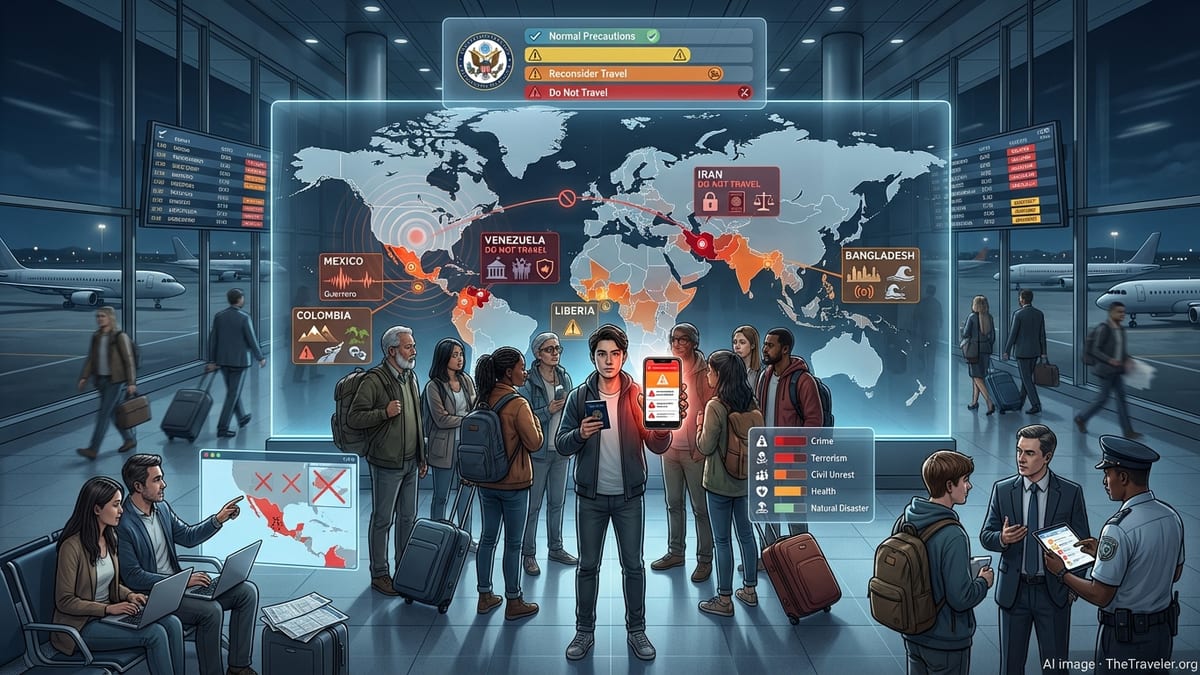
Guidance Targets Travel to the Highest-Risk Destinations
Publicly available information indicates that the new recommendations are directed at Americans considering travel to destinations categorized at the most severe advisory levels, including areas with active conflict, terrorism, kidnapping and wrongful detention risks. Coverage of the guidance links it to the US Department of State’s existing four-tier travel advisory system, where Level 4 alerts already urge travelers not to visit certain countries because of extreme danger.
According to published coverage, the guidance frames wills, contingency planning and DNA samples as additional layers of preparation for people who choose to go ahead with such trips despite warnings. The emphasis is not on typical tourism but on journeys to locations where the risk of serious injury, death or disappearance is significantly higher than average international travel.
Reporting on the new material notes that it reflects concern over a growing number of hostage situations, conflict-zone incidents and complex crises involving US nationals overseas. The suggested steps are presented as part of a broader “worst case” planning mindset that includes discussions with family members and an honest assessment of individual risk tolerance.
What Travelers Are Being Asked to Do Before Departure
Coverage of the guidance indicates that Americans weighing high‑risk trips are encouraged to ensure they have a current will, up‑to‑date beneficiary designations and clear instructions for managing their affairs if they do not return. This aligns with long‑standing security advice that families living and working abroad should keep legal documents, insurance records and powers of attorney in order before a crisis arises.
In addition, recent reports highlight a recommendation that travelers leave a DNA sample with a trusted relative, medical provider or other secure custodian in the United States. The intent, according to these accounts, is to make identification easier in the event of death, mass‑casualty events or situations where remains are difficult to confirm. Guidance emphasizes that samples should be stored privately rather than handed over to governments or third parties without informed consent.
The same publicly available material describes broader contingency planning, such as providing family with copies of passports, itineraries and contact information, and designating a primary point of contact who can liaise with US consular services if needed. While these steps may feel unsettling to casual vacationers, the advice is tailored to travelers who knowingly enter environments where medical evacuation, secure communications and rapid consular assistance may be constrained or delayed.
Why DNA Samples Are Part of Modern Risk Planning
The idea of leaving a DNA sample for travel purposes may sound new, but it builds on practices that have emerged in disaster response and complex emergencies over several decades. Guidance for forensic teams and emergency planners has increasingly highlighted the role of DNA in identifying victims when conventional methods, such as visual recognition or personal effects, are inadequate. Recent technical toolkits from US justice and forensic agencies describe rapid DNA systems designed to help match victim samples and family reference samples more efficiently after mass‑casualty events.
International security and risk‑management frameworks used by humanitarian organizations and media workers have long encouraged comprehensive contingency planning for missions to high‑threat environments. These frameworks typically include updated next‑of‑kin information, medical data and, in some cases, prearranged access to biometric identifiers. The new US travel guidance extends that logic to a broader audience of citizens who might be exposed to similar levels of risk through work, reporting, or essential travel.
Privacy concerns remain a significant factor. Reports on the latest recommendations stress that the suggested DNA sample is intended to remain under the control of the traveler and trusted contacts, not as part of a centralized government database. This distinction differentiates voluntary preparedness measures from compulsory DNA collection policies that apply to people in custody or other specific legal contexts.
How This Fits Within Existing Travel and Security Advice
Travel-health and security agencies already advise Americans to think carefully before visiting countries subject to the most severe advisories, where armed conflict, disease outbreaks or serious crime create unpredictable conditions. The Centers for Disease Control and Prevention, for example, regularly posts travel health notices that outline outbreaks and infrastructure limitations in certain regions, and recommends that travelers reconsider or avoid trips to affected areas when risks are exceptionally high.
Similarly, international preparedness guidance from organizations linked to the World Health Organization and aviation bodies emphasizes contingency plans for emergencies ranging from epidemics to natural disasters. These documents encourage authorities and operators to plan for quarantine, evacuation and crisis communication, reflecting a broader global focus on what happens when travelers are caught up in extreme events.
Within that context, the US move to highlight wills, document organization and DNA samples can be seen as an extension of long‑standing emergency planning principles. Rather than changing the underlying message of “do not travel” to certain destinations, the guidance adds more granular advice for those who decide to assume the risk anyway, whether for professional, family or humanitarian reasons.
Implications for Travelers Considering High-Risk Trips
For most Americans planning conventional vacations or business trips to destinations with routine safety conditions, the latest guidance is unlikely to alter pre‑departure checklists. Standard recommendations such as registering travel plans, purchasing appropriate insurance and following local laws remain the core focus. The new measures are aimed much more narrowly at those whose itineraries include war zones, areas with active terrorist groups or regions where kidnapping and wrongful detention have been documented.
Travelers contemplating such journeys may now find that tour operators, employers and security advisers factor wills and DNA samples into their risk assessments and briefing materials. Some international organizations and media outlets already maintain internal protocols that require staff to complete similar preparations before deployment to high‑threat environments, and the public guidance could encourage wider adoption of those practices.
Ultimately, the recommendations underscore how international travel risk has evolved in recent years. As conflicts, health emergencies and complex crises intersect with tourism and global mobility, Americans choosing to visit the most dangerous destinations are being asked to plan not only for logistics and visas, but also for scenarios in which identification, repatriation and legal affairs become urgent priorities for families at home.
https://travel.state.gov/content/travel/en/traveladvisories/traveladvisories.html
https://www.karmactive.com/state-department-level-4-travel-warning-wills-dna/
https://nij.ojp.gov/topics/forensics/rapid-dna-mass-disaster-emergency-response-and-preparedness-toolkit
https://wwwnc.cdc.gov/travel/notices