


More news on this day
Jakarta’s main international airport has delayed its planned reopening after volcanic ash from Mount Anak Krakatau continued to drift across western Indonesia, extending widespread travel disruption and leaving hundreds of thousands of passengers stranded.
Get the latest news straight to your inbox!
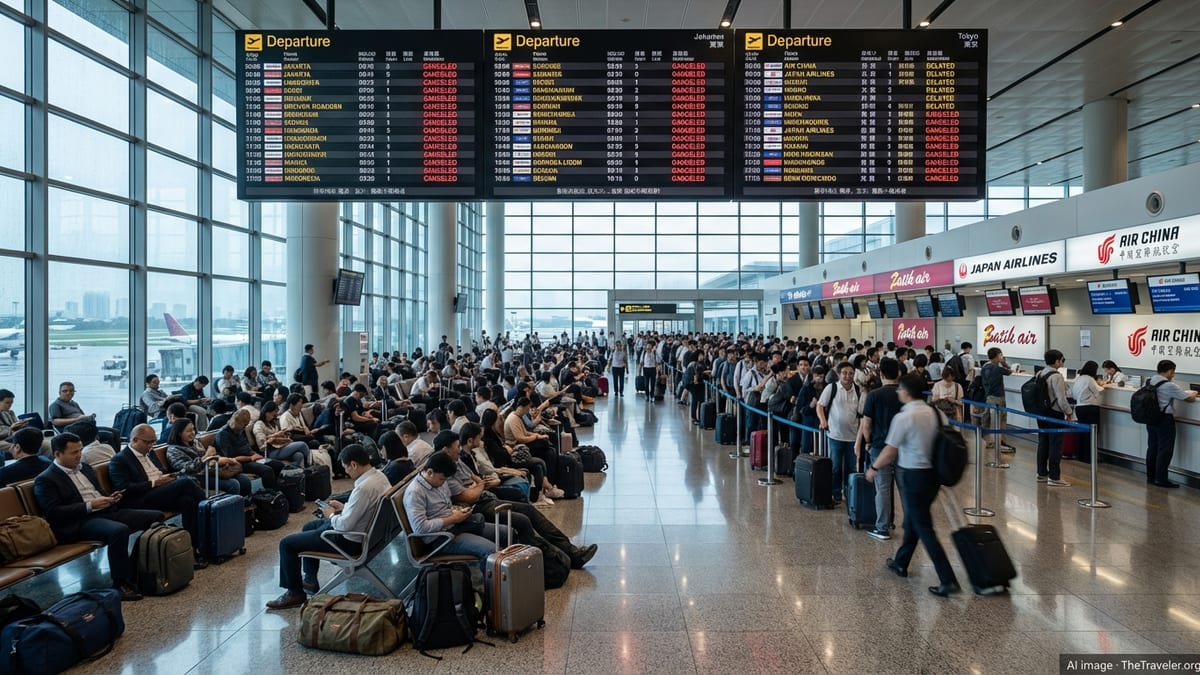
Closures extended as ash lingers over key air corridors
Publicly available information shows that Soekarno-Hatta International Airport outside Jakarta, along with at least three other major airports, postponed reopening on Monday after tests continued to detect volcanic ash in surrounding airspace. Initial expectations of a gradual restart gave way to a series of revised notices to air missions as ash clouds persisted at cruising altitudes used by commercial jets.
Indonesia’s transport ministry reported that a total of eight airports halted operations over the weekend once ash from Anak Krakatau’s eruption was observed along key flight paths. The closures affected airports in Jakarta and nearby provinces on Sumatra and Java, effectively shutting down several of the country’s busiest domestic and international hubs.
According to ministry figures cited in international coverage, the cumulative disruption since 5 September includes more than 2,000 flights that have been cancelled, delayed or diverted. The numbers have continued to climb as the airport closures were extended into a second day, with no firm timetable yet for a full restoration of services.
Indonesia’s civil aviation network is routinely exposed to volcanic risk, but the scale of the current shutdown, centered on the capital’s main gateway, has made this one of the most disruptive air transport events in the country in recent years.
Hundreds of thousands stranded across Indonesia
Travel industry reports indicate that more than 270,000 passengers have been stranded nationwide as a result of the extended airport closures. The bulk of those travelers are concentrated at Soekarno-Hatta, which handles tens of millions of passengers a year and serves as a primary hub for connections across Southeast Asia.
Data released by the transport ministry and shared in multiple news reports suggest that at least 1,500 flights have been affected at Jakarta’s main airport alone since Friday, including long-haul international routes as well as dense domestic corridors linking the capital to Medan, Surabaya and Denpasar. One airport operator update cited by regional media noted that roughly 30,000 passengers at Soekarno-Hatta were impacted on Monday morning.
Further north and east, airports in Lampung, Bandung and other cities have also faced closures or partial suspensions, stranding travelers who were attempting to transit through Jakarta or connect onward to smaller Indonesian islands. Local media coverage has described crowded terminals, long queues at airline counters and difficulties securing hotel rooms close to the affected airports.
The disruption has rippled beyond Indonesia’s borders, with connecting passengers stuck at foreign hubs after onward flights to Jakarta and other cities were cancelled. Regional carriers operating between Singapore, Kuala Lumpur and Jakarta have published advisories urging travelers to monitor flight status closely and consider rebooking where possible.
Anak Krakatau’s eruption and aviation safety concerns
The eruption at Mount Anak Krakatau, a volcanic island roughly 150 kilometers from Jakarta, began late last week with fountains of lava and dense ash plumes that rose high into the atmosphere. Monitoring agencies reported that ash clouds drifted across parts of Banten province, the capital region and sections of Sumatra, carried by shifting upper-level winds.
International aviation guidelines treat volcanic ash as a serious safety hazard, as fine particles can damage jet engines, scratch cockpit windows and interfere with onboard instruments. For that reason, aviation authorities in Indonesia have taken a cautious stance, keeping airports closed until satellite data and in-situ tests indicate that ash concentrations over approach and departure routes have fallen to safe levels.
Statements published by Indonesia’s transport ministry emphasize that decisions on reopening airspace are being coordinated with meteorological and volcanology agencies and guided by volcanic ash advisories. One ministry update on Monday stated that the closure of the eight affected airports was being extended again, with the timing of any reopening contingent on real-time assessments of ash movement.
The current eruption has revived memories of past Anak Krakatau activity, including the 2018 event in the same volcanic complex that generated a deadly tsunami. While the present episode has primarily disrupted aviation rather than causing direct damage on the ground, the extensive ashfall across populated regions has heightened public awareness of how quickly such eruptions can affect national infrastructure.
Impact on regional and long-haul travel plans
The shutdown of Jakarta’s main airport, a critical Southeast Asian hub, has had a cascading effect on travel plans well beyond Indonesia’s borders. Flight-tracking data cited in global media coverage show dozens of wide-body aircraft either diverted to alternate airports in the region or held on the ground at origin airports in Europe, the Middle East and Asia-Pacific while operators reassessed the situation.
Travel advisories issued by airlines and airport operators recommend that passengers bound for Indonesia check departure information repeatedly, even if their flight has not yet been formally cancelled. Some carriers have announced flexible rebooking policies for trips scheduled over the coming days, anticipating that schedules may remain unstable as airports reopen in stages and aircraft are repositioned.
Tourism analysts note that key leisure destinations such as Bali remain open, but many visitors rely on transits through Jakarta’s Soekarno-Hatta. With the capital’s airspace restricted, alternative routings via Surabaya, Denpasar or regional hubs like Singapore and Kuala Lumpur are under strain, and last-minute fares on remaining routes have risen in some markets.
Industry observers expect that even after airspace is declared safe, it could take several days to clear the backlog of passengers and reposition aircraft and crew. Travelers with flexible schedules are being encouraged by publicly available guidance to delay non-essential trips until operations stabilize.
What travelers should know right now
For passengers currently in Indonesia or scheduled to arrive in the coming days, the central message from airlines and airport operators is to rely on official digital channels. Flight status pages, mobile apps and social media feeds are being updated frequently as new airspace assessments are issued and notices to air missions change.
Travelers whose flights have been cancelled are generally being offered rebooking on later dates or alternative routes where capacity exists. Some carriers are also allowing itinerary changes without additional fees, though specific conditions vary by airline and ticket class. Passengers are being advised in public guidance to avoid coming to the airport until they have confirmed a new departure time.
Hotels near Soekarno-Hatta and other affected airports are reportedly under pressure as stranded travelers seek short-term accommodation. Travel platforms and local tourism boards recommend that visitors consider a wider radius around Jakarta for lodging and, where possible, make flexible bookings that can be adjusted as flight plans change.
With ash forecasts indicating that conditions may remain variable for at least the short term, travel experts suggest that anyone planning trips to or through Indonesia build in additional time, keep essential medication and valuables in carry-on bags, and maintain regular contact with airlines or agents. As Anak Krakatau’s activity and the prevailing winds evolve, authorities are expected to adjust airspace restrictions in line with updated safety assessments.
Hindustan Times: Jakarta airport delays reopening after volcanic eruption
Al Jazeera: Thousands stranded as Anak Krakatau eruption shutters Indonesian airports
The Guardian: Volcano eruption in Indonesia leaves 170,000 travellers stranded
Indonesian Transport Ministry: update on extended airport closures
Malay Mail: Indonesia extends airport closures as Anak Krakatau eruption strands 270,000 passengers